PUBLISHER: Mordor Intelligence | PRODUCT CODE: 2187173

PUBLISHER: Mordor Intelligence | PRODUCT CODE: 2187173
Vietnam Pet Food - Market Share Analysis, Industry Trends & Statistics, Growth Forecasts (2027 - 2032)
According to Mordor Intelligence, the Vietnam pet food market size was valued at USD 168 million in 2026 and estimated to grow from USD 180.8 million in 2027 to reach USD 257.6 million by 2032, at a CAGR of 7.34% during the forecast period (2027-2032).
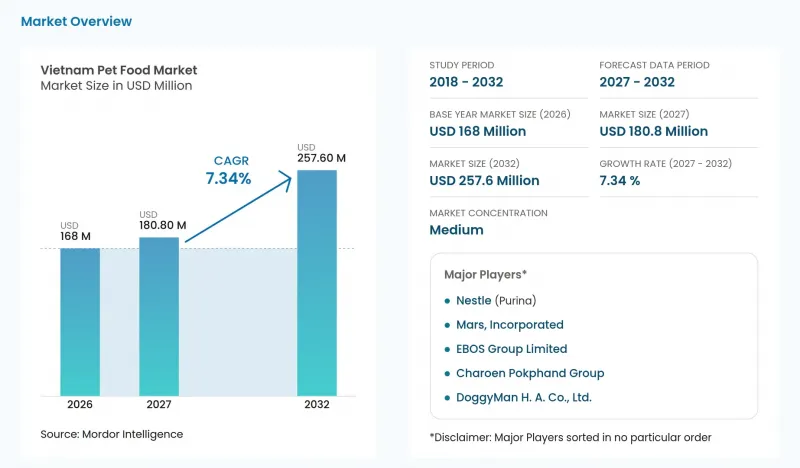
In volume terms, the market size was 101.7 thousand Metric Tons in 2026 and estimated to grow from 108 thousand Metric Tons in 2027 to reach 145.9 thousand Metric Tons by 2032, at a CAGR of 6.2% during the forecast period (2027-2032). This report is segmented by Pet Food Product (Food, Pet Treats, Pet Veterinary Diets, and Pet Nutraceuticals/Supplements), Pets (Dogs, Cats, and Other Pets), and Distribution Channel (Specialty Stores, Supermarkets/Hypermarkets, Online Channel, Convenience Stores, and Other Channels). The market forecasts are provided in terms of value (USD) and volume (Metric Tons), based on availability.
Vietnam Pet Food Market Trends and Insights
Rising disposable incomes of pet owners
Higher household incomes can make a recurring commercial feeding routine easier to sustain without requiring an immediate move into premium products. Vietnam's average per-capita household income at current prices rose 9.3% in 2025 from 2024, according to preliminary household survey results. For pet-food suppliers, the demand mechanism is greater capacity to absorb repeat food expenditure alongside other household needs. The distinction matters commercially because broader participation in prepared feeding and an increase in spending per purchase are separate opportunities. Because the 9.3% rise is a nominal national per-capita measure, it points to wider capacity for routine purchases more than to a shift toward premium diets.
Humanization of pets boosting functional diets
Family-like treatment of dogs makes specific health benefits a stronger basis for differentiating commercial diets in Vietnam. Agriculture and Agri-Food Canada estimated dog-food retail value would rise 10% in 2026 from 2025, linking demand to digestion and coat benefits. These needs give suppliers a clearer proposition than premium positioning alone, because a defined benefit connects the formulation to an owner's concern. Success depends on making the purpose of a functional diet understandable without treating every food purchase as a health intervention. The same report ties expected value growth to owners prioritizing long-term health through commercial diets, giving functional claims a role in expanding dog-food spending.
Price sensitivity in rural provinces
For a price-sensitive owner in a rural province, prepared food has to fit the cost of feeding each dog or cat every day. The relevant comparison is the cost of the daily ration, since a cheaper pack can still require frequent replacement. Feeding additional animals multiplies that commitment, making the price tier important across the household's full ration requirement. An entry-priced recipe can ease the burden if its regular ration fits the owner's feeding budget. Where that daily cost remains unaffordable, conversion to regular prepared-food use is delayed even when a pack's purchase price is within reach.
Other drivers and restraints analyzed in the detailed report include:
- Expansion of specialty retail chains
- Growth of e-commerce and last-mile delivery
- Volatile supply of premium protein inputs
For complete list of drivers and restraints, kindly check the Table Of Contents.
Segment Analysis
Food accounted for a 49.18% share of the Vietnam pet food market size in 2026, making it the largest segment. Thailand exported 19.88 million kilograms of dog or cat food put up for retail sale to Vietnam in 2025. That shipment base illustrates the commercial scale of a supply route serving packaged feeding, with goods already prepared for retail distribution. The supplier opportunity centers on reaching routine food demand through a viable distribution network rather than relying only on specialized nutritional occasions.
Pet nutraceuticals and supplements are the fastest-growing segment, with a forecast CAGR of 11.2% during 2027-2032. In 2025, Sitto Vietnam announced exclusive distribution of VetSynova's VF+Core functional soup supplements in Vietnam, with products available through veterinary clinics and hospitals. This route can connect an additional nutritional purchase to a professional care setting. Pet treats offer a distinct occasion, with dog treats and mixers serving as premium, health-oriented snacks that complement daily nutrition. Because VF+Core is distributed through veterinary clinics and hospitals, a supplement supplier's route to owners depends on clinic relationships, a different test from winning a place in a daily-feeding routine.
Complete Report Scope:
- By Pet Food Product
- Food
- By Sub Product
- Dry Pet Food
- By Sub Dry Pet Food
- Kibbles
- Other Dry Pet Food
- By Sub Dry Pet Food
- Wet Pet Food
- Dry Pet Food
- By Sub Product
- Pet Nutraceuticals/Supplements
- By Sub Product
- Milk Bioactives
- Omega-3 Fatty Acids
- Probiotics
- Proteins and Peptides
- Vitamins and Minerals
- Other Nutraceuticals
- By Sub Product
- Pet Treats
- By Sub Product
- Crunchy Treats
- Dental Treats
- Freeze-dried and Jerky Treats
- Soft and Chewy Treats
- Other Treats
- By Sub Product
- Pet Veterinary Diets
- By Sub Product
- Derma Diets
- Diabetes
- Digestive Sensitivity
- Obesity Diets
- Oral Care Diets
- Renal
- Urinary Tract Disease
- Other Veterinary Diets
- By Sub Product
- Food
- By Pets
- Cats
- Dogs
- Other Pets
- By Distribution Channel
- Convenience Stores
- Online Channel
- Specialty Stores
- Supermarkets/Hypermarkets
- Other Channels
List of Companies Covered in this Report:
- EBOS Group Limited
- Mars, Incorporated
- Charoen Pokphand Group
- Nestle (Purina)
- DoggyMan H. A. Co., Ltd.
- VAFO PRAHA s.r.o.
- ADM
- Alltech
- Schell & Kampeter, Inc. (Diamond Pet Foods)
- Virbac
- Unicharm Corporation
- Spectrum Brands, Inc.
- Inaba Foods (USA) Inc.
- Colgate-Palmolive Company (Hill's Pet Nutrition, Inc.)
- Thai Union Group PCL
- Vinapet Investment & Development Joint Stock Company
Additional Benefits:
- The market estimate (ME) sheet in Excel format
- 3 months of analyst support
TABLE OF CONTENTS
1 INTRODUCTION
- 1.1 Study Assumptions and Market Definition
- 1.2 Scope of the Study
2 RESEARCH METHODOLOGY
3 EXECUTIVE SUMMARY
4 MARKET LANDSCAPE
- 4.1 Market Overview
- 4.2 Market Drivers
- 4.2.1 Rising disposable incomes of pet owners
- 4.2.2 Humanization of pets boosting functional diets
- 4.2.3 Expansion of specialty retail chains
- 4.2.4 Growth of e-commerce and last-mile delivery
- 4.2.5 Government incentives for meat by-product use
- 4.2.6 Expatriate demand for imported grain-free diets
- 4.3 Market Restraints
- 4.3.1 Price sensitivity in rural provinces
- 4.3.2 Volatile supply of premium protein inputs
- 4.3.3 Plastic-waste regulations driving costs
- 4.3.4 Saturation of dog-food segment in Tier-1 cities
- 4.4 Industry Value Chain Analysis
- 4.5 Regulatory Landscape
- 4.6 Technological Outlook
- 4.7 Porter's Five Forces Analysis
- 4.7.1 Threat of New Entrants
- 4.7.2 Bargaining Power of Suppliers
- 4.7.3 Bargaining Power of Buyers
- 4.7.4 Threat of Substitutes
- 4.7.5 Competitive Rivalry
- 4.8 KEY INDUSTRY TRENDS
- 4.8.1 Pet Population
- 4.8.1.1 Cats
- 4.8.1.2 Dogs
- 4.8.1.3 Other Pets
- 4.8.2 Pet Expenditure
- 4.8.3 Consumer Trends
- 4.8.1 Pet Population
- 4.9 Trade Analysis
- 4.10 Ingredient Trends
- 4.11 KEY STRATEGIC QUESTIONS FOR PET FOOD CEOS
5 MARKET SIZE AND GROWTH FORECASTS (VALUE AND VOLUME)
- 5.1 By Pet Food Product
- 5.1.1 Food
- 5.1.1.1 By Sub Product
- 5.1.1.1.1 Dry Pet Food
- 5.1.1.1.1.1 By Sub Dry Pet Food
- 5.1.1.1.1.1.1 Kibbles
- 5.1.1.1.1.1.2 Other Dry Pet Food
- 5.1.1.1.1.1 By Sub Dry Pet Food
- 5.1.1.1.2 Wet Pet Food
- 5.1.1.1.1 Dry Pet Food
- 5.1.1.1 By Sub Product
- 5.1.2 Pet Nutraceuticals/Supplements
- 5.1.2.1 By Sub Product
- 5.1.2.1.1 Milk Bioactives
- 5.1.2.1.2 Omega-3 Fatty Acids
- 5.1.2.1.3 Probiotics
- 5.1.2.1.4 Proteins and Peptides
- 5.1.2.1.5 Vitamins and Minerals
- 5.1.2.1.6 Other Nutraceuticals
- 5.1.2.1 By Sub Product
- 5.1.3 Pet Treats
- 5.1.3.1 By Sub Product
- 5.1.3.1.1 Crunchy Treats
- 5.1.3.1.2 Dental Treats
- 5.1.3.1.3 Freeze-dried and Jerky Treats
- 5.1.3.1.4 Soft and Chewy Treats
- 5.1.3.1.5 Other Treats
- 5.1.3.1 By Sub Product
- 5.1.4 Pet Veterinary Diets
- 5.1.4.1 By Sub Product
- 5.1.4.1.1 Derma Diets
- 5.1.4.1.2 Diabetes
- 5.1.4.1.3 Digestive Sensitivity
- 5.1.4.1.4 Obesity Diets
- 5.1.4.1.5 Oral Care Diets
- 5.1.4.1.6 Renal
- 5.1.4.1.7 Urinary Tract Disease
- 5.1.4.1.8 Other Veterinary Diets
- 5.1.4.1 By Sub Product
- 5.1.1 Food
- 5.2 By Pets
- 5.2.1 Cats
- 5.2.2 Dogs
- 5.2.3 Other Pets
- 5.3 By Distribution Channel
- 5.3.1 Convenience Stores
- 5.3.2 Online Channel
- 5.3.3 Specialty Stores
- 5.3.4 Supermarkets/Hypermarkets
- 5.3.5 Other Channels
6 COMPETITIVE LANDSCAPE
- 6.1 Market Concentration
- 6.2 Strategic Moves
- 6.3 Market Share Analysis
- 6.4 Company Profiles (includes Global level Overview, Market level overview, Core Segments, Financials as available, Strategic Information, Market Rank/Share for key companies, Products and Services, and Recent Developments)
- 6.4.1 EBOS Group Limited
- 6.4.2 Mars, Incorporated
- 6.4.3 Charoen Pokphand Group
- 6.4.4 Nestle (Purina)
- 6.4.5 DoggyMan H. A. Co., Ltd.
- 6.4.6 VAFO PRAHA s.r.o.
- 6.4.7 ADM
- 6.4.8 Alltech
- 6.4.9 Schell & Kampeter, Inc. (Diamond Pet Foods)
- 6.4.10 Virbac
- 6.4.11 Unicharm Corporation
- 6.4.12 Spectrum Brands, Inc.
- 6.4.13 Inaba Foods (USA) Inc.
- 6.4.14 Colgate-Palmolive Company (Hill's Pet Nutrition, Inc.)
- 6.4.15 Thai Union Group PCL
- 6.4.16 Vinapet Investment & Development Joint Stock Company
7 MARKET OPPORTUNITIES AND FUTURE OUTLOOK
- 7.1 White-Space and Unmet-Need Assessment

