PUBLISHER: Mordor Intelligence | PRODUCT CODE: 2187233

PUBLISHER: Mordor Intelligence | PRODUCT CODE: 2187233
India Pet Food - Market Share Analysis, Industry Trends & Statistics, Growth Forecasts (2027 - 2032)
According to Mordor Intelligence, the India pet food market size is expected to increase from USD 0.98 billion in 2026 to USD 1.09 billion in 2027 and reach USD 1.82 billion by 2032, growing at a CAGR of 10.84% over 2027-2032.
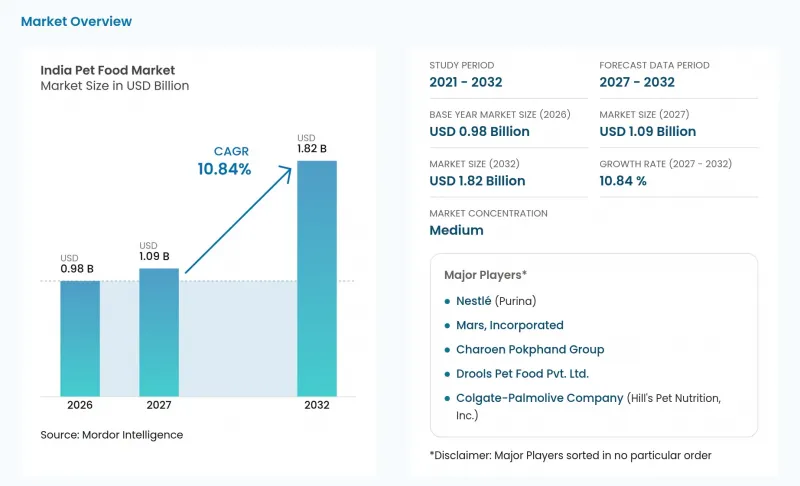
The market volume is expected to increase from 236 thousand metric tons in 2026 to 254 thousand metric tons in 2027 and reach 366.7 thousand metric tons by 2032, growing at a CAGR of 7.62% over 2027-2032. This report is segmented by Pet Food Product (Food, Pet Treats, Pet Nutraceuticals/Supplements, and Pet Veterinary Diets), Pets (Dogs, Cats, and Other Pets), and Distribution Channel (Specialty Stores, Online Channel, Supermarkets/Hypermarkets, Other Channels, and Convenience Stores). The market forecasts are provided in terms of value (USD) and volume (metric tons), based on availability.
India Pet Food Market Trends and Insights
Urban pet ownership upsurge
An urban pet base gives suppliers a pool of animals around which to build local distribution and feeding propositions. As of July 6, 2026, Greater Chennai Corporation's website contained records for 126,781 pets in Chennai. The corporation introduced online pet licensing in August 2023 and launched an enhanced portal in October 2025 that required anti-rabies vaccination and microchipping to obtain a license. To convert that presence into product demand, a supplier must offer a feeding proposition that works for the owners it can reach. Pet registration tied to vaccination and identification creates an organized local pet-care setting around which retailers and food brands can build feeding outreach.
Pet care spending surges amid rising incomes and humanization trends
Higher nutrition spending can support domestic producers when local supply does not meet the range of products buyers seek. Retail value sales of premium dry dog food in India rose from USD 51.2 million in 2020 to USD 99 million in 2025, a 14.1% CAGR over 2020-2025. India's retail dog and cat food imports grew 16.2% annually from 2020 to 2025. Agriculture and Agri-Food Canada said the 2025 trade deficit suggested domestic demand outpaced local production capacity, particularly in premium and expanding segments. Premium dry dog food offers a defined category in which rising retail spending and the broader import-reliance signal intersect. For a domestic premium dry recipe, that overlap makes overseas brands the competitive reference for winning existing packaged-food spending.
High price sensitivity in Tier 2/3 cities
For a price-sensitive household in a Tier 2/3 city, the cost of regular commercial feeding matters beyond the price of an initial trial pack. A product that fits an occasional purchase can be difficult to fund as the principal meal over repeated feeding occasions. For suppliers, this makes the affordable daily ration a more demanding price target than the smallest pack's entry cost. Smaller entry packs can make trial more accessible, but the commercial feeding proposition must also work at the cost of regular use. The supplier's constraint is the price tier that can support daily feeding, which limits premium positioning even when an entry pack is affordable.
Other drivers and restraints analyzed in the detailed report include:
- Expansion of e-commerce and quick-commerce delivery
- Domestic extrusion capacity expansion lowers prices
- Low packaged-food penetration vs homemade diets
For complete list of drivers and restraints, kindly check the Table Of Contents.
Segment Analysis
Food accounted for a 77.82% share of the India pet food market size in 2026 and is forecast to be the fastest-growing segment, with a CAGR of 11.2% over 2027-2032. The scale of this segment makes core meals central to the commercial opportunity for food producers. For FY2024-25, Drools Pet Food Pvt. Ltd. told the Delhi High Court that kibble products under its DROOLS mark contributed around 70% to 75% of its annual revenue. Most of Drools's revenue therefore depends on core kibble demand.
Food manufacturers can broaden the feeding choices they address by pairing meal formats with a defined regional distribution route. On September 8, 2026, Godrej Pet Care, a subsidiary of Godrej Consumer Products Ltd., debuted Godrej Ninja cat food in Tamil Nadu, where dry and wet formats were available through local pet retailers. The range covered kittens and adult cats, combining life-stage coverage with different meal formats. Availability through local pet retailers in Tamil Nadu made the range's reach dependent on that state's pet-store network.
Complete Report Scope:
- By Pet Food Product
- Food
- By Sub Product
- Dry Pet Food
- By Sub Dry Pet Food
- Kibbles
- Other Dry Pet Food
- By Sub Dry Pet Food
- Wet Pet Food
- Dry Pet Food
- By Sub Product
- Pet Nutraceuticals/Supplements
- By Sub Product
- Milk Bioactives
- Omega-3 Fatty Acids
- Probiotics
- Proteins and Peptides
- Vitamins and Minerals
- Other Nutraceuticals
- By Sub Product
- Pet Treats
- By Sub Product
- Crunchy Treats
- Dental Treats
- Freeze-dried and Jerky Treats
- Soft and Chewy Treats
- Other Treats
- By Sub Product
- Pet Veterinary Diets
- By Sub Product
- Diabetes
- Digestive Sensitivity
- Oral Care Diets
- Renal
- Urinary tract disease
- Obesity Diets
- Derma Diets
- Other Veterinary Diets
- By Sub Product
- Food
- By Pets
- Cats
- Dogs
- Other Pets
- By Distribution Channel
- Convenience Stores
- Online Channel
- Specialty Stores
- Supermarkets/Hypermarkets
- Other Channels
List of Companies Covered in this Report:
- Mars, Incorporated
- Colgate-Palmolive Company (Hill's Pet Nutrition, Inc.)
- General Mills Inc.
- Nestle (Purina)
- Schell & Kampeter, Inc. (Diamond Pet Foods)
- ADM
- Drools Pet Food Pvt. Ltd.
- Farmina Pet Foods
- Charoen Pokphand Group
- Virbac
- Heads Up For Tails
- Godrej Pet Care
- Allana Group (Bowler's Nutrimax)
Additional Benefits:
- The market estimate (ME) sheet in Excel format
- 3 months of analyst support
TABLE OF CONTENTS
1 INTRODUCTION
- 1.1 Study Assumptions and Market Definition
- 1.2 Scope of the Study
2 RESEARCH METHODOLOGY
3 EXECUTIVE SUMMARY
4 MARKET LANDSCAPE
- 4.1 Market Overview
- 4.2 Market Drivers
- 4.2.1 Urban pet ownership upsurge
- 4.2.2 Pet care spending surges amid rising incomes and humanization trends
- 4.2.3 Expansion of e-commerce and quick-commerce delivery
- 4.2.4 Domestic extrusion capacity expansion lowers prices
- 4.2.5 Pet-insurance rollout lifts premium-diet spending
- 4.2.6 Functional ingredients sourced from food waste cut formulation cost
- 4.3 Market Restraints
- 4.3.1 High price sensitivity in Tier 2/3 cities
- 4.3.2 Low packaged-food penetration vs homemade diets
- 4.3.3 Dependence on imported wet food and specialty ingredients
- 4.3.4 Fragmented regulatory oversight slows feed-standard rollout
- 4.4 Industry Value Chain Analysis
- 4.5 Regulatory Landscape
- 4.6 Technological Outlook
- 4.7 Porter's Five Forces Analysis
- 4.7.1 Threat of New Entrants
- 4.7.2 Bargaining Power of Suppliers
- 4.7.3 Bargaining Power of Buyers
- 4.7.4 Threat of Substitutes
- 4.7.5 Competitive Rivalry
- 4.8 REPORT OFFERS
- 4.9 EXECUTIVE SUMMARY AND KEY FINDINGS
- 4.10 KEY INDUSTRY TRENDS
- 4.10.1 Pet Population
- 4.10.1.1 Cats
- 4.10.1.2 Dogs
- 4.10.1.3 Other Pets
- 4.10.2 Pet Expenditure
- 4.10.3 Consumer Trends
- 4.10.1 Pet Population
- 4.11 Trade Analysis
- 4.12 Ingredient Trends
- 4.13 KEY STRATEGIC QUESTIONS FOR PET FOOD CEOS
5 MARKET SIZE AND GROWTH FORECASTS (VALUE AND VOLUME)
- 5.1 By Pet Food Product
- 5.1.1 Food
- 5.1.1.1 By Sub Product
- 5.1.1.1.1 Dry Pet Food
- 5.1.1.1.1.1 By Sub Dry Pet Food
- 5.1.1.1.1.1.1 Kibbles
- 5.1.1.1.1.1.2 Other Dry Pet Food
- 5.1.1.1.1.1 By Sub Dry Pet Food
- 5.1.1.1.2 Wet Pet Food
- 5.1.1.1.1 Dry Pet Food
- 5.1.1.1 By Sub Product
- 5.1.2 Pet Nutraceuticals/Supplements
- 5.1.2.1 By Sub Product
- 5.1.2.1.1 Milk Bioactives
- 5.1.2.1.2 Omega-3 Fatty Acids
- 5.1.2.1.3 Probiotics
- 5.1.2.1.4 Proteins and Peptides
- 5.1.2.1.5 Vitamins and Minerals
- 5.1.2.1.6 Other Nutraceuticals
- 5.1.2.1 By Sub Product
- 5.1.3 Pet Treats
- 5.1.3.1 By Sub Product
- 5.1.3.1.1 Crunchy Treats
- 5.1.3.1.2 Dental Treats
- 5.1.3.1.3 Freeze-dried and Jerky Treats
- 5.1.3.1.4 Soft and Chewy Treats
- 5.1.3.1.5 Other Treats
- 5.1.3.1 By Sub Product
- 5.1.4 Pet Veterinary Diets
- 5.1.4.1 By Sub Product
- 5.1.4.1.1 Diabetes
- 5.1.4.1.2 Digestive Sensitivity
- 5.1.4.1.3 Oral Care Diets
- 5.1.4.1.4 Renal
- 5.1.4.1.5 Urinary tract disease
- 5.1.4.1.6 Obesity Diets
- 5.1.4.1.7 Derma Diets
- 5.1.4.1.8 Other Veterinary Diets
- 5.1.4.1 By Sub Product
- 5.1.1 Food
- 5.2 By Pets
- 5.2.1 Cats
- 5.2.2 Dogs
- 5.2.3 Other Pets
- 5.3 By Distribution Channel
- 5.3.1 Convenience Stores
- 5.3.2 Online Channel
- 5.3.3 Specialty Stores
- 5.3.4 Supermarkets/Hypermarkets
- 5.3.5 Other Channels
6 COMPETITIVE LANDSCAPE
- 6.1 Market Concentration
- 6.2 Strategic Moves
- 6.3 Market Share Analysis
- 6.4 Company Profiles (includes Global level Overview, Market level overview, Core Segments, Financials as available, Strategic Information, Market Rank/Share for key companies, Products and Services, and Recent Developments)
- 6.4.1 Mars, Incorporated
- 6.4.2 Colgate-Palmolive Company (Hill's Pet Nutrition, Inc.)
- 6.4.3 General Mills Inc.
- 6.4.4 Nestle (Purina)
- 6.4.5 Schell & Kampeter, Inc. (Diamond Pet Foods)
- 6.4.6 ADM
- 6.4.7 Drools Pet Food Pvt. Ltd.
- 6.4.8 Farmina Pet Foods
- 6.4.9 Charoen Pokphand Group
- 6.4.10 Virbac
- 6.4.11 Heads Up For Tails
- 6.4.12 Godrej Pet Care
- 6.4.13 Allana Group (Bowler's Nutrimax)
7 MARKET OPPORTUNITIES AND FUTURE OUTLOOK
- 7.1 White-Space and Unmet-Need Assessment

