PUBLISHER: Mordor Intelligence | PRODUCT CODE: 2187219

PUBLISHER: Mordor Intelligence | PRODUCT CODE: 2187219
Gas Turbine - Market Share Analysis, Industry Trends & Statistics, Growth Forecasts (2027 - 2032)
According to Mordor Intelligence, the gas turbine market size is expected to increase from USD 21.11 billion in 2026 to USD 22.47 billion in 2027 and reach USD 31.32 billion by 2032, growing at a CAGR of 6.87% over 2027-2032.
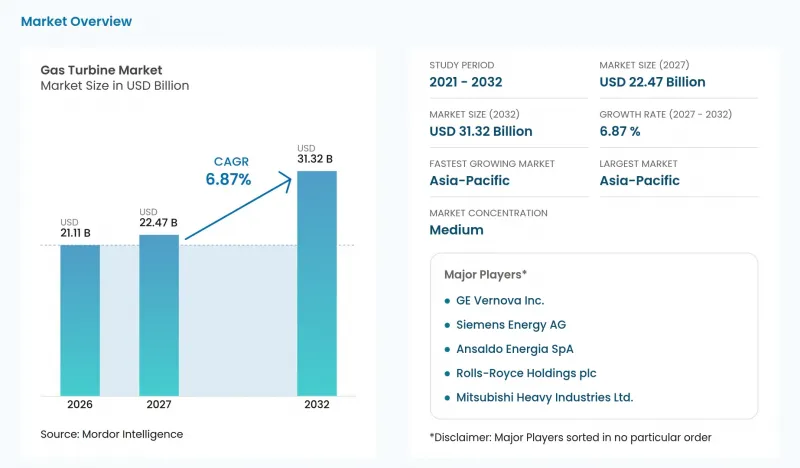
This report is segmented by Capacity (Above 120 MW, 30 to 120 MW, and more), Type (Combined Cycle, Simple/Open Cycle, and more), Fuel Type (Natural Gas, Liquid Fuels, and more), End-User Industry (Power, Oil and Gas, and more), and Geography (Asia-Pacific, North America, and more). The market forecasts are provided in terms of value (USD), based on availability.
Global Gas Turbine Market Trends and Insights
LNG-linked Island Grids in SEA Driving Mobile Aeroderivative Demand
Isolated island grids turn local electricity requirements into demand for on-site aeroderivative turbine capacity. PT PLN Batam operated 20 TM2500 Gen4 SAC gas turbines across 9 isolated-grid locations in Indonesia in 2026. Serving separate isolated grids distributes the equipment requirement across individual sites rather than concentrating it at one interconnected generating station. That deployment also gives overhaul timing and parts supply a recurring commercial role across a substantial fleet. The common turbine platform makes the operator a fleet-scale customer, while each isolated location gives the supplier a separate availability requirement. An equipment supplier can address several local generating requirements through one fleet relationship, provided its delivery and support reach the dispersed locations.
Petrochemical Cogeneration Build-out in Middle East
Petrochemical expansion creates turbine demand tied to simultaneous steam and electricity requirements, giving cogeneration a distinct industrial investment basis. In September 2026, MEED reported continuing construction of the Najim cogeneration facility for the Amiral petrochemicals complex in Jubail, Saudi Arabia. The facility is planned to supply up to 475 MW of power and approximately 452 metric tons of steam per hour. Also in September, MEED reported, citing sources, that Petrokemya selected Siemens Energy for its planned 730 MW electricity and steam cogeneration project in Jubail. Supplier selection and construction create different commercial entry points within the same regional build-out.
Gas-price Volatility Following Russia's Invasion of Ukraine Curtailing EU Projects
EU wholesale gas prices rose early in 2025 after Russian pipeline gas exports via Ukraine halted in January 2025. The European Commission's EU wholesale gas benchmark, based on Dutch TTF day-ahead prices, averaged EUR 36/MWh (USD 40.7/MWh) in 2025, 5% above 2024 but 22% below 2021. At an unchanged electricity selling price, a higher gas bill leaves less cash flow to repay the initial turbine equipment investment. An annual average can also conceal the timing of a short-term increase within the operating year. A developer whose proposal works only at that average has limited room to absorb a recurrence of the early-year price pressure.
Other drivers and restraints analyzed in the detailed report include:
- Disaster-Relief Leasing Surge for Aeroderivative Sets in Caribbean
- Utility-scale Battery Storage Displacing Peaking Turbines (US/Australia)
For complete list of drivers and restraints, kindly check the Table Of Contents.
Segment Analysis
Turbines above 120 MW accounted for a 58.15% share of the gas turbine market size in 2026, making them the largest segment. As turbine manufacturer and turnkey contractor, Mitsubishi Heavy Industries completed 10 M701JAC units across 3 combined-cycle sites in Thailand by January 2025. The M701JAC's published 2015 and 2018 simple-cycle ISO base ratings are 574 MW and 448 MW, respectively, placing both versions above 120 MW. The Thailand program covered 6,700 MW of total combined-cycle plant output. Winning this kind of program requires manufacturing capacity and turnkey execution capability, since the same contractor delivers both turbines and complete plants.
Turbines rated 30 to 120 MW are the fastest-growing segment, with a forecast CAGR of 7.3% over 2027-2032. In November 2025, Mitsubishi Power received an H-25 order for Chang Chun Petrochemical's Miaoli cogeneration facility in Taiwan through Mitsubishi Corporation Machinery. The turbine's output is approximately 30 MW, and operation was scheduled around the end of 2028. The factory project was designed to convert boilers fired by heavy oil and coal to a natural-gas-fired system supplying electricity and steam. Here, equipment demand comes from redesigning an industrial utility system, giving the capacity band a route into factory conversion projects with a specified combined power-and-steam requirement.
Combined cycle was the largest segment at 75.21% of industry revenue in 2026 and is forecast to be the fastest-growing segment, with a CAGR of 7.3% over 2027-2032. Siemens Energy's May 2026 agreement with Mai-Liao Power Corporation covered equipment and long-term service for 2 planned 1,200 MW combined-cycle units in Taiwan. The new plant would replace 1,800 MW of coal-fired generation, with commercial operation scheduled by December 31, 2029. That replacement links turbine demand to a generator's transition between generating assets, while the service agreement extends the supplier relationship beyond equipment delivery. The planned plant's total capacity exceeds the coal capacity it would replace, so replacement also creates an expansion opportunity for turbine suppliers.
Engineering, procurement and construction (EPC) contractors also shape the segment's turbine orders by connecting equipment selection with responsibility for plant delivery. In May 2025, GE Vernova secured an order for 5 of its 7H-class gas turbines from the Tecnicas Reunidas and Orascom Construction EPC joint venture for Saudi Arabia's 3 GW Qurayyah combined-cycle expansion. The expansion included readiness to build a carbon-capture unit. That EPC procurement structure places the turbine package within the contractor's wider responsibility for delivering the generating plant. The planned carbon-capture interface gives the equipment bid an integration requirement beyond supplying the specified turbine units.
Complete Report Scope:
- By Capacity
- Below 30 MW
- 30 to 120 MW
- Above 120 MW
- By Type
- Combined Cycle
- Simple/Open Cycle
- Cogeneration/CHP
- By Fuel Type
- Natural Gas
- Liquid Fuels (Diesel/Kerosene/LPG)
- Other Fuel Types (Hydrogen, Biogas)
- By End-User Industry
- Power
- Oil and Gas
- Other End-user Industries (Industrial, Marine)
- By Geography
- North America
- United States
- Canada
- Mexico
- Europe
- United Kingdom
- Germany
- France
- Italy
- Spain
- Russia
- Rest of Europe
- Asia-Pacific
- China
- India
- Japan
- South Korea
- ASEAN Countries
- Rest of Asia-Pacific
- South America
- Brazil
- Argentina
- Chile
- Rest of South America
- Middle East and Africa
- Saudi Arabia
- United Arab Emirates
- South Africa
- Egypt
- Rest of Middle East and Africa
- North America
Geography Analysis
Asia-Pacific was the largest region with a 60.01% share of the gas turbine market size in 2026 and is forecast to be the fastest-growing, with a CAGR of 7.8% over 2027-2032. Doosan Enerbility's September 30, 2026, Petrovietnam contract covers Vietnam's planned 1,155 MW O Mon III combined-cycle plant, with EPC alongside Petrovietnam subsidiary PTSC and Doosan steam-turbine supply, targeting completion by 2030. Malakoff's February 2026 Mitsubishi Power agreement allowed manufacturing/delivery slot reservations for 2 M701JAC turbine-generator sets at a planned 1,400 MW northern Peninsular Malaysia plant, contingent on a definitive supply agreement. O Mon III gives the contractor a defined delivery commitment, while the Malakoff reservation leaves the equipment sale dependent on a definitive supply agreement.
In the rest of Europe, Energa Group was building a combined-cycle plant in Gdansk, Poland, in October 2026 as flexible capacity for the national electricity system. In the rest of Asia-Pacific, AGL agreed in October 2025 to buy 4 Siemens AB gas turbines for Western Australia's Kwinana Swift Gas 2 firming project, approved for investment in March 2026. In South America, Brazil's approximately 1.7 GW GNA II plant began commercial operation in May 2025, with a 500 kV grid connection and a private LNG terminal serving its complex. In the rest of South America, Guyana's September 2026 Wales project update described preparation of its first turbine to receive natural gas before expected December firing and testing. For a South American plant developer, procuring a turbine leaves fuel access and grid connection as separate requirements for delivering power.
In the rest of the Middle East and Africa, Mitsubishi Power's January 2026 Facility E turbine contract in Qatar serves a planned project combining electricity generation and desalination. In North America, on October 6, 2026, Doosan Enerbility shipped a gas turbine for U.S. company SpaceXAI for planned deployment in U.S. power and AI infrastructure. In the United Arab Emirates, Fujairah Power Company F3 LLC began commercial operation of its natural-gas combined-cycle plant on July 12, 2025. Emirates Water and Electricity Company (EWEC) was that project company's electricity offtaker. Its power purchase agreement with EWEC tied the generation business to long-term contracted electricity sales.
- GE Vernova Inc.
- Siemens Energy AG
- Mitsubishi Heavy Industries Ltd.
- Kawasaki Heavy Industries Ltd.
- Ansaldo Energia SpA
- Everllence SE
- Wartsila Oyj Abp
- Rolls-Royce Holdings plc
- Solar Turbines Incorporated
- Capstone Green Energy Holdings, Inc.
- Doosan Enerbility Co., Ltd.
- IHI Corporation
- Bharat Heavy Electricals Limited
- Harbin Electric Co. Ltd.
- Shanghai Electric Group Co. Ltd.
- Destinus OPRA BV
- Baker Hughes Company
- Vericor Power Systems LLC
- Zorya-Mashproekt
- Nanjing Turbine & Electric Machinery Group
Additional Benefits:
- The market estimate (ME) sheet in Excel format
- 3 months of analyst support
TABLE OF CONTENTS
1 INTRODUCTION
- 1.1 Study Assumptions and Market Definition
- 1.2 Scope of the Study
2 RESEARCH METHODOLOGY
3 EXECUTIVE SUMMARY
4 MARKET LANDSCAPE
- 4.1 Market Overview
- 4.2 Market Drivers
- 4.2.1 LNG-linked Island Grids in SEA Driving Mobile Aeroderivative Demand
- 4.2.2 Petrochemical Cogeneration Build-out in Middle East
- 4.2.3 Disaster-Relief Leasing Surge for Aeroderivative Sets in Caribbean
- 4.3 Market Restraints
- 4.3.1 Gas-price Volatility Following Russia's Invasion of Ukraine Curtailing EU Projects
- 4.3.2 Utility-scale Battery Storage Displacing Peaking Turbines (US/Australia)
- 4.3.3 ESG-driven Financing Restrictions informed by EU Taxonomy
- 4.3.4 Super-alloy Supply-Chain Shortages for Large-Frame Hot-gas-path Parts
- 4.4 Industry Value Chain Analysis
- 4.5 Regulatory Landscape
- 4.6 Technological Outlook
- 4.7 Porter's Five Forces Analysis
- 4.7.1 Threat of New Entrants
- 4.7.2 Bargaining Power of Suppliers
- 4.7.3 Bargaining Power of Buyers
- 4.7.4 Threat of Substitutes
- 4.7.5 Competitive Rivalry
5 MARKET SIZE AND GROWTH FORECASTS (VALUE)
- 5.1 By Capacity
- 5.1.1 Below 30 MW
- 5.1.2 30 to 120 MW
- 5.1.3 Above 120 MW
- 5.2 By Type
- 5.2.1 Combined Cycle
- 5.2.2 Simple/Open Cycle
- 5.2.3 Cogeneration/CHP
- 5.3 By Fuel Type
- 5.3.1 Natural Gas
- 5.3.2 Liquid Fuels (Diesel/Kerosene/LPG)
- 5.3.3 Other Fuel Types (Hydrogen, Biogas)
- 5.4 By End-User Industry
- 5.4.1 Power
- 5.4.2 Oil and Gas
- 5.4.3 Other End-user Industries (Industrial, Marine)
- 5.5 By Geography
- 5.5.1 North America
- 5.5.1.1 United States
- 5.5.1.2 Canada
- 5.5.1.3 Mexico
- 5.5.2 Europe
- 5.5.2.1 United Kingdom
- 5.5.2.2 Germany
- 5.5.2.3 France
- 5.5.2.4 Italy
- 5.5.2.5 Spain
- 5.5.2.6 Russia
- 5.5.2.7 Rest of Europe
- 5.5.3 Asia-Pacific
- 5.5.3.1 China
- 5.5.3.2 India
- 5.5.3.3 Japan
- 5.5.3.4 South Korea
- 5.5.3.5 ASEAN Countries
- 5.5.3.6 Rest of Asia-Pacific
- 5.5.4 South America
- 5.5.4.1 Brazil
- 5.5.4.2 Argentina
- 5.5.4.3 Chile
- 5.5.4.4 Rest of South America
- 5.5.5 Middle East and Africa
- 5.5.5.1 Saudi Arabia
- 5.5.5.2 United Arab Emirates
- 5.5.5.3 South Africa
- 5.5.5.4 Egypt
- 5.5.5.5 Rest of Middle East and Africa
- 5.5.1 North America
6 COMPETITIVE LANDSCAPE
- 6.1 Market Concentration
- 6.2 Strategic Moves
- 6.3 Market Share Analysis
- 6.4 Company Profiles (includes Global level Overview, Market level overview, Core Segments, Financials as available, Strategic Information, Market Rank/Share for key companies, Products and Services, and Recent Developments)
- 6.4.1 GE Vernova Inc.
- 6.4.2 Siemens Energy AG
- 6.4.3 Mitsubishi Heavy Industries Ltd.
- 6.4.4 Kawasaki Heavy Industries Ltd.
- 6.4.5 Ansaldo Energia SpA
- 6.4.6 Everllence SE
- 6.4.7 Wartsila Oyj Abp
- 6.4.8 Rolls-Royce Holdings plc
- 6.4.9 Solar Turbines Incorporated
- 6.4.10 Capstone Green Energy Holdings, Inc.
- 6.4.11 Doosan Enerbility Co., Ltd.
- 6.4.12 IHI Corporation
- 6.4.13 Bharat Heavy Electricals Limited
- 6.4.14 Harbin Electric Co. Ltd.
- 6.4.15 Shanghai Electric Group Co. Ltd.
- 6.4.16 Destinus OPRA BV
- 6.4.17 Baker Hughes Company
- 6.4.18 Vericor Power Systems LLC
- 6.4.19 Zorya-Mashproekt
- 6.4.20 Nanjing Turbine & Electric Machinery Group
7 MARKET OPPORTUNITIES AND FUTURE OUTLOOK
- 7.1 White-Space and Unmet-Need Assessment

