PUBLISHER: Mordor Intelligence | PRODUCT CODE: 2187240

PUBLISHER: Mordor Intelligence | PRODUCT CODE: 2187240
Data Center Liquid Cooling - Market Share Analysis, Industry Trends & Statistics, Growth Forecasts (2027 - 2032)
According to Mordor Intelligence, the data center liquid cooling market size is estimated at USD 6.77 billion in 2026 and is projected to be USD 8.3 billion in 2027, reaching USD 22.56 billion by 2032, growing at a CAGR of 22.14% from 2027 to 2032.
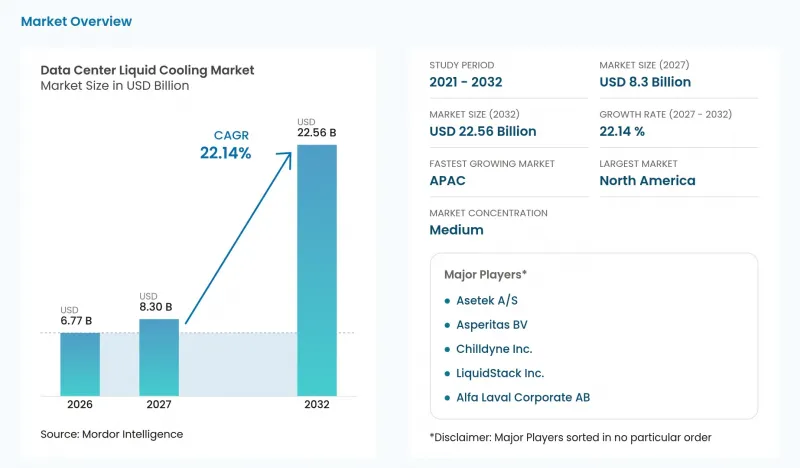
This report is segmented by Segmentation by Cooling Technology (Direct-to-Chip Liquid Cooling and more), Segmentation by Coolant Type (Single-Phase Hydrocarbon Fluids and more), Segmentation by Data Center Type (Hyperscale and more), Segmentation by Application / Workload, and Geography. The market forecasts are provided in terms of value (USD), based on availability.
Global Data Center Liquid Cooling Market Trends and Insights
Surging rack densities (>30 kW) in AI and HPC facilities
High-density computing concentrates the cooling opportunity in the racks placing the greatest demands on facility infrastructure. Uptime Institute's 2026 global survey found more operators reporting peak rack densities of 30 kW or higher for advanced computing workloads. It linked rising rack power demands to AI and other enterprise applications, while average modal densities continued their slow upward movement. This combination makes a facility-wide density average a poor guide to the cooling requirements of its most demanding computing installations. Peak rack heat loads can justify targeted liquid-cooling investment even when the facility's average density does not call for conversion.
Hyperscale operators' net-zero roadmaps accelerating liquid adoption
Microsoft's 2030 carbon-negative and water-positive commitments place cooling design within a broader hyperscale environmental roadmap. Microsoft reported that about 90% of its owned data-center fleet operated with low- to zero-water cooling systems in 2025. It described its liquid-cooled AI data centers as using closed-loop, direct-to-chip cooling for chip-level temperature control without water evaporation. That operating characteristic serves the water objective through the cooling loop itself, connecting an environmental commitment with a specific thermal architecture. For Microsoft's liquid-cooled AI facilities, adding chip-cooling capacity can support computing demand without adding evaporative losses from that cooling operation.
Limited field expertise among facility engineers
Liquid-cooling expertise creates a deployment constraint within the broader data-center workforce. A 2025 peer-reviewed perspective by Intel Corporation and Intel Labs China researchers identified a lack of skilled workers as a challenge hindering liquid-cooling technologies. It said installation, operation, maintenance and troubleshooting generally require specialized knowledge and skills from operators. Across data-center positions generally, Uptime Institute's 2026 survey found that more than half of respondents had difficulty finding qualified candidates. An operator relying on a general facilities workforce may carry that skills gap into commissioning and maintenance, limiting how much new cooling equipment it can put into dependable service.
Other drivers and restraints analyzed in the detailed report include:
- OEM warranties now covering direct-to-chip loops
- Nvidia and AMD liquid-ready reference designs driving ecosystem
- High upfront retrofit costs for brown-field sites
For complete list of drivers and restraints, kindly check the Table Of Contents.
Segment Analysis
Direct-to-chip liquid cooling accounted for a 42.79% share of the data center liquid cooling market size in 2026, making it the largest segment. In February 2026, CoolIT Systems Inc., acquired by Ecolab in July 2026, reported that its coldplates cooled more than 5 million GPUs, CPUs and AI accelerators worldwide. It also reported use of its direct liquid-cooling technology in 7 of the top 10 supercomputers, including El Capitan. Those footprints connect chip-level cooling with both a large processor population and demanding computing installations. A coldplate design's commercial reach can multiply across processor positions within each system, linking component supply to computing deployment scale.
Immersion cooling is forecast to be the fastest-growing segment, at a CAGR of 26.12% from 2027 to 2032. Shell reported in 2026 that its own immersion-cooling fluids were in use at its data centers in Houston and Amsterdam. Rear-door heat exchangers offered NorthC another route at Munchenstein (Basel) 1 in Switzerland, where Legrand's USystems equipment was installed without interrupting operations by November 2025. Shell develops its immersion fluids in its own laboratories, combining the fluid-developer and data-center-operator roles in this example. Combining those roles can connect fluid development directly with operating requirements, giving immersion adoption a path within the same organization.
Single-phase hydrocarbon fluids represented a 45.08% data center liquid cooling market share in 2026, making them the largest segment. Intel certified Shell Lubricants' immersion fluids in 2025 for compatibility with 4th and 5th Gen Intel Xeon processors, the first fluid line to earn its Data Center Certification for Immersion Cooling. Shell's single-phase S3 X offering uses a GTL-based hydrocarbon fluid. Such processor-specific validation gives fluid selection a defined relationship with the computing platform. Its commercial value lies in qualifying the fluid for an identified hardware environment, rather than relying on the broad hydrocarbon category as a sufficient specification.
Two-phase fluorocarbon fluids are forecast to be the fastest-growing segment, at a CAGR of 25.14% from 2027 to 2032. Among the remaining coolants, water/glycol solutions have an operating use in some Microsoft data centers, where a propylene-glycol solution serves closed-loop cooling systems. In May 2025, Chemours agreed with Navin Fluorine International Limited to manufacture Opteon two-phase immersion fluid, with initial manufacturing capacity planned for 2026. In August 2026, Navin Fluorine's investor presentation targeted completion of the Chemours project by the end of September 2026. Navin Fluorine's project schedule therefore sets when contract-manufactured Opteon capacity can begin.
Complete Report Scope:
- By Segmentation by Cooling Technology
- Immersion Cooling
- Direct-to-Chip Liquid Cooling
- Rear-Door Heat Exchangers (RDHx)
- Cold-Plate / In-row Liquid Systems
- By Segmentation by Coolant Type
- Single-Phase Hydrocarbon Fluids
- Two-Phase Fluorocarbon Fluids
- Water / Glycol Solutions
- Nanofluids and Other Specialty Liquids
- By Segmentation by Data Center Type
- Hyperscale
- Colocation
- Enterprise / On-Premise
- Edge and Micro DCs
- By Segmentation by Application / Workload
- High-Performance Computing (HPC)
- Artificial Intelligence / Machine Learning
- Cryptocurrency Mining
- Cloud and Virtualization
- By Geography
- North America
- United States
- Canada
- South America
- Brazil
- Rest of South America
- Europe
- Germany
- United Kingdom
- France
- Netherlands
- Russia
- Rest of Europe
- APAC
- China
- Japan
- India
- Australia
- Rest of APAC
- Middle East and Africa
- Middle East
- Saudi Arabia
- United Arab Emirates
- Africa
- South Africa
- Rest of MEA
- Middle East
- North America
Geography Analysis
North America accounted for 36.97% of the data center liquid cooling market size in 2026, the largest regional share. In its September 2025 announcement, Microsoft said closed-loop liquid cooling served more than 90% of capacity at its first Fairwater facility in Mount Pleasant, Wisconsin, United States. It confirmed the first Mount Pleasant facility was fully operational in June 2026, while its second facility was under construction. For cooling vendors, the high liquid-cooling coverage at this AI facility connects regional opportunity to the computing installation as a whole, extending its scope beyond individual chip-level components.
APAC is forecast to be the fastest-growing region, at a CAGR of 27.17% from 2027 to 2032. In May 2026, Equinix announced KL2 in Cyberjaya, Malaysia, with more than 2,200 cabinets at full build-out and a substantial portion of capacity supporting liquid cooling for AI and HPC. AirTrunk's planned JHB2 campus in Johor Bahru, Malaysia, was designed for more than 270 MW of capacity and a design PUE of 1.37 using liquid cooling. AirTrunk announced development financing in July 2026, and IFC recorded financing investment in August 2026. Both campuses specify liquid cooling in their designs, and KL2 had reached structural construction by July 2026, so the question for suppliers is when each site reaches equipment installation.
Outside the leading regions, cooling projects connect high-density readiness with different stages of physical implementation. In South America, ODATA, an Aligned Data Centers company, announced Aligned's DeltaFlow, developed with Munters, at SP04 in Brazil in September 2026, with installation and first-phase testing under way. Europe's SINES DC in Portugal brought its first building into operation in 2025, coupling closed-loop freshwater process cooling with seawater heat rejection. Within Middle East and Africa, Teraco, majority-owned by Digital Realty, completed its JB4 expansion in Ekurhuleni, South Africa, in 2025, enabling clients to deploy direct-to-chip cooling for denser AI workloads. Halls ready for clients to deploy cooling can create a later opportunity for equipment sales than an installation already under way.
- Alfa Laval Corporate AB
- Asetek A/S
- Asperitas BV
- Chilldyne Inc.
- CoolIT Systems Inc.
- Fujitsu Ltd.
- Kaori Heat Treatment Co., Ltd.
- Lenovo Group Ltd.
- LiquidStack Inc.
- LiquidCool Solutions Inc.
- Iceotope Technologies Ltd.
- Rittal GmbH and Co. KG
- Schneider Electric SE
- Submer Technologies SL and Submer Inc.
- Vertiv Group Corp.
- Wiwynn Corporation
- 3M Company
- Engineered Fluids Inc.
- Green Revolution Cooling Inc.
- Syensqo SA
- Mikros Technologies
- Midas Green Technologies LLC
- USystems Ltd. (Legrand Group)
Additional Benefits:
- The market estimate (ME) sheet in Excel format
- 3 months of analyst support
TABLE OF CONTENTS
1 INTRODUCTION
- 1.1 Study Assumptions and Market Definition
- 1.2 Scope of the Study
2 RESEARCH METHODOLOGY
3 EXECUTIVE SUMMARY
4 MARKET LANDSCAPE
- 4.1 Market Overview
- 4.2 Market Drivers
- 4.2.1 Surging rack densities (>30 kW) in AI and HPC facilities
- 4.2.2 Hyperscale operators' net-zero roadmaps accelerating liquid adoption
- 4.2.3 OEM warranties now covering direct-to-chip loops
- 4.2.4 Nvidia and AMD liquid-ready reference designs driving ecosystem
- 4.2.5 Government incentives for green DCs underwrite CAPEX
- 4.2.6 Re-use of waste-heat for district heating monetizes OPEX savings
- 4.3 Market Restraints
- 4.3.1 Limited field expertise among facility engineers
- 4.3.2 High upfront retrofit costs for brown-field sites
- 4.3.3 Fluid material-compatibility concerns (long-term seals, PCB)
- 4.3.4 Supply risk of specialty dielectric fluids
- 4.4 Industry Value Chain Analysis
- 4.5 Regulatory Landscape
- 4.6 Technological Outlook
- 4.7 Porter's Five Forces Analysis
- 4.7.1 Threat of New Entrants
- 4.7.2 Bargaining Power of Suppliers
- 4.7.3 Bargaining Power of Buyers
- 4.7.4 Threat of Substitutes
- 4.7.5 Competitive Rivalry
5 MARKET SIZE AND GROWTH FORECASTS (VALUE)
- 5.1 By Segmentation by Cooling Technology
- 5.1.1 Immersion Cooling
- 5.1.2 Direct-to-Chip Liquid Cooling
- 5.1.3 Rear-Door Heat Exchangers (RDHx)
- 5.1.4 Cold-Plate / In-row Liquid Systems
- 5.2 By Segmentation by Coolant Type
- 5.2.1 Single-Phase Hydrocarbon Fluids
- 5.2.2 Two-Phase Fluorocarbon Fluids
- 5.2.3 Water / Glycol Solutions
- 5.2.4 Nanofluids and Other Specialty Liquids
- 5.3 By Segmentation by Data Center Type
- 5.3.1 Hyperscale
- 5.3.2 Colocation
- 5.3.3 Enterprise / On-Premise
- 5.3.4 Edge and Micro DCs
- 5.4 By Segmentation by Application / Workload
- 5.4.1 High-Performance Computing (HPC)
- 5.4.2 Artificial Intelligence / Machine Learning
- 5.4.3 Cryptocurrency Mining
- 5.4.4 Cloud and Virtualization
- 5.5 By Geography
- 5.5.1 North America
- 5.5.1.1 United States
- 5.5.1.2 Canada
- 5.5.2 South America
- 5.5.2.1 Brazil
- 5.5.2.2 Rest of South America
- 5.5.3 Europe
- 5.5.3.1 Germany
- 5.5.3.2 United Kingdom
- 5.5.3.3 France
- 5.5.3.4 Netherlands
- 5.5.3.5 Russia
- 5.5.3.6 Rest of Europe
- 5.5.4 APAC
- 5.5.4.1 China
- 5.5.4.2 Japan
- 5.5.4.3 India
- 5.5.4.4 Australia
- 5.5.4.5 Rest of APAC
- 5.5.5 Middle East and Africa
- 5.5.5.1 Middle East
- 5.5.5.1.1 Saudi Arabia
- 5.5.5.1.2 United Arab Emirates
- 5.5.5.2 Africa
- 5.5.5.2.1 South Africa
- 5.5.5.2.2 Rest of MEA
- 5.5.5.1 Middle East
- 5.5.1 North America
6 COMPETITIVE LANDSCAPE
- 6.1 Market Concentration
- 6.2 Strategic Moves
- 6.3 Market Share Analysis
- 6.4 Company Profiles (includes Global level Overview, Market level overview, Core Segments, Financials as available, Strategic Information, Market Rank/Share for key companies, Products and Services, and Recent Developments)
- 6.4.1 Alfa Laval Corporate AB
- 6.4.2 Asetek A/S
- 6.4.3 Asperitas BV
- 6.4.4 Chilldyne Inc.
- 6.4.5 CoolIT Systems Inc.
- 6.4.6 Fujitsu Ltd.
- 6.4.7 Kaori Heat Treatment Co., Ltd.
- 6.4.8 Lenovo Group Ltd.
- 6.4.9 LiquidStack Inc.
- 6.4.10 LiquidCool Solutions Inc.
- 6.4.11 Iceotope Technologies Ltd.
- 6.4.12 Rittal GmbH and Co. KG
- 6.4.13 Schneider Electric SE
- 6.4.14 Submer Technologies SL and Submer Inc.
- 6.4.15 Vertiv Group Corp.
- 6.4.16 Wiwynn Corporation
- 6.4.17 3M Company
- 6.4.18 Engineered Fluids Inc.
- 6.4.19 Green Revolution Cooling Inc.
- 6.4.20 Syensqo SA
- 6.4.21 Mikros Technologies
- 6.4.22 Midas Green Technologies LLC
- 6.4.23 USystems Ltd. (Legrand Group)
7 MARKET OPPORTUNITIES AND FUTURE OUTLOOK
- 7.1 White-Space and Unmet-Need Assessment

