PUBLISHER: Mordor Intelligence | PRODUCT CODE: 2187257

PUBLISHER: Mordor Intelligence | PRODUCT CODE: 2187257
India Instant Noodles - Market Share Analysis, Industry Trends & Statistics, Growth Forecasts (2027 - 2032)
According to Mordor Intelligence, the India instant noodles market size is expected to increase from USD 1.8 billion in 2026 to USD 2.04 billion in 2027 and reach USD 3.74 billion by 2032, growing at a CAGR of 12.86% over 2027-2032.
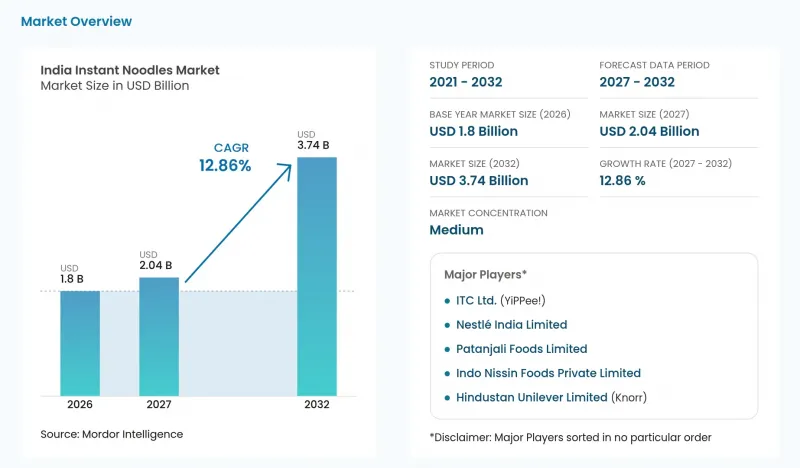
This report is segmented by Product Type (Vegetarian and Non-Vegetarian), Serving (Single Serve Packs and Multi Serve Packs), Packaging (Packet and Cup/Bowl), Flavor Variant (Masala, Chinese, and more), and Distribution Channel (Supermarkets/Hypermarkets, Convenience/Grocery Stores, and more). The market forecasts are provided in terms of value (USD), based on availability.
India Instant Noodles Market Trends and Insights
Rapid urbanization and changing lifestyles
For an urban household, the value of instant noodles can lie in making a small meal possible within limited preparation time. The World Bank estimated India's urban population at 522,441,248 in 2025 under national definitions. If urban households adopt noodles for short-break meals, portion size and preparation requirements become ways to turn that population base into demand. Portion design would then compete on suitability for a defined meal task, alongside rather than solely through premium flavor differentiation. Even limited household adoption across such a large urban base could support substantial demand for packs suited to short meal breaks.
Premiumization via Korean/K-flavor wave
Premiumization requires a flavor proposition that can coexist with the inexpensive everyday noodle pack. In September 2025, Mint reported that Nestle India's Korean-style MAGGI noodles were positioned above its own mass-market noodles on price. That comparison illustrates how an established brand can offer a separate spending tier within the same broad meal category. For the quarter ended June 30, 2025, ITC reported that its recently launched YiPPee! range of Korean noodles continued to scale up amid consumer traction. The price comparison and reported traction support a Korean offering with its own demand test. A separate Korean tier can broaden the price ladder while leaving the mass-market noodle proposition intact.
Health concerns about high sodium, MSG, and preservatives
A buyer seeking to limit sodium or particular additives may place an instant-noodle meal outside the household's everyday food routine. That concern can constrain purchase frequency even when the buyer values the convenience and flavor of the product. A flavor-led upgrade alone does not resolve a dietary objection because the buyer is judging the ingredients and intended frequency of consumption. A clearly explained product proposition can help that buyer make a choice, but it cannot remove a personal dietary limit. The remaining commercial constraint is a ceiling on how often the product earns a place in the meal routine of that specific buyer.
Other drivers and restraints analyzed in the detailed report include:
- Product innovation and packaging
- Rising demand for convenient, ready-to-eat food
- Regulatory and food safety scrutiny
For complete list of drivers and restraints, kindly check the Table Of Contents.
Segment Analysis
Vegetarian noodles were the largest segment with a 67.78% share in 2026 and the fastest-growing segment, with a projected 13.12% CAGR during 2027-2032. Qualifying vegetarian noodle packages containing plant-origin ingredients, additives or processing aids must display a green filled circle inside a green-outlined square, on a contrasting background near the front-panel product or brand name. Households can use that front-panel cue to confirm suitability across the leading vegetarian range, even when flavor names or serving formats differ. As the range expands, separating dietary identification from flavor gives producers room to vary the eating experience while preserving a recognizable suitability cue.
Non-vegetarian noodles bring a separate labeling and product-identity decision into the same meal category. FSSAI requires packaged non-vegetarian foods containing animal-origin ingredients, additives or processing aids to carry a brown filled triangle inside a brown-outlined square. Nestle India identifies MAGGI Chicken Noodles as the only non-vegetarian variant within its MAGGI 2-Minute Noodles line. This makes the animal-origin distinction commercially relevant to how a brand presents a particular variety within its wider portfolio. Within the MAGGI 2-Minute Noodles line, clear dietary identification lets a chicken variety share the convenience proposition while remaining a distinct choice.
Single-serve packs accounted for a 61.98% share of the India instant noodles market size in 2026. The largest segment can address an individual meal through a defined portion that does not require the buyer to divide a larger quantity before preparation. Its commercial role is strongest when the eating occasion ends with that serving, allowing the pack to fit a particular meal task.
Multi-serve packs are forecast to be the fastest-growing segment, with a 13.06% CAGR during 2027-2032. The format allows the eating occasion to be shared or repeated from a larger pack, giving it a different household role. A household preparing noodles for more than one person can judge the product on the total meal it supplies, with serving quantity determining whether the larger pack adds practical value. Producers can translate that use into a distinct offering through clear portion guidance and a configuration suited to the intended number of servings. The growth logic is more food supplied per household meal decision, with preparation convenience preserved as the reason to choose noodles.
Complete Report Scope:
- By Product Type
- Vegetarian
- Non-Vegetarian
- By Serving
- Single Serve Packs
- Multi Serve Packs
- By Packaging
- Cup/Bowl
- Packet
- By Flavor Variant
- Masala
- Spicy (Korean)
- Chinese
- Others
- By Distribution Channel
- Supermarkets/Hypermarkets
- Convenience/Grocery Stores
- Online Retail Stores
- Other Distribution Channels
List of Companies Covered in this Report:
- Nestle India Limited
- ITC Ltd. (YiPPee!)
- Indo Nissin Foods Private Limited
- CG Foods India Private Limited (Wai Wai)
- Hindustan Unilever Limited (Knorr)
- Patanjali Foods Limited
- Capital Foods (Smith and Jones)
- Inbisco India (Mamee)
- Millet Amma
- Future Consumer Limited (Tasty Treat)
- Tata Consumer Products (Ching's)
- ITA Foods (MasterChow)
- Bambino Agro
- Balaji Wafers Private Limited
- Gopal Snacks Ltd
- Well Grow Co. Limited
- Haldiram Snacks Food Pvt. Ltd
- Veeba Foods
- Tat Hui Foods PTE Ltd
- Supreme Nutri Grain Private Limited
Additional Benefits:
- The market estimate (ME) sheet in Excel format
- 3 months of analyst support
TABLE OF CONTENTS
1 INTRODUCTION
- 1.1 Study Assumptions and Market Definition
- 1.2 Scope of the Study
2 RESEARCH METHODOLOGY
3 EXECUTIVE SUMMARY
4 MARKET LANDSCAPE
- 4.1 Market Overview
- 4.2 Market Drivers
- 4.2.1 Rapid urbanization and changing lifestyles
- 4.2.2 Premiumization via Korean/K-flavor wave
- 4.2.3 Product innovation and packaging
- 4.2.4 Rising demand for convenient, ready-to-eat food
- 4.2.5 Flavor experimentation and trend adoption
- 4.2.6 Growth of e-commerce and quick-commerce platforms
- 4.3 Market Restraints
- 4.3.1 Health concerns about high sodium, MSG, and preservatives
- 4.3.2 Regulatory and food safety scrutiny
- 4.3.3 Intense competition and price wars
- 4.3.4 Anti-HFSS (high fat, salt, sugar) advertising rules restricting kid-focused promos
- 4.4 Industry Value Chain Analysis
- 4.5 Regulatory Landscape
- 4.6 Technological Outlook
- 4.7 Porter's Five Forces Analysis
- 4.7.1 Threat of New Entrants
- 4.7.2 Bargaining Power of Suppliers
- 4.7.3 Bargaining Power of Buyers
- 4.7.4 Threat of Substitutes
- 4.7.5 Competitive Rivalry
5 MARKET SIZE AND GROWTH FORECASTS (VALUE)
- 5.1 By Product Type
- 5.1.1 Vegetarian
- 5.1.2 Non-Vegetarian
- 5.2 By Serving
- 5.2.1 Single Serve Packs
- 5.2.2 Multi Serve Packs
- 5.3 By Packaging
- 5.3.1 Cup/Bowl
- 5.3.2 Packet
- 5.4 By Flavor Variant
- 5.4.1 Masala
- 5.4.2 Spicy (Korean)
- 5.4.3 Chinese
- 5.4.4 Others
- 5.5 By Distribution Channel
- 5.5.1 Supermarkets/Hypermarkets
- 5.5.2 Convenience/Grocery Stores
- 5.5.3 Online Retail Stores
- 5.5.4 Other Distribution Channels
6 COMPETITIVE LANDSCAPE
- 6.1 Market Concentration
- 6.2 Strategic Moves
- 6.3 Market Share Analysis
- 6.4 Company Profiles (includes Global level Overview, Market level overview, Core Segments, Financials as available, Strategic Information, Market Rank/Share for key companies, Products and Services, and Recent Developments)
- 6.4.1 Nestle India Limited
- 6.4.2 ITC Ltd. (YiPPee!)
- 6.4.3 Indo Nissin Foods Private Limited
- 6.4.4 CG Foods India Private Limited (Wai Wai)
- 6.4.5 Hindustan Unilever Limited (Knorr)
- 6.4.6 Patanjali Foods Limited
- 6.4.7 Capital Foods (Smith and Jones)
- 6.4.8 Inbisco India (Mamee)
- 6.4.9 Millet Amma
- 6.4.10 Future Consumer Limited (Tasty Treat)
- 6.4.11 Tata Consumer Products (Ching's)
- 6.4.12 ITA Foods (MasterChow)
- 6.4.13 Bambino Agro
- 6.4.14 Balaji Wafers Private Limited
- 6.4.15 Gopal Snacks Ltd
- 6.4.16 Well Grow Co. Limited
- 6.4.17 Haldiram Snacks Food Pvt. Ltd
- 6.4.18 Veeba Foods
- 6.4.19 Tat Hui Foods PTE Ltd
- 6.4.20 Supreme Nutri Grain Private Limited
7 MARKET OPPORTUNITIES AND FUTURE OUTLOOK
- 7.1 White-Space and Unmet-Need Assessment

