PUBLISHER: Mordor Intelligence | PRODUCT CODE: 2187666

PUBLISHER: Mordor Intelligence | PRODUCT CODE: 2187666
Instant Noodles - Market Share Analysis, Industry Trends & Statistics, Growth Forecasts (2027 - 2032)
According to Mordor Intelligence, the instant noodles market size is expected to increase from USD 55.68 billion in 2026 to USD 60.91 billion in 2027 and reach USD 93.16 billion by 2032, growing at a CAGR of 8.87% over 2027-2032.
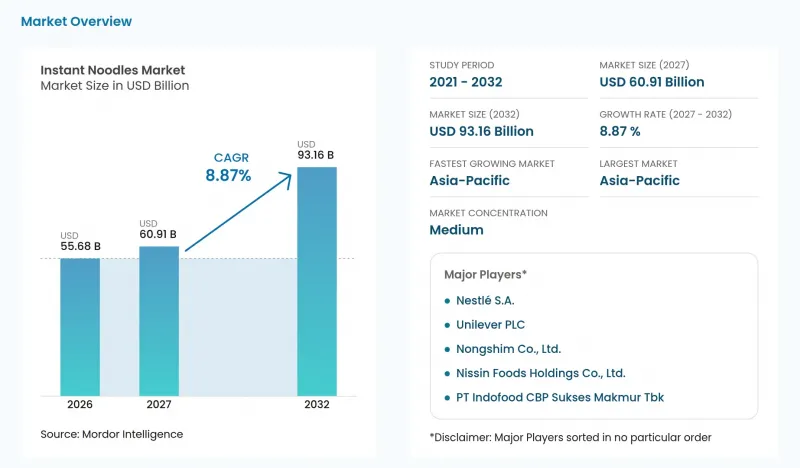
The market volume is expected to increase from 123.7 billion servings in 2026 to 127.2 billion servings in 2027 and reach 146 billion servings by 2032, growing at a CAGR of 2.8% over 2027-2032. This report is segmented by Product Type (Vegetarian and Non-vegetarian), Serving (Single-Serve Packs and Multi Packs), Packaging (Packet and Cup/Bowls), Distribution Channel (Supermarkets/Hypermarkets, Convenience/Grocery Stores, and more), and Geography (Asia-Pacific, North America, and more). The market forecasts are provided in terms of value (USD) and volume (servings), based on availability.
Global Instant Noodles Market Trends and Insights
Busy lifestyles increase demand for quick, ready-to-eat meals
For a time-pressed buyer, a meal prepared by adding hot water reduces the preparation effort needed to fit food into the day. The World Instant Noodles Association (WINA) estimated global instant-noodle demand at 123.4 billion servings in its revised 2025 total. That serving base makes additional eating occasions commercially consequential. An extra occasion adds demand without requiring a larger portion in each pack. At that scale, a hypothetical 1% increase in eating occasions would equal about 1.2 billion additional servings.
Fortified noodles with vitamins and minerals target nutrition needs
Fortification lets producers address nutrition needs within a familiar convenience meal, allowing nutritional positioning to support the core range. PT Indofood Sukses Makmur Tbk reported that all Indomie instant-noodle products contained added iron, vitamin A, and B-complex vitamins B1, B6, B12, niacin, folic acid, and pantothenic acid in 2025. The named additions give that appeal a specific basis in recipe composition rather than preparation speed. Manufacturers can make those specific additions visible when seeking households that weigh convenience alongside nutritional content. Incremental demand depends on the nutrients making noodles acceptable for a meal a household would otherwise exclude.
Rising health concerns over high sodium content
Health-related salt limits can constrain how often a buyer considers an instant-noodle meal, making sodium content a barrier to frequent use. Malaysia's Ministry of Health, in its 2020 dietary guidance, advises limiting high-salt foods, including instant noodles, and choosing lower-sodium foods within the same food group. This makes sodium composition a dietary objection that a wider range of flavors alone cannot settle. Canada requires covered prepackaged foods that meet the applicable sodium threshold to carry a prescribed front-of-package symbol, subject to exemptions and calculation rules. For a noodle recipe that meets the applicable threshold and is not exempt, the symbol puts its sodium warning on the principal display panel at the point of sale.
Other drivers and restraints analyzed in the detailed report include:
- Innovative textures like stir-fried or soup-less noodles attract foodies
- Long shelf life supports stocking and emergency use
- Gluten and concerns about MSG limit consumption for sensitive groups
For complete list of drivers and restraints, kindly check the Table Of Contents.
Segment Analysis
Vegetarian noodles represented a 56.62% instant noodles market share in 2026 as the largest segment and are forecast to be the fastest-growing segment, with a CAGR of 9.4% over 2027-2032. In March 2025, Wow! Momo said it had entered India's FMCG cup-noodle segment with Wow! Noodles, a line including vegetarian flavors. The restaurant brand's entry provides a concrete example of suppliers extending the vegetarian offer into packaged meals. Its new line brings vegetarian recipes into a cup format rather than treating the dietary category as a packaging declaration alone.
Existing Food Safety and Standards Authority of India (FSSAI) regulations require vegetarian food packages containing plant-origin ingredients, additives and processing aids to display a green filled circle inside a green-outlined square. Non-vegetarian noodle packages in India with animal-origin ingredients, additives or processing aids require a brown filled triangle inside a brown-outlined square meeting regulation 5(4)(c)'s minimum dimensions, and the manufacturer, packer or seller may add a declaration when egg is the only non-vegetarian ingredient. The green symbol makes the vegetarian status of a qualifying packaged meal visible, giving manufacturers a defined way to distinguish it in India. Plant-origin additives and processing aids are part of the vegetarian recipe boundary, so the dietary promise reaches beyond the noodle's main ingredient.
Single-serve packs accounted for a 61.42% share of the instant noodles market size in 2026. In Japan, Nissin Food Products' Cup Noodle ranked first in cup-type instant-noodle sales by value from April 2025 to March 2026. Cup Noodle, sold as 78-gram individual meals, also set record sales in Japan for the ninth consecutive fiscal year in FY2025, which ran from April 2025 through March 2026. This example connects an individual meal format with sustained branded sales, rather than preparation convenience alone.
Multipacks are the fastest-growing segment, with a projected CAGR of 10.05% over 2027-2032. Premier Foods plc reported higher Nissin noodle sales in its UK Grocery business for the 52 weeks ended March 28, 2026, supported by launches of Demae Ramen chicken multipacks and Soba Protein pots. Ottogi Corporation said 13 million produced units of its Jin Ramen 5-pack multipack, offered with a sticker-insert promotion, sold out within 50 days in the first half of 2025. Both cases place multipack competition in bundle design, with recipe-specific packs in the UK and a promotion-backed 5-pack from Ottogi.
Complete Report Scope:
- By Product Type
- Vegetarian
- Non-vegetarian
- By Serving
- Single-Serve Packs
- Multi Packs
- By Packaging
- Cup/Bowls
- Packet
- By Distribution Channel
- Supermarkets/Hypermarkets
- Convenience/Grocery Stores
- Online Retail Stores
- Others Distribution Channel
- By Geography
- North America
- United States
- Canada
- Mexico
- Rest of North America
- Europe
- Germany
- United Kingdom
- Italy
- France
- Spain
- Netherlands
- Poland
- Belgium
- Sweden
- Rest of Europe
- Asia-Pacific
- China
- India
- Japan
- Australia
- Indonesia
- South Korea
- Thailand
- Rest of Asia-Pacific
- South America
- Brazil
- Argentina
- Colombia
- Chile
- Peru
- Rest of South America
- Middle East and Africa
- South Africa
- Saudi Arabia
- United Arab Emirates
- Turkey
- Rest of Middle East and Africa
- North America
Geography Analysis
Asia-Pacific held a 75.77% instant noodles market share in 2026 and is the largest and fastest-growing region, with a projected CAGR of 10.25% over 2027-2032. WINA estimated instant-noodle demand in China/Hong Kong at 43.27 billion servings in 2025, establishing a substantial consumption base within the region. India's estimated demand rose from 8.82 billion servings in 2024 to 9.6 billion in 2025, adding a separate source of incremental consumption. For manufacturers, serving growth in India presents an expansion opportunity distinct from supplying China/Hong Kong's much larger established consumption base.
In North America, WINA says chicken is the most popular U.S. instant-noodle flavor, with short noodles generally eaten using a spoon and fork and microwaveable products also popular. That combination makes preparation and eating behavior commercially relevant design choices, encouraging a close fit between noodle length, serving vessel and heating method. Europe presented a different volume backdrop, as WINA reported that it was the only region where instant-noodle demand in servings did not grow in 2025. In that setting, a European producer's volume gain requires capturing a larger share of existing servings rather than relying on category expansion.
South America's use profile is illustrated by Brazil, where WINA describes a preference for savory soup-less instant noodles, especially chicken, alongside popular creamy soup varieties. That combination supports separate product positions for soup-less noodles and creamy soup meals, with texture and flavor shaping the local eating occasion. In the Middle East and Africa, Nigeria provides a different demand example, with children and students eating noodles for breakfast, snacks and school lunches. Those occasions create a potential role for products suited to school-day meals and between-meal use, making the intended eater central to product design. Nigerian children's and students' preference for a large amount of noodles per meal makes a small snack-sized pack a weaker fit for a full meal.
- Nissin Foods Holdings Co., Ltd.
- Unilever PLC
- Nestle S.A.
- Nongshim Co., Ltd.
- PT Indofood CBP Sukses Makmur Tbk
- Tingyi (Cayman Islands) Holding Corp.
- Samyang Foods Co., Ltd.
- Toyo Suisan Kaisha, Ltd.
- Ajinomoto Co., Inc.
- Ottogi Corporation
- Acecook Co., Ltd.
- Uni-President Enterprises Corp.
- Wings Food
- Masan Consumer Holdings
- Vifon
- Capital Foods Pvt Ltd.
- Thai President Foods PCL
- Paldo Co., Ltd.
- Baixiang Food Group
- Mr Lee's Pure Foods Co.
Additional Benefits:
- The market estimate (ME) sheet in Excel format
- 3 months of analyst support
TABLE OF CONTENTS
1 INTRODUCTION
- 1.1 Study Assumptions and Market Definition
- 1.2 Scope of the Study
2 RESEARCH METHODOLOGY
3 EXECUTIVE SUMMARY
4 MARKET LANDSCAPE
- 4.1 Market Overview
- 4.2 Market Drivers
- 4.2.1 Busy lifestyles increase demand for quick, ready-to-eat meals
- 4.2.2 Fortified noodles with vitamins and minerals target nutrition needs
- 4.2.3 Innovative textures like stir-fried or soup-less noodles attract foodies
- 4.2.4 Long shelf life supports stocking and emergency use
- 4.2.5 Online retail and delivery platforms expand product availability
- 4.2.6 Wide flavor variety attracts diverse taste preferences
- 4.3 Market Restraints
- 4.3.1 Rising health concerns over high sodium content
- 4.3.2 Gluten and concerns about MSG limit consumption for sensitive groups
- 4.3.3 Environmental concerns about single-use plastic packaging
- 4.3.4 Counterfeit and unbranded products undermine trusted brands
- 4.4 Industry Value Chain Analysis
- 4.5 Regulatory Landscape
- 4.6 Technological Outlook
- 4.7 Porter's Five Forces Analysis
- 4.7.1 Threat of New Entrants
- 4.7.2 Bargaining Power of Suppliers
- 4.7.3 Bargaining Power of Buyers
- 4.7.4 Threat of Substitutes
- 4.7.5 Competitive Rivalry
5 MARKET SIZE AND GROWTH FORECASTS (VALUE AND VOLUME)
- 5.1 By Product Type
- 5.1.1 Vegetarian
- 5.1.2 Non-vegetarian
- 5.2 By Serving
- 5.2.1 Single-Serve Packs
- 5.2.2 Multi Packs
- 5.3 By Packaging
- 5.3.1 Cup/Bowls
- 5.3.2 Packet
- 5.4 By Distribution Channel
- 5.4.1 Supermarkets/Hypermarkets
- 5.4.2 Convenience/Grocery Stores
- 5.4.3 Online Retail Stores
- 5.4.4 Others Distribution Channel
- 5.5 By Geography
- 5.5.1 North America
- 5.5.1.1 United States
- 5.5.1.2 Canada
- 5.5.1.3 Mexico
- 5.5.1.4 Rest of North America
- 5.5.2 Europe
- 5.5.2.1 Germany
- 5.5.2.2 United Kingdom
- 5.5.2.3 Italy
- 5.5.2.4 France
- 5.5.2.5 Spain
- 5.5.2.6 Netherlands
- 5.5.2.7 Poland
- 5.5.2.8 Belgium
- 5.5.2.9 Sweden
- 5.5.2.10 Rest of Europe
- 5.5.3 Asia-Pacific
- 5.5.3.1 China
- 5.5.3.2 India
- 5.5.3.3 Japan
- 5.5.3.4 Australia
- 5.5.3.5 Indonesia
- 5.5.3.6 South Korea
- 5.5.3.7 Thailand
- 5.5.3.8 Rest of Asia-Pacific
- 5.5.4 South America
- 5.5.4.1 Brazil
- 5.5.4.2 Argentina
- 5.5.4.3 Colombia
- 5.5.4.4 Chile
- 5.5.4.5 Peru
- 5.5.4.6 Rest of South America
- 5.5.5 Middle East and Africa
- 5.5.5.1 South Africa
- 5.5.5.2 Saudi Arabia
- 5.5.5.3 United Arab Emirates
- 5.5.5.4 Turkey
- 5.5.5.5 Rest of Middle East and Africa
- 5.5.1 North America
6 COMPETITIVE LANDSCAPE
- 6.1 Market Concentration
- 6.2 Strategic Moves
- 6.3 Market Share Analysis
- 6.4 Company Profiles (includes Global level Overview, Market level overview, Core Segments, Financials as available, Strategic Information, Market Rank/Share for key companies, Products and Services, and Recent Developments)
- 6.4.1 Nissin Foods Holdings Co., Ltd.
- 6.4.2 Unilever PLC
- 6.4.3 Nestle S.A.
- 6.4.4 Nongshim Co., Ltd.
- 6.4.5 PT Indofood CBP Sukses Makmur Tbk
- 6.4.6 Tingyi (Cayman Islands) Holding Corp.
- 6.4.7 Samyang Foods Co., Ltd.
- 6.4.8 Toyo Suisan Kaisha, Ltd.
- 6.4.9 Ajinomoto Co., Inc.
- 6.4.10 Ottogi Corporation
- 6.4.11 Acecook Co., Ltd.
- 6.4.12 Uni-President Enterprises Corp.
- 6.4.13 Wings Food
- 6.4.14 Masan Consumer Holdings
- 6.4.15 Vifon
- 6.4.16 Capital Foods Pvt Ltd.
- 6.4.17 Thai President Foods PCL
- 6.4.18 Paldo Co., Ltd.
- 6.4.19 Baixiang Food Group
- 6.4.20 Mr Lee's Pure Foods Co.
7 MARKET OPPORTUNITIES AND FUTURE OUTLOOK
- 7.1 White-Space and Unmet-Need Assessment

