PUBLISHER: Mordor Intelligence | PRODUCT CODE: 2187274

PUBLISHER: Mordor Intelligence | PRODUCT CODE: 2187274
Condom - Market Share Analysis, Industry Trends & Statistics, Growth Forecasts (2027 - 2032)
According to Mordor Intelligence, the condom market size is estimated at USD 12.77 billion in 2026 and is projected to be USD 13.7 billion in 2027, reaching USD 19.65 billion by 2032, growing at a CAGR of 7.48% from 2027 to 2032.
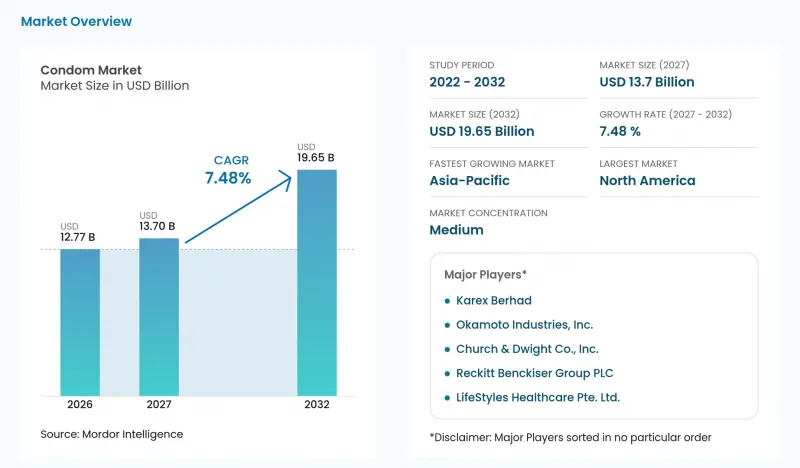
This report is segmented by Material Type (Latex and Non-latex), End User (Men and Women), Distribution Channel (Pharmacies and Drug Stores, Hypermarkets/Supermarkets, and more), and Geography (North America, Asia-Pacific, and more). The market forecasts are provided in terms of value (USD), based on availability.
Global Condom Market Trends and Insights
Growing awareness about sexually transmitted infections (STIs)
Awareness gives suppliers a recognized prevention rationale, while sustained use determines how fully that recognition can become demand. The HSE commissioned Ipsos B&A to survey 1,134 Republic of Ireland residents aged 18 to 30 online in January 2025, with results weighted to 806,000 adults in that age group. When prompted with multiple possible prevention methods, 89% selected condoms as effective against STI transmission, excluding HIV. Separately, 79% reported having had intercourse without a condom at some point in their lives. For suppliers serving Irish young adults, awareness can support additional unit demand when that recognized prevention rationale leads to condom use on occasions that would otherwise be unprotected.
Sex education initiatives in schools and communities
Education initiatives can strengthen demand by making prevention knowledge teachable before potential users face a purchasing decision. In March 2026, WHO reported that a small but growing number of countries were improving comprehensive sexuality education content and delivery in and outside schools. In 2025, UNESCO's O3 Programme supported training for 305 teachers in 23 primary and 13 secondary schools in South Sudan, including hard-to-reach and vulnerable communities. Preparing teachers gives education providers a way to embed prevention knowledge in repeated instruction across participating schools. The opportunity for suppliers is a broader base of informed potential users, with its reach constrained by the uneven educational access identified by WHO.
Cultural and religious stigma
Stigma can constrain access through the social exposure attached to both buying condoms and requesting them at a service point. A 2025 qualitative study of young cisgender adults in Poblacion District 4, Burauen, Leyte, Philippines, found that social judgment and gender expectations made women feel ashamed when purchasing condoms. One participant also described embarrassment about asking for condoms at a barangay office because people might talk about them. Moving distribution from a shop to a local office could therefore leave the barrier intact if obtaining supplies still requires a visible request. For services addressing these needs, the remaining constraint is the perceived social cost of being seen seeking protection.
Other drivers and restraints analyzed in the detailed report include:
- Rise in government and public health campaigns
- Innovation in latex-free condoms
- Misconceptions about condom efficacy
For complete list of drivers and restraints, kindly check the Table Of Contents.
Segment Analysis
Latex accounted for a 79.57% share of the condom market size in 2026, making it the largest segment. Tianjin Human-Care Latex Co., Ltd., a wholly owned subsidiary of Lifestyles Health Industry Co., Ltd., operates 5 natural-latex condom production lines in Tianjin, China. Cupid Limited reported for FY2025-26 that its natural-rubber-latex female condom held WHO/UNFPA prequalification and was supplied to more than 50 countries. For suppliers, specialized production infrastructure and qualified products with international reach give latex a commercial foundation across different condom formats and routes to buyers.
Non-latex is forecast to be the fastest-growing segment, at a CAGR of 10.14% from 2027 to 2032. Reckitt reported that its nitrile male condom Durex Intensity became one of its best-selling portfolio products after launching in Europe in early 2025. The company linked nitrile to body-heat transfer and enhanced sensation without compromising protection. That product result connects a material choice with the experience offered to buyers, giving suppliers a specific basis for differentiation.
Complete Report Scope:
- By Material Type
- Latex
- Non-latex
- By End User
- Men
- Women
- By Distribution Channel
- Hypermarkets/Supermarkets
- Convenience Stores
- Pharmacies and Drug Stores
- Online Retail Stores
- Other Distribution Channels
- By Geography
- North America
- United States
- Canada
- Mexico
- Rest of North America
- Europe
- Spain
- United Kingdom
- Germany
- Russia
- France
- Italy
- Rest of Europe
- Asia-Pacific
- China
- Japan
- India
- Australia
- Rest of Asia-Pacific
- South America
- Brazil
- Argentina
- Rest of South America
- Middle East and Africa
- South Africa
- Saudi Arabia
- Rest of Middle East and Africa
- North America
Geography Analysis
North America held a 34.85% condom market share in 2026, making it the largest regional market. On February 3, 2026, New York City's Department of Citywide Administrative Services awarded Global Protection Corp. a 5-year requirements contract valued at USD 6.11 million for condoms and lubricant packets for the city's Condom Availability Program. An April 2026 NYC Health announcement confirmed the renewed 5-year partnership with ONE Condoms, the brand owned by Global Protection Corp., with supply through January 2031. By packaging condoms with lubricant, the procurement creates a supplier opportunity around a complete prevention offer, making the ability to serve the combined requirement part of the commercial case.
Asia-Pacific is forecast to be the fastest-growing region, at a CAGR of 10.42% from 2027 to 2032. Thailand's Thai Nippon Rubber Industry Public Company Limited implemented one concentrated-natural-latex condom production machine in the second quarter of 2026. Its project plan aimed to improve revenue-generating capability and gross profit margin through advanced production technology. For Thai Nippon, the commercial test is whether the implemented natural-latex technology supports both revenue generation and gross margin, rather than equipment installation alone.
In Europe, England's provisional 2025 official statistics in development showed reported condom use at last sex with a partner of another sex in 19.8% of women's and 16.4% of men's face-to-face sexual-health-service attendances. This English country case concerns use within a clinical service setting, where product provision can be paired with prevention communication. Brazil's Unified Health System offers a South American example, providing external and internal condoms, including textured and sensitive varieties, through primary care and specialized STI services on individual demand without registration or quantity limits. South Africa's national example within Middle East and Africa is a state contract covering male and female condoms and lubricant. For suppliers, these examples suggest service-linked communication in England, public-health distribution in Brazil and combined condom-and-lubricant offers for South Africa's state buyer.
- Reckitt Benckiser Group PLC
- LifeStyles Healthcare Pte. Ltd.
- Church & Dwight Co., Inc.
- Karex Berhad
- Fuji Latex Co., Ltd.
- Cupid Limited
- Okamoto Industries, Inc.
- Veru Inc.
- Mankind Pharma Limited
- Mayer Laboratories, Inc.
- Ansell Limited
- Thai Nippon Rubber Industry Public Company Limited
- HLL Lifecare Limited
- Global Protection Corp.
- Australian Therapeutic Supplies PTY Ltd.
- Richter Rubber Technology Sdn. Bhd.
- Ritex GmbH
- RFSU AB
- Unique Condom Corp.
- Caution Wear Corp.
Additional Benefits:
- The market estimate (ME) sheet in Excel format
- 3 months of analyst support
TABLE OF CONTENTS
1 INTRODUCTION
- 1.1 Study Assumptions and Market Definition
- 1.2 Scope of the Study
2 RESEARCH METHODOLOGY
3 EXECUTIVE SUMMARY
4 MARKET LANDSCAPE
- 4.1 Market Overview
- 4.2 Market Drivers
- 4.2.1 Growing awareness about sexually transmitted infections (STIs)
- 4.2.2 Sex education initiatives in schools and communities
- 4.2.3 Rise in government and public health campaigns
- 4.2.4 Innovation in latex-free condoms
- 4.2.5 Growing adoption of female condoms
- 4.2.6 Rising acceptance of casual relationships and dating apps
- 4.3 Market Restraints
- 4.3.1 Cultural and religious stigma
- 4.3.2 Misconceptions about condom efficacy
- 4.3.3 Accessibility issues in rural and remote areas
- 4.3.4 Competition from alternative contraception
- 4.4 Industry Value Chain Analysis
- 4.5 Regulatory Landscape
- 4.6 Technological Outlook
- 4.7 Porter's Five Forces Analysis
- 4.7.1 Threat of New Entrants
- 4.7.2 Bargaining Power of Suppliers
- 4.7.3 Bargaining Power of Buyers
- 4.7.4 Threat of Substitutes
- 4.7.5 Competitive Rivalry
- 4.8 Consumer Behavior Analysis
5 MARKET SIZE AND GROWTH FORECASTS (VALUE)
- 5.1 By Material Type
- 5.1.1 Latex
- 5.1.2 Non-latex
- 5.2 By End User
- 5.2.1 Men
- 5.2.2 Women
- 5.3 By Distribution Channel
- 5.3.1 Hypermarkets/Supermarkets
- 5.3.2 Convenience Stores
- 5.3.3 Pharmacies and Drug Stores
- 5.3.4 Online Retail Stores
- 5.3.5 Other Distribution Channels
- 5.4 By Geography
- 5.4.1 North America
- 5.4.1.1 United States
- 5.4.1.2 Canada
- 5.4.1.3 Mexico
- 5.4.1.4 Rest of North America
- 5.4.2 Europe
- 5.4.2.1 Spain
- 5.4.2.2 United Kingdom
- 5.4.2.3 Germany
- 5.4.2.4 Russia
- 5.4.2.5 France
- 5.4.2.6 Italy
- 5.4.2.7 Rest of Europe
- 5.4.3 Asia-Pacific
- 5.4.3.1 China
- 5.4.3.2 Japan
- 5.4.3.3 India
- 5.4.3.4 Australia
- 5.4.3.5 Rest of Asia-Pacific
- 5.4.4 South America
- 5.4.4.1 Brazil
- 5.4.4.2 Argentina
- 5.4.4.3 Rest of South America
- 5.4.5 Middle East and Africa
- 5.4.5.1 South Africa
- 5.4.5.2 Saudi Arabia
- 5.4.5.3 Rest of Middle East and Africa
- 5.4.1 North America
6 COMPETITIVE LANDSCAPE
- 6.1 Market Concentration
- 6.2 Strategic Moves
- 6.3 Market Share Analysis
- 6.4 Company Profiles (includes Global level Overview, Market level overview, Core Segments, Financials as available, Strategic Information, Market Rank/Share for key companies, Products and Services, and Recent Developments)
- 6.4.1 Reckitt Benckiser Group PLC
- 6.4.2 LifeStyles Healthcare Pte. Ltd.
- 6.4.3 Church & Dwight Co., Inc.
- 6.4.4 Karex Berhad
- 6.4.5 Fuji Latex Co., Ltd.
- 6.4.6 Cupid Limited
- 6.4.7 Okamoto Industries, Inc.
- 6.4.8 Veru Inc.
- 6.4.9 Mankind Pharma Limited
- 6.4.10 Mayer Laboratories, Inc.
- 6.4.11 Ansell Limited
- 6.4.12 Thai Nippon Rubber Industry Public Company Limited
- 6.4.13 HLL Lifecare Limited
- 6.4.14 Global Protection Corp.
- 6.4.15 Australian Therapeutic Supplies PTY Ltd.
- 6.4.16 Richter Rubber Technology Sdn. Bhd.
- 6.4.17 Ritex GmbH
- 6.4.18 RFSU AB
- 6.4.19 Unique Condom Corp.
- 6.4.20 Caution Wear Corp.
7 MARKET OPPORTUNITIES AND FUTURE OUTLOOK
- 7.1 White-Space and Unmet-Need Assessment

