PUBLISHER: Mordor Intelligence | PRODUCT CODE: 2187299

PUBLISHER: Mordor Intelligence | PRODUCT CODE: 2187299
E-book - Market Share Analysis, Industry Trends & Statistics, Growth Forecasts (2027 - 2032)
According to Mordor Intelligence, the e-book market size is estimated at USD 18.85 billion in 2026 and is projected to be USD 19.72 billion in 2027, reaching USD 24.34 billion by 2032, growing at a CAGR of 4.3% from 2027 to 2032.
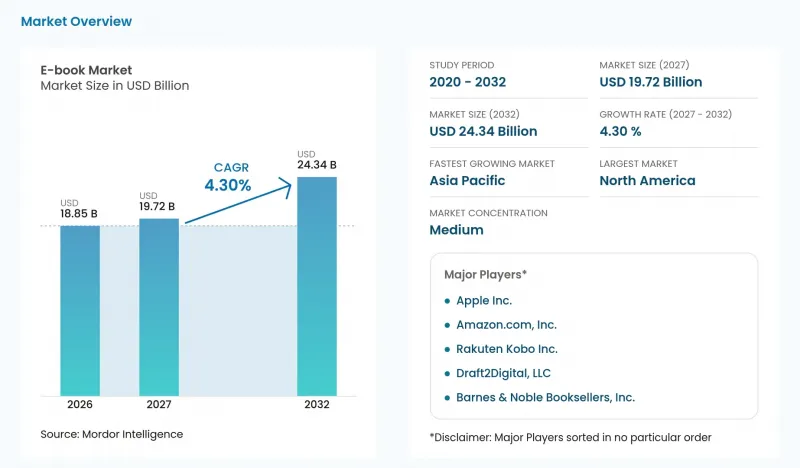
This report is segmented by Revenue Model (Subscription, Pay-per-download, and more), Genre (Fiction, Non-fiction, and more), End-user (Individual Consumers and Institutional), and Geography (North America, Europe, and more). The market forecasts are provided in terms of value (USD), based on availability.
Global E-book Market Trends and Insights
Increasing penetration of mobile devices
Mobile access expands the potential readership for digital books without making a dedicated reading device the starting requirement. By the end of 2025, around 4.8 billion people used mobile internet on their own device worldwide. That installed base gives publishers a route to readers who can consider digital titles through equipment they already use. Mobile internet adoption added around 160 million users in 2025, compared with around 190 million in 2024. Continued expansion supports a wider addressable audience. Slower mobile internet additions strengthen the case for converting existing connected users into paying readers alongside reaching newcomers.
Expanding global internet connectivity
Connectivity expands digital distribution reach while improving affordability can ease the cost of maintaining access. ITU estimated that 6 billion people, or 74% of the world's population, used the internet in 2025, up from 5.8 billion people, or 71%, in 2024. The global median data-only mobile broadband basket price fell from 1.5% of gross national income per capita in 2024 to 1.4% in 2025. For publishers, the combination strengthens the potential audience for delivering books beyond a physical retail footprint. The enlarged connected audience makes paid-content affordability a separate question from technical reach. Even after the improvement in broadband affordability, readers face connectivity costs alongside book prices, so content pricing competes within the same total outlay.
Privacy and copyright issues among e-sellers and authors
Copyright-related permissions can limit both an author's digital sales channels and a library's lending service. Amazon requires voluntarily enrolled KDP Select e-books to be distributed only through KDP or public libraries during each 90-day term, while permitting other formats elsewhere. Enrollment automatically renews unless the author opts out, making the restriction a continuing channel decision for participating authors. Rightsholders' licensing provisions and technical protection measures restricted some European libraries' freedom to lend e-books. In a European library e-lending study, respondents indicated that titles might be withdrawn from packages and offered again on different terms. These limits can leave enrolled authors with fewer digital outlets and affected libraries with extra acquisition work before readers can access a collection.
Other drivers and restraints analyzed in the detailed report include:
- Growth of digital education and e-learning
- Rising adoption of subscription-based reading platforms
- Persistent preference for print books in emerging markets
For complete list of drivers and restraints, kindly check the Table Of Contents.
Segment Analysis
Subscription (all-you-can-read) accounted for a 55.91% share of the e-book market size in 2026. Amazon reported USD 69.3 million in total KDP Select author earnings for September 2026. Books enrolled in KDP Select are automatically included in Kindle Unlimited, which allows subscribers to read as many books as they want. Subscribers can move between enrolled titles without making a new purchase for each book, giving frequent readers a reason to value a broad subscription catalog. For an enrolled title, earning from the KDP Select Global Fund requires Kindle Unlimited reading, making readership valuable beyond catalog inclusion.
Institutional licensing is the fastest-growing segment, with a projected CAGR of 4.85% from 2027 to 2032. Libraries and schools in OverDrive's global network recorded 379.4 million e-book checkouts in 2025, up 3% from 2024. That activity gives institutional suppliers an observable use case for expanding the reading access that library and school collections provide. A licensing proposal can therefore be judged against the reading service it enables, alongside the content being offered. Because libraries license titles to be borrowed, circulation rather than title count is the measure an institutional supplier is likely to answer to.
Complete Report Scope:
- By Revenue Model
- Subscription (all-you-can-read)
- Pay-per-download
- Freemium / Ad-supported
- Institutional licensing
- By Genre
- Fiction
- Non-fiction
- Education and Academic
- Comics and Graphic Novels
- Professional and Technical
- By End-user
- Individual Consumers
- Adults
- Children and Young Adults
- Institutional
- K-12 Schools
- Higher Education
- Corporate / Professional Training
- Public Libraries
- Individual Consumers
- By Geography
- North America
- United States
- Canada
- South America
- Brazil
- Argentina
- Chile
- Rest of South America
- Europe
- United Kingdom
- Germany
- France
- Spain
- Italy
- Russia
- Rest of Europe
- Asia Pacific
- China
- Japan
- India
- South Korea
- Indonesia
- Rest of Asia Pacific
- Middle East and Africa
- Middle East
- Saudi Arabia
- United Arab Emirates
- Turkey
- Rest of Middle East
- Africa
- South Africa
- Nigeria
- Egypt
- Rest of Africa
- Middle East
- North America
Geography Analysis
North America held a 39.5% share of the e-book market size in 2026. In the United States, publisher-reported e-book revenue reached USD 2.2 billion in 2025, up 3.2% from 2024. Canadian publisher University of Toronto Press (UTP) and Paradigm Publishing Services announced a dual-platform access collaboration for libraries subscribing to UTP e-book collections in September 2026. Paradigm is a division of De Gruyter Brill, and the proposed arrangement would give access to licensed UTP collections through UTP Publishing and De Gruyter Brill. Such an arrangement would make platform choice part of the licensing terms, giving content owners a service distinction beyond the titles included.
Asia Pacific is the fastest-growing geography, with a projected CAGR of 4.55% from 2027 to 2032. China's online-literature user base reached 646 million in 2025, up 1.2% year over year, with the measure based on 31 major companies and about 30,000 surveyed users. Southeast Asia tied with North America as the leading destination for Chinese online-literature exports in 2025, covering text, audio, and adaptation formats. Indonesia's Perpusnas digital-library service iPusnas recorded 770,106 new users in 2025, illustrating how institutional access can expand the audience for publishers' reading collections alongside commercial online literature.
In South America, Brazilian publishers' e-book subscription revenue grew 63% in 2025 compared with 2024, showing a commercial role for recurring access. Colombia's technical-scientific and education digital books predominantly use PDF or EPUB e-books and multiuser licenses, giving institutional access a distinct local role. In Europe, digital sales accounted for a lower proportion of French publishers' literature sales in 2025 than in 2024. In the Netherlands, Bol.com Kobo Plus and Kobo Books were the most-used e-book platforms in 2026, making their readership relevant to publishers' distribution choices. For the Middle East and Africa, Amazon and the Abu Dhabi Arabic Language Centre launched a globally available storefront with more than 33,000 Arabic Kindle e-books in 2026, offering a language-led route across national boundaries.
- Amazon.com, Inc.
- Rakuten Kobo Inc.
- Apple Inc.
- Barnes & Noble Booksellers, Inc.
- Draft2Digital, LLC
- Blurb, Inc.
- DIY Media Group, Inc.
- Lulu Press, Inc.
- Macmillan Publishers Ltd
- Scribd, Inc.
- Google LLC
- Hachette Livre SA
- HarperCollins Publishers LLC
- Penguin Random House LLC
- OverDrive, Inc.
- Storytel AB
- Wattpad Corp.
- Inkitt GmbH
- John Wiley & Sons, Inc.
- Pearson plc
- Cengage Learning, Inc.
Additional Benefits:
- The market estimate (ME) sheet in Excel format
- 3 months of analyst support
TABLE OF CONTENTS
1 INTRODUCTION
- 1.1 Study Assumptions and Market Definition
- 1.2 Scope of the Study
2 RESEARCH METHODOLOGY
3 EXECUTIVE SUMMARY
4 MARKET LANDSCAPE
- 4.1 Market Overview
- 4.2 Market Drivers
- 4.2.1 Increasing penetration of mobile devices
- 4.2.2 Expanding global internet connectivity
- 4.2.3 Growth of digital education and e-learning
- 4.2.4 Rising adoption of subscription-based reading platforms
- 4.2.5 Blockchain-enabled rights management and micropayments
- 4.2.6 Publisher D2C storefront integration with CRM data
- 4.3 Market Restraints
- 4.3.1 Privacy and copyright issues among e-sellers and authors
- 4.3.2 Persistent preference for print books in emerging markets
- 4.3.3 Interoperability limitations across e-reader ecosystems
- 4.3.4 Digital fatigue driving screen-time reduction initiatives
- 4.4 Industry Value Chain Analysis
- 4.5 Regulatory Landscape
- 4.6 Technological Outlook
- 4.7 Porter's Five Forces Analysis
- 4.7.1 Threat of New Entrants
- 4.7.2 Bargaining Power of Suppliers
- 4.7.3 Bargaining Power of Buyers
- 4.7.4 Threat of Substitutes
- 4.7.5 Competitive Rivalry
5 MARKET SIZE AND GROWTH FORECASTS (VALUE)
- 5.1 By Revenue Model
- 5.1.1 Subscription (all-you-can-read)
- 5.1.2 Pay-per-download
- 5.1.3 Freemium / Ad-supported
- 5.1.4 Institutional licensing
- 5.2 By Genre
- 5.2.1 Fiction
- 5.2.2 Non-fiction
- 5.2.3 Education and Academic
- 5.2.4 Comics and Graphic Novels
- 5.2.5 Professional and Technical
- 5.3 By End-user
- 5.3.1 Individual Consumers
- 5.3.1.1 Adults
- 5.3.1.2 Children and Young Adults
- 5.3.2 Institutional
- 5.3.2.1 K-12 Schools
- 5.3.2.2 Higher Education
- 5.3.2.3 Corporate / Professional Training
- 5.3.2.4 Public Libraries
- 5.3.1 Individual Consumers
- 5.4 By Geography
- 5.4.1 North America
- 5.4.1.1 United States
- 5.4.1.2 Canada
- 5.4.2 South America
- 5.4.2.1 Brazil
- 5.4.2.2 Argentina
- 5.4.2.3 Chile
- 5.4.2.4 Rest of South America
- 5.4.3 Europe
- 5.4.3.1 United Kingdom
- 5.4.3.2 Germany
- 5.4.3.3 France
- 5.4.3.4 Spain
- 5.4.3.5 Italy
- 5.4.3.6 Russia
- 5.4.3.7 Rest of Europe
- 5.4.4 Asia Pacific
- 5.4.4.1 China
- 5.4.4.2 Japan
- 5.4.4.3 India
- 5.4.4.4 South Korea
- 5.4.4.5 Indonesia
- 5.4.4.6 Rest of Asia Pacific
- 5.4.5 Middle East and Africa
- 5.4.5.1 Middle East
- 5.4.5.1.1 Saudi Arabia
- 5.4.5.1.2 United Arab Emirates
- 5.4.5.1.3 Turkey
- 5.4.5.1.4 Rest of Middle East
- 5.4.5.2 Africa
- 5.4.5.2.1 South Africa
- 5.4.5.2.2 Nigeria
- 5.4.5.2.3 Egypt
- 5.4.5.2.4 Rest of Africa
- 5.4.5.1 Middle East
- 5.4.1 North America
6 COMPETITIVE LANDSCAPE
- 6.1 Market Concentration
- 6.2 Strategic Moves
- 6.3 Market Share Analysis
- 6.4 Company Profiles (includes Global level Overview, Market level overview, Core Segments, Financials as available, Strategic Information, Market Rank/Share for key companies, Products and Services, and Recent Developments)
- 6.4.1 Amazon.com, Inc.
- 6.4.2 Rakuten Kobo Inc.
- 6.4.3 Apple Inc.
- 6.4.4 Barnes & Noble Booksellers, Inc.
- 6.4.5 Draft2Digital, LLC
- 6.4.6 Blurb, Inc.
- 6.4.7 DIY Media Group, Inc.
- 6.4.8 Lulu Press, Inc.
- 6.4.9 Macmillan Publishers Ltd
- 6.4.10 Scribd, Inc.
- 6.4.11 Google LLC
- 6.4.12 Hachette Livre SA
- 6.4.13 HarperCollins Publishers LLC
- 6.4.14 Penguin Random House LLC
- 6.4.15 OverDrive, Inc.
- 6.4.16 Storytel AB
- 6.4.17 Wattpad Corp.
- 6.4.18 Inkitt GmbH
- 6.4.19 John Wiley & Sons, Inc.
- 6.4.20 Pearson plc
- 6.4.21 Cengage Learning, Inc.
7 MARKET OPPORTUNITIES AND FUTURE OUTLOOK
- 7.1 White-Space and Unmet-Need Assessment

