PUBLISHER: Mordor Intelligence | PRODUCT CODE: 2187301

PUBLISHER: Mordor Intelligence | PRODUCT CODE: 2187301
Bicycle - Market Share Analysis, Industry Trends & Statistics, Growth Forecasts (2027 - 2032)
According to Mordor Intelligence, the bicycle market size is expected to grow from USD 92.14 billion in 2026 to USD 101.7 billion in 2027 and is forecast to reach USD 162.1 billion by 2032 at 9.78% CAGR over 2027-2032.
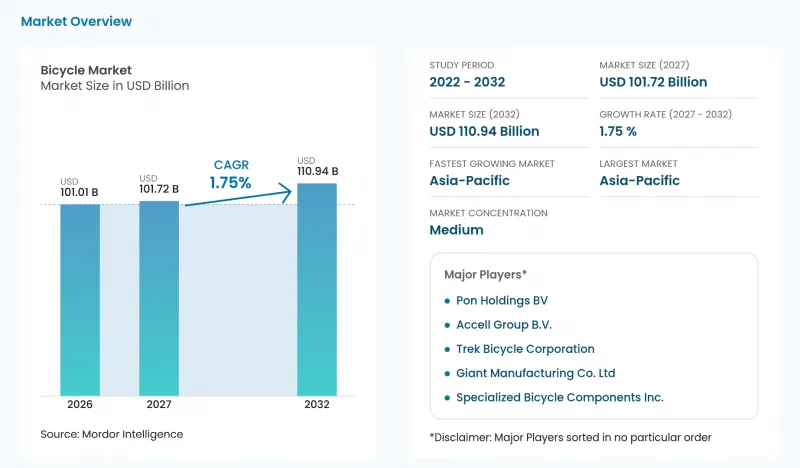
This report is segmented by Bicycle Type (E-Bikes and more), Design (Regular and more), Activity (Road/ City and more), Price Range (Mass/Budget and more), End User (Adults and more), Distribution Channel (Offline Channels and more), and Geography (Asia-Pacific and more). The market forecasts are provided in terms of value (USD), based on availability.
Global Bicycle Market Trends and Insights
Urban congestion boosts bicycle usage for daily commute
Congested commutes create a demand case for bicycles that can serve a useful part of a daily journey. TomTom measured 79 hours of annual rush-hour traffic delay in Chicago in 2025, up 5 hours 6 minutes from 2024. Its coverage included metropolitan and central-city roads, including fast roads and highways. Toronto's 1,660-response cycling survey, conducted from November 5, 2025, through January 9, 2026, found that 5% of respondents used bikes or e-bikes as their primary commuting mode. Another 39.6% said they combined cycling with public transit at least sometimes. Mixed bicycle-transit journeys give commuter-bike suppliers a route to relevance without requiring the bicycle to replace the entire commute.
Fitness trends increase popularity of cycling activities
Fitness-related demand creates a clearer selling opportunity when a riding motivation connects with a specific intended bicycle purchase. In Germany's 2025 Cycling Monitor, 62% of respondents who cycled more often than in childhood or youth cited health motives for the increase. Most respondents, however, reported cycling less often than in their younger years. Separately, 14% of 598 purchase or lease planners named a sports bike among the types they expected to acquire in the following 12 months. The survey covered German residents aged 14 to 69, and the purchase question allowed multiple bicycle types. Sports-bike purchase plans therefore provide a more concrete commercial target than treating every health-motivated rider as a prospective purchaser.
Availability of substitute like bikes, and other faster transport modes discourages the use of bicycle
Access to an established commuting alternative can weaken the case for acquiring a bicycle specifically for the journey to work or study. A study published in 2025 of students at 17 institutions in Lyon, France, found that public-transport season-ticket possession reduced the modeled likelihood of bicycle commuting. The substitution effect was stronger for shared bicycles than for privately owned bicycles. The model also identified residential location, shared-bike accessibility and home-campus distance as strong influences on active travel choice. Private-bicycle sellers serving those Lyon students therefore face an alternative commuting option that can weaken the use case for ownership, even though substitution was stronger for shared bicycles.
Other drivers and restraints analyzed in the detailed report include:
- Government support encourages eco-friendly transportation methods
- Environmental awareness and sustainability drives bicycle usage among consumers
- Presence of counterfeit bicycles hinders market growth
For complete list of drivers and restraints, kindly check the Table Of Contents.
Segment Analysis
E-bikes accounted for a 51.79% share of the bicycle market size in 2026 and are forecast to grow at a 12.05% CAGR over 2027-2032, making them the largest segment and fastest-growing segment by bicycle type. Around 2 million e-bikes were sold in Germany in 2025. That annual volume supports treating electric bicycles as a core offering, with an established sales base around which producers and retailers can organize their businesses. For suppliers, the opportunity combines serving that operating scale with deciding which electric model range can justify the next purchase.
German e-bike sales also rose around 2% in the first half of 2026 compared with the first half of 2025. Conventional bicycles had a distinct purchase audience in Germany's 2025 Cycling Monitor, with 26% of potential buyers selecting them for a planned purchase or lease in the following 12 months. That stated preference gives a conventional offer a separate commercial purpose alongside electric growth. Retailers can address the choice through distinct electric and conventional model ranges, allowing each type to compete on the riding purpose the prospective buyer intends it to serve.
Regular bicycles were the largest design segment, accounting for 84.99% of revenue in 2026. For a commuter who can store a full-size bicycle at home and work, the buying decision can center on riding position and carrying needs. A recreational rider may prioritize handling on the intended route while using the same broad frame format. Regular design can therefore span distinct buyer requirements, allowing suppliers to specialize their offers by riding task within the largest design segment.
Foldable bicycles are forecast to be the fastest-growing segment at a 10.72% CAGR over 2027-2032. Brompton Bicycle Ltd sold 6,707 G Line folding gravel bikes in the year ended March 31, 2025, representing 9% of its bicycle sales by volume. Its gravel orientation supplies a distinct recreational application within a foldable product. Folding can address handling of the bicycle between rides, while the riding category gives it a defined activity. The model launched in autumn 2024 in the United Kingdom and Europe, so its contribution by March 2025 shows that recreational specialization can establish a sales base within a folding range.
Complete Report Scope:
- By Bicycle Type
- E-Bikes
- Conventional/Traditional Bicycles
- By Design
- Regular
- Foldable
- By Activity
- Road/ City
- Mountain Terrain (MTB)
- Hybrid
- Others
- By Price Range
- Mass/Budget
- Premium/Luxury
- By End User
- Adults
- Kids
- By Distribution Channel
- Online Channels
- Offline Channels
- By Geography
- North America
- United States
- Canada
- Mexico
- Rest of North America
- Europe
- Germany
- United Kingdom
- Italy
- France
- Spain
- Netherlands
- Poland
- Belgium
- Sweden
- Rest of Europe
- Asia-Pacific
- China
- India
- Japan
- Australia
- Indonesia
- South Korea
- Thailand
- Singapore
- Rest of Asia-Pacific
- South America
- Brazil
- Argentina
- Colombia
- Chile
- Peru
- Rest of South America
- Middle East and Africa
- South Africa
- Saudi Arabia
- United Arab Emirates
- Nigeria
- Egypt
- Morocco
- Turkey
- Rest of Middle East and Africa
- North America
Geography Analysis
Asia-Pacific held a 48.82% bicycle market share in 2026 and is forecast to be the fastest-growing region at a 12.4% CAGR over 2027-2032. China's bicycle sector produced 110.8 million bicycles in 2025, up 11.3% from 2024, and exported nearly 48.94 million bicycles, up 2.4% over the same period. More than 12.5 million electric bicycles were sold through China's trade-in policy in 2025. The policy channel provides a defined replacement occasion for complete electric bicycles. China's production base can serve both international distribution and domestic replacement, so the commercial opportunity depends on the route to the buyer rather than factory output alone.
In Europe, Canyon opened a Munich store in March 2025 that combined its online sales with in-person test rides and direct purchases. In North America, Canyon launched its first US Experience Partner at Pedalers Fork in Calabasas, California, in 2025, providing demonstrations, advice, sizing and service. Canada had a distinct commuting audience, with 244,000 Canadians mainly using a bicycle to reach work in 2025. Canyon's Munich store and Calabasas partner show how a direct brand can add local contact through its own retail outlet or an established local operator.
South America's rail-linked cycling use case included Trensurb's Porto Alegre metropolitan service in Brazil, whose 2025 guide permitted one clean, nonmotorized bicycle per rider. Its specified off-peak weekday windows and 5:00 a.m. to 11:00 p.m. weekend and holiday hours made boarding time a condition of that combined journey. The Middle East and Africa region has an education-access application in Ghana, where Ghana TVET Service, Trans-Saharan Industries and the Ministry of Education launched a bicycle program on May 6, 2026. The program aimed to improve learners' access to technical and vocational institutions in underserved areas of Ghana. The program launched with 100 locally assembled bicycles donated by Trans-Saharan Industries to learners in 10 schools in northern Ghana, so its bicycle supply came through an industry donor rather than retail purchase.
- Accell Group B.V.
- Trek Bicycle Corporation
- Pon Holdings BV
- Giant Manufacturing Co. Ltd
- Specialized Bicycle Components Inc.
- Shimano Inc.
- Scott Sports SA
- Merida Industry Co. Ltd
- Stryder Cycle Private Limited
- Cycles Devinci inc.
- Pending System GmbH & Co. KG
- Brompton Bicycle Ltd
- Decathlon SE
- Rad Life Mobility Inc.
- Riese & Muller GmbH
- ZEG Zweirad-Einkaufs-Genossenschaft eG
- Yadea Group Holdings Ltd
- Canyon Bicycles GmbH
- Hero Cycles Limited
- Ribble Cycles
Additional Benefits:
- The market estimate (ME) sheet in Excel format
- 3 months of analyst support
TABLE OF CONTENTS
1 INTRODUCTION
- 1.1 Study Assumptions and Market Definition
- 1.2 Scope of the Study
2 RESEARCH METHODOLOGY
3 EXECUTIVE SUMMARY
4 MARKET LANDSCAPE
- 4.1 Market Overview
- 4.2 Market Drivers
- 4.2.1 Urban congestion boosts bicycle usage for daily commute
- 4.2.2 Fitness trends increase popularity of cycling activities
- 4.2.3 Government support encourages eco-friendly transportation methods
- 4.2.4 Environmental awareness and sustainability drives bicycle usage among consumers
- 4.2.5 Workplace wellness programs encourage employee bicycle usage
- 4.2.6 Rising fuel prices make bicycles cost-effective alternatives
- 4.3 Market Restraints
- 4.3.1 Availability of substitute like bikes, and other faster transport modes discourages the use of bicycle
- 4.3.2 Presence of counterfeit bicycles hinders market growth
- 4.3.3 High e-bike cost restricts wider adoption globally
- 4.3.4 Poor road conditions in rural areas hinder smooth bicycle experience
- 4.4 Industry Value Chain Analysis
- 4.5 Regulatory Landscape
- 4.6 Technological Outlook
- 4.7 Porter's Five Forces Analysis
- 4.7.1 Threat of New Entrants
- 4.7.2 Bargaining Power of Suppliers
- 4.7.3 Bargaining Power of Buyers
- 4.7.4 Threat of Substitutes
- 4.7.5 Competitive Rivalry
- 4.8 Consumer Behavior Analysis
5 MARKET SIZE AND GROWTH FORECASTS (VALUE)
- 5.1 By Bicycle Type
- 5.1.1 E-Bikes
- 5.1.2 Conventional/Traditional Bicycles
- 5.2 By Design
- 5.2.1 Regular
- 5.2.2 Foldable
- 5.3 By Activity
- 5.3.1 Road/ City
- 5.3.2 Mountain Terrain (MTB)
- 5.3.3 Hybrid
- 5.3.4 Others
- 5.4 By Price Range
- 5.4.1 Mass/Budget
- 5.4.2 Premium/Luxury
- 5.5 By End User
- 5.5.1 Adults
- 5.5.2 Kids
- 5.6 By Distribution Channel
- 5.6.1 Online Channels
- 5.6.2 Offline Channels
- 5.7 By Geography
- 5.7.1 North America
- 5.7.1.1 United States
- 5.7.1.2 Canada
- 5.7.1.3 Mexico
- 5.7.1.4 Rest of North America
- 5.7.2 Europe
- 5.7.2.1 Germany
- 5.7.2.2 United Kingdom
- 5.7.2.3 Italy
- 5.7.2.4 France
- 5.7.2.5 Spain
- 5.7.2.6 Netherlands
- 5.7.2.7 Poland
- 5.7.2.8 Belgium
- 5.7.2.9 Sweden
- 5.7.2.10 Rest of Europe
- 5.7.3 Asia-Pacific
- 5.7.3.1 China
- 5.7.3.2 India
- 5.7.3.3 Japan
- 5.7.3.4 Australia
- 5.7.3.5 Indonesia
- 5.7.3.6 South Korea
- 5.7.3.7 Thailand
- 5.7.3.8 Singapore
- 5.7.3.9 Rest of Asia-Pacific
- 5.7.4 South America
- 5.7.4.1 Brazil
- 5.7.4.2 Argentina
- 5.7.4.3 Colombia
- 5.7.4.4 Chile
- 5.7.4.5 Peru
- 5.7.4.6 Rest of South America
- 5.7.5 Middle East and Africa
- 5.7.5.1 South Africa
- 5.7.5.2 Saudi Arabia
- 5.7.5.3 United Arab Emirates
- 5.7.5.4 Nigeria
- 5.7.5.5 Egypt
- 5.7.5.6 Morocco
- 5.7.5.7 Turkey
- 5.7.5.8 Rest of Middle East and Africa
- 5.7.1 North America
6 COMPETITIVE LANDSCAPE
- 6.1 Market Concentration
- 6.2 Strategic Moves
- 6.3 Market Share Analysis
- 6.4 Company Profiles (includes Global level Overview, Market level overview, Core Segments, Financials as available, Strategic Information, Market Rank/Share for key companies, Products and Services, and Recent Developments)
- 6.4.1 Accell Group B.V.
- 6.4.2 Trek Bicycle Corporation
- 6.4.3 Pon Holdings BV
- 6.4.4 Giant Manufacturing Co. Ltd
- 6.4.5 Specialized Bicycle Components Inc.
- 6.4.6 Shimano Inc.
- 6.4.7 Scott Sports SA
- 6.4.8 Merida Industry Co. Ltd
- 6.4.9 Stryder Cycle Private Limited
- 6.4.10 Cycles Devinci inc.
- 6.4.11 Pending System GmbH & Co. KG
- 6.4.12 Brompton Bicycle Ltd
- 6.4.13 Decathlon SE
- 6.4.14 Rad Life Mobility Inc.
- 6.4.15 Riese & Muller GmbH
- 6.4.16 ZEG Zweirad-Einkaufs-Genossenschaft eG
- 6.4.17 Yadea Group Holdings Ltd
- 6.4.18 Canyon Bicycles GmbH
- 6.4.19 Hero Cycles Limited
- 6.4.20 Ribble Cycles
7 MARKET OPPORTUNITIES AND FUTURE OUTLOOK
- 7.1 White-Space and Unmet-Need Assessment

