PUBLISHER: Mordor Intelligence | PRODUCT CODE: 2187303

PUBLISHER: Mordor Intelligence | PRODUCT CODE: 2187303
Laundry Detergents - Market Share Analysis, Industry Trends & Statistics, Growth Forecasts (2027 - 2032)
According to Mordor Intelligence, the laundry detergents market size is expected to increase from USD 107.5 million in 2026 to USD 112.4 million in 2027 and reach USD 138.9 million by 2032, growing at a CAGR of 4.32% over 2027-2032.
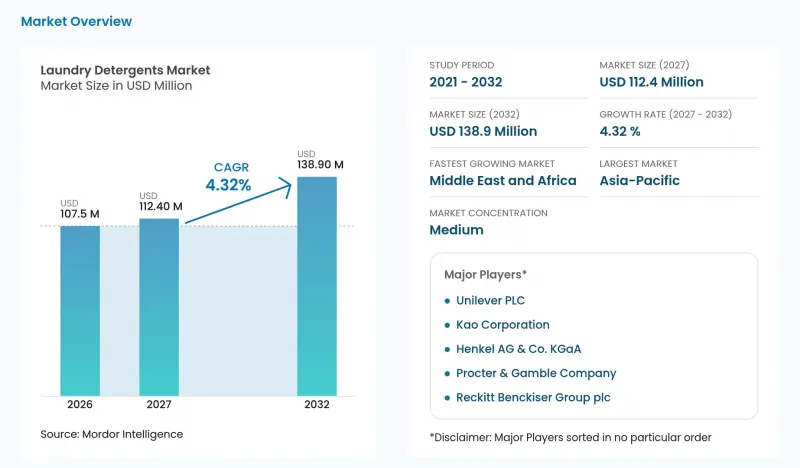
This report is segmented by Product Type (Laundry Liquid and more), Packaging (Sachets/Pouches and more), Category (Conventional/Synthetic and more), Distribution Channel (Supermarkets/Hypermarkets and more), and Geography (Asia-Pacific and more). The market forecasts are provided in terms of value (USD), based on availability.
Global Laundry Detergents Market Trends and Insights
Surge in cold-water washing formulations
For households choosing cold cycles, detergent makers can compete on cleaning at the selected temperature. Tide launched Tide evo, a concentrated waterless laundry detergent tile, nationally in the United States in February 2026 and said it was available at major retailers nationwide. Tide described the tile as activating instantly in cold water, linking the format to the low-temperature use case. This gives the manufacturer a way to combine a distinct physical format with a cycle-specific performance promise, rather than relying on a packaging change alone. A tile that activates in cold water lets households keep their chosen wash setting and change only the detergent format.
Growth of e-commerce refill subscription models
Regularly scheduled deliveries give detergent sellers a way to sustain demand between individual shopping decisions. By March 2026, Sheets Laundry Club had acquired over 60,000 Amazon Subscribe & Save subscribers across its program in approximately 4 years. The company also offers laundry detergent sheets through a home-delivery subscription program. Sheets Laundry Club's Amazon Subscribe & Save subscribers received discounted pricing and coupons for signing up for regularly scheduled deliveries. Subscribe & Save also gave the company predictable recurring revenue. A discount tied to a standing delivery schedule can turn separate shopping decisions into repeat orders, supporting continuing demand for the seller's laundry products.
Volatile linear alkylbenzene (LAB) feedstock prices
The US-Iran escalation that began on February 28, 2026, disrupted shipping through the Strait of Hormuz and intensified input-cost pressure in Asian LAB supply. Thai Oil reported higher LAB prices in Q2 2026 and tighter Asian supply, particularly in India, which relies heavily on imports from Middle Eastern producers. Indian detergent makers importing LAB from Middle Eastern suppliers must weigh thinner margins against higher shelf prices, with less scope to fund demand expansion or preserve buyer affordability.
Other drivers and restraints analyzed in the detailed report include:
- Rising penetration of washing machines in emerging Asia
- Bio-based surfactant progress toward cost parity
- Counterfeits in informal retail networks
For complete list of drivers and restraints, kindly check the Table Of Contents.
Segment Analysis
Laundry liquid accounted for a 43.14% share of the laundry detergents market size in 2026, making it the largest segment. For the 52 weeks ended November 2, 2025, liquid detergent was the largest format in the U.S. laundry aisle, although unit sales fell 1.3%, according to Circana data reported by Happi. The decline puts emphasis on the product proposition within the format, rather than treating format leadership as a guarantee of rising purchases. For liquid brands, keeping households in the format and winning their label choice are separate tasks when unit demand weakens.
Fabric softener is forecast to be the fastest-growing segment, with a CAGR of 6.25% over 2027-2032. In Japan, premium fabric-softener sales value in 2025 reached 115% of the previous year's level, according to INTAGE SRI+ data reported by Lion Corporation. For brands considering a higher-value offer, the premium sales result makes product positioning a distinct decision from simply expanding the number of washing occasions. Premium softener suppliers can target an additional fabric-care purchase alongside detergent instead of depending on households to wash more often.
Sachets and pouches represented a 53.1% laundry detergents market share in 2026, the largest packaging segment. In a Q1 2025 NielsenIQ survey, 67% of the 922 sachet purchasers reported buying detergent powder or liquid in sachets. The overall survey covered 1,034 respondents in Delhi, Mumbai, Kolkata, and Bengaluru, including urban and peripheral zones. Among respondents who bought detergent sachets in these 4 cities, suppliers can compete for an existing pack choice without asking households to adopt another packaging system.
PET bottles are forecast to be the fastest-growing segment, with a CAGR of 4.95% over 2027-2032. Lion Corporation launched renewed NANOX one laundry detergents nationwide in Japan in September 2025, using 100% recycled PET for the main bottle. This links a detergent range to a defined material specification, giving the producer a packaging proposition that can be developed alongside the formula. A bottle supplier seeking that business must be able to meet the recycled-PET specification, so material sourcing becomes part of qualifying for the detergent range.
Complete Report Scope:
- By Product Type
- Detergent Powder
- Laundry Liquid
- Fabric Softener
- Other Product Types
- By Packaging
- PET Bottles
- Sachets/Pouches
- Others
- By Category
- Conventional/Synthetic
- Organic/Natural
- By Distribution Channel
- Supermarkets/Hypermarkets
- Convenience Stores
- Online Retail Stores
- Other Distribution Channels
- By Geography
- North America
- United States
- Canada
- Mexico
- Rest of North America
- Europe
- Germany
- United Kingdom
- France
- Italy
- Spain
- Russia
- Netherlands
- Poland
- Belgium
- Sweden
- Rest of Europe
- Asia-Pacific
- China
- India
- Japan
- South Korea
- Australia
- Indonesia
- Thailand
- Singapore
- Rest of Asia-Pacific
- South America
- Brazil
- Argentina
- Colombia
- Chile
- Peru
- Rest of South America
- Middle East and Africa
- Saudi Arabia
- United Arab Emirates
- Nigeria
- Egypt
- Morocco
- Turkey
- South Africa
- Rest of Middle East and Africa
- North America
Geography Analysis
Asia-Pacific held a 36.53% laundry detergents market share in 2026, making it the largest regional market. Blue Moon reported that its liquid laundry detergent ranked first in overall market share among same-category products in China for 17 consecutive years from 2009 through 2025. The ranking drew on representative large-retailer surveys that excluded Hainan, Tibet, Hong Kong, Macao, and Taiwan, giving the record particular relevance to suppliers competing for organized retail sales. A new formulation entering those surveyed channels meets a supplier that held first place in same-category overall market share for 17 consecutive years through 2025.
Middle East and Africa is forecast to be the fastest-growing regional market, with a CAGR of 5.15% over 2027-2032. The Fassi complex in Pabre, Burkina Faso, makes powdered detergents and liquid and solid soap. At its March 6, 2025, inauguration, the complex was reported to have capacity of 300 metric tons per day. The inauguration established a domestic production base for these cleaning products in Burkina Faso, adding local manufacturing capacity to the regional supply base.
In North America, Guatemala's Unidad Nacional de Atencion al Enfermo Renal Cronico recorded an April 2025 bar laundry-soap purchase order from SERAVANZA, Sociedad Anonima, illustrating an institutional sales channel. Europe's supplier base includes Detergenti SA, which operates Procter & Gamble Company's Ariel detergent-pod factory at Urlati, Romania, providing a local manufacturing counterpart for pod distributors. BASF's 2025 Latin American laundry-habits survey ranked cleaning in cold and quick cycles fifth among Brazil's top 5 preferred laundry claims, drawn from 20 tested. In South America, Ecolimpio offered bulk laundry detergent in Santa Cruz, Bolivia, in June 2025, letting buyers choose quantities and reuse containers. For a bulk retailer such as Ecolimpio, the sale quantity can vary independently of the container, which widens the ways to serve a household without reformulating the detergent.
- Procter & Gamble Company
- Unilever PLC
- Henkel AG & Co. KGaA
- Reckitt Benckiser Group plc
- The Clorox Company
- Church & Dwight Co., Inc.
- S. C. Johnson & Son, Inc.
- Kao Corporation
- LG H&H Co., Ltd.
- Nirma Group
- Colgate-Palmolive Company
- Amway Corporation
- PZ Cussons
- Lion Corporation
- Molly's Suds
- Fena Pvt Ltd
- RSPL Group (Ghadi)
- Guangzhou Liby Enterprise
- Nice Group Co., Ltd
- Godrej Consumer Products
Additional Benefits:
- The market estimate (ME) sheet in Excel format
- 3 months of analyst support
TABLE OF CONTENTS
1 INTRODUCTION
- 1.1 Study Assumptions and Market Definition
- 1.2 Scope of the Study
2 RESEARCH METHODOLOGY
3 EXECUTIVE SUMMARY
4 MARKET LANDSCAPE
- 4.1 Market Overview
- 4.2 Market Drivers
- 4.2.1 Surge in cold-water washing formulations
- 4.2.2 Growth of e-commerce refill subscription models
- 4.2.3 Rising penetration of washing machines in emerging Asia
- 4.2.4 Bio-based surfactant progress toward cost parity
- 4.2.5 Smart-laundry IoT dispensers in commercial laundromats
- 4.2.6 Ban on phosphate-based detergents in additional nations
- 4.3 Market Restraints
- 4.3.1 Volatile linear alkylbenzene (LAB) feedstock prices
- 4.3.2 Counterfeits in informal retail networks
- 4.3.3 Microplastic discharge regulations tightening
- 4.3.4 Consumer shift toward detergent-free ultrasonic cleaners
- 4.4 Industry Value Chain Analysis
- 4.5 Regulatory Landscape
- 4.6 Technological Outlook
- 4.7 Porter's Five Forces Analysis
- 4.7.1 Threat of New Entrants
- 4.7.2 Bargaining Power of Suppliers
- 4.7.3 Bargaining Power of Buyers
- 4.7.4 Threat of Substitutes
- 4.7.5 Competitive Rivalry
- 4.8 Consumer Behavior Analysis
5 MARKET SIZE AND GROWTH FORECASTS (VALUE)
- 5.1 By Product Type
- 5.1.1 Detergent Powder
- 5.1.2 Laundry Liquid
- 5.1.3 Fabric Softener
- 5.1.4 Other Product Types
- 5.2 By Packaging
- 5.2.1 PET Bottles
- 5.2.2 Sachets/Pouches
- 5.2.3 Others
- 5.3 By Category
- 5.3.1 Conventional/Synthetic
- 5.3.2 Organic/Natural
- 5.4 By Distribution Channel
- 5.4.1 Supermarkets/Hypermarkets
- 5.4.2 Convenience Stores
- 5.4.3 Online Retail Stores
- 5.4.4 Other Distribution Channels
- 5.5 By Geography
- 5.5.1 North America
- 5.5.1.1 United States
- 5.5.1.2 Canada
- 5.5.1.3 Mexico
- 5.5.1.4 Rest of North America
- 5.5.2 Europe
- 5.5.2.1 Germany
- 5.5.2.2 United Kingdom
- 5.5.2.3 France
- 5.5.2.4 Italy
- 5.5.2.5 Spain
- 5.5.2.6 Russia
- 5.5.2.7 Netherlands
- 5.5.2.8 Poland
- 5.5.2.9 Belgium
- 5.5.2.10 Sweden
- 5.5.2.11 Rest of Europe
- 5.5.3 Asia-Pacific
- 5.5.3.1 China
- 5.5.3.2 India
- 5.5.3.3 Japan
- 5.5.3.4 South Korea
- 5.5.3.5 Australia
- 5.5.3.6 Indonesia
- 5.5.3.7 Thailand
- 5.5.3.8 Singapore
- 5.5.3.9 Rest of Asia-Pacific
- 5.5.4 South America
- 5.5.4.1 Brazil
- 5.5.4.2 Argentina
- 5.5.4.3 Colombia
- 5.5.4.4 Chile
- 5.5.4.5 Peru
- 5.5.4.6 Rest of South America
- 5.5.5 Middle East and Africa
- 5.5.5.1 Saudi Arabia
- 5.5.5.2 United Arab Emirates
- 5.5.5.3 Nigeria
- 5.5.5.4 Egypt
- 5.5.5.5 Morocco
- 5.5.5.6 Turkey
- 5.5.5.7 South Africa
- 5.5.5.8 Rest of Middle East and Africa
- 5.5.1 North America
6 COMPETITIVE LANDSCAPE
- 6.1 Market Concentration
- 6.2 Strategic Moves
- 6.3 Market Share Analysis
- 6.4 Company Profiles (includes Global level Overview, Market level overview, Core Segments, Financials as available, Strategic Information, Market Rank/Share for key companies, Products and Services, and Recent Developments)
- 6.4.1 Procter & Gamble Company
- 6.4.2 Unilever PLC
- 6.4.3 Henkel AG & Co. KGaA
- 6.4.4 Reckitt Benckiser Group plc
- 6.4.5 The Clorox Company
- 6.4.6 Church & Dwight Co., Inc.
- 6.4.7 S. C. Johnson & Son, Inc.
- 6.4.8 Kao Corporation
- 6.4.9 LG H&H Co., Ltd.
- 6.4.10 Nirma Group
- 6.4.11 Colgate-Palmolive Company
- 6.4.12 Amway Corporation
- 6.4.13 PZ Cussons
- 6.4.14 Lion Corporation
- 6.4.15 Molly's Suds
- 6.4.16 Fena Pvt Ltd
- 6.4.17 RSPL Group (Ghadi)
- 6.4.18 Guangzhou Liby Enterprise
- 6.4.19 Nice Group Co., Ltd
- 6.4.20 Godrej Consumer Products
7 MARKET OPPORTUNITIES AND FUTURE OUTLOOK
- 7.1 White-Space and Unmet-Need Assessment

