PUBLISHER: Mordor Intelligence | PRODUCT CODE: 2187314

PUBLISHER: Mordor Intelligence | PRODUCT CODE: 2187314
Outsourced Semiconductor Assembly And Test (OSAT) - Market Share Analysis, Industry Trends & Statistics, Growth Forecasts (2027 - 2032)
According to Mordor Intelligence, the outsourced semiconductor assembly and test (OSAT) market size is projected to expand from USD 51.12 billion in 2026 and USD 55.5 billion in 2027 to USD 82.46 billion by 2032, registering a CAGR of 8.24% between 2027 and 2032.
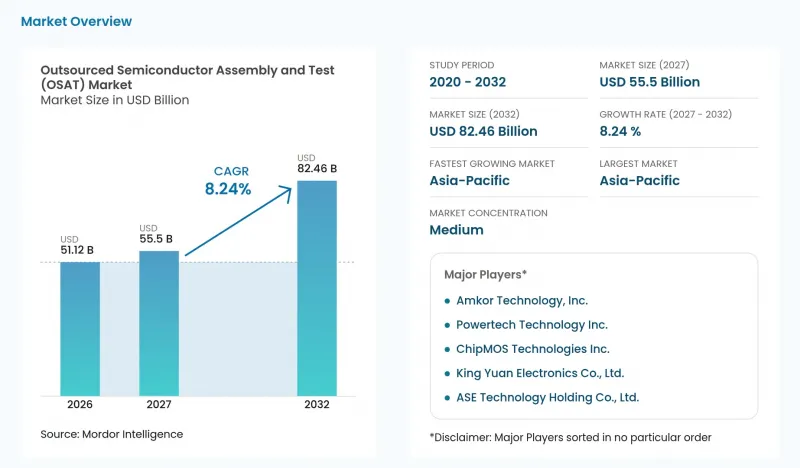
This report is segmented by Service Type (Packaging and Testing), Packaging Type (Ball Grid Array, Flip-Chip, and more), Application (Communication, Consumer Electronics, and more), Technology Node ( >=28 nm, 10/7 nm, and more), and Geography (Asia-Pacific, North America, and more). The market forecasts are provided in terms of value (USD), based on availability.
Global Outsourced Semiconductor Assembly And Test (OSAT) Market Trends and Insights
Soaring semiconductor content per vehicle
Vehicle electronics offer packaging suppliers a demand opportunity through both powertrain mix and semiconductor value within electric platforms. Infineon estimated average semiconductor bills of materials of approximately USD 750 per internal combustion vehicle and USD 1,400 per battery electric vehicle in 2025. It projected the battery electric figure at approximately USD 1,600 in 2030. For high-end cars, its 2030 estimate extended up to approximately USD 2,500, indicating a distinct value opportunity within that forecast. OSAT suppliers can participate in this richer electronics content when chip suppliers outsource the associated assembly and testing. Securing electronics-intensive vehicle platforms would consequently expose a service provider to a larger semiconductor value pool without depending solely on more vehicles being produced.
5G-led demand for advanced RF packages
5G gives packaging suppliers exposure to both network infrastructure investment and the expansion of connected device services. Ericsson reported 162 million additional 5G subscriptions globally in the first quarter of 2026, taking the total to 3.1 billion. Amkor Technology, Inc. identified continued infrastructure build-out and 5G-enabled devices among the trends fueling outsourced packaging and test services. Ericsson's June 2026 report also identified uneven regional uptake of 5G fixed wireless access. Ericsson places the strongest fixed wireless uptake in North America, the Nordics, Gulf Cooperation Council countries, and parts of Asia, locating service demand behind Amkor's 5G infrastructure trend in those markets.
Vertical integration by leading foundries and IDMs
When a foundry or integrated device manufacturer (IDM) retains packaging and testing within its production chain, the externally addressable service pool can narrow. An independent OSAT can face competition for the processing stages that a customer chooses to place outside that integrated flow. TSMC operates the CoWoS advanced-packaging process, placing that back-end service within a foundry's own offering. For AI-chip suppliers using this process, the foundry can therefore serve as both wafer manufacturer and advanced-packaging provider. Independent providers seeking that packaging work face a narrower opening when the integrated flow can accommodate it, with external access dependent on the foundry's capacity limits.
Other drivers and restraints analyzed in the detailed report include:
- AI/HPC chiplet architectures needing heterogeneous integration
- Foundry capacity shortages driving fab-lite outsourcing
- Cap-ex intensity and long equipment lead-times
For complete list of drivers and restraints, kindly check the Table Of Contents.
Segment Analysis
Packaging accounted for a 76.4% share of the outsourced semiconductor assembly and test (OSAT) market size in 2026. Within this largest service segment, ASE Technology Holding Co., Ltd. reported unaudited 2025 packaging revenue of TWD 308.3 billion (USD 9.83 billion). The group also reported growth in its leading-edge advanced packaging business in the first half of 2026 compared with the first half of 2025. Its packaging revenue had increased 17.8% from 2024 to 2025, tying ASE's reported scale to expansion of the service business.
Testing is forecast to grow at a 10.05% CAGR between 2027 and 2032, making it the fastest-growing service segment. ASE said its testing business outpaced the 35% year-over-year growth of its core packaging and testing revenue in the first half of 2026. The group reported USD 1.14 billion in testing equipment capital expenditures out of USD 3.4 billion in total equipment capital expenditures in 2025. Testing was approximately 11% of 2025 group net revenue across packaging, testing, electronic manufacturing services, and other operations. Testing absorbed about 34% of ASE's 2025 equipment capital expenditures, aligning its disproportionate equipment commitment with a business that subsequently outpaced core-business growth.
Ball grid array (BGA) was the largest packaging-type segment, accounting for 23.58% of packaging-services revenue in 2026. Tongfu Microelectronics Co., Ltd. reported that its oversized, multi-chip FCBGA packaging reached batch mass production in 2025. The company also reported developing key technologies for these packages and thermal-management solutions, linking its production milestone to a specific flip-chip BGA format. Providers pursuing oversized multi-chip BGA programs therefore need to connect package and thermal-management engineering with batch-production execution, making production capability part of the competitive offer.
Fan-out packaging (FO-WLP / FO-BGA) is projected to grow at a 10.72% CAGR between 2027 and 2032, making it the fastest-growing packaging-type segment. In May 2025, Deca Technologies and IBM agreed to implement Deca's M-Series and Adaptive Patterning technologies at IBM's Bromont, Quebec, facility. IBM planned a high-volume manufacturing line focused on Deca's M-Series Fan-out Interposer Technology. System-in-package (SiP) provides a separate integration route, with Amkor reporting approximately USD 3.08 billion in 2025 advanced SiP module sales for applications including RF front-end, connectivity, sensors, and memory. In fan-out, IBM's planned Bromont line would extend deployment of Deca's interposer process into IBM's manufacturing operations, giving fan-out technology providers a growth route through implementation at an existing packaging site.
Complete Report Scope:
- By Service Type
- Packaging
- Testing
- By Packaging Type
- Ball Grid Array (BGA)
- Chip-Scale Package (CSP)
- Quad Flat / Dual-Inline (QFP/DIP)
- Multi-Chip Module (MCM)
- Wafer-Level Packaging (WLP)
- Fan-Out Packaging (FO-WLP / FO-BGA)
- System-in-Package (SiP)
- Through-Silicon Via (2.5D/3D TSV)
- Flip-Chip (FC-BGA / FC-CSP)
- By Application
- Communication
- Consumer Electronics
- Automotive
- Computing and Networking
- Industrial
- Other Applications
- By Technology Node
- >=28 nm
- 16/14 nm
- 10/7 nm
- 5 nm and below
- Legacy (90-65 nm)
- By Geography
- North America
- United States
- Canada
- Mexico
- South America
- Brazil
- Argentina
- Rest of South America
- Europe
- Germany
- France
- United Kingdom
- Italy
- Netherlands
- Russia
- Rest of Europe
- Asia-Pacific
- China
- Taiwan
- South Korea
- Japan
- Singapore
- Malaysia
- India
- Rest of Asia-Pacific
- Middle East and Africa
- Middle East
- Israel
- United Arab Emirates
- Saudi Arabia
- Turkey
- Rest of Middle East
- Africa
- South Africa
- Nigeria
- Rest of Africa
- Middle East
- North America
Geography Analysis
Asia-Pacific held a 73.47% outsourced semiconductor assembly and test (OSAT) market share in 2026 and is forecast to grow at a 9.1% CAGR between 2027 and 2032, making it the largest and fastest-growing region. On May 8, 2026, Advanced Semiconductor Engineering, Inc. and WUS Printed Circuit Co., Ltd. announced a planned FOCoS and FC-BGA packaging facility in Kaohsiung, Taiwan, for AI, cloud computing, and autonomous driving. Completion was scheduled for September 2029. UTAC Group's network also includes UTAC Thai Limited factories in Thailand and PT UTAC Manufacturing Services Indonesia's manufacturing site in Indonesia. For suppliers serving advanced computing, Taiwan's project illustrates a growth path through FOCoS and FC-BGA investment, complementing the region's established cross-country assembly and test footprint.
North America's capacity opportunity includes a customer-backed advanced packaging and test campus project in the United States. In September 2026, Amkor announced an Arizona Phase 2 expansion expected to add 60,000 square meters of cleanroom space after customer commitments exceeded Phase 1's planned 33,000 square meters. Europe has an established service channel through Portugal, where Amkor provides packaging and test services through its factories and other operations. These locations imply different commercial timelines for buyers seeking regional capacity, with Arizona's additional space dependent on project delivery and Portugal supported by an existing operating footprint.
In South America, the Brazilian development bank BNDES approved financing for HT Micron Semicondutores in Sao Leopoldo, Brazil, in September 2026. The Hana Micron group company planned to add assembly, packaging, and test capacity specifically for LPDDR5X memory devices. HT Micron's Brazilian operation serves the information and communications technology industry through integrated-circuit packaging and testing. In the Gulf Cooperation Council (GCC) countries, Ericsson's June 2026 Mobility Report attributes 5G fixed wireless adoption to demand for high-speed alternatives to fixed broadband and to national initiatives for underserved areas and smart cities. That telecom build-out gives communications-oriented semiconductor suppliers a regional end-use context.
- ASE Technology Holding Co., Ltd.
- Amkor Technology, Inc.
- JCET Group Co., Ltd.
- Siliconware Precision Industries Co., Ltd.
- Powertech Technology Inc.
- King Yuan Electronics Co., Ltd.
- Tongfu Microelectronics Co., Ltd.
- Tianshui Huatian Technology Co., Ltd.
- UTAC Holdings Ltd.
- Unisem (M) Berhad
- Hana Micron Inc.
- ChipMOS Technologies Inc.
- Formosa Advanced Technologies Co., Ltd.
- Chipbond Technology Corporation
- Lingsen Precision Industries, Ltd.
- Suchi Semicon Pvt. Ltd.
- Nepes Corporation
- Silicon Box Pte. Ltd.
- Shinko Electric Industries Co., Ltd.
- Carsem (M) Sdn. Bhd.
- SFA Semicon Co., Ltd.
- STATS ChipPAC Pte. Ltd.
- Orient Semiconductor Electronics, Ltd.
- Integra Technologies LLC
- Amkor Technology Korea, Inc.
Additional Benefits:
- The market estimate (ME) sheet in Excel format
- 3 months of analyst support
TABLE OF CONTENTS
1 INTRODUCTION
- 1.1 Study Assumptions and Market Definition
- 1.2 Scope of the Study
2 RESEARCH METHODOLOGY
3 EXECUTIVE SUMMARY
4 MARKET LANDSCAPE
- 4.1 Market Overview
- 4.2 Market Drivers
- 4.2.1 Soaring semiconductor content per vehicle
- 4.2.2 5G-led demand for advanced RF packages
- 4.2.3 AI/HPC chiplet architectures needing heterogeneous integration
- 4.2.4 Foundry capacity shortages driving fab-lite outsourcing
- 4.2.5 U.S. CHIPS and EU Chips Acts incentivizing local OSAT build-out
- 4.2.6 Sustainability mandates pushing wafer-level fan-out adoption
- 4.3 Market Restraints
- 4.3.1 Vertical integration by leading foundries and IDMs
- 4.3.2 Cap-ex intensity and long equipment lead-times
- 4.3.3 Geopolitical export controls on advanced tools
- 4.3.4 Skilled-labor shortages in advanced packaging engineering
- 4.4 Industry Value Chain Analysis
- 4.5 Regulatory Landscape
- 4.6 Technological Outlook
- 4.7 Porter's Five Forces Analysis
- 4.7.1 Threat of New Entrants
- 4.7.2 Bargaining Power of Suppliers
- 4.7.3 Bargaining Power of Buyers
- 4.7.4 Threat of Substitutes
- 4.7.5 Competitive Rivalry
- 4.8 Impact of Macroeconomic Factors
5 MARKET SIZE AND GROWTH FORECASTS (VALUE)
- 5.1 By Service Type
- 5.1.1 Packaging
- 5.1.2 Testing
- 5.2 By Packaging Type
- 5.2.1 Ball Grid Array (BGA)
- 5.2.2 Chip-Scale Package (CSP)
- 5.2.3 Quad Flat / Dual-Inline (QFP/DIP)
- 5.2.4 Multi-Chip Module (MCM)
- 5.2.5 Wafer-Level Packaging (WLP)
- 5.2.6 Fan-Out Packaging (FO-WLP / FO-BGA)
- 5.2.7 System-in-Package (SiP)
- 5.2.8 Through-Silicon Via (2.5D/3D TSV)
- 5.2.9 Flip-Chip (FC-BGA / FC-CSP)
- 5.3 By Application
- 5.3.1 Communication
- 5.3.2 Consumer Electronics
- 5.3.3 Automotive
- 5.3.4 Computing and Networking
- 5.3.5 Industrial
- 5.3.6 Other Applications
- 5.4 By Technology Node
- 5.4.1 >=28 nm
- 5.4.2 16/14 nm
- 5.4.3 10/7 nm
- 5.4.4 5 nm and below
- 5.4.5 Legacy (90-65 nm)
- 5.5 By Geography
- 5.5.1 North America
- 5.5.1.1 United States
- 5.5.1.2 Canada
- 5.5.1.3 Mexico
- 5.5.2 South America
- 5.5.2.1 Brazil
- 5.5.2.2 Argentina
- 5.5.2.3 Rest of South America
- 5.5.3 Europe
- 5.5.3.1 Germany
- 5.5.3.2 France
- 5.5.3.3 United Kingdom
- 5.5.3.4 Italy
- 5.5.3.5 Netherlands
- 5.5.3.6 Russia
- 5.5.3.7 Rest of Europe
- 5.5.4 Asia-Pacific
- 5.5.4.1 China
- 5.5.4.2 Taiwan
- 5.5.4.3 South Korea
- 5.5.4.4 Japan
- 5.5.4.5 Singapore
- 5.5.4.6 Malaysia
- 5.5.4.7 India
- 5.5.4.8 Rest of Asia-Pacific
- 5.5.5 Middle East and Africa
- 5.5.5.1 Middle East
- 5.5.5.1.1 Israel
- 5.5.5.1.2 United Arab Emirates
- 5.5.5.1.3 Saudi Arabia
- 5.5.5.1.4 Turkey
- 5.5.5.1.5 Rest of Middle East
- 5.5.5.2 Africa
- 5.5.5.2.1 South Africa
- 5.5.5.2.2 Nigeria
- 5.5.5.2.3 Rest of Africa
- 5.5.5.1 Middle East
- 5.5.1 North America
6 COMPETITIVE LANDSCAPE
- 6.1 Market Concentration
- 6.2 Strategic Moves
- 6.3 Market Share Analysis
- 6.4 Company Profiles (includes Global level Overview, Market level overview, Core Segments, Financials as available, Strategic Information, Market Rank/Share for key companies, Products and Services, and Recent Developments)
- 6.4.1 ASE Technology Holding Co., Ltd.
- 6.4.2 Amkor Technology, Inc.
- 6.4.3 JCET Group Co., Ltd.
- 6.4.4 Siliconware Precision Industries Co., Ltd.
- 6.4.5 Powertech Technology Inc.
- 6.4.6 King Yuan Electronics Co., Ltd.
- 6.4.7 Tongfu Microelectronics Co., Ltd.
- 6.4.8 Tianshui Huatian Technology Co., Ltd.
- 6.4.9 UTAC Holdings Ltd.
- 6.4.10 Unisem (M) Berhad
- 6.4.11 Hana Micron Inc.
- 6.4.12 ChipMOS Technologies Inc.
- 6.4.13 Formosa Advanced Technologies Co., Ltd.
- 6.4.14 Chipbond Technology Corporation
- 6.4.15 Lingsen Precision Industries, Ltd.
- 6.4.16 Suchi Semicon Pvt. Ltd.
- 6.4.17 Nepes Corporation
- 6.4.18 Silicon Box Pte. Ltd.
- 6.4.19 Shinko Electric Industries Co., Ltd.
- 6.4.20 Carsem (M) Sdn. Bhd.
- 6.4.21 SFA Semicon Co., Ltd.
- 6.4.22 STATS ChipPAC Pte. Ltd.
- 6.4.23 Orient Semiconductor Electronics, Ltd.
- 6.4.24 Integra Technologies LLC
- 6.4.25 Amkor Technology Korea, Inc.
7 MARKET OPPORTUNITIES AND FUTURE OUTLOOK
- 7.1 White-Space and Unmet-Need Assessment

