PUBLISHER: Mordor Intelligence | PRODUCT CODE: 2187326

PUBLISHER: Mordor Intelligence | PRODUCT CODE: 2187326
Pharmaceutical Contract Development And Manufacturing Organization (CDMO) - Market Share Analysis, Industry Trends & Statistics, Growth Forecasts (2027 - 2032)
According to Mordor Intelligence, the pharmaceutical contract development and manufacturing organization (CDMO) market size is projected to expand from USD 275.3 billion in 2026 and USD 292.7 billion in 2027 to USD 403.3 billion by 2032, registering a CAGR of 6.62% between 2027 and 2032.
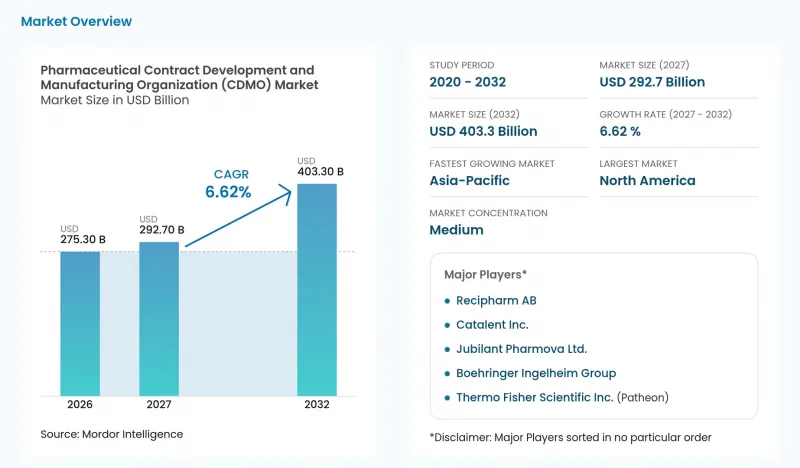
This report is segmented by Service Type (API Manufacturing and more), Molecule Type (Small Molecule and more), Dosage Form (Solid Oral and more), Therapeutic Area (Oncology and more), and Geography (North America and more). The market forecasts are provided in terms of value (USD), based on availability.
Global Pharmaceutical Contract Development And Manufacturing Organization (CDMO) Market Trends and Insights
Increasing outsourcing volume by large pharmaceutical companies
Large pharmaceutical sponsors expand access to commercial production through long-duration commitments to external manufacturing networks. In April 2025, Regeneron agreed to have FUJIFILM Biotechnologies (formerly FUJIFILM Diosynth Biotechnologies) manufacture bulk drug product for its commercial biologic medicines in Holly Springs, North Carolina, under a 10-year agreement. The arrangement was expected to nearly double Regeneron's US large-scale manufacturing capacity. In February 2026, GSK renewed a 5-year manufacturing partnership with Bora Pharmaceuticals that expanded access to multiple Bora sites. GSK is the largest pharmaceutical partner at Bora's Mississauga facility, where Bora provides end-to-end manufacturing for more than 20 commercial product lines. Together, these commitments show how outsourcing can anchor recurring commercial workloads, giving CDMOs a reason to organize capacity around sustained product supply instead of relying exclusively on development batches.
Surge in biologics and complex-molecule pipelines
Complex-therapy pipeline growth expands the potential customer base for specialized development services before programs reach commercial manufacturing. The ISCT/Citeline global cell and gene therapy pipeline contained 383 active clinical trials in its 2026 edition, compared with 322 in the 2025 edition. Phase I and II studies represented 95% of that 2026 clinical-trial pipeline. This concentration makes progression through clinical development a central condition for translating the larger trial population into commercial supply requirements. Development-stage sponsors offer the nearer service opportunity, because the trial mix supports clinical-development work before it supports commitments to commercial manufacturing suites.
Stringent multi-region regulatory requirements
US-bound pharmaceutical batches can face import detention after manufacturing is completed. On February 12, 2025, FDA added India-based contract manufacturer Zenzi Pharmaceutical Industries Private Limited to Import Alert 66-79 for all drugs and drug products from the listed establishment. Zenzi remained on the Red List in the September 23, 2026 edition. The alert covers foreign establishments refusing FDA inspection or a mandatory remote regulatory assessment, and FDA divisions may detain covered shipments without physical examination. Release may be considered after case-by-case evaluation of evidence when shipments are detained. Export manufacturers with a listing like this face US entry as the point where an otherwise completed batch can stall, adding release-review delay after production.
Other drivers and restraints analyzed in the detailed report include:
- Cost- and speed-advantage of manufacturing in emerging markets
- Consolidation toward end-to-end one-stop CDMOs
- Capacity-utilization and lead-time risk
For complete list of drivers and restraints, kindly check the Table Of Contents.
Segment Analysis
API manufacturing accounted for a 54.64% share of the pharmaceutical contract development and manufacturing organization (CDMO) market size in 2026. Cambrex Corporation's Charles City, Iowa, site manufactures active pharmaceutical ingredients (APIs) and intermediates, including highly potent molecules and controlled substances. In October 2025, the company announced a planned USD 120 million investment to increase the site's large-scale API manufacturing capacity by 40%, to nearly 1 million liters. In March 2026, Cambrex completed initial engineering studies for the new large-scale API plant at the site, progress toward the previously announced USD 120 million investment.
Finished dosage form (FDF) development and manufacturing is forecast to be the fastest-growing service segment, with a CAGR of 7.45% between 2027 and 2032. Ardena completed its acquisition of Catalent's Somerset, New Jersey, facility in February 2025, adding late-stage and small-scale commercial oral drug manufacturing capabilities. A newer patient-oriented dosage-form assignment connects outsourced production directly to a planned product introduction. In August 2026, Cycle Pharmaceuticals agreed to have Forma Life Sciences manufacture FDA-approved CAVHANZA (nilotinib) orally disintegrating tablets in Irvine, California, to establish US commercial supply ahead of Cycle's introduction. Product-specific supply preparation extends the FDF assignment from developing a dosage form to establishing a commercial manufacturing route for an approved therapy.
Small molecules represented a 61.35% pharmaceutical contract development and manufacturing organization (CDMO) market share in 2026. Lonza Group reported more than 135 commercial small molecules in its 2025 Advanced Synthesis portfolio, covering APIs, highly potent APIs, dosage forms and delivery systems, and particle engineering. It also signed a large multiyear commercial small-molecule drug-substance supply agreement in 2025.
High-potency APIs are forecast to be the fastest-growing molecule segment, with a CAGR of 8.35% between 2027 and 2032. Aragen Life Sciences began operating its OneHP high-potency development and manufacturing platform at Nacharam in Hyderabad, India, on October 6, 2026. The platform operates one manufacturing line designed for annual API capacity of 500 to 600 kilograms and supports highly potent compounds, including cytotoxic molecules. It connects milligram-scale discovery with process development and multi-kilogram manufacturing under current good manufacturing practice (cGMP). Keeping those stages on one campus makes early process development part of the manufacturing relationship before a potent compound reaches larger batch requirements.
Complete Report Scope:
- By Service Type
- API Manufacturing
- Small Molecule
- Large Molecule
- High-Potency (HPAPI)
- FDF Development and Manufacturing
- Solid Dose
- Liquid Dose
- Injectable Dose
- Secondary Packaging
- API Manufacturing
- By Molecule Type
- Small Molecule
- Large Molecule (Biologics and Biosimilars)
- High-Potency APIs
- By Dosage Form
- Solid Oral
- Sterile Injectables
- Topicals and Transdermals
- Specialty/Novel (e.g., ODT, Long-acting)
- By Therapeutic Area
- Oncology
- Metabolic and Endocrine
- Cardiovascular
- CNS and Psychiatry
- Infectious Diseases and Vaccines
- By Geography
- North America
- United States
- Canada
- Mexico
- Europe
- Germany
- United Kingdom
- France
- Italy
- Spain
- Russia
- Rest of Europe
- Asia-Pacific
- China
- India
- Japan
- South Korea
- Australia and New Zealand
- Rest of Asia-Pacific
- Middle East and Africa
- Middle East
- United Arab Emirates
- Saudi Arabia
- Turkey
- Rest of Middle East
- Africa
- South Africa
- Nigeria
- Egypt
- Rest of Africa
- Middle East
- South America
- Brazil
- Argentina
- Rest of South America
- North America
Geography Analysis
North America accounted for a 37.88% share of the pharmaceutical contract development and manufacturing organization (CDMO) market size in 2026. FUJIFILM Biotechnologies' Holly Springs site in North Carolina, United States, launched cGMP production in 2025 with 8 bioreactors of 20,000 liters each. One of North America's largest end-to-end cell-culture facilities, it gives sponsors an external manufacturing option linked to substantial production assets within the region.
Asia-Pacific is forecast to be the fastest-growing geography, with a CAGR of 7.6% between 2027 and 2032. Aragen's installed small-molecule capacity across Hyderabad and Visakhapatnam in India stood at 364,000 liters on March 31, 2026. In July 2026, AGC Biologics, an AGC Inc. subsidiary, entered a long-term agreement to provide commercial manufacturing at Yokohama, Japan, for multiple products of an unnamed global biopharmaceutical customer. At the announcement, the site was under development, with GMP-compliant services planned for 2027. The Japanese agreement illustrates a route to expansion in which a future service launch is backed by a customer commitment, rather than capacity construction alone.
Within Europe, the EU's GMP guidance requires a written contract between the contract giver and contract acceptor for outsourced pharmaceutical activities. Aenova provides drug-product development, manufacturing, and packaging at sites in Germany, Switzerland, Italy, Ireland, and Romania. In the Middle East and Africa, Egypt's SEDICO and Sandoz Global agreed in March 2025 to technology transfer for local manufacture of 5 essential oncology products. Porton Advanced Solutions and EVA Pharma signed a June 2025 memorandum of understanding to develop CAR-T manufacturing capabilities, with hubs planned in Egypt and Saudi Arabia. In South America, Anvisa's August 2025 certification of Akums' Haridwar, India, sterile facility authorized manufacture and export to Brazil, opening a route through qualified overseas production.
- Thermo Fisher Scientific Inc. (Patheon)
- Lonza Group
- Catalent Inc.
- Samsung Biologics Co. Ltd.
- WuXi AppTec Inc.
- Recipharm AB
- Jubilant Pharmova Ltd.
- Boehringer Ingelheim Group
- Pfizer CentreOne
- Aenova Holding GmbH
- Fujifilm Biotechnologies
- Simtra BioPharma Solutions
- Corden Pharma GmbH
- AbbVie Contract Manufacturing
- Cambrex Corporation
- Syneos Health Inc.
- IQVIA Holdings Inc.
- Fortrea
- PAREXEL International Corporation
- ICON PLC
- Charles River Laboratories International Inc.
- Eurofins Scientific SE
- SGS Life Science Services SA
- CMIC Holdings Co. Ltd
- Novotech Pty Ltd
- Hangzhou Tigermed Consulting Co. Ltd
- Samsung Bioepis Co. Ltd
- Labtec GmbH (AdhexPharma S.A.S.)
- Tapemark
- Famar SA
Additional Benefits:
- The market estimate (ME) sheet in Excel format
- 3 months of analyst support
TABLE OF CONTENTS
1 INTRODUCTION
- 1.1 Study Assumptions and Market Definition
- 1.2 Scope of the Study
2 RESEARCH METHODOLOGY
3 EXECUTIVE SUMMARY
4 MARKET LANDSCAPE
- 4.1 Market Overview
- 4.2 Market Drivers
- 4.2.1 Increasing outsourcing volume by large pharmaceutical companies
- 4.2.2 Surge in biologics and complex-molecule pipelines
- 4.2.3 Cost- and speed-advantage of manufacturing in emerging markets
- 4.2.4 Consolidation toward end-to-end one-stop CDMOs
- 4.2.5 AI-enabled rapid process-development platforms
- 4.2.6 GLP-1 and peptide HPAPI capacity build-outs
- 4.3 Market Restraints
- 4.3.1 Stringent multi-region regulatory requirements
- 4.3.2 Capacity-utilization and lead-time risk
- 4.3.3 High capex for sterile biologics suites
- 4.3.4 Scarcity of skilled aseptic-manufacturing talent
- 4.4 Industry Value Chain Analysis
- 4.5 Regulatory Landscape
- 4.6 Technological Outlook
- 4.7 Porter's Five Forces Analysis
- 4.7.1 Threat of New Entrants
- 4.7.2 Bargaining Power of Suppliers
- 4.7.3 Bargaining Power of Buyers
- 4.7.4 Threat of Substitutes
- 4.7.5 Competitive Rivalry
- 4.8 Investment and Funding Landscape
5 MARKET SIZE AND GROWTH FORECASTS (VALUE)
- 5.1 By Service Type
- 5.1.1 API Manufacturing
- 5.1.1.1 Small Molecule
- 5.1.1.2 Large Molecule
- 5.1.1.3 High-Potency (HPAPI)
- 5.1.2 FDF Development and Manufacturing
- 5.1.2.1 Solid Dose
- 5.1.2.2 Liquid Dose
- 5.1.2.3 Injectable Dose
- 5.1.3 Secondary Packaging
- 5.1.1 API Manufacturing
- 5.2 By Molecule Type
- 5.2.1 Small Molecule
- 5.2.2 Large Molecule (Biologics and Biosimilars)
- 5.2.3 High-Potency APIs
- 5.3 By Dosage Form
- 5.3.1 Solid Oral
- 5.3.2 Sterile Injectables
- 5.3.3 Topicals and Transdermals
- 5.3.4 Specialty/Novel (e.g., ODT, Long-acting)
- 5.4 By Therapeutic Area
- 5.4.1 Oncology
- 5.4.2 Metabolic and Endocrine
- 5.4.3 Cardiovascular
- 5.4.4 CNS and Psychiatry
- 5.4.5 Infectious Diseases and Vaccines
- 5.5 By Geography
- 5.5.1 North America
- 5.5.1.1 United States
- 5.5.1.2 Canada
- 5.5.1.3 Mexico
- 5.5.2 Europe
- 5.5.2.1 Germany
- 5.5.2.2 United Kingdom
- 5.5.2.3 France
- 5.5.2.4 Italy
- 5.5.2.5 Spain
- 5.5.2.6 Russia
- 5.5.2.7 Rest of Europe
- 5.5.3 Asia-Pacific
- 5.5.3.1 China
- 5.5.3.2 India
- 5.5.3.3 Japan
- 5.5.3.4 South Korea
- 5.5.3.5 Australia and New Zealand
- 5.5.3.6 Rest of Asia-Pacific
- 5.5.4 Middle East and Africa
- 5.5.4.1 Middle East
- 5.5.4.1.1 United Arab Emirates
- 5.5.4.1.2 Saudi Arabia
- 5.5.4.1.3 Turkey
- 5.5.4.1.4 Rest of Middle East
- 5.5.4.2 Africa
- 5.5.4.2.1 South Africa
- 5.5.4.2.2 Nigeria
- 5.5.4.2.3 Egypt
- 5.5.4.2.4 Rest of Africa
- 5.5.4.1 Middle East
- 5.5.5 South America
- 5.5.5.1 Brazil
- 5.5.5.2 Argentina
- 5.5.5.3 Rest of South America
- 5.5.1 North America
6 COMPETITIVE LANDSCAPE
- 6.1 Market Concentration
- 6.2 Strategic Moves
- 6.3 Market Share Analysis
- 6.4 Company Profiles (includes Global level Overview, Market level overview, Core Segments, Financials as available, Strategic Information, Market Rank/Share for key companies, Products and Services, and Recent Developments)
- 6.4.1 Thermo Fisher Scientific Inc. (Patheon)
- 6.4.2 Lonza Group
- 6.4.3 Catalent Inc.
- 6.4.4 Samsung Biologics Co. Ltd.
- 6.4.5 WuXi AppTec Inc.
- 6.4.6 Recipharm AB
- 6.4.7 Jubilant Pharmova Ltd.
- 6.4.8 Boehringer Ingelheim Group
- 6.4.9 Pfizer CentreOne
- 6.4.10 Aenova Holding GmbH
- 6.4.11 Fujifilm Biotechnologies
- 6.4.12 Simtra BioPharma Solutions
- 6.4.13 Corden Pharma GmbH
- 6.4.14 AbbVie Contract Manufacturing
- 6.4.15 Cambrex Corporation
- 6.4.16 Syneos Health Inc.
- 6.4.17 IQVIA Holdings Inc.
- 6.4.18 Fortrea
- 6.4.19 PAREXEL International Corporation
- 6.4.20 ICON PLC
- 6.4.21 Charles River Laboratories International Inc.
- 6.4.22 Eurofins Scientific SE
- 6.4.23 SGS Life Science Services SA
- 6.4.24 CMIC Holdings Co. Ltd
- 6.4.25 Novotech Pty Ltd
- 6.4.26 Hangzhou Tigermed Consulting Co. Ltd
- 6.4.27 Samsung Bioepis Co. Ltd
- 6.4.28 Labtec GmbH (AdhexPharma S.A.S.)
- 6.4.29 Tapemark
- 6.4.30 Famar SA
7 MARKET OPPORTUNITIES AND FUTURE OUTLOOK
- 7.1 White-Space and Unmet-Need Assessment

