PUBLISHER: Mordor Intelligence | PRODUCT CODE: 2187338

PUBLISHER: Mordor Intelligence | PRODUCT CODE: 2187338
Gaming - Market Share Analysis, Industry Trends & Statistics, Growth Forecasts (2027 - 2032)
According to Mordor Intelligence, the gaming market size is expected to increase from USD 224.7 billion in 2026 to USD 245.9 billion in 2027 and reach USD 376.1 billion by 2032, growing at a CAGR of 8.87% over 2027-2032.
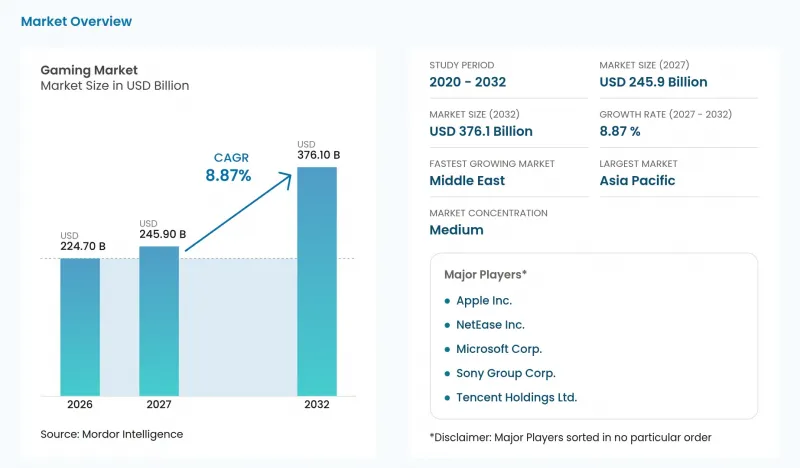
This report is segmented by Gaming Platform (Mobile Games, Console Games, and more), Revenue Model (Free-to-Play, Pay-to-Play / Premium, and more), Genre (Action/Adventure, Other Genres, and more), Player Age Group (18-35 Years, 36-50 Years, and more), and Geography (Asia Pacific, North America, and more). The market forecasts are provided in terms of value (USD), based on availability.
Global Gaming Market Trends and Insights
Mobile-first Monetization Surge
Mobile publishers can expand receipts by renewing established franchises across distinct regional release windows. Gravity reported 12.2% growth in consolidated mobile-game revenue in 2025 from 2024. It attributed the increase mainly to initial revenue from Ragnarok M: Classic and Ragnarok X: Next Generation. Ragnarok M: Classic launched in Southeast Asia in February 2025 and in Taiwan, Hong Kong, and Macau in April 2025. Ragnarok Origin revenues partially offset the increase, showing that the portfolio's contribution varied across titles. That mix exposes Gravity's growth to the launch calendar, because the newer releases had to outweigh weaker Ragnarok Origin receipts.
5G-enabled Cloud Gaming Uptake
Responsive mobile play makes network treatment commercially relevant to cloud-gaming access. In December 2025, Deutsche Telekom made its integration with NVIDIA's GeForce NOW available to eligible customers on its 5G+ network in Germany. Across sessions from October 7, 2025, to February 1, 2026, Telekom reported 20% lower latency in GeForce NOW sessions receiving gaming-slice treatment on its network. The comparison used other GeForce NOW sessions on that same network without the treatment. The same analysis reported 73% fewer frames with packet loss in treated sessions. Telekom ties the packet-loss reduction to smoother play without image loss, so eligible GeForce NOW users receive a measured delivery difference on the treated connection.
China's Tight Game Approval and Play-time Quota Regime
China's play-time controls restrict the hours during which publishers can serve younger online players. Effective September 1, 2021, the National Press and Publication Administration permits service to minors under 18 only from 8 to 9 p.m. on Fridays, Saturdays, Sundays, and statutory holidays. The restriction covers online game companies and platforms, concentrating permitted access within those windows. Separately, NetEase Inc. said in April 2026 that approval failures or delays, among other factors, could delay launches or cancel pipeline development. Publishers therefore face constraints on both access to younger customers and the timing of new releases. Designing around permitted play sessions cannot remove the separate approval risk attached to commercialization.
Other drivers and restraints analyzed in the detailed report include:
- AAA IP Trans-media Expansion Boosting Console and PC Revenues
- Increase in Live-service and In-game Advertising Revenues
- iOS ATT and Privacy Rules Inflating User-Acquisition Costs
For complete list of drivers and restraints, kindly check the Table Of Contents.
Segment Analysis
Mobile games accounted for a 49.72% share of the gaming market size in 2026, making them the largest segment. Sensor Tower reported worldwide mobile-game in-app purchase revenue of USD 39.8 billion in the first half of 2026, down 2% from USD 40.6 billion a year earlier. Tencent reported operating 7 of China's 10 leading domestic mobile games by average quarterly daily active users in Q2 2025, citing QuestMobile rankings. A challenger launching in China therefore competes with an operator that already holds most of the country's highest-use mobile titles. An entrant's growth case needs gains for its own games rather than an assumption that worldwide in-app purchase spending will expand.
Cloud gaming is the fastest-growing segment, with a forecast CAGR of 25.6% over 2027-2032. In November 2025, Microsoft reported that Xbox Cloud Gaming hours streamed by Game Pass subscribers were 45% higher than at the same time in 2024. For VR/AR gaming, Valve's September 2026 Steam survey reported VR headsets among 1.35% of Steam users. Game Pass can capture additional streamed play within an existing subscription relationship, whereas VR distribution on Steam depends on reaching the small headset-owning audience.
Free-to-play (F2P) was the largest segment, accounting for 85.3% of total industry revenue in 2026. In the 3 months ended June 30, 2026, Roblox averaged 123 million daily active registered accounts, including approximately 1.6 million average daily unique paying users, across its platform of gaming, education, and entertainment experiences. In 2025, Roblox said most experiences were free, creators determined each experience's business model, and most free experiences allowed purchases of experience-specific enhancements. That structure separates audience reach from the purchase decision, giving creators a monetization opportunity within experiences users can access without payment. Because creators set each experience's business model, monetization on Roblox follows separate creator decisions rather than one platform-wide price.
Subscription and game-pass offerings are the fastest-growing segment, with a forecast CAGR of 13.3% over 2027-2032. Microsoft reported nearly USD 5 billion in annual Game Pass revenue for fiscal 2025, which ended June 30, 2025, reaching that level for the first time. Discord announced Nitro Rewards on May 11, 2026, including a Game Pass Starter Edition benefit at no extra cost for Nitro members where available. Bundling places game access inside another membership, creating a route to players through a partner's customer relationship. The Starter Edition benefit makes the Nitro partnership an entry-level route into Game Pass alongside the service's established annual revenue base.
Complete Report Scope:
- By Gaming Platform
- Mobile Games
- PC Games (Downloaded/Box and Browser)
- Console Games
- Cloud Gaming
- VR/AR Gaming
- By Revenue Model
- Free-to-Play (F2P)
- Pay-to-Play / Premium
- Subscription and Game-Pass
- By Genre
- Action/Adventure
- Shooter and Battle Royale
- Role-Playing (RPG/MMORPG)
- Sports and Racing
- Other Genres
- By Player Age Group
- Under 18 Years
- 18-35 Years
- 36-50 Years
- Above 50 Years
- By Geography
- North America
- United States
- Canada
- Mexico
- South America
- Brazil
- Argentina
- Rest of South America
- Europe
- Germany
- United Kingdom
- France
- Italy
- Spain
- Russia
- Rest of Europe
- Asia Pacific
- China
- Japan
- South Korea
- India
- Australia
- New Zealand
- Rest of Asia Pacific
- Middle East
- United Arab Emirates
- Saudi Arabia
- Turkey
- Rest of Middle East
- Africa
- South Africa
- Nigeria
- Kenya
- Rest of Africa
- North America
Geography Analysis
Asia Pacific accounted for 49.51% of the gaming market size in 2026, making it the largest regional market. China had 684 million game users in the first half of 2026, up 0.82% from a year earlier. Indonesia's Ministry of Trade cited more than 192 million game players in 2025 data from the Agate Whitepaper. China's modest user-base change puts greater commercial weight on engagement and monetization within an already extensive audience. For a publisher seeking additional users, Indonesia offers a separate large audience rather than a dependence on faster expansion in China's near-flat user base.
The Middle East is forecast to grow at a CAGR of 9.9% over 2027-2032, making it the fastest-growing region. The Saudi Center for Opinion Polling's 2025 study of Saudi mobile-phone users aged 18 or older found that approximately 7 out of 10 surveyed players made monthly game payments. In May 2026, Savvy Games Group and Roblox signed a memorandum of understanding to support Saudi developers through training, community building, and technical support. The commercial opening combines recurring game-content demand with a planned route for Saudi creators to develop content for an audience with demonstrated payment activity.
North America's content-spending base includes the United States, where consumers spent USD 52.4 billion on video game content in 2025. In South America, Brazil's surveyed active gamers aged 16 or older most regularly played action, puzzle, and shooter games in 2025, and 82% played with others in person at least monthly. Across 16 European markets, 82% of players had played on mobile in 2025, making it the most-used device in that sample. In Africa, South African surveyed active gamers aged 16 or older most regularly played puzzle, action, and sports games in 2025, and 76% played with others in person at least monthly. These patterns favor mobile access in the European sample and social formats in Brazil and South Africa, where action and puzzle preferences overlap.
- Tencent Holdings Ltd.
- Sony Group Corp.
- Microsoft Corp.
- Apple Inc.
- NetEase Inc.
- Nintendo Co. Ltd.
- Activision Blizzard Inc.
- Electronic Arts Inc.
- Epic Games Inc.
- Sea Ltd. (Garena)
- Roblox Corp.
- Krafton Inc.
- Bandai Namco Holdings Inc.
- Take-Two Interactive Software Inc.
- Ubisoft Entertainment SA
- Square Enix Holdings Co. Ltd.
- Valve Corp.
- Zynga Inc.
- Embracer Group AB
- Jam City Inc.
- miHoYo Co. Ltd. (HoYoverse)
- Com2uS Corp.
- ZeptoLab UK Ltd.
Additional Benefits:
- The market estimate (ME) sheet in Excel format
- 3 months of analyst support
TABLE OF CONTENTS
1 INTRODUCTION
- 1.1 Study Assumptions and Market Definition
- 1.2 Scope of the Study
2 RESEARCH METHODOLOGY
3 EXECUTIVE SUMMARY
4 MARKET LANDSCAPE
- 4.1 Market Overview
- 4.2 Market Drivers
- 4.2.1 Mobile-first Monetization Surge
- 4.2.2 5G-enabled Cloud Gaming Uptake
- 4.2.3 AAA IP Trans-media Expansion Boosting Console and PC Revenues
- 4.2.4 Increase in Live-service and In-game Advertising Revenues
- 4.2.5 Generative AI-driven User-Generated Content Workflows
- 4.2.6 Telco Bundling of Game Pass-style Subscriptions in Emerging Markets
- 4.3 Market Restraints
- 4.3.1 China's Tight Game Approval and Play-time Quota Regime
- 4.3.2 iOS ATT and Privacy Rules Inflating User-Acquisition Costs
- 4.3.3 Global AAA Talent Shortage Driving Development Delays
- 4.3.4 Rising Cloud-compute Costs Squeezing Margins of F2P Publishers
- 4.4 Industry Value Chain Analysis
- 4.5 Regulatory Landscape
- 4.6 Technological Outlook
- 4.7 Porter's Five Forces Analysis
- 4.7.1 Threat of New Entrants
- 4.7.2 Bargaining Power of Suppliers
- 4.7.3 Bargaining Power of Buyers
- 4.7.4 Threat of Substitutes
- 4.7.5 Competitive Rivalry
- 4.8 Impact of Macroeconomic Factors on the Market
5 MARKET SIZE AND GROWTH FORECASTS (VALUE)
- 5.1 By Gaming Platform
- 5.1.1 Mobile Games
- 5.1.2 PC Games (Downloaded/Box and Browser)
- 5.1.3 Console Games
- 5.1.4 Cloud Gaming
- 5.1.5 VR/AR Gaming
- 5.2 By Revenue Model
- 5.2.1 Free-to-Play (F2P)
- 5.2.2 Pay-to-Play / Premium
- 5.2.3 Subscription and Game-Pass
- 5.3 By Genre
- 5.3.1 Action/Adventure
- 5.3.2 Shooter and Battle Royale
- 5.3.3 Role-Playing (RPG/MMORPG)
- 5.3.4 Sports and Racing
- 5.3.5 Other Genres
- 5.4 By Player Age Group
- 5.4.1 Under 18 Years
- 5.4.2 18-35 Years
- 5.4.3 36-50 Years
- 5.4.4 Above 50 Years
- 5.5 By Geography
- 5.5.1 North America
- 5.5.1.1 United States
- 5.5.1.2 Canada
- 5.5.1.3 Mexico
- 5.5.2 South America
- 5.5.2.1 Brazil
- 5.5.2.2 Argentina
- 5.5.2.3 Rest of South America
- 5.5.3 Europe
- 5.5.3.1 Germany
- 5.5.3.2 United Kingdom
- 5.5.3.3 France
- 5.5.3.4 Italy
- 5.5.3.5 Spain
- 5.5.3.6 Russia
- 5.5.3.7 Rest of Europe
- 5.5.4 Asia Pacific
- 5.5.4.1 China
- 5.5.4.2 Japan
- 5.5.4.3 South Korea
- 5.5.4.4 India
- 5.5.4.5 Australia
- 5.5.4.6 New Zealand
- 5.5.4.7 Rest of Asia Pacific
- 5.5.5 Middle East
- 5.5.5.1 United Arab Emirates
- 5.5.5.2 Saudi Arabia
- 5.5.5.3 Turkey
- 5.5.5.4 Rest of Middle East
- 5.5.6 Africa
- 5.5.6.1 South Africa
- 5.5.6.2 Nigeria
- 5.5.6.3 Kenya
- 5.5.6.4 Rest of Africa
- 5.5.1 North America
6 COMPETITIVE LANDSCAPE
- 6.1 Market Concentration
- 6.2 Strategic Moves
- 6.3 Market Share Analysis
- 6.4 Company Profiles (includes Global level Overview, Market level overview, Core Segments, Financials as available, Strategic Information, Market Rank/Share for key companies, Products and Services, and Recent Developments)
- 6.4.1 Tencent Holdings Ltd.
- 6.4.2 Sony Group Corp.
- 6.4.3 Microsoft Corp.
- 6.4.4 Apple Inc.
- 6.4.5 NetEase Inc.
- 6.4.6 Nintendo Co. Ltd.
- 6.4.7 Activision Blizzard Inc.
- 6.4.8 Electronic Arts Inc.
- 6.4.9 Epic Games Inc.
- 6.4.10 Sea Ltd. (Garena)
- 6.4.11 Roblox Corp.
- 6.4.12 Krafton Inc.
- 6.4.13 Bandai Namco Holdings Inc.
- 6.4.14 Take-Two Interactive Software Inc.
- 6.4.15 Ubisoft Entertainment SA
- 6.4.16 Square Enix Holdings Co. Ltd.
- 6.4.17 Valve Corp.
- 6.4.18 Zynga Inc.
- 6.4.19 Embracer Group AB
- 6.4.20 Jam City Inc.
- 6.4.21 miHoYo Co. Ltd. (HoYoverse)
- 6.4.22 Com2uS Corp.
- 6.4.23 ZeptoLab UK Ltd.
7 MARKET OPPORTUNITIES AND FUTURE OUTLOOK
- 7.1 White-Space and Unmet-Need Assessment

