PUBLISHER: Mordor Intelligence | PRODUCT CODE: 2187391

PUBLISHER: Mordor Intelligence | PRODUCT CODE: 2187391
Southeast Asia Gaming - Market Share Analysis, Industry Trends & Statistics, Growth Forecasts (2027 - 2032)
According to Mordor Intelligence, the Southeast Asia gaming market size was valued at USD 14.86 billion in 2026 and estimated to grow from USD 14.89 billion in 2027 to reach USD 15.21 billion by 2032, at a CAGR of 0.42% during the forecast period (2027-2032).
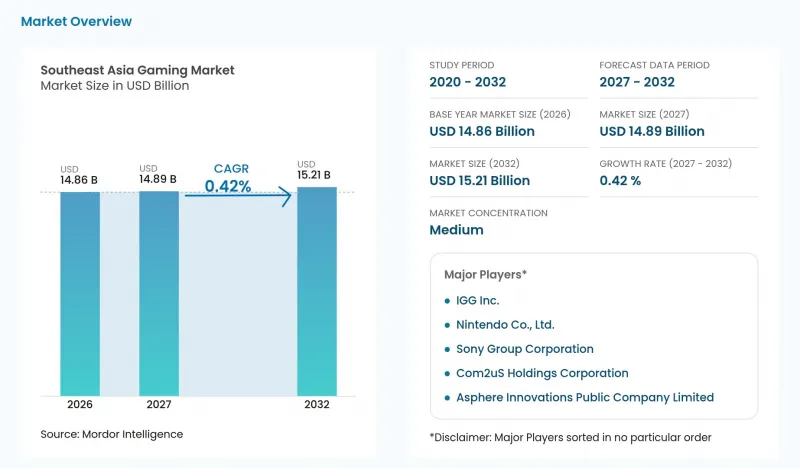
This report is segmented by Platform (Mobile, PC, and more), Revenue Model (Free-to-Play, In-Game Advertising, and more), Game Genre (MOBA / Strategy, Casual and Puzzle, and more), and Geography (Indonesia, Thailand, and more). The market forecasts are provided in terms of value (USD), based on availability.
Southeast Asia Gaming Market Trends and Insights
Rising mobile-internet penetration and affordable smartphones
Broad smartphone access gives mobile publishers a substantial technical base from which to build paying audiences. Household smartphone access in Malaysia reached 98.2% in 2025, compared with 97.9% in 2024. Internet use among Malaysians aged 15 and older rose to 98.3% in 2025 from 98.0% in 2024. Across ASEAN, mobile-operator investment, particularly in 4G and 5G, helped narrow the connectivity gap over the decade described by GSMA in 2025, although usage gaps persisted in many countries. APJII's 2026 survey put Indonesia's internet penetration at 81.7%. Closing usage gaps could widen the audience able to download and play mobile games beyond Malaysia's already extensive connected base.
5G rollout enabling low-latency competitive gaming
Low-latency connectivity supports mobile games in which rapid player responses are central to the experience. From April 2025 through March 2026, nPerf measured StarHub's 5G mobile internet latency in Singapore at 20.54 milliseconds. In Thailand, AIS offers its 5G GAME Mode package for selected mobile games in crowded areas. Use requires a 5G-compatible device, purchase of the package and 5G coverage. Those conditions focus the opportunity on players with both the required network access and compatible equipment. Publishers building latency-sensitive modes can therefore target Thailand's GAME Mode users as a defined customer subset, with content suited to the package's selected games and access conditions.
Low-spec device base limits high-fidelity titles
A minimum playable configuration can leave players below the hardware tier intended for a richer gaming experience. Gamota's March 2026 Southeast Asia device-pyramid heuristic placed 40% to 55% of devices in the low-end tier, while high-fidelity games need at least 6 GB RAM and a stable Adreno 600+ or Mali-G GPU. At Garena Delta Force's July 14, 2025, Vietnam launch, Android minimums were Snapdragon 450, 3 GB RAM, Android 7.1+ and 7 GB free storage. Recommended specifications were Snapdragon 865, 8 GB RAM, Android 10+ and 15 GB free storage. Publishers targeting lower-spec phones must therefore reconcile visual ambition with both memory and storage requirements. The recommended experience carries a higher device commitment, limiting the audience able to play at that fidelity.
Other drivers and restraints analyzed in the detailed report include:
- Increasing adoption of digital wallets and carrier billing
- Government support for esports and tax incentives
- Stringent content regulations and approval delays
For complete list of drivers and restraints, kindly check the Table Of Contents.
Segment Analysis
Mobile accounted for a 70.86% share of the Southeast Asia gaming market size in 2026. Indonesia accounted for roughly 40% of ASEAN-10 mobile-game downloads across Android and iOS in 2025. Within this largest segment, that concentration gives publishers a substantial national download pool, while mobile's revenue position makes it the central platform for regional monetization. A regional title therefore has to decide how much operating effort to commit to the Indonesian pool, because a broad mobile footprint can coexist with sharply uneven country-level acquisition.
Cloud/game-streaming is the fastest-growing segment, at a CAGR of 1.15% during 2027-2032. VNPT offers Home Game for households in Vietnam, streaming licensed games without downloads or high-spec equipment to PCs, mobile devices and smart TVs. In Thailand, AIS offers paid monthly GeForce NOW subscriptions through AIS or AIS Fibre 3, with access on newer square-shaped AIS PLAYBOX ATV devices. PC is forecast to contract, and by August 2026, gaming cafes in Hanoi operated by Spartacus Gaming Center, Gaming X and Vikings Gaming had closed or suspended operations. Remote access therefore has to be compelling enough for a household buyer to choose it over another local hardware commitment.
Complete Report Scope:
- By Platform
- Mobile
- PC
- Console
- Cloud/Game-Streaming
- By Revenue Model
- Free-to-Play (F2P)
- Premium / Pay-to-Play
- Subscription
- In-Game Advertising
- Hybrid and Web3 / Play-to-Earn
- By Game Genre
- MOBA / Strategy
- Shooter and Battle Royale
- Role-Playing Games (RPG)
- Casual and Puzzle
- Simulation and Sports
- Other Game Genre
- By Geography
- Indonesia
- Malaysia
- Philippines
- Singapore
- Thailand
- Vietnam
- Rest of Southeast Asia
List of Companies Covered in this Report:
- Asphere Innovations Public Company Limited
- IGG Inc.
- Com2uS Holdings Corporation
- Netmarble Corporation
- Tencent Holdings Limited
- Bandai Namco Entertainment Asia Pte. Ltd.
- Sea Limited
- Nintendo Co., Ltd.
- Sony Group Corporation
- NetEase, Inc.
- VNG Corporation
- Garena Online Private Limited
- Gravity Co., Ltd.
- Sky Mavis Pte. Ltd.
- Shanghai Moonton Technology Co., Ltd.
- Electronic Arts Inc.
- Activision Blizzard, Inc.
- Ubisoft Entertainment SA
- Square Enix Holdings Co., Ltd.
- Supercell Oy
- Rovio Entertainment Ltd
- Roblox Corporation
- Epic Games, Inc.
- Valve Corporation
- Riot Games, Inc.
- KRAFTON, Inc.
Additional Benefits:
- The market estimate (ME) sheet in Excel format
- 3 months of analyst support
TABLE OF CONTENTS
1 INTRODUCTION
- 1.1 Study Assumptions and Market Definition
- 1.2 Scope of the Study
2 RESEARCH METHODOLOGY
3 EXECUTIVE SUMMARY
4 MARKET LANDSCAPE
- 4.1 Market Overview
- 4.2 Market Drivers
- 4.2.1 Rising mobile-internet penetration and affordable smartphones
- 4.2.2 5G rollout enabling low-latency competitive gaming
- 4.2.3 Increasing adoption of digital wallets and carrier billing
- 4.2.4 Government support for esports and tax incentives
- 4.2.5 Emergence of out-of-app alternative distribution channels
- 4.2.6 Surging cloud-gaming cafes in tier-2 SEA cities
- 4.3 Market Restraints
- 4.3.1 Low-spec device base limits high-fidelity titles
- 4.3.2 Stringent content regulations and approval delays
- 4.3.3 Volatile local currencies hurt IAP pricing
- 4.3.4 Rising digital-payment fraud and chargebacks
- 4.4 Industry Value Chain Analysis
- 4.5 Regulatory Landscape
- 4.6 Technological Outlook
- 4.7 Porter's Five Forces Analysis
- 4.7.1 Threat of New Entrants
- 4.7.2 Bargaining Power of Suppliers
- 4.7.3 Bargaining Power of Buyers
- 4.7.4 Threat of Substitutes
- 4.7.5 Competitive Rivalry
- 4.8 Impact of Macroeconomic Trends on the Market
5 MARKET SIZE AND GROWTH FORECASTS (VALUE)
- 5.1 By Platform
- 5.1.1 Mobile
- 5.1.2 PC
- 5.1.3 Console
- 5.1.4 Cloud/Game-Streaming
- 5.2 By Revenue Model
- 5.2.1 Free-to-Play (F2P)
- 5.2.2 Premium / Pay-to-Play
- 5.2.3 Subscription
- 5.2.4 In-Game Advertising
- 5.2.5 Hybrid and Web3 / Play-to-Earn
- 5.3 By Game Genre
- 5.3.1 MOBA / Strategy
- 5.3.2 Shooter and Battle Royale
- 5.3.3 Role-Playing Games (RPG)
- 5.3.4 Casual and Puzzle
- 5.3.5 Simulation and Sports
- 5.3.6 Other Game Genre
- 5.4 By Geography
- 5.4.1 Indonesia
- 5.4.2 Malaysia
- 5.4.3 Philippines
- 5.4.4 Singapore
- 5.4.5 Thailand
- 5.4.6 Vietnam
- 5.4.7 Rest of Southeast Asia
6 COMPETITIVE LANDSCAPE
- 6.1 Market Concentration
- 6.2 Strategic Moves
- 6.3 Market Share Analysis
- 6.4 Company Profiles (includes Global level Overview, Market level overview, Core Segments, Financials as available, Strategic Information, Market Rank/Share for key companies, Products and Services, and Recent Developments)
- 6.4.1 Asphere Innovations Public Company Limited
- 6.4.2 IGG Inc.
- 6.4.3 Com2uS Holdings Corporation
- 6.4.4 Netmarble Corporation
- 6.4.5 Tencent Holdings Limited
- 6.4.6 Bandai Namco Entertainment Asia Pte. Ltd.
- 6.4.7 Sea Limited
- 6.4.8 Nintendo Co., Ltd.
- 6.4.9 Sony Group Corporation
- 6.4.10 NetEase, Inc.
- 6.4.11 VNG Corporation
- 6.4.12 Garena Online Private Limited
- 6.4.13 Gravity Co., Ltd.
- 6.4.14 Sky Mavis Pte. Ltd.
- 6.4.15 Shanghai Moonton Technology Co., Ltd.
- 6.4.16 Electronic Arts Inc.
- 6.4.17 Activision Blizzard, Inc.
- 6.4.18 Ubisoft Entertainment SA
- 6.4.19 Square Enix Holdings Co., Ltd.
- 6.4.20 Supercell Oy
- 6.4.21 Rovio Entertainment Ltd
- 6.4.22 Roblox Corporation
- 6.4.23 Epic Games, Inc.
- 6.4.24 Valve Corporation
- 6.4.25 Riot Games, Inc.
- 6.4.26 KRAFTON, Inc.
7 MARKET OPPORTUNITIES AND FUTURE OUTLOOK
- 7.1 White-Space and Unmet-Need Assessment

