PUBLISHER: Mordor Intelligence | PRODUCT CODE: 2187350

PUBLISHER: Mordor Intelligence | PRODUCT CODE: 2187350
North America ATV and UTV - Market Share Analysis, Industry Trends & Statistics, Growth Forecasts (2027 - 2032)
According to Mordor Intelligence, the North America ATV and UTV market size is projected to expand from USD 11.79 billion in 2026 and USD 12.68 billion in 2027 to USD 17.95 billion by 2032, registering a CAGR of 7.2% between 2027 and 2032.
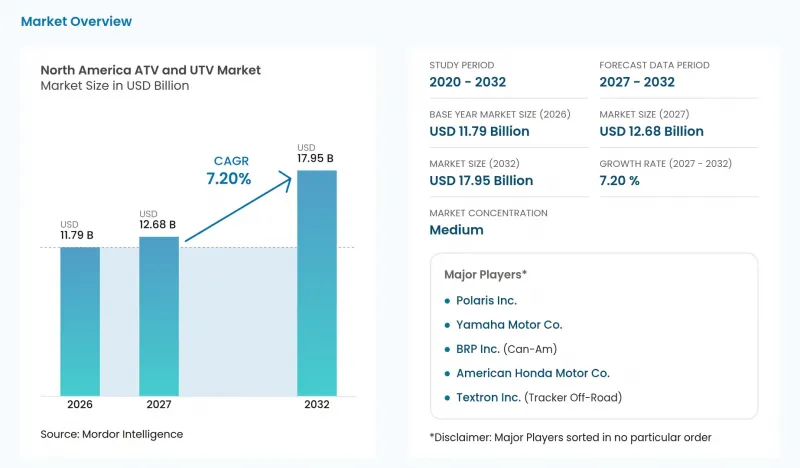
This report is segmented by Vehicle Type (Utility Terrain Vehicles and more), Propulsion/Fuel Type (Gasoline and more), End-use Industry (Recreation & Sports and more), Seating/Capacity (2 - 3 seat and more), Drive Type (4-Wheel Drive and more), and Geography (United States and more). The market forecasts are provided in terms of value (USD), based on availability.
North America ATV and UTV Market Trends and Insights
Growing agricultural mechanization needs
Farm mechanization supports vehicle demand through specific transport jobs and access to livestock and fields. Kansas State University Research and Extension described ATVs and UTVs as essential tools on Kansas farms and ranches in May 2025. In the same account, ATVs were used for livestock checks and weed spraying, while UTVs were described as suited to transporting tools, feed, and calves. That distinction makes carrying capability relevant alongside access across fields. A farm or ranch needing both kinds of work therefore has a reason to own both vehicle types, with the choice following the task.
Rising recreational & motorsports activities
Connected riding routes can strengthen the ownership case by turning individual trail sections into a longer recreational itinerary. Pennsylvania DCNR announced nearly 1,000 miles of connected roads and trails for the Northcentral Regional ATV Trail's 2026 season across Clinton, Lycoming, Potter, and Tioga counties. The announced network included 130 additional miles, with the season scheduled from May 22 through September 27, 2026. Such access can make the same vehicle useful for a longer planned outing, with route continuity adding value to the ownership proposition. An expanded, season-bound network can support a specific recreational offer, making access to connected riding a commercial feature alongside vehicle performance.
High purchase & maintenance costs
Borrowing costs can restrict recreational vehicle purchases because they raise the payment attached to a financed vehicle. Polaris linked inflation, higher borrowing costs, and negative headlines with cautious North American recreational off-road vehicle consumers and a pressured retail outlook in Q2 2026. For a financed ATV or UTV, a higher borrowing rate increases the payment attached to the same vehicle price. The pressure is especially relevant to discretionary recreation, where the vehicle represents an additional household commitment. An entry-level model can lower the amount financed, but borrowing expenses still raise the cost of completing the sale.
Other drivers and restraints analyzed in the detailed report include:
- Silent electric SxS demand in conservation & hunting
- Technological advances in suspension & safety
- Lithium supply-chain volatility
For complete list of drivers and restraints, kindly check the Table Of Contents.
Segment Analysis
Utility terrain vehicles (UTVs/side-by-sides) accounted for a 71.25% share of the North America ATV and UTV market size in 2026 and are forecast to be the fastest-growing segment, with a CAGR of 7.34% between 2027 and 2032. Polaris management's unaudited estimates put North American side-by-side retail sales at 525,000 units in 2025, more than twice the 255,000 estimated ATV units. A side-by-side program can address different work and riding uses within this established retail category. That volume gap gives side-by-side platforms the larger base over which suppliers spread development and distribution.
Savannah's planned purchase illustrates an institutional application for ATVs. In March 2025, the Savannah Airport Commission obtained city approval to purchase 2 ATVs for assignment to the Airport Police Department. The airport commission was the purchasing agency and the police department the intended recipient, separating the contracting customer from the vehicle user. The approval gives a prospective ATV supplier a defined public-safety assignment to address through an airport buyer.
Gasoline represented a 62.66% North America ATV and UTV market share in 2026, making it the largest segment. Honda North Carolina Manufacturing is the exclusive source for Honda ATVs sold in North America, including FourTrax and TRX models, with annual ATV capacity of 75,000 units. The 2027 FourTrax Rancher manual specifies unleaded gasoline with a pump octane number of 86 or higher. Because the Rancher runs on pump gasoline of 86 octane or higher, a buyer of a model from that single production source can refuel at ordinary fuel stops.
Electric vehicles are forecast to be the fastest-growing segment, registering a CAGR of 7.4% between 2027 and 2032. Waev launched the GEM eX electric work UTV in the United States in 2025, combining all-terrain capability with street-legal low-speed vehicle (LSV) status. The LSV offering addresses roads with speed limits up to 35 miles per hour (56 kilometers per hour), a distinction from most off-road-only competitors. That combination can address assignments requiring both all-terrain capability and travel on eligible roads. For a commercial buyer, this makes route access a potential reason to choose an electric work vehicle alongside the propulsion system itself.
Complete Report Scope:
- By Vehicle Type
- All-Terrain Vehicles (ATVs)
- Sport ATVs
- Utility/Work ATVs
- Utility Terrain Vehicles (UTVs/Side-by-Sides)
- Sport UTVs
- Multi-purpose UTVs
- All-Terrain Vehicles (ATVs)
- By Propulsion/Fuel Type
- Gasoline
- Diesel
- Electric
- By End-use Industry
- Hybrid
- Recreation & Sports
- Agriculture & Forestry
- Industrial & Construction
- Military & Government
- Search, Rescue & Emergency Services
- By Seating/Capacity
- Single-seat
- 2 - 3 seat
- 4 - 6 seat
- By Drive Type
- 2-Wheel Drive
- 4-Wheel Drive
- All-Wheel Drive
- By Geography
- United States
- Canada
- Rest of North America
List of Companies Covered in this Report:
- Polaris Inc.
- BRP Inc. (Can-Am)
- American Honda Motor Co.
- Yamaha Motor Co.
- Kawasaki Heavy Industries
- Textron Inc. (Tracker Off-Road)
- Suzuki Motor Corp.
- CFMOTO Powersports
- Kubota Corp.
- Deere & Company (Gator)
- Mahindra Automotive NA (ROXOR)
- Segway Powersports
- Hisun Motors Corp.
- DRR USA Inc.
- Intimidator Group, LLC
- ODES Powersports
- Club Car LLC
- Toro Co.
- Kioti (Daedong-USA)
Additional Benefits:
- The market estimate (ME) sheet in Excel format
- 3 months of analyst support
TABLE OF CONTENTS
1 INTRODUCTION
- 1.1 Study Assumptions and Market Definition
- 1.2 Scope of the Study
2 RESEARCH METHODOLOGY
3 EXECUTIVE SUMMARY
4 MARKET LANDSCAPE
- 4.1 Market Overview
- 4.2 Market Drivers
- 4.2.1 Growing agricultural mechanization needs
- 4.2.2 Rising recreational & motorsports activities
- 4.2.3 Silent electric SxS demand in conservation & hunting
- 4.2.4 Technological advances in suspension & safety
- 4.2.5 Trail-tourism incentive programs
- 4.2.6 Rural broadband-enabled fleet connectivity
- 4.3 Market Restraints
- 4.3.1 High purchase & maintenance costs
- 4.3.2 Lithium supply-chain volatility
- 4.3.3 Emission & noise regulation tightening
- 4.3.4 Land-owner liability litigation
- 4.4 Industry Value Chain Analysis
- 4.5 Regulatory Landscape
- 4.6 Technological Outlook
- 4.7 Porter's Five Forces Analysis
- 4.7.1 Threat of New Entrants
- 4.7.2 Bargaining Power of Suppliers
- 4.7.3 Bargaining Power of Buyers
- 4.7.4 Threat of Substitutes
- 4.7.5 Competitive Rivalry
5 MARKET SIZE AND GROWTH FORECASTS (VALUE)
- 5.1 By Vehicle Type
- 5.1.1 All-Terrain Vehicles (ATVs)
- 5.1.1.1 Sport ATVs
- 5.1.1.2 Utility/Work ATVs
- 5.1.2 Utility Terrain Vehicles (UTVs/Side-by-Sides)
- 5.1.2.1 Sport UTVs
- 5.1.2.2 Multi-purpose UTVs
- 5.1.1 All-Terrain Vehicles (ATVs)
- 5.2 By Propulsion/Fuel Type
- 5.2.1 Gasoline
- 5.2.2 Diesel
- 5.2.3 Electric
- 5.3 By End-use Industry
- 5.3.1 Hybrid
- 5.3.2 Recreation & Sports
- 5.3.3 Agriculture & Forestry
- 5.3.4 Industrial & Construction
- 5.3.5 Military & Government
- 5.3.6 Search, Rescue & Emergency Services
- 5.4 By Seating/Capacity
- 5.4.1 Single-seat
- 5.4.2 2 - 3 seat
- 5.4.3 4 - 6 seat
- 5.5 By Drive Type
- 5.5.1 2-Wheel Drive
- 5.5.2 4-Wheel Drive
- 5.5.3 All-Wheel Drive
- 5.6 By Geography
- 5.6.1 United States
- 5.6.2 Canada
- 5.6.3 Rest of North America
6 COMPETITIVE LANDSCAPE
- 6.1 Market Concentration
- 6.2 Strategic Moves
- 6.3 Market Share Analysis
- 6.4 Company Profiles (includes Global level Overview, Market level overview, Core Segments, Financials as available, Strategic Information, Market Rank/Share for key companies, Products and Services, and Recent Developments)
- 6.4.1 Polaris Inc.
- 6.4.2 BRP Inc. (Can-Am)
- 6.4.3 American Honda Motor Co.
- 6.4.4 Yamaha Motor Co.
- 6.4.5 Kawasaki Heavy Industries
- 6.4.6 Textron Inc. (Tracker Off-Road)
- 6.4.7 Suzuki Motor Corp.
- 6.4.8 CFMOTO Powersports
- 6.4.9 Kubota Corp.
- 6.4.10 Deere & Company (Gator)
- 6.4.11 Mahindra Automotive NA (ROXOR)
- 6.4.12 Segway Powersports
- 6.4.13 Hisun Motors Corp.
- 6.4.14 DRR USA Inc.
- 6.4.15 Intimidator Group, LLC
- 6.4.16 ODES Powersports
- 6.4.17 Club Car LLC
- 6.4.18 Toro Co.
- 6.4.19 Kioti (Daedong-USA)
7 MARKET OPPORTUNITIES AND FUTURE OUTLOOK
- 7.1 White-Space and Unmet-Need Assessment

