PUBLISHER: Mordor Intelligence | PRODUCT CODE: 2187352

PUBLISHER: Mordor Intelligence | PRODUCT CODE: 2187352
Advertising Services - Market Share Analysis, Industry Trends & Statistics, Growth Forecasts (2027 - 2032)
According to Mordor Intelligence, the advertising services market size is expected to grow from USD 1.23 trillion in 2026 to USD 1.4 trillion in 2027 and is forecast to reach USD 2.6 trillion by 2032 at 13.18% CAGR over 2027-2032.
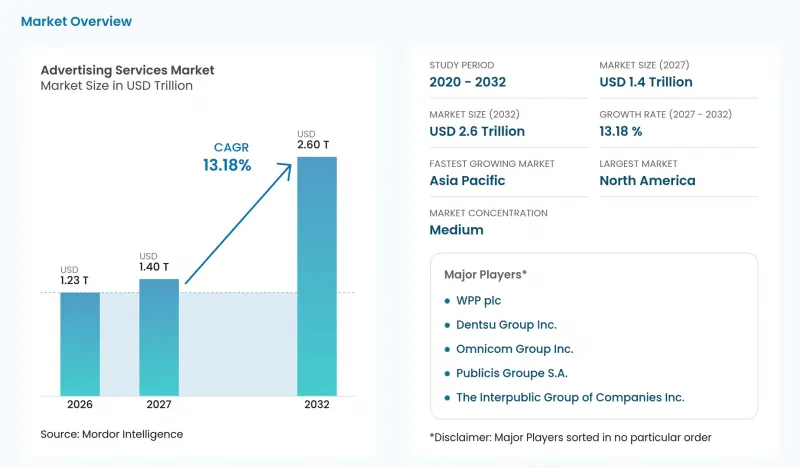
This report is segmented by Platform (Online and more), Advertising Channel (Social-Media Publishing and more), End-user Industry (Retail and more), Agency Type (Full-Service Integrated Agency and more), and Geography (North America and more). The market forecasts are provided in terms of value (USD), based on availability.
Global Advertising Services Market Trends and Insights
Rise of Mobile-first Programmatic Video Advertising
Video growth supports advertising-service demand through complementary work in format planning and the execution of automated media purchases. U.S. digital video advertising revenue grew 25.4% year over year in 2025, compared with 19.2% growth in 2024. That category includes connected TV, social video, online video and short-form video. Separately, 58% of Australian content publishers' video inventory was bought programmatically in the December 2025 quarter. The breadth of video formats makes selecting the appropriate creative treatment a distinct task from arranging an automated inventory purchase. That separation supports distinct fees for video creative adaptation alongside programmatic placement, linking service revenue to format requirements as well as inventory volume.
Expanding Social-commerce and Influencer Ecosystems
Creator-led advertising demand extends to media placements around creators as well as the direct relationships between brands and creative talent. IAB estimated U.S. creator advertising spending at USD 43.9 billion for 2026, 18% above its 2025 estimate. The estimate includes direct partnerships, paid amplification and intentional advertising beside creators with whom brands have no direct partnership, across media channels. Those routes create different assignments for agencies arranging an endorsement and agencies planning placements beside creator content. Creator-focused media buying opens these budgets to placement specialists even when no direct brand-creator contract is involved.
Escalating Digital Ad-fraud and Invalid Traffic
Invalid connected TV impressions create a cost burden because a paid delivery can fail to reach a genuine viewer. DoubleVerify identified fraud as a source of potential advertiser losses in unprotected CTV campaigns. Its regional findings distinguished bots that imitate users from traffic generated by data-center servers. Separately, in Q2 2026, the Association of National Advertisers reported that 37.5 cents of each CTV advertising dollar reached an attentive, non-fraudulent impression. These findings make delivery volume an incomplete basis for judging the quality of a purchased contact. Verifying CTV delivery adds a service cost before buyers can distinguish paid impressions from attentive human exposure.
Other drivers and restraints analyzed in the detailed report include:
- Accelerating Shift of SMB Budgets to Self-serve Digital Platforms
- Retail-media Networks Monetizing First-party Shopper Data
- Widespread Consumer Ad-blocking and Fatigue
For complete list of drivers and restraints, kindly check the Table Of Contents.
Segment Analysis
Online accounted for a 62.04% share of the advertising services market size in 2026, making it the largest segment, and is forecast to be the fastest-growing segment at a 13.75% CAGR over 2027-2032. IAB and PwC reported U.S. internet advertising revenue of USD 294.6 billion in 2025, up 13.9% year over year. The IAB and PwC figure is compiled from revenue reported by companies selling advertising on the internet, so it measures placement sales by websites, ad networks, exchanges and mobile providers. Separately billed planning, creative and optimization work is a distinct service line, which gives suppliers without their own inventory a way into the online segment.
IAB Australia reported 14% year-over-year internet advertising growth in FY26, providing a separate example of demand beyond the United States. That country-level expansion supports a service offering adapted to the local digital advertising business. Offline advertising also attracts continued commitments, with 70% of the top 100 U.S. out-of-home advertisers increasing spending in 2025 compared with 2024. These buyers illustrate why a digital growth strategy can coexist with a distinct physical-placement offering. Agencies can pursue expanding digital assignments while preserving a separate capability for clients whose campaigns include out-of-home media.
Social-media publishing represented a 29.49% advertising services market share in 2026, making it the largest segment. IAB and PwC reported U.S. social-media advertising revenue of USD 117.7 billion in 2025. Their measure covers targeted advertising through social platforms, messaging applications and social news feeds. That breadth gives an agency several placement environments to address within a social advertising assignment, even when the buyer treats social as one channel.
Influencer and creator marketing is forecast to be the fastest-growing segment at a 14.7% CAGR over 2027-2032. IAB UK reported 20.1% growth in creator-partnership revenue in 2025 from 2024 for campaigns targeting UK consumers on creators' own digital platforms. The measure includes production, distribution and digital rights. These components give providers several responsibilities to price within the creator's campaign, rather than reducing the assignment to the appearance of a sponsored message. Pricing digital rights alongside production links the assignment to the uses the advertiser acquires, creating a revenue component beyond the initial creative output.
Complete Report Scope:
- By Platform
- Online
- Offline
- By Advertising Channel
- Social-media publishing
- Search-engine ads
- Display and online video
- Influencer / creator marketing
- Native advertising
- TV spots
- Radio commercials
- Print media
- Outdoor and transit (OOH / DOOH)
- Direct mail
- By End-user Industry
- Retail (incl. grocery)
- Ecommerce and DTC brands
- Travel and tourism
- Media and entertainment
- Financial services
- Healthcare and pharma
- Automotive
- Other End-user Industries
- By Agency Type
- Full-service integrated agency
- Media-buying and planning agency
- Digital-only performance agency
- Creative boutique
- In-house brand studio
- By Geography
- North America
- United States
- Canada
- Mexico
- South America
- Brazil
- Argentina
- Rest of South America
- Europe
- Germany
- United Kingdom
- France
- Italy
- Spain
- Russia
- Rest of Europe
- Asia Pacific
- China
- Japan
- India
- South Korea
- Southeast Asia
- Rest of Asia Pacific
- Middle East and Africa
- Saudi Arabia
- United Arab Emirates
- Turkey
- South Africa
- Rest of Middle East
- North America
Geography Analysis
North America accounted for a 37.88% share of the advertising services market size in 2026, making it the largest geography. WPP Media's June 2026 forecast identified the region as an engine of global advertising growth driven by the United States. Canadian digital advertising revenue reached CAD 21.1 billion (USD 15.1 billion) in 2025, up 16% year over year. That expansion gives providers an additional national demand base for North American advertising assignments. Serving that growth requires Canadian campaign execution, so U.S. scale alone is an incomplete basis for a regional service offering.
Asia Pacific is the fastest-growing geography, with a forecast CAGR of 14.1% over 2027-2032. Dentsu's December 2025 outlook forecast rising advertising spending in China and India in 2026, identifying major sporting events and rapid digital expansion as supports. Digital expansion supports assignments in both creative production and media placement, while sporting events provide a specific occasion around which an advertiser can commission a campaign. Combining those briefs with longer-lived digital assignments can extend the agency relationship beyond the sporting occasion, making campaign duration part of the service proposition for advertisers in China and India.
In South America, Brazil's 330-agency Cenp-Meios panel tracked executed 2025 insertion orders across media and locations, while Chile's AAM members reported direct and programmatic digital buying in July 2026, excluding retail media. European retailers' digital-property advertising expanded in 2025 at constant currency, while Poland's digital advertising grew 15% year over year, with search benefiting most and video and display gaining budget share. Middle East and North Africa's connected TV advertising grew 31% year over year in 2025, while Arabian Contracting Services Co.'s affiliate Arabian United Media Services Company signed a Cairo transport-advertising contract. Signed May 5, 2025, the exclusive 10-year agreement with MOT Investment and Development Co. covered screens at 28 bus rapid transit stations and 10 static pedestrian advertising bridges on Greater Cairo's Ring Road. Chile's reported direct and programmatic buying and Poland's shift toward video and display present suppliers with different channel mixes.
- WPP plc
- Omnicom Group Inc.
- The Interpublic Group of Companies Inc.
- Publicis Groupe S.A.
- Dentsu Group Inc.
- Havas N.V.
- Stagwell Inc.
- Accenture plc (Accenture Song)
- Hakuhodo DY Holdings Inc.
- Deloitte Touche Tohmatsu Ltd. (Deloitte Digital)
- PwC Advisory Services LLP (PwC Digital Services)
- Cognizant Technology Solutions Corp. (Cognizant Interactive)
- IBM Corp. (IBM iX)
- Salesforce Inc. (Marketing Cloud Services)
- Lamar Advertising Company
- JCDecaux SE
- Clear Channel Outdoor Holdings Inc.
- Fiverr International Ltd.
- S4 Capital plc (Monks)
- Wieden + Kennedy Inc.
- Droga5 LLC
- Serviceplan Group SE & Co. KG
- M&C Saatchi plc
Additional Benefits:
- The market estimate (ME) sheet in Excel format
- 3 months of analyst support
TABLE OF CONTENTS
1 INTRODUCTION
- 1.1 Study Assumptions and Market Definition
- 1.2 Scope of the Study
2 RESEARCH METHODOLOGY
3 EXECUTIVE SUMMARY
4 MARKET LANDSCAPE
- 4.1 Market Overview
- 4.2 Market Drivers
- 4.2.1 Rise of Mobile-first Programmatic Video Advertising
- 4.2.2 Expanding Social-commerce and Influencer Ecosystems
- 4.2.3 Accelerating Shift of SMB Budgets to Self-serve Digital Platforms
- 4.2.4 Retail-media Networks Monetizing First-party Shopper Data
- 4.2.5 Cookieless Identity Solutions Boosting First-party Data Activation
- 4.2.6 Generative-AI Creative Optimization Cutting Campaign Cycle Times
- 4.3 Market Restraints
- 4.3.1 Escalating Digital Ad-fraud and Invalid Traffic
- 4.3.2 Widespread Consumer Ad-blocking and Fatigue
- 4.3.3 Stricter Global Privacy Regulations (GDPR, CPRA, PIPL)
- 4.3.4 Data-analytics Talent Shortage Within Full-service Agencies
- 4.4 Industry Value Chain Analysis
- 4.5 Regulatory Landscape
- 4.6 Technological Outlook
- 4.7 Porter's Five Forces Analysis
- 4.7.1 Threat of New Entrants
- 4.7.2 Bargaining Power of Suppliers
- 4.7.3 Bargaining Power of Buyers
- 4.7.4 Threat of Substitutes
- 4.7.5 Competitive Rivalry
5 MARKET SIZE AND GROWTH FORECASTS (VALUE)
- 5.1 By Platform
- 5.1.1 Online
- 5.1.2 Offline
- 5.2 By Advertising Channel
- 5.2.1 Social-media publishing
- 5.2.2 Search-engine ads
- 5.2.3 Display and online video
- 5.2.4 Influencer / creator marketing
- 5.2.5 Native advertising
- 5.2.6 TV spots
- 5.2.7 Radio commercials
- 5.2.8 Print media
- 5.2.9 Outdoor and transit (OOH / DOOH)
- 5.2.10 Direct mail
- 5.3 By End-user Industry
- 5.3.1 Retail (incl. grocery)
- 5.3.2 Ecommerce and DTC brands
- 5.3.3 Travel and tourism
- 5.3.4 Media and entertainment
- 5.3.5 Financial services
- 5.3.6 Healthcare and pharma
- 5.3.7 Automotive
- 5.3.8 Other End-user Industries
- 5.4 By Agency Type
- 5.4.1 Full-service integrated agency
- 5.4.2 Media-buying and planning agency
- 5.4.3 Digital-only performance agency
- 5.4.4 Creative boutique
- 5.4.5 In-house brand studio
- 5.5 By Geography
- 5.5.1 North America
- 5.5.1.1 United States
- 5.5.1.2 Canada
- 5.5.1.3 Mexico
- 5.5.2 South America
- 5.5.2.1 Brazil
- 5.5.2.2 Argentina
- 5.5.2.3 Rest of South America
- 5.5.3 Europe
- 5.5.3.1 Germany
- 5.5.3.2 United Kingdom
- 5.5.3.3 France
- 5.5.3.4 Italy
- 5.5.3.5 Spain
- 5.5.3.6 Russia
- 5.5.3.7 Rest of Europe
- 5.5.4 Asia Pacific
- 5.5.4.1 China
- 5.5.4.2 Japan
- 5.5.4.3 India
- 5.5.4.4 South Korea
- 5.5.4.5 Southeast Asia
- 5.5.4.6 Rest of Asia Pacific
- 5.5.5 Middle East and Africa
- 5.5.5.1 Saudi Arabia
- 5.5.5.2 United Arab Emirates
- 5.5.5.3 Turkey
- 5.5.5.4 South Africa
- 5.5.5.5 Rest of Middle East
- 5.5.1 North America
6 COMPETITIVE LANDSCAPE
- 6.1 Market Concentration
- 6.2 Strategic Moves
- 6.3 Market Share Analysis
- 6.4 Company Profiles (includes Global level Overview, Market level overview, Core Segments, Financials as available, Strategic Information, Market Rank/Share for key companies, Products and Services, and Recent Developments)
- 6.4.1 WPP plc
- 6.4.2 Omnicom Group Inc.
- 6.4.3 The Interpublic Group of Companies Inc.
- 6.4.4 Publicis Groupe S.A.
- 6.4.5 Dentsu Group Inc.
- 6.4.6 Havas N.V.
- 6.4.7 Stagwell Inc.
- 6.4.8 Accenture plc (Accenture Song)
- 6.4.9 Hakuhodo DY Holdings Inc.
- 6.4.10 Deloitte Touche Tohmatsu Ltd. (Deloitte Digital)
- 6.4.11 PwC Advisory Services LLP (PwC Digital Services)
- 6.4.12 Cognizant Technology Solutions Corp. (Cognizant Interactive)
- 6.4.13 IBM Corp. (IBM iX)
- 6.4.14 Salesforce Inc. (Marketing Cloud Services)
- 6.4.15 Lamar Advertising Company
- 6.4.16 JCDecaux SE
- 6.4.17 Clear Channel Outdoor Holdings Inc.
- 6.4.18 Fiverr International Ltd.
- 6.4.19 S4 Capital plc (Monks)
- 6.4.20 Wieden + Kennedy Inc.
- 6.4.21 Droga5 LLC
- 6.4.22 Serviceplan Group SE & Co. KG
- 6.4.23 M&C Saatchi plc
7 MARKET OPPORTUNITIES AND FUTURE OUTLOOK
- 7.1 White-Space and Unmet-Need Assessment

