PUBLISHER: Mordor Intelligence | PRODUCT CODE: 2187365

PUBLISHER: Mordor Intelligence | PRODUCT CODE: 2187365
E-learning - Market Share Analysis, Industry Trends & Statistics, Growth Forecasts (2027 - 2032)
According to Mordor Intelligence, the e-learning market size is estimated at USD 275.9 billion in 2026 and is projected to be USD 305.8 billion in 2027, reaching USD 506.6 billion by 2032, growing at a CAGR of 10.62% from 2027 to 2032.
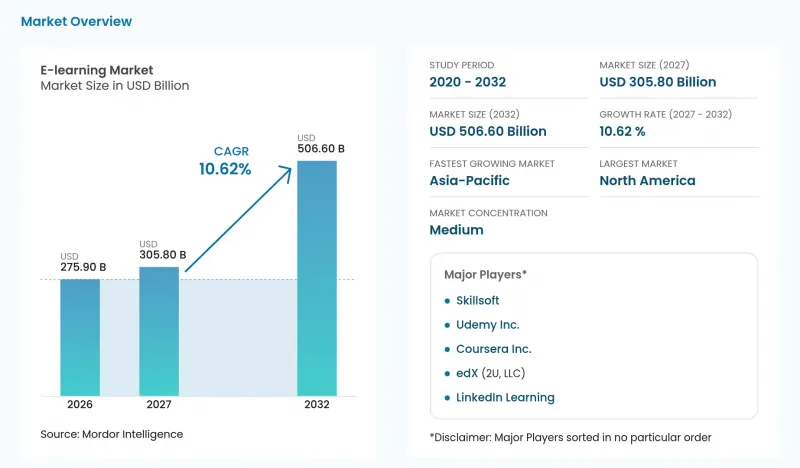
This report is segmented by Delivery Mode (Self-Paced and Instructor-Led), Deployment (Cloud and On-Premise), Technology (Online e-learning, Mobile e-learning, and more), End-User (Academic, Corporate, and more), and Geography (North America, Europe, and more). The market forecasts are provided in terms of value (USD), based on availability.
Global E-learning Market Trends and Insights
Growing penetration of smartphones & high-speed internet
Connected-device reach expands the potential audience for learning services, while network capability determines which forms of instruction can reach that audience. ITU reported that 5G coverage had expanded to 55% of the world's population in 2025. GSMA reported 4.8 billion people using mobile internet on their own device by the end of 2025. However, additions slowed to around 160 million people during 2025 from 190 million in 2024. Learning providers must convert connected users into learners to turn this distribution base into demand. Course distribution aimed at existing users can therefore address a much broader population than offers relying solely on first-time mobile-internet users.
Corporate up-skilling demand amid digital transformation
Employers' skills priorities create an opening for digital-learning suppliers that can serve training needs through organizational accounts. For 2025-2030, 85% of employers surveyed by the World Economic Forum expected to prioritize workforce upskilling in response to macrotrends. Coursera Inc. reported 1,730 paid enterprise customers at December 31, 2025, up 7% year over year. This direct-sales measure combines business, campus, and government accounts, excludes Teams and channel customers, and may count organizational divisions separately. Together, the findings connect an expressed training priority with measured account expansion for an online-learning supplier, creating a basis for organizational demand. An employer account gives suppliers a route to serve workforce learning without acquiring every employee as a separate retail customer.
Low completion rates & learner-engagement challenges
Remote instruction does not remove the work required to keep learners involved, creating a service burden alongside the delivery platform. In a 2025 survey, 72% of organizations cited learner engagement as their top challenge with virtual instructor-led training. For training suppliers, this makes a connected classroom an incomplete solution when the teaching format fails to sustain participation. Buyers seeking useful instruction must consider the facilitation needed to turn attendance into active learning, complicating a purchase based solely on delivery capacity. That requirement can limit the cost advantage available from moving instruction online if additional teaching effort is needed. The remaining constraint is the expense of supporting engagement within the remote session itself.
Other drivers and restraints analyzed in the detailed report include:
- Government initiatives for digital education
- Cost advantages over classroom training
- Digital divide in rural & low-income areas
For complete list of drivers and restraints, kindly check the Table Of Contents.
Segment Analysis
Self-paced accounted for a 57.67% share of the e-learning market size in 2026. Pearson's 2025 presentation reported about 500,000 paid subscribers for its Mondly online English language learning tools. Mondly's business solutions include at least 130 hours of self-paced learning. Learner-controlled pacing separates access to instruction from the scheduling of a shared teaching session, allowing purchasers to progress through material at different times. Flexible timing widens the circumstances in which a subscription is usable, so this library can serve learners who cannot attend scheduled sessions.
Instructor-led is the fastest-growing segment, with a forecast CAGR of 12.5% from 2027 to 2032. A 2026 Class and Training magazine report found that 98% of 545 surveyed organizations used virtual instructor-led training, with 40% relying on it for at least half their training programs. This usage connects the format to organizational program delivery, giving guided virtual instruction an established place within the surveyed buyers' training activities. For suppliers, the commercial task is to provide teaching capacity suited to live programs and the cohorts using them. With adoption already widespread in this sample, suppliers can target a larger role within existing training programs through services that accommodate additional guided instruction.
Cloud was the largest and fastest-growing segment, with a 54.82% share in 2026 and a forecast CAGR of 11.55% from 2027 to 2032. Shanghai Able Digital's Cloud LMS had 676 subscribing customers in China in 2025. Cloud deployment combines access to learning-management software with the supplier's responsibility for operating the hosted system throughout each customer's subscription. Across a base of 676 subscribers, that service relationship gives the provider an opportunity to earn from continuing platform access as well as winning new customers.
On-premise deployments also create migration work when institutions change how they operate their learning environment. On-premise infrastructure at the University of Portsmouth hosted more than 3,000 Moodle modules and courses before the university migrated them, with associated files, activities, and enrollments, to cloud in summer 2025. Cloud Moodle began operating in August 2025 after that move from on-premise hosting. For university buyers, a change in hosting therefore involves moving the course environment and its associated records, making the transition broader than the selection of a new access arrangement. Completing the move before the new academic year made migration timing part of instructional continuity even though the university kept Moodle.
Complete Report Scope:
- By Delivery Mode
- Self-Paced
- Instructor-Led
- By Deployment
- Cloud
- On-Premise
- By Technology
- Online e-learning
- Learning Management System (LMS)
- Mobile e-learning
- Rapid e-learning
- Virtual Classroom
- By End-User
- Academic
- Corporate
- Government & Public Sector
- By Geography
- North America
- United States
- Canada
- Mexico
- South America
- Brazil
- Peru
- Chile
- Argentina
- Rest of South America
- Europe
- United Kingdom
- Germany
- France
- Spain
- Italy
- BENELUX (Belgium, Netherlands, Luxembourg)
- NORDICS (Denmark, Finland, Iceland, Norway, Sweden)
- Rest of Europe
- Asia-Pacific
- India
- China
- Japan
- Australia
- South Korea
- South East Asia (Singapore, Malaysia, Thailand, Indonesia, Vietnam, Philippines)
- Rest of Asia-Pacific
- Middle East & Africa
- United Arab Emirates
- Saudi Arabia
- South Africa
- Nigeria
- Rest of Middle East & Africa
- North America
Geography Analysis
North America represented 34.41% of the e-learning market size in 2026. In 2024-25, 6,206,019 undergraduates at U.S. Title IV institutions were enrolled exclusively in distance-education courses, measured as 12-month unduplicated headcount. Public institutions accounted for 4,311,654 of those undergraduates, and total graduate enrollment exclusively in distance-education courses across U.S. Title IV institutions was 1,829,746. The public-campus concentration identifies where suppliers can reach much of this U.S. undergraduate learning population, making public institutions a central academic channel for online course delivery within North America.
Asia-Pacific is forecast to grow at a CAGR of 12.2% from 2027 to 2032. Coursera reported regional revenue of USD 108.9 million in 2025, up from USD 89.7 million in 2024, allocated by customer billing address. In May 2026, Philippine Normal University signed a one-year OpenLearning LMS agreement for 5,000 students through reseller CE-Logic Inc., specifying a June 1, 2026 start. The one-year, 5,000-student term was in line with Philippine procurement rules limiting the duration and value of public-institution contracts, with expansion to all 12,000 university students an opportunity under a longer-term arrangement. Institutional procurement therefore stages how quickly this LMS rollout can widen, making growth through larger university contracts contingent on subsequent agreements.
Europe combines established online participation with varied delivery settings, with 34.8% of EU internet users reporting online courses or learning-material use for the first quarter of 2025. In South America, 449 students graduated in 2025 from Argentina's rural digital-platform school model across 6 provinces, with urban teachers and local tutors supporting instruction. Within the Middle East and Africa, the Democratic Republic of the Congo's education minister described locally hosted tablet content for students without internet at a March 2025 UNESCO webinar. The latter examples make local teaching support and offline content delivery distinct ways to extend digital instruction into underserved classrooms. A platform-only supplier would need local teaching partners or an offline delivery option to address the rural and disconnected classrooms in these examples.
- Coursera Inc.
- Udemy Inc.
- LinkedIn Learning
- edX (2U, LLC)
- Skillsoft
- Pluralsight
- Blackboard Inc.
- Instructure (Canvas)
- Cornerstone OnDemand
- Moodle
- Docebo S.p.A.
- Pearson plc
- Litmos
- G-Cube
- Chegg Inc.
- Udacity
- D2L Corp. (Brightspace)
- Google LLC (Classroom)
- Aptara
- FutureLearn Ltd.
Additional Benefits:
- The market estimate (ME) sheet in Excel format
- 3 months of analyst support
TABLE OF CONTENTS
1 INTRODUCTION
- 1.1 Study Assumptions and Market Definition
- 1.2 Scope of the Study
2 RESEARCH METHODOLOGY
3 EXECUTIVE SUMMARY
4 MARKET LANDSCAPE
- 4.1 Market Overview
- 4.2 Market Drivers
- 4.2.1 Growing penetration of smartphones & high-speed internet
- 4.2.2 Corporate up-skilling demand amid digital transformation
- 4.2.3 Government initiatives for digital education
- 4.2.4 Cost advantages over classroom training
- 4.2.5 Rise of micro-credential partnerships between universities & Big Tech
- 4.2.6 EdTech venture funding shift toward emerging markets
- 4.3 Market Restraints
- 4.3.1 Low completion rates & learner-engagement challenges
- 4.3.2 Digital divide in rural & low-income areas
- 4.3.3 Content-localization barriers for multilingual markets
- 4.3.4 Data-privacy regulatory complexity
- 4.4 Industry Value Chain Analysis
- 4.5 Regulatory Landscape
- 4.6 Technological Outlook
- 4.7 Porter's Five Forces Analysis
- 4.7.1 Threat of New Entrants
- 4.7.2 Bargaining Power of Suppliers
- 4.7.3 Bargaining Power of Buyers
- 4.7.4 Threat of Substitutes
- 4.7.5 Competitive Rivalry
- 4.8 Consumer Behavior Insights in the E-Learning Market
5 MARKET SIZE AND GROWTH FORECASTS (VALUE)
- 5.1 By Delivery Mode
- 5.1.1 Self-Paced
- 5.1.2 Instructor-Led
- 5.2 By Deployment
- 5.2.1 Cloud
- 5.2.2 On-Premise
- 5.3 By Technology
- 5.3.1 Online e-learning
- 5.3.2 Learning Management System (LMS)
- 5.3.3 Mobile e-learning
- 5.3.4 Rapid e-learning
- 5.3.5 Virtual Classroom
- 5.4 By End-User
- 5.4.1 Academic
- 5.4.2 Corporate
- 5.4.3 Government & Public Sector
- 5.5 By Geography
- 5.5.1 North America
- 5.5.1.1 United States
- 5.5.1.2 Canada
- 5.5.1.3 Mexico
- 5.5.2 South America
- 5.5.2.1 Brazil
- 5.5.2.2 Peru
- 5.5.2.3 Chile
- 5.5.2.4 Argentina
- 5.5.2.5 Rest of South America
- 5.5.3 Europe
- 5.5.3.1 United Kingdom
- 5.5.3.2 Germany
- 5.5.3.3 France
- 5.5.3.4 Spain
- 5.5.3.5 Italy
- 5.5.3.6 BENELUX (Belgium, Netherlands, Luxembourg)
- 5.5.3.7 NORDICS (Denmark, Finland, Iceland, Norway, Sweden)
- 5.5.3.8 Rest of Europe
- 5.5.4 Asia-Pacific
- 5.5.4.1 India
- 5.5.4.2 China
- 5.5.4.3 Japan
- 5.5.4.4 Australia
- 5.5.4.5 South Korea
- 5.5.4.6 South East Asia (Singapore, Malaysia, Thailand, Indonesia, Vietnam, Philippines)
- 5.5.4.7 Rest of Asia-Pacific
- 5.5.5 Middle East & Africa
- 5.5.5.1 United Arab Emirates
- 5.5.5.2 Saudi Arabia
- 5.5.5.3 South Africa
- 5.5.5.4 Nigeria
- 5.5.5.5 Rest of Middle East & Africa
- 5.5.1 North America
6 COMPETITIVE LANDSCAPE
- 6.1 Market Concentration
- 6.2 Strategic Moves
- 6.3 Market Share Analysis
- 6.4 Company Profiles (includes Global level Overview, Market level overview, Core Segments, Financials as available, Strategic Information, Market Rank/Share for key companies, Products and Services, and Recent Developments)
- 6.4.1 Coursera Inc.
- 6.4.2 Udemy Inc.
- 6.4.3 LinkedIn Learning
- 6.4.4 edX (2U, LLC)
- 6.4.5 Skillsoft
- 6.4.6 Pluralsight
- 6.4.7 Blackboard Inc.
- 6.4.8 Instructure (Canvas)
- 6.4.9 Cornerstone OnDemand
- 6.4.10 Moodle
- 6.4.11 Docebo S.p.A.
- 6.4.12 Pearson plc
- 6.4.13 Litmos
- 6.4.14 G-Cube
- 6.4.15 Chegg Inc.
- 6.4.16 Udacity
- 6.4.17 D2L Corp. (Brightspace)
- 6.4.18 Google LLC (Classroom)
- 6.4.19 Aptara
- 6.4.20 FutureLearn Ltd.
7 MARKET OPPORTUNITIES AND FUTURE OUTLOOK
- 7.1 White-Space and Unmet-Need Assessment

