PUBLISHER: Mordor Intelligence | PRODUCT CODE: 2187366

PUBLISHER: Mordor Intelligence | PRODUCT CODE: 2187366
Footwear - Market Share Analysis, Industry Trends & Statistics, Growth Forecasts (2027 - 2032)
According to Mordor Intelligence, the footwear market size is expected to increase from USD 400.6 billion in 2026 to USD 413.9 billion in 2027 and reach USD 482.1 billion by 2032, growing at a CAGR of 3.1% over 2027-2032.
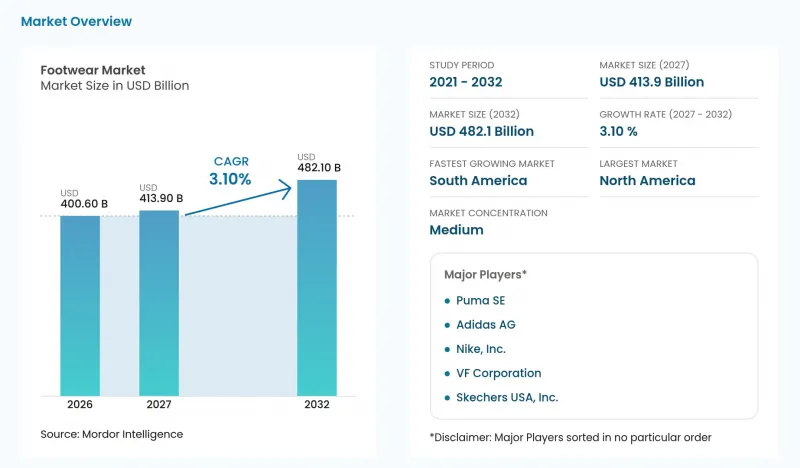
This report is segmented by Product Type (Non-Athletic Footwear and Athletic Footwear), End User (Women, Men, and more), Category (Mass and Premium), Distribution Channel (Specialty Stores, Online Retail Stores, and more), and Geography (North America, Asia-Pacific, and more). The market forecasts are provided in terms of value (USD), based on availability.
Global Footwear Market Trends and Insights
Surging Demand for Athleisure Footwear
Back-to-school spending gives athletic and athleisure footwear a demand opportunity beyond purchases tied solely to sporting activity. In a June 2026 U.S. survey, consumers expected back-to-school net spending on athletic and athleisure shoes to rise 11% from 2025. This expectation gives suppliers a reason to address the school-season buying occasion with a combined performance and everyday-wear proposition. The commercial mechanism is broader relevance for the same footwear category rather than dependence on a single sport. Brands can pursue that demand through versatile designs while preserving a clear reason for choosing the shoe. For retailers, the opportunity centers on capturing a defined seasonal spending intention before it disperses across competing product choices.
Aggressive Marketing and Influencer Collaborations
Marketing partnerships give footwear brands a route to connect functional products with a recognizable cultural identity. On November 10, 2025, Skechers announced actress and entrepreneur Sofia Vergara as its newest brand ambassador for fashion-meets-comfort footwear. Adidas reported more than 9 billion views and over 400 million engagements across its digital ecosystem for its 2026 World Cup marketing. That brand-wide exposure illustrates the scale at which partnership-based storytelling can compete for consumer attention. For comfort footwear, a style-focused ambassador offers a more specific route into fashion consideration than broad campaign reach alone. The commercial task is to connect that attention to the shoe's particular appeal, so recognition supports a product choice rather than becoming the entire proposition.
Extensive Availability of Counterfeit Products
Counterfeit availability constrains legitimate brands by serving demand that may not transfer readily to authentic footwear. The UK Intellectual Property Office's 2025 survey covered 200 UK adults who knowingly bought counterfeit footwear, excluding sports footwear. Asked what they would do without counterfeits, 22% said they would buy from the brand, 21% said they would go without footwear, and 40% would choose similar cheaper products. These hypothetical choices suggest that counterfeit buyers are difficult for original suppliers to win back, even if imitation supply is removed. Counterfeit access leaves legitimate brands contesting a price-sensitive customer base whose stated alternatives often lead away from the original brand.
Other drivers and restraints analyzed in the detailed report include:
- Rise of Sustainable and Bio-based Materials
- Growth of D2C Digital-Native Footwear Brands
- Volatile Raw-Material Prices and Supply-Chain Disruptions
For complete list of drivers and restraints, kindly check the Table Of Contents.
Segment Analysis
Non-athletic footwear accounted for a 56.65% share of the footwear market size in 2026. Crocs Brand's footwear and related accessories generated USD 1 billion worldwide in Q2 2026, up 4.3% in reported dollars from Q2 2025. Crocs describes Croslite, used in the vast majority of its brand's footwear, as a proprietary closed-cell resin formulated for lightweight, water-resistant comfort. Those characteristics give a casual franchise a construction-based proposition alongside its visual identity. Crocs sold 128.9 million Crocs Brand footwear units in 2025, up 1.5% from 2024, giving its widely used comfort material a high-volume commercial base.
Athletic footwear is the fastest-growing segment, with a forecast CAGR of 4.5% over 2027-2032. Adidas reported double-digit footwear revenue increases in several Performance categories in the first half of 2026, led by Running, Training, and Motorsport. The company attributed those results to a wider product offering and product innovation. These distinct sporting uses offer several routes to performance demand, allowing a footwear supplier to develop more than one commercial franchise.
Women represented a 48.78% footwear market share in 2026. Women's footwear represented 61% of Caleres' total net sales in fiscal 2025, which ended January 31, 2026. Caleres also said its Brand Portfolio gained share in women's fashion footwear during the 13 weeks ended August 1, 2026, according to Circana. A substantial company sales base can thus coexist with an opportunity to improve competitive position within women's footwear. With women's footwear supplying most of Caleres' sales, category-specific product and brand decisions can influence the commercial performance of its wider portfolio.
Kids' footwear is forecast to be the fastest-growing segment, at a CAGR of 4.4% over 2027-2032. 361 Degrees International Limited reported 11.7% year-over-year growth in its Kids footwear revenue for the six months ended June 30, 2026. The group's revenue and results primarily came from sales in China. A dedicated kids' footwear business can address the young wearer's fit and the adult buyer's product choice through separate design and communication decisions. Within a China-focused group, growth in children's shoes can diversify the sources of footwear revenue by buyer and wearer, beyond the adult sports customer.
Complete Report Scope:
- By Product Type
- Athletic Footwear
- Running Shoes
- Sports Shoes
- Trekking/Hiking Shoes
- Other Athletic Footwear
- Non-Athletic Footwear
- Boots
- Flip-Flops/Slippers
- Sneakers
- Other Non-Athletic Footwear
- Athletic Footwear
- By End User
- Men
- Women
- Kids
- By Category
- Mass
- Premium
- By Distribution Channel
- Supermarkets/Hypermarkets
- Specialty Stores
- Online Retail Stores
- Other Distribution Channels
- By Geography
- North America
- United States
- Canada
- Mexico
- Rest of North America
- Europe
- Germany
- United Kingdom
- France
- Italy
- Spain
- Russia
- Netherlands
- Belgium
- Sweden
- Rest of Europe
- Asia-Pacific
- China
- India
- Japan
- South Korea
- Australia
- Indonesia
- Rest of Asia-Pacific
- South America
- Brazil
- Argentina
- Colombia
- Rest of South America
- Middle East and Africa
- Saudi Arabia
- United Arab Emirates
- Turkey
- South Africa
- Rest of Middle East and Africa
- North America
Geography Analysis
North America accounted for 31.23% of the footwear market size in 2026. NIKE Brand's North America footwear revenue was USD 13.3 billion in fiscal 2026, up 5% from fiscal 2025 in both reported and currency-neutral terms, through wholesale and NIKE Direct channels. Its regional results included the distinct NIKE and Jordan brands, placing more than one footwear identity within the substantial company revenue base. Serving that base can require channel-specific brand execution, so winning independent wholesale accounts and sustaining demand through the brand's own direct channel are different commercial tasks in North America.
South America is forecast to be the fastest-growing geography, with a CAGR of 4.65% over 2027-2032. Vulcabras reported growth in its Brazilian domestic business in Q2 2026 compared with Q2 2025. The company linked its Q1 2026 athletic-footwear performance to consistent demand across 3 brands and production capacity expansion implemented during 2025. Capacity investment provides an operating route to serving additional footwear demand, linking brand performance with the ability to make more pairs.
Europe was Adidas' home market and its largest region by net sales in 2025. In Asia-Pacific, Adidas opened Originals flagship stores in culturally relevant neighborhoods in Seoul and Shanghai in 2025, displaying many locally exclusive products. Those city-specific assortments can make the retail footprint a tool for product localization as well as distribution. Within Middle East and Africa, South Africa's reported footwear exports to destinations outside Botswana, Eswatini, Lesotho, and Namibia totaled 3.69 million pairs in 2025. These examples show distinct commercial bases, with Adidas' home-market sales position in Europe, locally exclusive flagship ranges in Seoul and Shanghai, and South African export volume.
- Nike, Inc.
- Adidas AG
- Puma SE
- VF Corporation
- Skechers USA, Inc.
- ASICS Corporation
- Under Armour, Inc.
- New Balance Athletics, Inc.
- Deckers Outdoor Corp.
- Anta Sports Products Ltd.
- Li-Ning Company Ltd.
- ABC-MART
- Kering SA (Gucci)
- Wolverine World Wide, Inc.
- Misto Holdings Corp.
- LVMH Moet Hennessy Louis Vuitton SE (Louis Vuitton)
- Brooks Sports, Inc.
- Bata India
- Columbia Sportswear Company
- Crocs, Inc.
Additional Benefits:
- The market estimate (ME) sheet in Excel format
- 3 months of analyst support
TABLE OF CONTENTS
1 INTRODUCTION
- 1.1 Study Assumptions and Market Definition
- 1.2 Scope of the Study
2 RESEARCH METHODOLOGY
3 EXECUTIVE SUMMARY
4 MARKET LANDSCAPE
- 4.1 Market Overview
- 4.2 Market Drivers
- 4.2.1 Surging Demand for Athleisure Footwear
- 4.2.2 Aggressive Marketing and Influencer Collaborations
- 4.2.3 Rise of Sustainable and Bio-based Materials
- 4.2.4 Growth of D2C Digital-Native Footwear Brands
- 4.2.5 Adoption of Smart and Connected Footwear
- 4.2.6 Expansion of Resale and Sneakerhead Culture
- 4.3 Market Restraints
- 4.3.1 Extensive Availability of Counterfeit Products
- 4.3.2 Volatile Raw-Material Prices and Supply-Chain Disruptions
- 4.3.3 ESG Scrutiny on Labor Practices
- 4.3.4 Anti-Plastic Legislation Limiting Synthetic Uppers
- 4.4 Industry Value Chain Analysis
- 4.5 Regulatory Landscape
- 4.6 Technological Outlook
- 4.7 Porter's Five Forces Analysis
- 4.7.1 Threat of New Entrants
- 4.7.2 Bargaining Power of Suppliers
- 4.7.3 Bargaining Power of Buyers
- 4.7.4 Threat of Substitutes
- 4.7.5 Competitive Rivalry
- 4.8 Consumer Behavior Analysis
5 MARKET SIZE AND GROWTH FORECASTS (VALUE)
- 5.1 By Product Type
- 5.1.1 Athletic Footwear
- 5.1.1.1 Running Shoes
- 5.1.1.2 Sports Shoes
- 5.1.1.3 Trekking/Hiking Shoes
- 5.1.1.4 Other Athletic Footwear
- 5.1.2 Non-Athletic Footwear
- 5.1.2.1 Boots
- 5.1.2.2 Flip-Flops/Slippers
- 5.1.2.3 Sneakers
- 5.1.2.4 Other Non-Athletic Footwear
- 5.1.1 Athletic Footwear
- 5.2 By End User
- 5.2.1 Men
- 5.2.2 Women
- 5.2.3 Kids
- 5.3 By Category
- 5.3.1 Mass
- 5.3.2 Premium
- 5.4 By Distribution Channel
- 5.4.1 Supermarkets/Hypermarkets
- 5.4.2 Specialty Stores
- 5.4.3 Online Retail Stores
- 5.4.4 Other Distribution Channels
- 5.5 By Geography
- 5.5.1 North America
- 5.5.1.1 United States
- 5.5.1.2 Canada
- 5.5.1.3 Mexico
- 5.5.1.4 Rest of North America
- 5.5.2 Europe
- 5.5.2.1 Germany
- 5.5.2.2 United Kingdom
- 5.5.2.3 France
- 5.5.2.4 Italy
- 5.5.2.5 Spain
- 5.5.2.6 Russia
- 5.5.2.7 Netherlands
- 5.5.2.8 Belgium
- 5.5.2.9 Sweden
- 5.5.2.10 Rest of Europe
- 5.5.3 Asia-Pacific
- 5.5.3.1 China
- 5.5.3.2 India
- 5.5.3.3 Japan
- 5.5.3.4 South Korea
- 5.5.3.5 Australia
- 5.5.3.6 Indonesia
- 5.5.3.7 Rest of Asia-Pacific
- 5.5.4 South America
- 5.5.4.1 Brazil
- 5.5.4.2 Argentina
- 5.5.4.3 Colombia
- 5.5.4.4 Rest of South America
- 5.5.5 Middle East and Africa
- 5.5.5.1 Saudi Arabia
- 5.5.5.2 United Arab Emirates
- 5.5.5.3 Turkey
- 5.5.5.4 South Africa
- 5.5.5.5 Rest of Middle East and Africa
- 5.5.1 North America
6 COMPETITIVE LANDSCAPE
- 6.1 Market Concentration
- 6.2 Strategic Moves
- 6.3 Market Share Analysis
- 6.4 Company Profiles (includes Global level Overview, Market level overview, Core Segments, Financials as available, Strategic Information, Market Rank/Share for key companies, Products and Services, and Recent Developments)
- 6.4.1 Nike, Inc.
- 6.4.2 Adidas AG
- 6.4.3 Puma SE
- 6.4.4 VF Corporation
- 6.4.5 Skechers USA, Inc.
- 6.4.6 ASICS Corporation
- 6.4.7 Under Armour, Inc.
- 6.4.8 New Balance Athletics, Inc.
- 6.4.9 Deckers Outdoor Corp.
- 6.4.10 Anta Sports Products Ltd.
- 6.4.11 Li-Ning Company Ltd.
- 6.4.12 ABC-MART
- 6.4.13 Kering SA (Gucci)
- 6.4.14 Wolverine World Wide, Inc.
- 6.4.15 Misto Holdings Corp.
- 6.4.16 LVMH Moet Hennessy Louis Vuitton SE (Louis Vuitton)
- 6.4.17 Brooks Sports, Inc.
- 6.4.18 Bata India
- 6.4.19 Columbia Sportswear Company
- 6.4.20 Crocs, Inc.
7 MARKET OPPORTUNITIES AND FUTURE OUTLOOK
- 7.1 White-Space and Unmet-Need Assessment

