PUBLISHER: Mordor Intelligence | PRODUCT CODE: 2194811

PUBLISHER: Mordor Intelligence | PRODUCT CODE: 2194811
China Footwear - Market Share Analysis, Industry Trends & Statistics, Growth Forecasts (2027 - 2032)
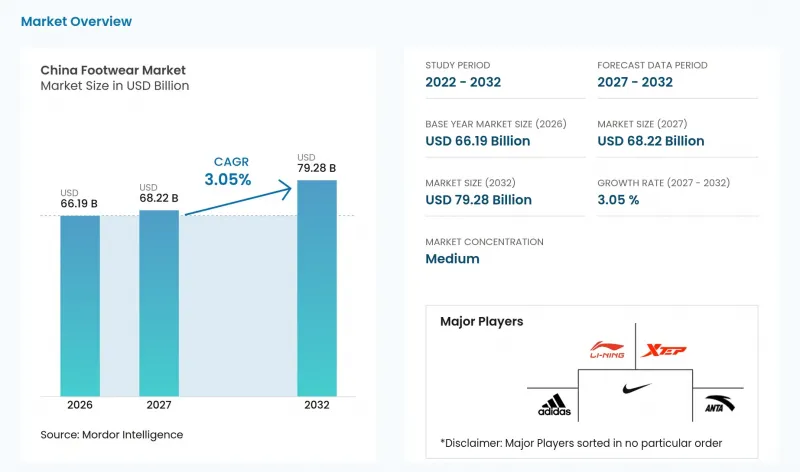
According to Mordor Intelligence, the China footwear market size is expected to grow from USD 66.19 billion in 2026 to USD 68.22 billion in 2027 and is forecast to reach USD 79.28 billion by 2032 at a 3.05% CAGR over 2027-2032.
China Footwear Market Trends and Insights
Rising Sports Participation Drives Athletic Footwear Demand
Rising sports consumption and government support are creating growth opportunities for China's athletic footwear market. For instance, in May 2026, according to the General Administration of Sport of China, revenue from sports footwear and apparel among 28 listed companies increased by 7.38% in 2025, while sports product sales across four major e-commerce platforms grew by 15.89% . Additionally, in September 2025, China's State Council aimed to expand the sports industry to more than RMB 7 trillion by 2030, supporting sports consumption and product development. These developments are driving demand for running, training, and lifestyle athletic footwear.
Outdoor and Recreational Activity Expansion Opens New Footwear Categories
Growing participation in outdoor and recreational activities is creating opportunities for specialized footwear in China. For instance, in November 2025, according to the Department of Sports Economy and General Administration of Sport of China, data from 2024-2025 show that China hosted 749 road-running events with at least 800 participants, attracting more than 7 million participant entries. Demand for outdoor sports products also increased, with sales of cross-country running shoes rising by 100% and ski boot sales growing by more than 80% . These trends highlight opportunities for footwear brands to expand their ranges of running, hiking, trekking, and winter sports footwear to meet the needs of consumers engaged in a variety of outdoor activities.
Intense Price Competition and Cost Volatility Compress Industry Margins
Intense price competition in China's footwear market is pressuring manufacturers, particularly those operating in the mass-market athletic and casual footwear segments. Heavy discounting can reduce profitability and constrain investment in innovation, product development, and quality improvements. Manufacturers also face fluctuations in raw material and production costs, making it more difficult to maintain competitive prices while preserving product quality. Price competition across online and offline channels can further weaken brand differentiation and diminish the appeal of premium footwear collections.
Other drivers and restraints analyzed in the detailed report include:
- Fashion, Comfort, and Premium Demand Reshape Footwear Mix
- Domestic Brand Expansion and Manufacturing Technology Reshape Competition
- Cautious Consumer Spending and Counterfeit Exposure Limit Growth
For complete list of drivers and restraints, kindly check the Table Of Contents.
Segment Analysis
Non-athletic footwear held 57.12% of the China footwear market in 2026. This segment includes boots, sneakers, flip-flops, slippers, and other casual footwear designed for everyday use. Sneakers drive demand by combining lifestyle appeal with suitability for light physical activities. Flip-flops and slippers remain popular in the mass-market segment because of their affordability and convenience. Boots meet seasonal demand, particularly during winter in northern provinces. Overall, the category benefits from broad consumer demand for comfortable, practical, and affordable footwear for daily activities rather than specialized performance products.
Athletic footwear is projected to register a CAGR of 3.65% during 2027-2032. It includes running shoes, sports shoes, trekking footwear, and hiking footwear, driven by growing consumer interest in exercise and outdoor recreation. Consumers increasingly seek footwear that provides comfort, durability, grip, and support for a range of physical activities. Product safety and quality requirements also prompt manufacturers to enhance material selection, testing, and production processes. These factors create opportunities for brands to address diverse consumer needs, ranging from everyday sports use to specialized outdoor activities, while differentiating products based on performance, comfort, and reliability.
The mass segment accounted for 88.21% of China footwear market in 2026. Affordable footwear remains popular in China, as consumers seek practical products at reasonable prices. The expanding reach of e-commerce and the availability of footwear across various price points, particularly in lower-tier cities, support demand. Domestic brands address this demand through cost-effective manufacturing and a broad range of styles. This trend creates opportunities for manufacturers to strengthen their market presence by offering comfortable, durable, and stylish footwear at competitive prices while meeting the needs of budget-conscious consumers.
Premium footwear is projected to register a CAGR of 3.91% during 2027-2032. Premium footwear appeals to consumers who prioritize quality, design, durability, and performance. Chinese manufacturers can strengthen this segment by improving materials, construction, and finishing to meet elevated consumer expectations. The growing recognition of Putian Shoes also enables domestic producers to showcase product quality and strengthen brand credibility. By maintaining consistent quality standards and offering distinctive designs, brands can attract consumers willing to pay more for footwear while continuing to serve the broader mass-market segment.
Complete Report Scope:
- By Product Type
- Athletic Footwear
- Running Shoes
- Sport Shoes
- Trekking/Hiking Shoes
- Other Athletic Footwear
- Non- Athletic Footwear
- Boots
- Flip-Flops/ Slippers
- Sneakers
- Other Non-Athletic Footwear
- Athletic Footwear
- By End User
- Men
- Women
- Kids
- By Category
- Mass
- Premium
- By Distribution Channel
- Supermarkets/Hypermarkets
- Specialty Stores
- Online Retail Stores
- Other Distribution Channels
List of Companies Covered in this Report:
- Nike (China) Inc. (Nike)
- ANTA Sports Products Limited (ANTA)
- adidas AG (adidas)
- Li Ning Company Limited (Li-Ning)
- Xtep International Holdings Limited (Xtep)
- 361 Degrees International Limited (361°)
- Skechers U.S.A., Inc. (Skechers)
- New Balance Athletics, Inc. (New Balance)
- ASICS Corporation (ASICS)
- PUMA SE (PUMA)
- On Holding AG (On)
- Anta Sports Products Limited (FILA)
- China Dongxiang (Group) Co., Ltd. (Kappa China)
- Belle International Holdings Limited (Belle)
- Qiaodan Sports Co., Ltd. (Qiaodan)
- Columbia Sportswear Company (Columbia)
- Under Armour, Inc. (Under Armour)
- VF Corporation (The North Face)
- Kering SA (Gucci)
- Birkenstock Holding plc (BIRKENSTOCK)
Additional Benefits:
- The market estimate (ME) sheet in Excel format
- 3 months of analyst support
TABLE OF CONTENTS
1 INTRODUCTION
- 1.1 Study Assumptions and Market Definition
- 1.2 Scope of the Study
2 RESEARCH METHODOLOGY
3 EXECUTIVE SUMMARY
4 MARKET LANDSCAPE
- 4.1 Market Overview
- 4.2 Market Drivers
- 4.2.1 Rising Participation in Sports and Fitness Activities
- 4.2.2 Increasing Interest in Outdoor and Recreational Activities
- 4.2.3 Growing Consumer Preference for Fashionable and Premium Footwear
- 4.2.4 Expansion of Domestic Footwear Brands
- 4.2.5 Increasing Demand for Comfortable and Versatile Footwear
- 4.2.6 Advancements in Footwear Materials and Manufacturing Technologies
- 4.3 Market Restraints
- 4.3.1 Intense Market Competition and Price Pressure
- 4.3.2 Cautious Consumer Spending
- 4.3.3 Volatility in Raw Material and Manufacturing Costs
- 4.3.4 Counterfeit Products and Brand Imitation
- 4.4 Consumer Behavior Analysis
- 4.5 Regulatory Landscape
- 4.6 Technological Outlook
- 4.7 Porter's Five Forces Analysis
- 4.7.1 Bargaining Power of Suppliers
- 4.7.2 Bargaining Power of Buyers
- 4.7.3 Threat of New Entrants
- 4.7.4 Threat of Substitutes
- 4.7.5 Intensity of Competitive Rivalry
5 MARKET SIZE AND GROWTH FORECASTS (VALUE)
- 5.1 By Product Type
- 5.1.1 Athletic Footwear
- 5.1.1.1 Running Shoes
- 5.1.1.2 Sport Shoes
- 5.1.1.3 Trekking/Hiking Shoes
- 5.1.1.4 Other Athletic Footwear
- 5.1.2 Non- Athletic Footwear
- 5.1.2.1 Boots
- 5.1.2.2 Flip-Flops/ Slippers
- 5.1.2.3 Sneakers
- 5.1.2.4 Other Non-Athletic Footwear
- 5.1.1 Athletic Footwear
- 5.2 By End User
- 5.2.1 Men
- 5.2.2 Women
- 5.2.3 Kids
- 5.3 By Category
- 5.3.1 Mass
- 5.3.2 Premium
- 5.4 By Distribution Channel
- 5.4.1 Supermarkets/Hypermarkets
- 5.4.2 Specialty Stores
- 5.4.3 Online Retail Stores
- 5.4.4 Other Distribution Channels
6 COMPETITIVE LANDSCAPE
- 6.1 Market Concentration
- 6.2 Strategic Moves
- 6.3 Market Share Analysis
- 6.4 Company Profiles (includes Global Level Overview, Market Level Overview, Core Segments, Financials as available, Strategic Information, Market Rank/Share, Products and Services, Recent Developments)
- 6.4.1 Nike (China) Inc. (Nike)
- 6.4.2 ANTA Sports Products Limited (ANTA)
- 6.4.3 adidas AG (adidas)
- 6.4.4 Li Ning Company Limited (Li-Ning)
- 6.4.5 Xtep International Holdings Limited (Xtep)
- 6.4.6 361 Degrees International Limited (361°)
- 6.4.7 Skechers U.S.A., Inc. (Skechers)
- 6.4.8 New Balance Athletics, Inc. (New Balance)
- 6.4.9 ASICS Corporation (ASICS)
- 6.4.10 PUMA SE (PUMA)
- 6.4.11 On Holding AG (On)
- 6.4.12 Anta Sports Products Limited (FILA)
- 6.4.13 China Dongxiang (Group) Co., Ltd. (Kappa China)
- 6.4.14 Belle International Holdings Limited (Belle)
- 6.4.15 Qiaodan Sports Co., Ltd. (Qiaodan)
- 6.4.16 Columbia Sportswear Company (Columbia)
- 6.4.17 Under Armour, Inc. (Under Armour)
- 6.4.18 VF Corporation (The North Face)
- 6.4.19 Kering SA (Gucci)
- 6.4.20 Birkenstock Holding plc (BIRKENSTOCK)
7 MARKET OPPORTUNITIES AND FUTURE OUTLOOK

