PUBLISHER: Mordor Intelligence | PRODUCT CODE: 2187376

PUBLISHER: Mordor Intelligence | PRODUCT CODE: 2187376
AI Infrastructure - Market Share Analysis, Industry Trends & Statistics, Growth Forecasts (2027 - 2032)
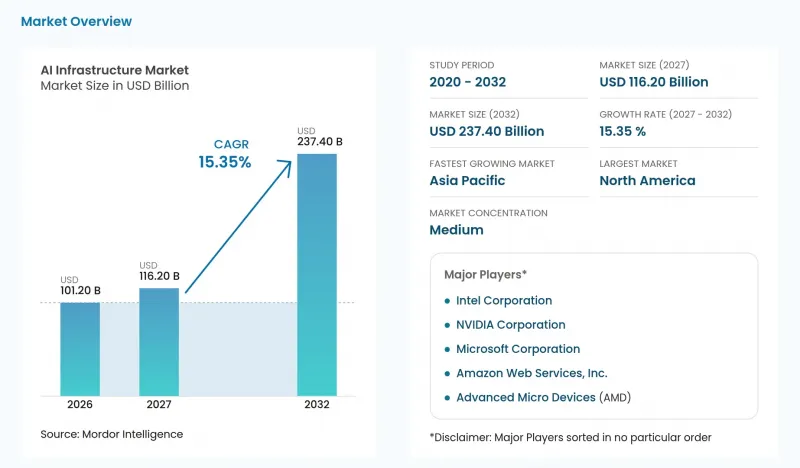
According to Mordor Intelligence, the AI infrastructure market size is expected to grow from USD 101.2 billion in 2026 to USD 116.2 billion in 2027 and is forecast to reach USD 237.4 billion by 2032 at 15.35% CAGR over 2027-2032.
Global AI Infrastructure Market Trends and Insights
Soaring H100/H200 GPU Backlogs Among Hyperscalers
Training demand can reach infrastructure suppliers through cloud operators before individual AI developers secure dedicated hardware. On August 27, 2025, NVIDIA CEO Jensen Huang said large cloud providers were renting capacity from one another as AI startups sought training capacity. He described reports of H100 and H200 sellouts as market buzz. Huang linked the pressure on capacity to startups training reasoning models. The peer rentals indicate a gap between providers' own capacity and the training demand they were trying to serve. Closing that gap with owned systems would convert the pressure for training access into new GPU orders across the artificial intelligence infrastructure market.
Rapid AI-Specific Network Fabrics (InfiniBand NDR, Ethernet 800G)
A compute-cluster upgrade needs a network configuration that can connect the expanded system as a usable whole. Meta specified 800G of scale-out I/O per GPU for an Ethernet-connected configuration at its Prometheus supercluster in New Albany, Ohio. NVIDIA separately reported 2.6x year-over-year growth for Spectrum-X Ethernet in its second quarter of fiscal 2027, highlighting continued investment across the artificial intelligence infrastructure industry. Meta said it chose 800G per GPU because the GB200 platform scaled up nearly every other dimension while scale-out bandwidth would otherwise have stayed at 400G. This design choice makes network capacity part of the accelerator upgrade, increasing the bandwidth specified with each GPU rather than treating networking as a later addition.
AI-Class GPUs in Chronic Short Supply Through 2026
For an operator requiring a specified computing system, a supply constraint can separate a purchase decision from usable AI capacity. NVIDIA's Q2 fiscal 2027 filing reported certain supply constraints while outlining future shipments of both Blackwell and Rubin systems. This makes delivery availability a distinct limit on expansion, even when a buyer is willing to fund additional equipment. AWS presented its purpose-built Trainium and Inferentia Spot Instances as alternative compute options for cost-sensitive AI workloads during GPU constraints. Where the required system cannot be supplied, however, an operator's capacity addition must wait for hardware availability, leaving the commercial cost in delayed access to the selected computing configuration.
Other drivers and restraints analyzed in the detailed report include:
- Energy-Efficient Liquid Cooling Adoption
- Government CHIPS-Type Subsidies for AI Fabs
- 400 V / 48 V Power-Conversion Limitations in Legacy Data Centers
For complete list of drivers and restraints, kindly check the Table Of Contents.
Segment Analysis
Hardware accounted for a 68.13% share of the AI infrastructure market size in 2026. Dell Technologies reported USD 32.5 billion in AI-optimized server net revenue for the first 6 months of fiscal 2027, ended July 31, 2026, up 222% year over year. Dell attributed most of the increase to higher unit sales, with a smaller contribution from higher average selling prices. Because Dell sells these as complete servers for training, fine-tuning and inference, this revenue represents integrated-system sales valued once at the system price.
Software is forecast to be the fastest-growing segment at 16.4% CAGR over 2027-2032. In October 2025, Hitachi reported that its internally operated AI platform incorporated tools including Red Hat OpenShift AI and supported more than 250 information technology and operational technology projects. The platform supported AI and machine-learning model development and operation, with Red Hat supplying OpenShift AI among its tools. A single internally operated platform serving that many projects places software demand at the shared platform layer, rather than within each individual project.
On-premise deployment represented a 57.16% AI infrastructure market share in 2026. Hewlett Packard Enterprise (HPE) reported strong enterprise demand for its Private Cloud AI platform for large-scale on-premises deployments in fiscal Q3 2026, with customers seeking to optimize token economics. HPE added that this demand was rapidly scaling its order bookings and customer base. Such demand links equipment ownership to the economics of repeated model use. The expanding customer base makes token economics a reason to choose private infrastructure across more enterprise deployments, beyond scaling individual installations.
Cloud deployment is forecast to be the fastest-growing segment at 16.15% CAGR over 2027-2032. Google Cloud revenue grew 82% year over year in Q2 2026, driven by demand for AI infrastructure and AI solutions. Microsoft separately reported that Azure and other cloud services revenue increased 43% year over year in the quarter ended June 30, 2026. Growth in both providers' reported cloud businesses places the expansion across separate operating platforms, giving the cloud deployment outlook a broader commercial base than a single build program.
Complete Report Scope:
- By Offering
- Hardware
- Processor
- Storage
- Memory
- Software
- System Optimisation
- AI Middleware and MLOps
- Hardware
- By Deployment
- On-Premise
- Cloud
- By End User
- Enterprises
- Government and Defense
- Cloud Service Providers
- By Processor Architecture
- CPU
- GPU
- FPGA/ASIC (TPU, Inferentia, Gaudi, Cerebras)
- Other Processor Architectures
- By Geography
- North America
- United States
- Canada
- Mexico
- South America
- Brazil
- Argentina
- Rest of South America
- Europe
- United Kingdom
- Germany
- France
- Sweden
- Rest of Europe
- Asia Pacific
- China
- Japan
- India
- Australia
- South Korea
- Rest of Asia Pacific
- Middle East
- Saudi Arabia
- United Arab Emirates
- Turkey
- Rest of Middle East
- Africa
- South Africa
- Nigeria
- Rest of Africa
- North America
Geography Analysis
North America held a 39.4% AI infrastructure market share in 2026. Core Scientific billed 395 MW of customer power capacity at its US data centers in Q2 2026. Its billable measure covered leased capacity where service had commenced and the company was actively billing at period end. The operator serves AI-related workloads through its high-density colocation business. The 170 MW increase from Q1's 225 MW to Q2's 395 MW shows how quickly leased capacity at one US operator moved into paid service for AI-related workloads.
Asia Pacific is forecast to be the fastest-growing geography at 16.85% CAGR over 2027-2032. Google broke ground in April 2026 on its Visakhapatnam AI hub in India, with AdaniConneX and Nxtra by Airtel as partners and gigawatt-scale compute planned for startups and large enterprises. The developer of the related Vizag Hyperscale Data Centre Park may continue construction at its own risk pending the final outcome of public interest litigation and must follow statutory and environmental procedures. The planned gigawatt-scale compute makes the hub a prospective destination for AI equipment serving Indian startups and large enterprises as construction advances.
In South America, Eviden upgraded Brazil's LNCC-operated Santos Dumont scientific supercomputer to 18.85 petaflops in July 2025, adding AI capabilities for national research users. In Europe, the European High-Performance Computing Joint Undertaking (EuroHPC JU) selected 6 additional AI Factory sites in 2025, located in Czechia, Lithuania, the Netherlands, Poland, Romania and Spain, each intended to provide national AI-computing access and technical support to startups, smaller businesses and researchers. In the Middle East, HUMAIN's Saudi platform was live in August 2026, using AMD Instinct GPUs and Cisco networking to serve its customers. In Africa, Altron launched its South African AI Factory in October 2025, combining NVIDIA computing and software with training and support and serving 5 launch customers. Brazil and Europe channel equipment demand through public computing programs, while the Saudi and South African examples center on customer-facing operators, giving suppliers different institutional buyers.
- NVIDIA Corporation
- Intel Corporation
- Advanced Micro Devices (AMD)
- Amazon Web Services, Inc.
- Microsoft Corporation
- Google LLC
- IBM Corporation
- Cisco Systems, Inc.
- Hewlett Packard Enterprise
- Dell Technologies, Inc.
- Samsung Electronics Co., Ltd.
- Micron Technology, Inc.
- Arm Holdings plc
- Synopsys, Inc.
- Baidu, Inc.
- Alibaba Cloud
- Tencent Cloud
- Cerebras Systems
- Graphcore
- Huawei Technologies Co., Ltd.
Additional Benefits:
- The market estimate (ME) sheet in Excel format
- 3 months of analyst support
TABLE OF CONTENTS
1 INTRODUCTION
- 1.1 Study Assumptions and Market Definition
- 1.2 Scope of the Study
2 RESEARCH METHODOLOGY
3 EXECUTIVE SUMMARY
4 MARKET LANDSCAPE
- 4.1 Market Overview
- 4.2 Market Drivers
- 4.2.1 Soaring H100/H200 GPU Backlogs Among Hyperscalers
- 4.2.2 Rapid AI-Specific Network Fabrics (InfiniBand NDR, Ethernet 800G)
- 4.2.3 Energy-Efficient Liquid Cooling Adoption
- 4.2.4 Government CHIPS-Type Subsidies for AI Fabs
- 4.2.5 Cloud-Native AI Accelerator Instances Democratize Access
- 4.2.6 Open-Source AI Framework Optimization (e.g., Triton, TVM)
- 4.3 Market Restraints
- 4.3.1 AI-Class GPUs in Chronic Short Supply Through 2026
- 4.3.2 400 V / 48 V Power-Conversion Limitations in Legacy Data Centers
- 4.3.3 Sovereign-AI Export Controls (US-China, EU)
- 4.3.4 Rising Scope-2 Emissions Compliance Costs
- 4.4 Industry Value Chain Analysis
- 4.5 Regulatory Landscape
- 4.6 Technological Outlook
- 4.7 Porter's Five Forces Analysis
- 4.7.1 Threat of New Entrants
- 4.7.2 Bargaining Power of Suppliers
- 4.7.3 Bargaining Power of Buyers
- 4.7.4 Threat of Substitutes
- 4.7.5 Competitive Rivalry
- 4.8 Impact of Macroeconomic Factors on the Market
5 MARKET SIZE AND GROWTH FORECASTS (VALUE)
- 5.1 By Offering
- 5.1.1 Hardware
- 5.1.1.1 Processor
- 5.1.1.2 Storage
- 5.1.1.3 Memory
- 5.1.2 Software
- 5.1.2.1 System Optimisation
- 5.1.2.2 AI Middleware and MLOps
- 5.1.1 Hardware
- 5.2 By Deployment
- 5.2.1 On-Premise
- 5.2.2 Cloud
- 5.3 By End User
- 5.3.1 Enterprises
- 5.3.2 Government and Defense
- 5.3.3 Cloud Service Providers
- 5.4 By Processor Architecture
- 5.4.1 CPU
- 5.4.2 GPU
- 5.4.3 FPGA/ASIC (TPU, Inferentia, Gaudi, Cerebras)
- 5.4.4 Other Processor Architectures
- 5.5 By Geography
- 5.5.1 North America
- 5.5.1.1 United States
- 5.5.1.2 Canada
- 5.5.1.3 Mexico
- 5.5.2 South America
- 5.5.2.1 Brazil
- 5.5.2.2 Argentina
- 5.5.2.3 Rest of South America
- 5.5.3 Europe
- 5.5.3.1 United Kingdom
- 5.5.3.2 Germany
- 5.5.3.3 France
- 5.5.3.4 Sweden
- 5.5.3.5 Rest of Europe
- 5.5.4 Asia Pacific
- 5.5.4.1 China
- 5.5.4.2 Japan
- 5.5.4.3 India
- 5.5.4.4 Australia
- 5.5.4.5 South Korea
- 5.5.4.6 Rest of Asia Pacific
- 5.5.5 Middle East
- 5.5.5.1 Saudi Arabia
- 5.5.5.2 United Arab Emirates
- 5.5.5.3 Turkey
- 5.5.5.4 Rest of Middle East
- 5.5.6 Africa
- 5.5.6.1 South Africa
- 5.5.6.2 Nigeria
- 5.5.6.3 Rest of Africa
- 5.5.1 North America
6 COMPETITIVE LANDSCAPE
- 6.1 Market Concentration
- 6.2 Strategic Moves
- 6.3 Market Share Analysis
- 6.4 Company Profiles (includes Global level Overview, Market level overview, Core Segments, Financials as available, Strategic Information, Market Rank/Share for key companies, Products and Services, and Recent Developments)
- 6.4.1 NVIDIA Corporation
- 6.4.2 Intel Corporation
- 6.4.3 Advanced Micro Devices (AMD)
- 6.4.4 Amazon Web Services, Inc.
- 6.4.5 Microsoft Corporation
- 6.4.6 Google LLC
- 6.4.7 IBM Corporation
- 6.4.8 Cisco Systems, Inc.
- 6.4.9 Hewlett Packard Enterprise
- 6.4.10 Dell Technologies, Inc.
- 6.4.11 Samsung Electronics Co., Ltd.
- 6.4.12 Micron Technology, Inc.
- 6.4.13 Arm Holdings plc
- 6.4.14 Synopsys, Inc.
- 6.4.15 Baidu, Inc.
- 6.4.16 Alibaba Cloud
- 6.4.17 Tencent Cloud
- 6.4.18 Cerebras Systems
- 6.4.19 Graphcore
- 6.4.20 Huawei Technologies Co., Ltd.
7 MARKET OPPORTUNITIES AND FUTURE OUTLOOK
- 7.1 White-Space and Unmet-Need Assessment

