PUBLISHER: Mordor Intelligence | PRODUCT CODE: 2187377

PUBLISHER: Mordor Intelligence | PRODUCT CODE: 2187377
India Baby Care Products - Market Share Analysis, Industry Trends & Statistics, Growth Forecasts (2027 - 2032)
According to Mordor Intelligence, the India baby care products market size is expected to increase from USD 5.57 billion in 2026 to USD 6.23 billion in 2027 and reach USD 10.7 billion by 2032, growing at a CAGR of 11.42% over 2027-2032.
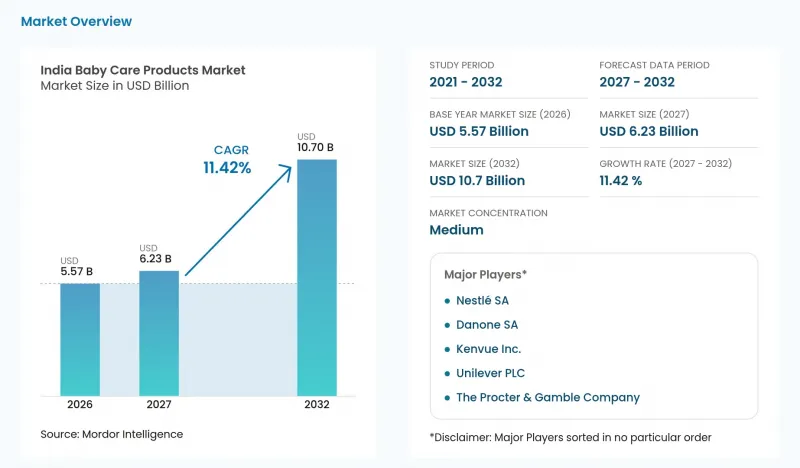
This report is segmented by Product Type (Baby Food and Beverages, Baby Toiletries, and more), Nature (Conventional/Synthetic and Organic/Natural), Age Group (Toddlers and Infants), and Distribution Channel (Supermarkets/Hypermarkets, Online Retail Stores, and more). The market forecasts are provided in terms of value (USD), based on availability.
India Baby Care Products Market Trends and Insights
Growing awareness of infant health and hygiene
Caregiver education can support demand for purposeful newborn-care products by making the reasoning behind daily care decisions easier to understand. The National Health Mission reported a 37% improvement in newborn-care knowledge among caregivers in special newborn care units assessed at 5 Himachal Pradesh facilities from December 2022 to March 2025. The state's Care Companion Programme trained 186,878 beneficiaries and caregivers through 10,846 sessions over the same period. Learning and program reach address different parts of the demand mechanism, connecting care knowledge with a population able to apply it. The commercial relevance lies with products that match the newborn-care tasks caregivers are taught.
Shift toward organic and chemical-free products
Ingredient origin can influence baby-care choices when a caregiver associates natural formulations with gentleness. One participant in a qualitative study of 25 Indian mothers said she preferred natural ingredients because she trusted them to be gentle and safe. The mothers were primary purchasing decision makers screened for natural baby-care brand use within the 6 months before interview. This preference gives suppliers a reason to explain the ingredient choices behind a care product, so that a natural claim names the ingredients behind it. Confidence in a specific ingredient promise can support continued selection within natural care, giving formulation credibility a direct commercial role.
High price sensitivity and proliferation of counterfeit products
Sale eligibility sets a precondition for access to baby-care products, because diapers without the required certification mark cannot be stored or offered for sale. BIS seized 286 packages of baby diapers, each containing 42 pieces, without the required BIS Standard Mark at a Flipkart India warehouse in Thiruvallur district, Tamil Nadu, on March 19, 2025. The applicable rule barred storage, sale or offer for sale without the Standard Mark under a valid BIS license. For diaper suppliers, this restriction reaches stock held for distribution as well as the retail offer. Suppliers therefore bear the compliance burden of maintaining licensed, marked diaper stock throughout distribution.
Other drivers and restraints analyzed in the detailed report include:
- Increasing awareness about product safety and certifications
- Technological advancements in baby care products
- Complex multi-agency regulatory approvals for baby cosmetics
For complete list of drivers and restraints, kindly check the Table Of Contents.
Segment Analysis
Baby food and beverages accounted for a 27.55% share of the India baby care products market size in 2026. The largest segment addresses feeding across infant and toddler stages, giving suppliers a product proposition organized around the caregiver's feeding decision. For a range of baby foods and beverages, format and intended use can make the offer more specific, allowing a product to be understood as part of a defined feeding task. The commercial unit of competition is consequently the age-specific feeding proposition, even when the supplier sells a broader baby-care range.
Baby skin care is the fastest-growing segment, forecast to expand at a 12.29% CAGR over 2027-2032. An expert-panel recommendation from the Indian Academy of Pediatrics' Neonatology Chapter includes emollient use once babies adapt to transition home after neonatal intensive care. The Skin Allergy Research Society and Society for Eczema Studies guideline for atopic dermatitis in India recommends regular moisturizer use for patients with that condition, with strong, high-certainty support for regular use. These recommendations tie a commercially familiar product format to defined care settings, making the intended use more specific than a general promise of gentleness. For skin-care suppliers, transition-home care calls for emollient guidance, while atopic-dermatitis care calls for instructions that support regular moisturizer use.
Conventional/synthetic products represented a 76.65% India baby care products market share in 2026. In July 2026, Swara Baby Products Limited reported annual capacity to produce approximately 2.66 billion baby diapers in India, alongside capacity for adult diapers or period panties, sanitary napkins and panty liners. Capacity on that scale shows the industrial base behind mass-produced disposable baby products. That supply base supports the position of conventional disposable formats within the largest part of retail spending.
Organic/natural products are the fastest-growing segment, with a forecast 13.55% CAGR over 2027-2032. ITC Limited describes Mother Sparsh as a premium Ayurvedic and natural baby-care brand covering personal care, health and hygiene, and expert care. ITC reported that the business recorded growth during FY2025-26, which it attributed to higher brand salience and adoption. Maintaining a recognizable natural brand identity across different care needs can let suppliers broaden the offering while preserving the formulation promise that links the range.
Complete Report Scope:
- By Product Type
- Baby Skin Care
- Baby Hair Care
- Baby Toiletries
- Bath and Fragrances
- Diapers and Wipes
- Baby Food and Beverages
- By Nature
- Organic/Natural
- Conventional/Synthetic
- By Age Group
- Infants (0-1 Year)
- Toddlers (1-3 Years)
- By Distribution Channel
- Supermarkets/Hypermarkets
- Pharmacies/Drug Stores
- Online Retail Stores
- Other Distribution Channels
List of Companies Covered in this Report:
- Kenvue Inc.
- The Procter & Gamble Company
- Nestle SA
- Unilever PLC
- Kimberly-Clark Corp.
- Danone SA
- Unicharm Corporation
- Himalaya Wellness Company
- Honasa Consumer Limited (Mamaearth)
- Dabur India Ltd
- Patanjali Ayurved Ltd
- Reckitt Benckiser Group plc
- ITC Limited (Mother Sparsh Baby Care Pvt Ltd)
- Emami Ltd
- Navashya Consumer Products Private Limited (SuperBottoms)
- Mee Mee (Me N Moms)
- Artsana SpA (Chicco)
- Sebapharma GmbH & Co. KG
- FirstCry (Brainbees Solutions)
- R for Rabbit Baby Products Pvt Ltd
Additional Benefits:
- The market estimate (ME) sheet in Excel format
- 3 months of analyst support
TABLE OF CONTENTS
1 INTRODUCTION
- 1.1 Study Assumptions and Market Definition
- 1.2 Scope of the Study
2 RESEARCH METHODOLOGY
3 EXECUTIVE SUMMARY
4 MARKET LANDSCAPE
- 4.1 Market Overview
- 4.2 Market Drivers
- 4.2.1 Growing awareness of infant health and hygiene
- 4.2.2 Shift toward organic and chemical-free products
- 4.2.3 Increasing awareness about product safety and certifications
- 4.2.4 Technological advancements in baby care products
- 4.2.5 Innovations in product offerings
- 4.2.6 Rising availability of international and premium brands
- 4.3 Market Restraints
- 4.3.1 High price sensitivity and proliferation of counterfeit products
- 4.3.2 Complex multi-agency regulatory approvals for baby cosmetics
- 4.3.3 Potential health concerns related to chemical residues
- 4.3.4 Limited awareness in semi-urban/rural areas
- 4.4 Industry Value Chain Analysis
- 4.5 Regulatory Landscape
- 4.6 Technological Outlook
- 4.7 Porter's Five Forces Analysis
- 4.7.1 Threat of New Entrants
- 4.7.2 Bargaining Power of Suppliers
- 4.7.3 Bargaining Power of Buyers
- 4.7.4 Threat of Substitutes
- 4.7.5 Competitive Rivalry
- 4.8 Consumer Behaviour Analysis
5 MARKET SIZE AND GROWTH FORECASTS (VALUE)
- 5.1 By Product Type
- 5.1.1 Baby Skin Care
- 5.1.2 Baby Hair Care
- 5.1.3 Baby Toiletries
- 5.1.3.1 Bath and Fragrances
- 5.1.3.2 Diapers and Wipes
- 5.1.4 Baby Food and Beverages
- 5.2 By Nature
- 5.2.1 Organic/Natural
- 5.2.2 Conventional/Synthetic
- 5.3 By Age Group
- 5.3.1 Infants (0-1 Year)
- 5.3.2 Toddlers (1-3 Years)
- 5.4 By Distribution Channel
- 5.4.1 Supermarkets/Hypermarkets
- 5.4.2 Pharmacies/Drug Stores
- 5.4.3 Online Retail Stores
- 5.4.4 Other Distribution Channels
6 COMPETITIVE LANDSCAPE
- 6.1 Market Concentration
- 6.2 Strategic Moves
- 6.3 Market Share Analysis
- 6.4 Company Profiles (includes Global level Overview, Market level overview, Core Segments, Financials as available, Strategic Information, Market Rank/Share for key companies, Products and Services, and Recent Developments)
- 6.4.1 Kenvue Inc.
- 6.4.2 The Procter & Gamble Company
- 6.4.3 Nestle SA
- 6.4.4 Unilever PLC
- 6.4.5 Kimberly-Clark Corp.
- 6.4.6 Danone SA
- 6.4.7 Unicharm Corporation
- 6.4.8 Himalaya Wellness Company
- 6.4.9 Honasa Consumer Limited (Mamaearth)
- 6.4.10 Dabur India Ltd
- 6.4.11 Patanjali Ayurved Ltd
- 6.4.12 Reckitt Benckiser Group plc
- 6.4.13 ITC Limited (Mother Sparsh Baby Care Pvt Ltd)
- 6.4.14 Emami Ltd
- 6.4.15 Navashya Consumer Products Private Limited (SuperBottoms)
- 6.4.16 Mee Mee (Me N Moms)
- 6.4.17 Artsana SpA (Chicco)
- 6.4.18 Sebapharma GmbH & Co. KG
- 6.4.19 FirstCry (Brainbees Solutions)
- 6.4.20 R for Rabbit Baby Products Pvt Ltd
7 MARKET OPPORTUNITIES AND FUTURE OUTLOOK
- 7.1 White-Space and Unmet-Need Assessment

