PUBLISHER: Global Market Insights Inc. | PRODUCT CODE: 2027628

PUBLISHER: Global Market Insights Inc. | PRODUCT CODE: 2027628
Electric Baby Car Market Opportunity, Growth Drivers, Industry Trend Analysis, and Forecast 2026 - 2035
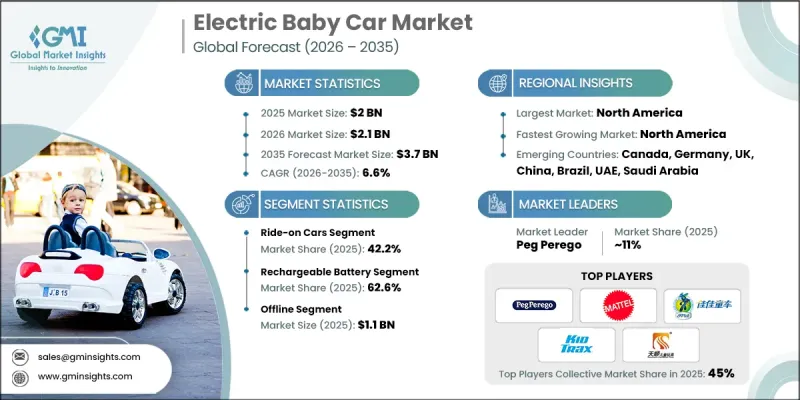
The Global Electric Baby Car Market was valued at USD 2 billion in 2025 and is estimated to grow at a CAGR of 6.6% to reach USD 3.7 billion by 2035.
The market is undergoing a transformation driven by rapid integration of smart technologies, which are redefining electric ride-on vehicles as connected and feature-rich products. Manufacturers are enhancing product appeal by incorporating advanced functionalities that improve both user engagement and safety. Mobile application integration has become a central feature, allowing parents to monitor and control vehicle performance in real time. These systems offer capabilities such as speed regulation, remote operation, and automated safety responses. The growing adoption of connected devices and IoT-enabled products is influencing purchasing decisions, particularly among tech-oriented consumers seeking innovative and secure toys. As a result, electric baby cars are evolving into premium offerings that combine entertainment, safety, and intelligent functionality, creating new growth opportunities for brands targeting higher-value market segments.
| Market Scope | |
|---|---|
| Start Year | 2025 |
| Forecast Year | 2026-2035 |
| Start Value | $2 Billion |
| Forecast Value | $3.7 Billion |
| CAGR | 6.6% |
Advanced safety and connectivity features are playing a critical role in shaping product development. Technologies such as GPS-enabled monitoring, secure access systems, and enhanced control mechanisms are improving operational safety while preventing unauthorized usage. Digital dashboards provide real-time insights into performance metrics, including speed and battery levels, offering a more immersive and vehicle-like experience. Integration of interactive features further enhances engagement while supporting early learning and cognitive development. These innovations align with the expectations of modern consumers who prioritize both safety and technological sophistication in children's products.
The ride-on cars segment accounted for 42.2% share in 2025, making them the leading product category. Their popularity is supported by interactive designs that simulate real driving experiences, appealing to both children and parents. Features such as lighting systems, secure seating, and integrated controls contribute to their strong adoption. The segment is expected to maintain steady growth as manufacturers continue to introduce models equipped with advanced connectivity, improved safety mechanisms, and enhanced user-friendly designs.
The offline distribution channels segment generated USD 1.1 billion in 2025. These channels remain essential due to their ability to provide immediate product availability and personalized customer support. Dealers and distributors play a key role in assisting buyers with product selection, offering after-sales services, and ensuring accessibility to standard configurations. The evolving distribution landscape has increased competition, prompting manufacturers to become more directly involved in the purchasing process while strengthening relationships across the supply chain.
United States Electric Baby Car Market 84.5% share in 2025 and is expected to grow at a CAGR of 6.3% through 2035. The region benefits from strong consumer adoption of advanced technologies, a well-established logistics infrastructure, and a high preference for premium outdoor products. Demand is further supported by increasing awareness of child safety features and a growing inclination toward technologically enhanced toys. Consumers in the region favor high-end models equipped with advanced functionalities, driving innovation and premiumization across the market.
Key players operating in the Global Electric Baby Car Market include Kid Trax, Peg Perego (PEG), Mattel/Fisher-Price, Best Ride On Cars, Aosom, RiiRoo, Kids VIP, Dynacraft BSC, Ryder Toys, Tobbi (Jaxpety Corp/HONGKONG EIWO Co.), Zhejiang Jiajia Ride-on Co., Ltd., Freddo Toys, Berghoff Toys, Solley, and Hebei Province Manufacturers. Companies in the electric baby car market are focusing on product innovation, integrating smart technologies such as app-based controls, connectivity features, and enhanced safety systems to differentiate their offerings. They are expanding manufacturing capabilities and optimizing supply chains to meet rising global demand efficiently. Strategic partnerships with distributors and retailers help improve market penetration and customer reach. Firms are also investing in branding and digital marketing to highlight product quality, safety, and technological advancements. Additionally, companies are introducing premium models with advanced features to target high-income consumers, while maintaining competitive pricing strategies for broader market appeal, ensuring sustained growth and a stronger competitive position.
Table of Contents
Chapter 1 Methodology and Scope
- 1.1 Market scope and definition
- 1.2 Research design
- 1.2.1 Research approach
- 1.2.2 Data collection methods
- 1.3 Data mining sources
- 1.3.1 Global
- 1.3.2 Regional/Country
- 1.4 Base estimates and calculations
- 1.4.1 Base year calculation
- 1.4.2 Key trends for market estimation
- 1.5 Primary research and validation
- 1.5.1 Primary sources
- 1.6 Forecast model
- 1.7 Research assumptions and limitations
Chapter 2 Executive Summary
- 2.1 Industry 360° synopsis
- 2.2 Key market trends
- 2.2.1 Regional
- 2.2.2 Product
- 2.2.3 Power Source
- 2.2.4 Age group
- 2.2.5 Pricing
- 2.2.6 Distribution channel
Chapter 3 Industry Insights
- 3.1 Industry ecosystem analysis
- 3.1.1 Supplier landscape
- 3.1.2 Profit margin
- 3.1.3 Value addition at each stage
- 3.1.4 Factor affecting the value chain
- 3.2 Industry impact forces
- 3.2.1 Growth drivers
- 3.2.1.1 Enforcement of Stringent Child Safety Regulation
- 3.2.1.2 Increased Parental Awareness and Focus on Child Safety
- 3.2.1.3 Technological Integration of Smart Seats
- 3.2.2 Industry pitfalls & challenges
- 3.2.2.1 High Initial Cost and Certified Seat Systems
- 3.2.2.2 Consumer Confusion and Installation Gaps
- 3.2.3 Opportunities
- 3.2.3.1 Growth in Emerging Economies.
- 3.2.3.2 Development of Lightweight and E-commerce Optimized Seats
- 3.2.1 Growth drivers
- 3.3 Growth potential analysis
- 3.4 Future market trends
- 3.5 Technology and innovation landscape
- 3.5.1 Current technological trends
- 3.5.2 Emerging technologies
- 3.6 Price trends
- 3.6.1 By region
- 3.6.2 By type
- 3.7 Regulatory landscape
- 3.7.1 Standards and compliance requirements
- 3.7.2 Regional regulatory frameworks
- 3.7.3 Certification standards
- 3.8 Porter's analysis
- 3.9 PESTEL analysis
Chapter 4 Competitive Landscape, 2025
- 4.1 Introduction
- 4.2 Company market share analysis
- 4.2.1 By region
- 4.2.1.1 North America
- 4.2.1.2 Europe
- 4.2.1.3 Asia Pacific
- 4.2.1.4 Latin America
- 4.2.1.5 Middle East and Africa
- 4.2.1 By region
- 4.3 Company matrix analysis
- 4.4 Competitive analysis of major market players
- 4.5 Competitive positioning matrix
- 4.6 Key developments
- 4.6.1 Mergers & acquisitions
- 4.6.2 Partnerships & collaborations
- 4.6.3 New product launches
- 4.6.4 Expansion plans
Chapter 5 Market Estimates and Forecast, By Product, 2022 - 2035 (USD Billion) (Thousand Units)
- 5.1 Key trends
- 5.2 Ride-on cars
- 5.3 Remote-controlled cars
- 5.4 Battery-powered vehicles
Chapter 6 Market Estimates and Forecast, By Age Group, 2022 - 2035 (USD Billion) (Thousand Units)
- 6.1 Key trends
- 6.2 0-1 years
- 6.3 1-3 years
- 6.4 3-5 years
Chapter 7 Market Estimates and Forecast, By Price, 2022 - 2035 (USD Billion) (Thousand Units)
- 7.1 Key trends
- 7.2 Low
- 7.3 Medium
- 7.4 High
Chapter 8 Market Estimates and Forecast, By Power Source, 2022 - 2035 (USD Billion) (Thousand Units)
- 8.1 Key trends
- 8.2 Rechargeable battery
- 8.3 Plug-in electric
Chapter 9 Market Estimates and Forecast, By Distribution Channel, 2022 - 2035 (USD Billion) (Thousand Units)
- 9.1 Key trends
- 9.2 Online
- 9.2.1 E-commerce site
- 9.2.2 Company owned site
- 9.3 Offline
- 9.3.1 Retail stores
- 9.3.2 Others
Chapter 10 Market Estimates and Forecast, By Region, 2022 - 2035 (USD Billion) (Thousand Units)
- 10.1 Key trends
- 10.2 North America
- 10.2.1 U.S.
- 10.2.2 Canada
- 10.3 Europe
- 10.3.1 Germany
- 10.3.2 UK
- 10.3.3 France
- 10.3.4 Italy
- 10.3.5 Spain
- 10.4 Asia Pacific
- 10.4.1 China
- 10.4.2 Japan
- 10.4.3 India
- 10.4.4 Australia
- 10.4.5 South Korea
- 10.5 Latin America
- 10.5.1 Brazil
- 10.5.2 Mexico
- 10.5.3 Argentina
- 10.6 Middle East and Africa
- 10.6.1 South Africa
- 10.6.2 Saudi Arabia
- 10.6.3 UAE
Chapter 11 Company Profiles
- 11.1 Aosom
- 11.2 Berghoff Toys
- 11.3 Best Ride On Cars
- 11.4 Dynacraft BSC
- 11.5 Freddo Toys
- 11.6 Hebei Province Manufacturers
- 11.7 Kid Trax
- 11.8 Kids VIP
- 11.9 Mattel/Fisher-Price
- 11.10 Peg Perego (PEG)
- 11.11 RiiRoo
- 11.12 Ryder Toys
- 11.13 Solley
- 11.14 Tobbi (Jaxpety Corp/HONGKONG EIWO Co.)
- 11.15 Zhejiang Jiajia Ride-on Co., Ltd.

