PUBLISHER: Mordor Intelligence | PRODUCT CODE: 2187405

PUBLISHER: Mordor Intelligence | PRODUCT CODE: 2187405
Land-based Military Electro-Optical and Infrared Systems - Market Share Analysis, Industry Trends & Statistics, Growth Forecasts (2027 - 2032)
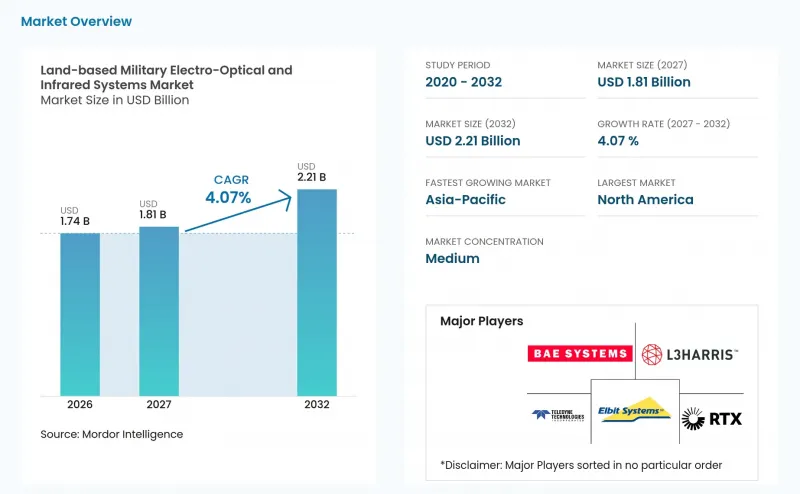
According to Mordor Intelligence, the land-based military electro-optical and infrared systems market size was valued at USD 1.74 billion in 2026 and is forecast to grow from USD 1.81 billion in 2027 to USD 2.21 billion by 2032, at a CAGR of 4.07% during 2027-2032.
Global Land-based Military Electro-Optical and Infrared Systems Market Trends and Insights
Armored Fleet Modernization and Open-Architecture Upgrades
Modernization of armored combat vehicles is supporting demand for advanced EO/IR systems, particularly thermal sights, stabilized observation equipment, and digital sensor integration. In H1 2026, HENSOLDT reported EUR 971 million (USD 1.08 billion) in order intake for its Optronics segment, compared with EUR 164 million (USD 186.86 million) in H1 2025. The company attributed much of this growth to contracts supplying digital optronics for Germany's Puma IFVs and Schakal wheeled IFVs. Its Ground-Based Systems product line also contributed to strong segment revenue growth. These developments highlight the importance of advanced observation and targeting technologies in military vehicle modernization. A Modular Open Systems Approach (MOSA) can facilitate future sensor replacement and subsystem upgrades, although platform-specific integration remains necessary. Continued vehicle procurement and modernization programs are therefore supporting opportunities across linefit and retrofit EO/IR applications.
Border Surveillance and Persistent Reconnaissance Demand
Military requirements for continuous battlefield surveillance, border monitoring, and force protection are supporting demand for multisensor EO/IR systems capable of operating in low-light and nighttime conditions. In February 2026, the US Army issued a sources-sought notice for gimballed high-definition EO/IR sensor replacements for its Base Expeditionary Targeting Surveillance Systems-Combined (BETSS-C) and Ground-Based Operational Surveillance System. The requirements included thermal imaging, color and low-light cameras, short-wave infrared (SWIR) capabilities, and 360-degree observation. These specifications reflect continuing interest in integrated sensor architectures that combine multiple imaging technologies for target detection and surveillance. Requirements for extended observation ranges and improved image processing create opportunities for advanced EO/IR equipment.
Detector Supply and Export-Control Constraints
Manufacturing advanced military EO/IR equipment requires specialized IR detectors, optical components, readout electronics, and qualified production capabilities. Supply-chain dependence on technically capable manufacturers can affect procurement flexibility and increase sourcing complexity. In May 2026, RRP Defence reportedly secured an order worth approximately INR 29.8 crore (USD 3.11 million) from Bharat Electronics Limited to supply high-precision germanium lenses for IR and thermal imaging applications, illustrating the importance of specialized optical components in defense equipment supply chains. Export regulations create additional barriers for international suppliers. The US Export Administration Regulations, including provisions updated in July 2026, impose licensing requirements on specified thermal imaging cameras and other controlled technologies based on classification and destination. These restrictions can complicate technology transfers, component sourcing, and international equipment sales. However, the available evidence does not establish a universal shortage of military IR detectors during 2026.
Other drivers and restraints analyzed in the detailed report include:
- Vehicle Protection and 360-Degree Situational Awareness
- Multispectral Sensing, Automated Recognition, and Indigenous Procurement
- Platform Integration, Cost, and Qualification Complexity
For complete list of drivers and restraints, kindly check the Table Of Contents.
Segment Analysis
Vehicle-mounted platforms accounted for 84.25% of the land-based military electro-optical and infrared systems market share in 2026, reflecting their widespread use on tanks, IFVs, UGVs, and mobile air defense platforms. Combat vehicles form the largest demand base, as they require sights, targeting equipment, driver vision systems, and broader surveillance coverage. Recovery and support vehicles also require observation equipment when operating near the front line. Counter-unmanned aircraft roles are increasing demand for sensors capable of detecting and tracking low, slow threats around mobile formations. In September 2025, Rheinmetall introduced its SEOSS 400 stabilized fire-control sensor at DSEI, featuring three-axis stabilization, AI-supported target identification, and an identification range of up to 6 km under specified conditions. The system was developed for next-generation combat vehicles and designed for integration into manned and unmanned platforms. Such developments reflect continued investment in vehicle-mounted sensing technologies as militaries modernize ground combat platforms.
Man-portable systems are forecast to grow at a 5.35% CAGR through 2032, faster than other types of subsegments. Infantry modernization creates demand for weapon sights, handheld thermal imagers, and dismounted soldier vision systems. Man-portable EO/IR equipment supports infantry surveillance, nighttime observation, target detection, and weapon aiming. Demand is driven by the need to enhance individual soldiers' capabilities without relying on vehicle-mounted observation systems. In October 2025, MKU Limited announced a contract worth approximately INR 660 crore (USD 74.69 million) to supply 29,762 Netro NW 3000 night-vision weapon sights to the Indian Army. The procurement involves image-intensifier-based equipment for infantry weapons, illustrating the scale of investment in soldier-carried EO technologies. Man-portable thermal imagers, weapon sights, and portable laser-ranging equipment address different operational requirements. Infantry modernization programs and vehicle-based sensing initiatives together support opportunities across both deployment categories.
Imaging systems accounted for 48.21% of the land-based military electro-optical and infrared systems market size in 2026. Imaging systems support fundamental observation and situational awareness requirements across military ground operations. These systems include visible-spectrum cameras, thermal imagers, night-vision devices, and integrated imaging assemblies used in combat vehicles and portable equipment. Their operational applications span driver vision, reconnaissance, battlefield observation, and surveillance. Advances in detector technology, image processing, and sensor integration have supported the development of increasingly capable imaging solutions. Targeting systems incorporate imaging equipment alongside functions such as laser ranging, stabilization, target tracking, and fire-control interfaces. Rheinmetall's SEOSS 400, introduced in September 2025, illustrates this integration through its stabilized sensor architecture, AI-supported target identification, and automated fire-control capabilities. These developments support demand for imaging and targeting equipment designed to meet increasingly complex military operational requirements.
Electronic support measure systems are forecast to grow at a 5.80% CAGR through 2032. EO warning and detection systems represent an adjacent opportunity within integrated land-platform sensing architectures. Such equipment can include laser warning receivers and EO/IR threat-detection sensors, depending on the system configuration. These technologies provide complementary information to vehicle crews and can be integrated with observation, targeting, and protection systems. However, conventional electronic support measures primarily detect and analyze radio-frequency emissions and should not be included in EO/IR equipment revenue without a clearly defined allocation methodology. This distinction is important when assessing market demand, as broader vehicle mission-system contracts can contain imaging, EW, and other sensor technologies.
Complete Report Scope:
- By Type
- Vehicle-Mounted
- Combat Vehicles
- Unmanned Ground Vehicles (UGVs)
- Mobile Air-Defense and Counter-UAS Platforms
- Armored Recovery and Support Vehicles
- Man-Portable
- Weapon Sights and Thermal Weapon Sights
- Handheld Thermal Imagers
- Laser Rangefinders and Designators
- Dismounted Soldier Vision Systems
- Vehicle-Mounted
- By System
- Imaging Systems
- Targeting Systems
- Electronic Support Measure Systems
- By Application
- Surveillance and Reconnaissance
- Identify Friend or Foe (IFF)
- Target Acquisition and Fire Control
- Driver Vision and Navigation
- Battlefield Situational Awareness
- Border, Base, and Perimeter Surveillance
- By Cooling Technology
- Cooled Systems
- Uncooled Systems
- By Fit
- Linefit
- Retrofit
- By Geography
- North America
- United States
- Canada
- Mexico
- Europe
- United Kingdom
- France
- Germany
- Italy
- Spain
- Russia
- Rest of Europe
- Asia-Pacific
- China
- Japan
- India
- South Korea
- Australia
- Rest of Asia-Pacific
- South America
- Brazil
- Rest of South America
- Middle East and Africa
- Middle East
- United Arab Emirates
- Saudi Arabia
- Israel
- Rest of Middle East
- Africa
- South Africa
- Rest of Africa
- Middle East
- North America
Geography Analysis
North America held 39.90% of the land-based military electro-optical and infrared systems market share in 2026. The region is supported by US Army modernization programs that cover main battle tanks, infantry vehicles, Stryker variants, and specialized reconnaissance vehicles. In April 2025, Teledyne FLIR Defense received a USD 74.20 million, four-year US Army contract for the M1135 Stryker NBCRV Sensor Suite Upgrade Program. Open-architecture requirements encourage modular equipment that can be upgraded over time. Canada adds allied procurement demand, while Mexico has more limited defense-spending capacity. The regional opportunity remains broad because vehicles across many mission types require sensing and decision-support equipment.
Europe is expanding as NATO members reinforce land-force capability and update equipment in response to the war in Ukraine. Germany is a significant procurement center for weapon sights, night-vision devices, fire-control sensors, and vehicle surveillance systems. Rheinmetall signed a framework contract with BAAINBw in February 2025 for the IdZ-ES soldier system, with a maximum volume of EUR 3.10 billion (USD 3.23 billion) through 2030. The market also gains from this larger regional push toward capable, networked land forces. The UK, France, Italy, Poland, the Scandinavian countries, and Eastern European allies provide additional depth to the program. Russian export capacity remains limited by component-supply disruption linked to sanctions and constrained access to key components.
Asia-Pacific is forecast to grow at a 5.52% CAGR through 2032, the fastest regional pace in the land-based military electro-optical and infrared systems market. Defense budget growth, territorial disputes, and national manufacturing goals are supporting modernization across the region. India, South Korea, Japan, and Australia are important procurement markets, with China also advancing armored modernization. Regional customers are seeking sensors for vehicles, border missions, and dismounted soldiers. The market is also supported by local supplier development as governments look to strengthen national control over sensitive technology. South America contributes selectively through upgrades in Brazil and Chile, while Gulf states and Israel continue to integrate advanced equipment on land platforms. Demand in the Middle East and Africa is driven by both platform modernization and border security requirements.
- BAE Systems plc
- Elbit Systems Ltd.
- Teledyne Technologies Incorporated
- L3Harris Technologies, Inc.
- RTX Corporation
- Leonardo S.p.A.
- Rheinmetall AG
- Thales Group
- HENSOLDT AG
- Israel Aerospace Industries Ltd.
- Saab AB
- Northrop Grumman Corporation
- Lockheed Martin Corporation
- Safran SA
- Rafael Advanced Defense Systems Ltd.
- ASELSAN A.S.
- Kongsberg Gruppen ASA
- Bharat Electronics Limited
- Hanwha Systems Co., Ltd.
- CONTROP Precision Technologies Ltd.
Additional Benefits:
- The market estimate (ME) sheet in Excel format
- 3 months of analyst support
TABLE OF CONTENTS
1 INTRODUCTION
- 1.1 Study Assumptions and Market Definition
- 1.2 Scope of the Study
2 RESEARCH METHODOLOGY
3 EXECUTIVE SUMMARY
4 MARKET LANDSCAPE
- 4.1 Market Overview
- 4.2 Market Drivers
- 4.2.1 Armored fleet modernization accelerating optronics demand
- 4.2.2 Border surveillance and persistent reconnaissance demand
- 4.2.3 Vehicle protection and 360-degree situational awareness integration
- 4.2.4 Multispectral sensing and AI-assisted target recognition
- 4.2.5 Asia-Pacific indigenous defense procurement
- 4.2.6 Open-architecture upgrades for legacy combat fleets
- 4.3 Market Restraints
- 4.3.1 Advanced IR detector supply remains a critical bottleneck
- 4.3.2 Export controls and sovereign sourcing limiting global scalability
- 4.3.3 Vehicle SWaP-C constraints challenging sensor integration
- 4.3.4 High cost and qualification complexity constraining advanced EO/IR adoption
- 4.4 Value Chain Analysis
- 4.5 Regulatory Landscape
- 4.6 Technological Outlook
- 4.7 Porter's Five Forces Analysis
- 4.7.1 Bargaining Power of Suppliers
- 4.7.2 Bargaining Power of Buyers
- 4.7.3 Threat of New Entrants
- 4.7.4 Threat of Substitutes
- 4.7.5 Intensity of Competitive Rivalry
5 MARKET SIZE AND GROWTH FORECASTS (VALUE)
- 5.1 By Type
- 5.1.1 Vehicle-Mounted
- 5.1.1.1 Combat Vehicles
- 5.1.1.2 Unmanned Ground Vehicles (UGVs)
- 5.1.1.3 Mobile Air-Defense and Counter-UAS Platforms
- 5.1.1.4 Armored Recovery and Support Vehicles
- 5.1.2 Man-Portable
- 5.1.2.1 Weapon Sights and Thermal Weapon Sights
- 5.1.2.2 Handheld Thermal Imagers
- 5.1.2.3 Laser Rangefinders and Designators
- 5.1.2.4 Dismounted Soldier Vision Systems
- 5.1.1 Vehicle-Mounted
- 5.2 By System
- 5.2.1 Imaging Systems
- 5.2.2 Targeting Systems
- 5.2.3 Electronic Support Measure Systems
- 5.3 By Application
- 5.3.1 Surveillance and Reconnaissance
- 5.3.2 Identify Friend or Foe (IFF)
- 5.3.3 Target Acquisition and Fire Control
- 5.3.4 Driver Vision and Navigation
- 5.3.5 Battlefield Situational Awareness
- 5.3.6 Border, Base, and Perimeter Surveillance
- 5.4 By Cooling Technology
- 5.4.1 Cooled Systems
- 5.4.2 Uncooled Systems
- 5.5 By Fit
- 5.5.1 Linefit
- 5.5.2 Retrofit
- 5.6 By Geography
- 5.6.1 North America
- 5.6.1.1 United States
- 5.6.1.2 Canada
- 5.6.1.3 Mexico
- 5.6.2 Europe
- 5.6.2.1 United Kingdom
- 5.6.2.2 France
- 5.6.2.3 Germany
- 5.6.2.4 Italy
- 5.6.2.5 Spain
- 5.6.2.6 Russia
- 5.6.2.7 Rest of Europe
- 5.6.3 Asia-Pacific
- 5.6.3.1 China
- 5.6.3.2 Japan
- 5.6.3.3 India
- 5.6.3.4 South Korea
- 5.6.3.5 Australia
- 5.6.3.6 Rest of Asia-Pacific
- 5.6.4 South America
- 5.6.4.1 Brazil
- 5.6.4.2 Rest of South America
- 5.6.5 Middle East and Africa
- 5.6.5.1 Middle East
- 5.6.5.1.1 United Arab Emirates
- 5.6.5.1.2 Saudi Arabia
- 5.6.5.1.3 Israel
- 5.6.5.1.4 Rest of Middle East
- 5.6.5.2 Africa
- 5.6.5.2.1 South Africa
- 5.6.5.2.2 Rest of Africa
- 5.6.5.1 Middle East
- 5.6.1 North America
6 COMPETITIVE LANDSCAPE
- 6.1 Market Concentration
- 6.2 Strategic Moves
- 6.3 Market Share Analysis
- 6.4 Company Profiles (includes Global level Overview, Market level Overview, Core Segments, Financials as available, Strategic Information, Market Rank/Share for key companies, Products and Services, and Recent Developments)
- 6.4.1 BAE Systems plc
- 6.4.2 Elbit Systems Ltd.
- 6.4.3 Teledyne Technologies Incorporated
- 6.4.4 L3Harris Technologies, Inc.
- 6.4.5 RTX Corporation
- 6.4.6 Leonardo S.p.A.
- 6.4.7 Rheinmetall AG
- 6.4.8 Thales Group
- 6.4.9 HENSOLDT AG
- 6.4.10 Israel Aerospace Industries Ltd.
- 6.4.11 Saab AB
- 6.4.12 Northrop Grumman Corporation
- 6.4.13 Lockheed Martin Corporation
- 6.4.14 Safran SA
- 6.4.15 Rafael Advanced Defense Systems Ltd.
- 6.4.16 ASELSAN A.S.
- 6.4.17 Kongsberg Gruppen ASA
- 6.4.18 Bharat Electronics Limited
- 6.4.19 Hanwha Systems Co., Ltd.
- 6.4.20 CONTROP Precision Technologies Ltd.
7 MARKET OPPORTUNITIES AND FUTURE OUTLOOK
- 7.1 White-space and Unmet-Need Assessment

