PUBLISHER: Mordor Intelligence | PRODUCT CODE: 2187417

PUBLISHER: Mordor Intelligence | PRODUCT CODE: 2187417
United States Automotive Collision Avoidance Systems - Market Share Analysis, Industry Trends & Statistics, Growth Forecasts (2026 - 2031)
According to Mordor Intelligence, the United States automotive collision avoidance systems market was valued at USD 6.55 billion in 2025 and is estimated at USD 7.07 billion in 2026 and is projected to reach USD 10.33 billion by 2031, at a CAGR of 7.89% during the forecast period (2026-2031).
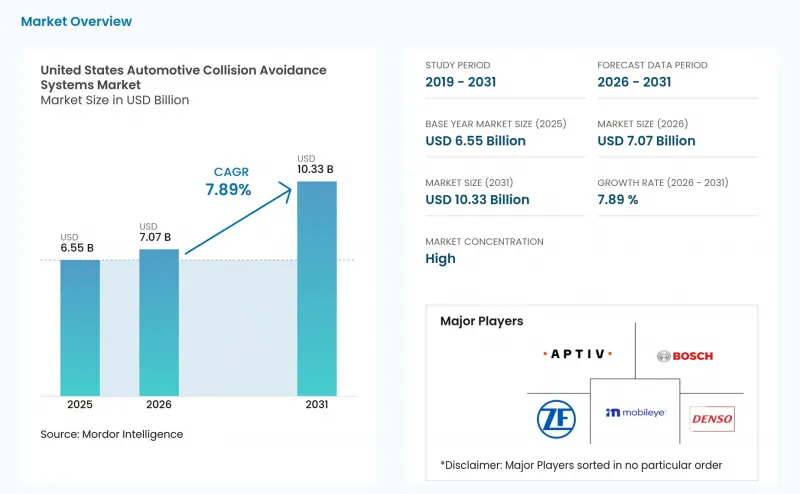
United States Automotive Collision Avoidance Systems Market Trends and Insights
Federal AEB and Pedestrian AEB Standardization
The federal automatic emergency braking rule sets a clear equipment deadline for the United States automotive collision avoidance systems market. NHTSA finalized FMVSS No. 127 in 2024 and requires automatic emergency braking, including pedestrian automatic emergency braking, on new light vehicles by September 2029. The standard makes consistent detection performance a vehicle-wide design requirement rather than a feature reserved for selected trims. Automakers must evaluate sensing, braking control, software validation, and driver alerts as one safety system. It raises the value of suppliers that can support testing, production launch, updates, dependable nighttime operation, and pedestrian detection. The rule also gives manufacturers a common basis for selecting hardware and software partners while increasing the importance of avoiding unnecessary braking events.
OEM Standard-Fit Expansion Across Volume Vehicles
The shift from option packages to standard equipment increases the number of vehicles that need collision avoidance hardware. It also changes procurement because an automaker may select a platform for several vehicle lines instead of buying separate components for each feature. The United States automotive collision avoidance systems market gains when a common architecture can support entry models and higher-content vehicles without repeated redesign. Standard fitment creates longer supply commitments for sensors, compute hardware, software, and service support. It requires automakers to manage cost, reliability, wiring, packaging, and updates across several trims. Suppliers that offer scalable platforms can meet this need while preserving meaningful differences between premium and volume programs.
High System Integration and Calibration Cost
Collision avoidance systems need accurate alignment after a repair affecting a windshield, bumper, grille, camera, or other sensor location. This creates a service requirement that can follow even a minor collision. Repair facilities need trained technicians, suitable work areas, tools, targets, and access to model-specific procedures. A vehicle can leave the factory with a capable system, but still create customer dissatisfaction if recalibration is difficult to arrange after damage. Consistent diagnostics and clear repair guidance can help preserve intended performance and reduce uncertainty for vehicle owners and fleets.
Other drivers and restraints analyzed in the detailed report include:
- Rising Consumer and Fleet Demand for Verified Crash Avoidance
- Sensor Fusion and Edge-AI Cost Curve Improvement
- Semiconductor and Sensor Supply-Chain Volatility
For complete list of drivers and restraints, kindly check the Table Of Contents.
Segment Analysis
Warning functions held 35.56% of the United States automotive collision avoidance systems market share by function type in 2025. This category includes forward collision warning, lane departure alerts, blind spot alerts, and related functions that prompt drivers to respond. Its established role reflects the familiarity of alert-based assistance across many vehicle categories. Warning functions can be introduced without changing the driver's primary responsibility for controlling the vehicle. They also provide a common foundation for safety packages that include more active forms of support.
Automated functions are projected to grow at an 8.81% CAGR through 2031. This group includes systems that can apply braking or provide steering assistance when a vehicle identifies an imminent risk. Their growth reflects the wider move toward intervention when a driver does not react in time. Monitoring functions remain relevant because information about driver attention can shape how a warning or intervention is delivered. Adaptive functions, including adaptive cruise control, continue to bridge basic alerts and more active assistance during routine driving.
Radar held 41.11% of technology revenue in 2025 within the United States automotive collision avoidance systems market. Its position reflects its ability to measure distance and relative speed across a range of driving situations. Automakers use radar to support adaptive cruise control, forward collision support, and other functions that depend on reliable range information. It can provide an important input when lighting conditions make visual sensing more difficult. Radar is increasingly combined with other technologies rather than used as a standalone solution.
Camera technology is projected to grow at a 15.71% CAGR through 2031. Cameras help the vehicle interpret lanes, road users, signs, and the broader visual context surrounding an object. This makes them important when a system needs more detailed scene understanding, including pedestrian recognition. LiDAR remains relevant for selected programs that require detailed three-dimensional perception, although its use differs by vehicle line. Ultrasonic sensors continue to support close-range functions, particularly parking and low-speed maneuvering.
Complete Report Scope:
- By Function Type
- Adaptive
- Automated
- Monitoring
- Warning
- By Technology Type
- Radar
- LiDAR
- Camera
- Ultrasonic
- By Vehicle Type
- Passenger Cars
- Commercial Vehicles
- By Application
- Adaptive Cruise Control (ACC)
- Autonomous Emergency Braking (AEB)
- Forward Collision Warning (FCW)
- Blind Spot Detection (BSD)
- Lane Departure Warning (LDW)
- Parking Assistance
- By State
- California
- Texas
- Florida
- New York
- Ohio
- Arizona
- Pennsylvania
- Illinois
- Rest of the United States
List of Companies Covered in this Report:
- Robert Bosch GmbH
- ZF Friedrichshafen AG
- Aptiv PLC
- Mobileye Global Inc.
- DENSO Corporation
- Magna International Inc.
- Autoliv Inc.
- Valeo SE
- Hyundai Mobis Co., Ltd.
- Panasonic Holdings Corporation
- Infineon Technologies AG
- NVIDIA Corporation
- NXP Semiconductors N.V.
- Texas Instruments Incorporated
- Analog Devices, Inc.
- Aisin Corporation
- Hitachi Astemo, Ltd.
- Gentex Corporation
- Luminar Technologies, Inc.
- Waymo LLC
- Tesla, Inc.
- Bendix Commercial Vehicle Systems LLC
- Knorr-Bremse AG
Additional Benefits:
- The market estimate (ME) sheet in Excel format
- 3 months of analyst support
TABLE OF CONTENTS
1 INTRODUCTION
- 1.1 Study Assumptions
- 1.2 Scope of the Study
2 RESEARCH METHODOLOGY
3 EXECUTIVE SUMMARY
4 MARKET LANDSCAPE
- 4.1 Market Overview
- 4.2 Market Drivers
- 4.2.1 Federal AEB and Pedestrian AEB Standardization
- 4.2.2 OEM Standard-Fit Expansion Across Volume Vehicles
- 4.2.3 Rising Consumer and Fleet Demand for Verified Crash Avoidance
- 4.2.4 Sensor Fusion and Edge-AI Cost Curve Improvement
- 4.2.5 Insurance and Repair-Economics Incentives for Preventive Safety
- 4.2.6 United States Nighttime and Vulnerable-Road-User Performance Gap Creating Upgrade Demand
- 4.3 Market Restraints
- 4.3.1 High System Integration and Calibration Cost
- 4.3.2 Semiconductor and Sensor Supply-Chain Volatility
- 4.3.3 Performance Degradation in Darkness, Adverse Weather, and Complex Road Geometry
- 4.3.4 Consumer Trust, False Alerts, and Liability Allocation
- 4.4 Value / Supply-Chain Analysis
- 4.5 Regulatory Landscape
- 4.6 Technological Outlook
- 4.7 Porters Five Forces Analysis
- 4.7.1 Threat of New Entrants
- 4.7.2 Bargaining Power of Buyers / Consumers
- 4.7.3 Bargaining Power of Suppliers
- 4.7.4 Threat of Substitute Products
- 4.7.5 Intensity of Competitive Rivalry
5 MARKET SIZE AND GROWTH FORECASTS, VALUE (USD)
- 5.1 By Function Type
- 5.1.1 Adaptive
- 5.1.2 Automated
- 5.1.3 Monitoring
- 5.1.4 Warning
- 5.2 By Technology Type
- 5.2.1 Radar
- 5.2.2 LiDAR
- 5.2.3 Camera
- 5.2.4 Ultrasonic
- 5.3 By Vehicle Type
- 5.3.1 Passenger Cars
- 5.3.2 Commercial Vehicles
- 5.4 By Application
- 5.4.1 Adaptive Cruise Control (ACC)
- 5.4.2 Autonomous Emergency Braking (AEB)
- 5.4.3 Forward Collision Warning (FCW)
- 5.4.4 Blind Spot Detection (BSD)
- 5.4.5 Lane Departure Warning (LDW)
- 5.4.6 Parking Assistance
- 5.5 By State
- 5.5.1 California
- 5.5.2 Texas
- 5.5.3 Florida
- 5.5.4 New York
- 5.5.5 Ohio
- 5.5.6 Arizona
- 5.5.7 Pennsylvania
- 5.5.8 Illinois
- 5.5.9 Rest of the United States
6 COMPETITIVE LANDSCAPE
- 6.1 Market Concentration
- 6.2 Strategic Moves
- 6.3 Market Share Analysis
- 6.4 Company Profiles (Includes Global Level Overview, Market Level Overview, Core Segments, Financials as available, Strategic Information, Market Rank/Share, Products and Services, Recent Developments)
- 6.4.1 Robert Bosch GmbH
- 6.4.2 ZF Friedrichshafen AG
- 6.4.3 Aptiv PLC
- 6.4.4 Mobileye Global Inc.
- 6.4.5 DENSO Corporation
- 6.4.6 Magna International Inc.
- 6.4.7 Autoliv Inc.
- 6.4.8 Valeo SE
- 6.4.9 Hyundai Mobis Co., Ltd.
- 6.4.10 Panasonic Holdings Corporation
- 6.4.11 Infineon Technologies AG
- 6.4.12 NVIDIA Corporation
- 6.4.13 NXP Semiconductors N.V.
- 6.4.14 Texas Instruments Incorporated
- 6.4.15 Analog Devices, Inc.
- 6.4.16 Aisin Corporation
- 6.4.17 Hitachi Astemo, Ltd.
- 6.4.18 Gentex Corporation
- 6.4.19 Luminar Technologies, Inc.
- 6.4.20 Waymo LLC
- 6.4.21 Tesla, Inc.
- 6.4.22 Bendix Commercial Vehicle Systems LLC
- 6.4.23 Knorr-Bremse AG
7 MARKET OPPORTUNITIES AND FUTURE OUTLOOK
- 7.1 White-Space and Unmet-Need Assessment

