PUBLISHER: Mordor Intelligence | PRODUCT CODE: 2187428

PUBLISHER: Mordor Intelligence | PRODUCT CODE: 2187428
India Switchgear - Market Share Analysis, Industry Trends & Statistics, Growth Forecasts (2027 - 2032)
According to Mordor Intelligence, the India switchgear market size is expected to increase from USD 5.78 billion in 2026 to USD 6.2 billion in 2027 and reach USD 8.96 billion by 2032, growing at a CAGR of 7.65% over 2027-2032.
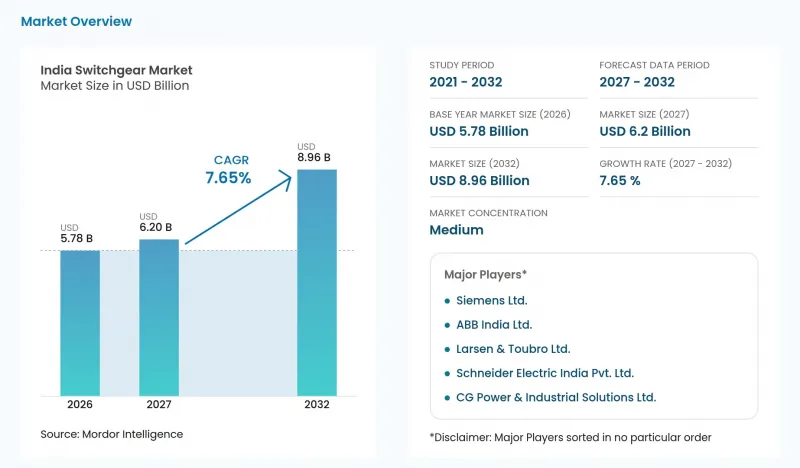
This report is segmented by Voltage (Low Voltage, Medium Voltage, and more), Insulation (Air Insulated Switchgear, Gas Insulated Switchgear, and more), Current Type (AC Switchgear and DC Switchgear), Installation (Indoor and Outdoor), and End-User (Utilities, Industrial, and more). The market forecasts are provided in terms of value (USD), based on availability.
India Switchgear Market Trends and Insights
Govt investment in T&D (RDSS)
Public distribution investment creates equipment opportunities through network reinforcement as well as new connections. By March 2026, the Revamped Distribution Sector Scheme (RDSS) had sanctioned INR 2.83 trillion (USD 29.9 billion) in distribution infrastructure, including smart metering, with INR 1.53 trillion (USD 16.16 billion) for loss-reduction works. Those works included new substations and substation augmentation, giving switchgear suppliers a demand pathway linked to physical network investment. The Ministry of Power reported cumulative RDSS releases of INR 471.2 billion (USD 4.95 billion) from FY2023 through August 2026. Released funding makes distribution-utility infrastructure a more concrete equipment opportunity than sanctioned program totals alone.
Renewable-grid integration surge
Renewable integration creates demand at the connection between generation capacity and the transmission network. By March 2026, commissioned Green Energy Corridor infrastructure covered 9,856 circuit-kilometers of lines and 24,300 MVA of substations for evacuating 24 GW of renewable capacity across 10 Indian states. The substation component gives switchgear suppliers a direct commercial link to renewable evacuation rather than generation additions alone. In March 2026, the Central Electricity Authority (CEA) also published a transmission plan to integrate over 900 GW of non-fossil capacity by 2035-36. The plan's non-fossil scope is broader than the renewable capacity served by the corridor program. Commissioned corridor assets and the longer planning horizon create separate selling windows for network extensions and future transmission packages.
High cap-ex of GIS & retrofits
Higher initial investment makes GIS adoption harder to justify when a substation buyer must establish its commercial advantage over an air-insulated design. The Consulting Electrical Engineers Association of Maharashtra's June 2025 comparison stated that GIS substations cost more than AIS substations in initial investment and operation. It attributed the difference to more sophisticated technology and materials, higher quality standards, and testing procedures. Because the premium applies to operation as well as the initial purchase, choosing GIS raises a utility's ongoing costs as well as its upfront budget. That continuing premium weakens the case for GIS where an air-insulated design is feasible, limiting adoption on price-sensitive projects.
Other drivers and restraints analyzed in the detailed report include:
- Urbanization & Smart-City electrification
- Data-center build-out demand
- Permit & land-acquisition delays
For complete list of drivers and restraints, kindly check the Table Of Contents.
Segment Analysis
Low voltage accounted for a 46.56% share of the India switchgear market size in 2026. ABB India Ltd. booked low-voltage panel orders from data-center operators in Mumbai in 2025. The company also booked orders for low-voltage panels and components from premium real estate developers in Karnataka and Andhra Pradesh that year. Orders from data-center operators in one metro and developers across 2 states show low-voltage panel demand arising in digital infrastructure and building construction at the same time.
High voltage is forecast to be the fastest-growing segment, with a 9.6% CAGR over 2027-2032. In February 2025, GE Vernova was selected by Sterlite Grid 32 Limited, a Sterlite Power subsidiary, to supply 765 kV gas-insulated switchgear for Khavda Phase IV Part C in India. The February 2025 announcement said the project was expected to be completed within 2 years. The supply selection ties opportunity to a defined transmission package, making the project's equipment scope central to the supplier's commercial position. The project's stated purpose of integrating solar and wind power ties this 765 kV demand to renewable evacuation corridors.
Air-insulated switchgear (AIS) represented a 71.05% India switchgear market share in 2026. POWERGRID reported an installed base of 54 AIS substations and 21 GIS substations, each at 765 kV, across its Indian transmission network on September 30, 2026. At that voltage, AIS substations outnumber GIS substations by more than 2 to 1 in POWERGRID's network. Suppliers of air-insulated equipment therefore have the larger installed base to serve whenever the operator expands existing 765 kV sites.
Other insulation configurations are forecast to be the fastest-growing segment, at a 15.4% CAGR over 2027-2032. Their smaller starting revenue base makes selective project entry a more direct commercial objective than replicating the established AIS business. Vacuum, dry-air, and solid-insulation SF6-free designs put the insulation choice at the center of a utility buyer's equipment specification. Suppliers of these designs can therefore compete for projects whose utility specifications call for a non-SF6 configuration.
Complete Report Scope:
- By Voltage
- Low Voltage
- Medium Voltage
- High Voltage
- By Insulation
- Gas Insulated Switchgear (GIS)
- Air Insulated Switchgear (AIS)
- Others
- By Current Type
- AC Switchgear
- DC Switchgear
- By Installation
- Indoor
- Outdoor
- By End-User
- Utilities
- Residential
- Commercial
- Industrial
List of Companies Covered in this Report:
- ABB India Ltd.
- Siemens Ltd.
- Schneider Electric India Pvt. Ltd.
- Larsen & Toubro Ltd.
- CG Power & Industrial Solutions Ltd.
- GE Vernova T&D India Ltd.
- Hitachi Energy India Ltd.
- Kirloskar Electric Co. Ltd.
- Havells India Ltd.
- Bharat Heavy Electricals Ltd.
- HPL Electric & Power Ltd.
- Eaton Power Quality Pvt. Ltd.
- Hyosung T&D India Pvt. Ltd.
- Toshiba T&D Systems (India) Pvt. Ltd.
- Mitsubishi Electric India Pvt. Ltd.
- Legrand India Pvt. Ltd.
- C&S Electric Ltd.
- Lucy Electric India Pvt. Ltd.
- MEIDEN India Pvt. Ltd.
- CHINT India Energy Solution Pvt. Ltd.
Additional Benefits:
- The market estimate (ME) sheet in Excel format
- 3 months of analyst support
TABLE OF CONTENTS
1 INTRODUCTION
- 1.1 Study Assumptions and Market Definition
- 1.2 Scope of the Study
2 RESEARCH METHODOLOGY
3 EXECUTIVE SUMMARY
4 MARKET LANDSCAPE
- 4.1 Market Overview
- 4.2 Market Drivers
- 4.2.1 Govt investment in T&D (RDSS)
- 4.2.2 Renewable-grid integration surge
- 4.2.3 Urbanization & Smart-City electrification
- 4.2.4 Data-center build-out demand
- 4.2.5 Smart/digital switchgear adoption
- 4.2.6 Metro-rail & EV-charging corridors
- 4.3 Market Restraints
- 4.3.1 High cap-ex of GIS & retrofits
- 4.3.2 Permit & land-acquisition delays
- 4.3.3 SF6 environmental-compliance risk
- 4.3.4 Fragmented after-sales service
- 4.4 Industry Value Chain Analysis
- 4.5 Regulatory Landscape
- 4.6 Technological Outlook
- 4.7 Porter's Five Forces Analysis
- 4.7.1 Threat of New Entrants
- 4.7.2 Bargaining Power of Suppliers
- 4.7.3 Bargaining Power of Buyers
- 4.7.4 Threat of Substitutes
- 4.7.5 Competitive Rivalry
- 4.8 PESTLE Analysis
5 MARKET SIZE AND GROWTH FORECASTS (VALUE)
- 5.1 By Voltage
- 5.1.1 Low Voltage
- 5.1.2 Medium Voltage
- 5.1.3 High Voltage
- 5.2 By Insulation
- 5.2.1 Gas Insulated Switchgear (GIS)
- 5.2.2 Air Insulated Switchgear (AIS)
- 5.2.3 Others
- 5.3 By Current Type
- 5.3.1 AC Switchgear
- 5.3.2 DC Switchgear
- 5.4 By Installation
- 5.4.1 Indoor
- 5.4.2 Outdoor
- 5.5 By End-User
- 5.5.1 Utilities
- 5.5.2 Residential
- 5.5.3 Commercial
- 5.5.4 Industrial
6 COMPETITIVE LANDSCAPE
- 6.1 Market Concentration
- 6.2 Strategic Moves
- 6.3 Market Share Analysis
- 6.4 Company Profiles (includes Global level Overview, Market level overview, Core Segments, Financials as available, Strategic Information, Market Rank/Share for key companies, Products and Services, and Recent Developments)
- 6.4.1 ABB India Ltd.
- 6.4.2 Siemens Ltd.
- 6.4.3 Schneider Electric India Pvt. Ltd.
- 6.4.4 Larsen & Toubro Ltd.
- 6.4.5 CG Power & Industrial Solutions Ltd.
- 6.4.6 GE Vernova T&D India Ltd.
- 6.4.7 Hitachi Energy India Ltd.
- 6.4.8 Kirloskar Electric Co. Ltd.
- 6.4.9 Havells India Ltd.
- 6.4.10 Bharat Heavy Electricals Ltd.
- 6.4.11 HPL Electric & Power Ltd.
- 6.4.12 Eaton Power Quality Pvt. Ltd.
- 6.4.13 Hyosung T&D India Pvt. Ltd.
- 6.4.14 Toshiba T&D Systems (India) Pvt. Ltd.
- 6.4.15 Mitsubishi Electric India Pvt. Ltd.
- 6.4.16 Legrand India Pvt. Ltd.
- 6.4.17 C&S Electric Ltd.
- 6.4.18 Lucy Electric India Pvt. Ltd.
- 6.4.19 MEIDEN India Pvt. Ltd.
- 6.4.20 CHINT India Energy Solution Pvt. Ltd.
7 MARKET OPPORTUNITIES AND FUTURE OUTLOOK
- 7.1 White-Space and Unmet-Need Assessment

