PUBLISHER: Mordor Intelligence | PRODUCT CODE: 2187433

PUBLISHER: Mordor Intelligence | PRODUCT CODE: 2187433
Off-Highway Wheels - Market Share Analysis, Industry Trends & Statistics, Growth Forecasts (2026 - 2031)
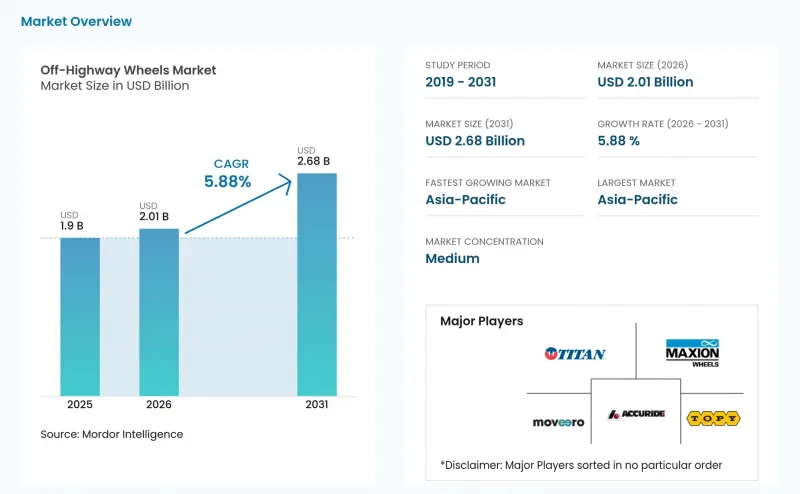
According to Mordor Intelligence, the off-highway wheels market size was valued at USD 1.90 billion in 2025 and is expected to grow from USD 2.01 billion in 2026 to reach USD 2.68 billion by 2031, at a 5.88% CAGR.
Global Off-Highway Wheels Market Trends and Insights
OEM Migration to Larger Wheel Diameters
Global equipment builders have already upsized standard wheel offerings by 2-4 inches, citing lower ground pressure, improved stability, and better operator comfort. Caterpillar's next-gen excavators boast larger wheels than earlier models, while John Deere's flagship tractors push diameter boundaries to cut compaction on soft soil. These changes invite premium wheel pricing but force suppliers to install new press lines and welding robots capable of handling wider drop-centers. Fast-follow firms lacking capex flexibility are teaming with contract fabricators, but their margins compress because OEMs stipulate PPM defect targets.
Infrastructure Megaprojects in Emerging Markets
Governments in Asia-Pacific and Africa are underwriting record-scale public works, ranging from expressways to energy corridors, that require immediate deployment of heavy machinery. India's National Infrastructure Pipeline budgeted USD 1.4 trillion for projects by FY2024-25, while Egypt's New Administrative Capital has already pulled in a significant number of excavators and loaders. Wheels must withstand continuous duty cycles, extreme axle loads, and abrasive terrain, steering OEMs to specify reinforced rims and deep-section designs. Because construction consortia operate under tight completion schedules, they prefer larger diameters that promise fewer tire changes and reduced downtime. Belt and Road initiatives across 65 countries amplify cross-border demand, prompting Western suppliers to form joint ventures with local assemblers to secure reliable aftermarket access.
Steel and Aluminum Price Volatility
In 2025, energy costs and blast-furnace outages significantly impacted steel prices, while aluminum prices experienced a notable increase year-on-year. Wheel producers locked into OEM frame contracts struggled to pass surcharges downstream, eroding margins. Smaller firms without derivatives hedges faced liquidity crunches and accelerated M&A discussions. Some shifted to scrap-based EAF supplies, but quality consistency issues limited adoption.
Other drivers and restraints analyzed in the detailed report include:
- Carbon-Footprint Targets Driving Alloy / Composite Uptake
- Rapid Farm Mechanization Across Asia-Pacific and Africa
- Raw-Material Supply-Chain Disruptions
For complete list of drivers and restraints, kindly check the Table Of Contents.
Segment Analysis
Steel wheels accounted for 70.14% of 2025 revenue because global supply chains deliver predictable quality at competitive cost. Composite wheels will grow fastest at a 9.05% CAGR, as OEMs chase notable weight savings that translate into lower fuel burn. Aluminum wheels serve mid-tier niches, offering corrosion resistance at modest premiums, while alloy wheels target specialty mining and marine applications. Certification lags and tooling expense slow composite penetration, but premium price points offset capital outlays, attracting both incumbents and new entrants. Steel retains strength in cost-sensitive regions where established forging and welding infrastructure favors high-volume throughput.
Composite wheels entice early adopters through sustainability credits and operator comfort gains derived from dampened vibration. OEM marketing teams position lightweight rims as productivity enhancers, citing reduced soil compaction and longer component life. Suppliers in North America and Europe highlight recycled carbon fiber content to appeal to ESG-driven buyers. Asian vendors counter with hybrid steel-composite constructions that cut costs while shrinking mass, thereby extending steel's relevance in the Off-Highway Wheels market.
Wheels spanning 20-30 inches delivered 48.33% of 2025 sales, balancing maneuverability and load capacity for mainstream construction and agricultural platforms. Assemblies above 30 inches will be climbing at a 7.86% CAGR to 2031, spurred by heavier payload requirements in mining haul trucks and high-flotation tractors. Below-20-inch wheels are losing share as compact equipment shifts to rubber tracks, but remain essential for backhoes and compact telehandlers operating in confined spaces.
The move toward larger diameters supports OEM objectives to lower ground pressure and widen contact patches, thereby improving tractive efficiency and operator comfort. Suppliers must invest in larger spin-forming machines and robotic welding cells to meet run-out tolerances on oversized rims. The capital burden justifies higher selling prices, enhancing revenue per unit but also raising barriers for late entrants.
Complete Report Scope:
- By Product Type
- Steel Wheels
- Aluminum Wheels
- Alloy Wheels
- Composite Wheels
- By Wheel Size
- Below 20 Inches
- 20-30 Inches
- Above 30 Inches
- By Application
- Construction Equipment
- Agricultural Equipment
- Mining Equipment
- Industrial Vehicles
- By End Use
- OEM
- Aftermarket
- By Geography
- North America
- United States
- Canada
- Rest of North America
- South America
- Brazil
- Argentina
- Rest of South America
- Europe
- Germany
- United Kingdom
- France
- Italy
- Spain
- Rest of Europe
- Asia-Pacific
- China
- India
- Japan
- South Korea
- Rest of Asia-Pacific
- Middle East and Africa
- United Arab Emirates
- Saudi Arabia
- South Africa
- Turkey
- Rest of Middle East and Africa
- North America
Geography Analysis
Asia-Pacific accounted for 44.12% of the Off-Highway Wheels market revenue in 2025 and will grow at a 7.24% CAGR through 2031. China's Belt and Road Initiative pumps capital into cross-border rail and highway assets, sustaining demand for earth-moving equipment. India's mechanization drive spurs tractor and skid-steer orders across rural cooperatives. ASEAN nations fast-track industrial park construction, boosting demand for telehandler and crane wheels. Supply-chain density in the region ensures material availability, while governmental tax rebates entice OEMs to co-locate final assembly.
North America retains a sizable slice of global turnover owing to pipeline rehabilitation projects, renewable-energy installations, and corn-belt agriculture upgrades. The CHIPS Act stimulates fabrication of semiconductor plants that require specialized heavy lifters, translating into niche wheel demand. Reshoring trends draw Titan International and Maxion Wheels to expand Illinois and Ontario factories, shortening cycle times and aligning with Buy American preferences .
Europe foregrounds decarbonization. EU regulations that penalize emissions intensify composite wheel adoption. Germany's quarry equipment segment opts for sensor-laden rims to comply with predictive maintenance directives that aim to eliminate catastrophic failures. Eastern European construction booms benefit from cohesion-fund allocations, and local rim makers upgrade presses to meet Western OEM tolerance requirements.
- Titan International, Inc.
- Maxion Wheels
- moveero (GKN Wheels)
- Accuride Corporation
- Topy Industries, Ltd.
- RIMEX
- JANTSA
- Wheels India Limited
- The Carlstar Group
- Unverferth Manufacturing Co., Inc.
- Levypyora Oy (Nokian Heavy Tyres Ltd)
- Global Wheel the Americas, LLC
- Dexstar Wheel
- Vlukon B.V.
- Zhejiang Jingu Co., Ltd.
- Trelleborg Wheel Systems (Yokohama TWS)
Additional Benefits:
- The market estimate (ME) sheet in Excel format
- 3 months of analyst support
TABLE OF CONTENTS
1 Introduction
- 1.1 Study Assumptions & Market Definition
- 1.2 Scope of the Study
2 Research Methodology
3 Executive Summary
4 Market Landscape
- 4.1 Market Overview
- 4.2 Market Drivers
- 4.2.1 OEM Migration to Larger Wheel Diameters
- 4.2.2 Infrastructure Megaprojects in Emerging Markets
- 4.2.3 Carbon-Footprint Targets Driving Alloy / Composite Uptake
- 4.2.4 Rapid Farm Mechanization Across Asia-Pacific and Africa
- 4.2.5 Smart-Sensor Wheels Enabling Predictive Maintenance
- 4.2.6 Near-Shoring of Heavy-Equipment Production
- 4.3 Market Restraints
- 4.3.1 Steel and Aluminum Price Volatility
- 4.3.2 Raw-Material Supply-Chain Disruptions
- 4.3.3 Track-System Substitution in Agri/Construction
- 4.3.4 Certification Lag for New Composite Designs
- 4.4 Value / Supply-Chain Analysis
- 4.5 Regulatory Landscape
- 4.6 Technological Outlook
- 4.7 Porter's Five Forces Analysis
- 4.7.1 Bargaining Power of Suppliers
- 4.7.2 Bargaining Power of Buyers
- 4.7.3 Threat of New Entrants
- 4.7.4 Threat of Substitutes
- 4.7.5 Competitive Rivalry
5 Market Size & Growth Forecasts (Value & Volume)
- 5.1 By Product Type
- 5.1.1 Steel Wheels
- 5.1.2 Aluminum Wheels
- 5.1.3 Alloy Wheels
- 5.1.4 Composite Wheels
- 5.2 By Wheel Size
- 5.2.1 Below 20 Inches
- 5.2.2 20-30 Inches
- 5.2.3 Above 30 Inches
- 5.3 By Application
- 5.3.1 Construction Equipment
- 5.3.2 Agricultural Equipment
- 5.3.3 Mining Equipment
- 5.3.4 Industrial Vehicles
- 5.4 By End Use
- 5.4.1 OEM
- 5.4.2 Aftermarket
- 5.5 By Geography
- 5.5.1 North America
- 5.5.1.1 United States
- 5.5.1.2 Canada
- 5.5.1.3 Rest of North America
- 5.5.2 South America
- 5.5.2.1 Brazil
- 5.5.2.2 Argentina
- 5.5.2.3 Rest of South America
- 5.5.3 Europe
- 5.5.3.1 Germany
- 5.5.3.2 United Kingdom
- 5.5.3.3 France
- 5.5.3.4 Italy
- 5.5.3.5 Spain
- 5.5.3.6 Rest of Europe
- 5.5.4 Asia-Pacific
- 5.5.4.1 China
- 5.5.4.2 India
- 5.5.4.3 Japan
- 5.5.4.4 South Korea
- 5.5.4.5 Rest of Asia-Pacific
- 5.5.5 Middle East and Africa
- 5.5.5.1 United Arab Emirates
- 5.5.5.2 Saudi Arabia
- 5.5.5.3 South Africa
- 5.5.5.4 Turkey
- 5.5.5.5 Rest of Middle East and Africa
- 5.5.1 North America
6 Competitive Landscape
- 6.1 Market Concentration
- 6.2 Strategic Moves
- 6.3 Market Share Analysis
- 6.4 Company Profiles (includes Global Level Overview, Market Level Overview, Core Segments, Financials as Available, Strategic Information, Market Rank/Share for Key Companies, Products and Services, SWOT Analysis, and Recent Developments)
- 6.4.1 Titan International, Inc.
- 6.4.2 Maxion Wheels
- 6.4.3 moveero (GKN Wheels)
- 6.4.4 Accuride Corporation
- 6.4.5 Topy Industries, Ltd.
- 6.4.6 RIMEX
- 6.4.7 JANTSA
- 6.4.8 Wheels India Limited
- 6.4.9 The Carlstar Group
- 6.4.10 Unverferth Manufacturing Co., Inc.
- 6.4.11 Levypyora Oy (Nokian Heavy Tyres Ltd)
- 6.4.12 Global Wheel the Americas, LLC
- 6.4.13 Dexstar Wheel
- 6.4.14 Vlukon B.V.
- 6.4.15 Zhejiang Jingu Co., Ltd.
- 6.4.16 Trelleborg Wheel Systems (Yokohama TWS)
7 Market Opportunities & Future Outlook
- 7.1 White-space & Unmet-need Assessment

