PUBLISHER: Mordor Intelligence | PRODUCT CODE: 2187637

PUBLISHER: Mordor Intelligence | PRODUCT CODE: 2187637
India Protein - Market Share Analysis, Industry Trends & Statistics, Growth Forecasts (2027 - 2032)
According to Mordor Intelligence, the India protein market size is expected to increase from USD 1.62 billion in 2026 to USD 1.73 billion in 2027 and reach USD 2.35 billion by 2032, growing at a CAGR of 6.3% over 2027-2032.
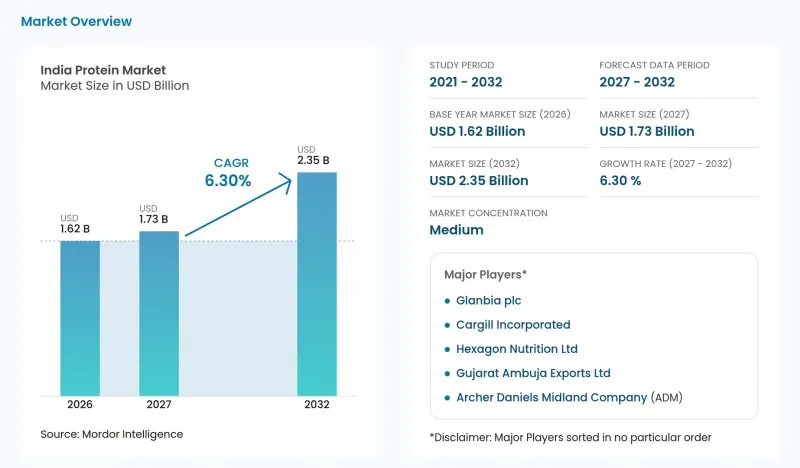
Volume is expected to increase from 327.3 thousand tons in 2026 to 345 thousand tons in 2027 and reach 448.8 thousand tons by 2032, growing at a CAGR of 5.4% over 2027-2032. This report is segmented by Source (Animal, Plant, and Microbial), Form (Concentrates, Isolates, Hydrolysates, and Other Forms), and Application (Food and Beverages, Animal Feed, Dietary Supplements and Sports Nutrition, and Personal Care and Cosmetics). The market forecasts are provided in terms of value (USD) and volume (tons), based on availability.
India Protein Market Trends and Insights
Growing mainstream adoption of high-protein diets and sports nutrition
Affordable protein products can connect mainstream dietary interest with the purchasing reach of online retail. In March 2026, Amazon India reported year-on-year growth of 35% for its online protein and nutrition portfolio and 42% for whey proteins. Nutrabay reported 80% growth in its private label over the prior year in December 2025, driven by demand for affordable protein-based products. Together, these examples link protein demand to both channel reach and affordability, giving manufacturers a rationale to develop accessible nutrition offerings. Growth at both a marketplace and a private label points to price-conscious online shoppers as a buyer group through which this driver reaches ingredient demand.
Protein fortification of everyday staples
Protein fortification can expand ingredient demand by making an ordinary meal the vehicle for additional protein. ITC Limited reported an encouraging consumer response to Aashirvaad High Protein Atta in FY2025-26. In 2025, iD Fresh Food launched plant-based protein idli-dosa batter delivering 15 grams of protein in 2 prepared idlis. Flour and batter therefore offer distinct routes for food manufacturers to incorporate protein into the preparation of familiar meals. Protein demand can then scale with fortified-food production because the stated dose must be delivered in each prepared serving.
Volatility in prices and supply of key inputs
The global whey crunch, driven by rising international demand and geopolitical and shipping disruptions, began in May 2026, squeezing Indian supplement makers' margins as they could not fully pass sharply higher input costs to consumers. This weakens the economics of expanding affordable whey-based products even where consumer interest supports additional demand. Yoga Bar said in May 2026 that operational efficiencies and scale offset part of the pressure while it absorbed some costs, believing the cycle could be temporary. Producers protecting consumer prices retain a cost burden that limits the margin available to support broader adoption.
Other drivers and restraints analyzed in the detailed report include:
- Expansion of ready-to-drink protein shakes, bars, and sachet-based formats
- Emerging use of precision fermentation to produce animal-free dairy proteins
- Allergenicity concerns and consumer skepticism
For complete list of drivers and restraints, kindly check the Table Of Contents.
Segment Analysis
Animal proteins accounted for a 58.29% share of the India protein market size in 2026. Parag Milk Foods reported daily whey-processing capacity of 1 million liters in FY2024-25. The integrated dairy producer also sells whey-protein products under its Avvatar brand, giving its processed whey a branded outlet.
Microbial proteins are forecast to be the fastest-growing segment, with a CAGR of 7.75% over 2027-2032. Perfect Day expects its joint Gujarat manufacturing facility with Zydus Lifesciences to produce 2,000 metric tons of recombinant beta-lactoglobulin in its first 12 months. Annual nameplate capacity is expected to be about 2,500 metric tons, with commercial deliveries expected in the first quarter of 2027. This creates a manufacturing opportunity centered on a specific animal-free whey protein and an identified production partnership. Those expectations imply the facility would run below full capacity during its first 12 months.
Complete Report Scope:
- By Source
- Animal
- Casein and Caseinates
- Collagen
- Egg Protein
- Gelatin
- Insect Protein
- Milk Protein
- Whey Protein
- Other Animal Proteins
- Microbial
- Algae Protein
- Mycoprotein
- Plant
- Hemp Protein
- Pea Protein
- Potato Protein
- Rice Protein
- Soy Protein
- Wheat Protein
- Other Plant Proteins
- Animal
- By Form
- Concentrates
- Isolates
- Hydrolysates
- Other Forms
- By Application
- Food and Beverages
- Bakery
- Beverages
- Breakfast Cereals
- Condiments/Sauces
- Confectionery
- Dairy and Dairy Alternative Products
- Meat/Poultry/Seafood and Meat Alternative Products
- RTE/RTC Food Products
- Snacks
- Infant Nutrition
- Other Food and Beverage Applications
- Personal Care and Cosmetics
- Animal Feed
- Dietary Supplements and Sports Nutrition
- Food and Beverages
List of Companies Covered in this Report:
- Archer Daniels Midland Company (ADM)
- Fonterra Co-operative Group Ltd
- Glanbia plc
- Hilmar Cheese Company Inc.
- International Flavors & Fragrances Inc. (IFF)
- Kerry Group plc
- Nakoda Dairy Pvt Ltd
- Nitta Gelatin Inc.
- Roquette Freres
- Sudzucker AG (BENEO)
- VIPPY Industries Ltd
- Cargill Incorporated
- DSM-Firmenich AG
- Gujarat Ambuja Exports Ltd
- Shree Panchvati Soy Industries
- Hexagon Nutrition Ltd
- Axiom Foods Inc.
- Novonesis A/S
- Devansoy Inc.
- Ingredion Incorporated
Additional Benefits:
- The market estimate (ME) sheet in Excel format
- 3 months of analyst support
TABLE OF CONTENTS
1 INTRODUCTION
- 1.1 Study Assumptions and Market Definition
- 1.2 Scope of the Study
2 RESEARCH METHODOLOGY
3 EXECUTIVE SUMMARY
4 MARKET LANDSCAPE
- 4.1 Market Overview
- 4.2 Market Drivers
- 4.2.1 Growing mainstream adoption of high-protein diets and sports nutrition
- 4.2.2 Protein fortification of everyday staples
- 4.2.3 Expansion of ready-to-drink protein shakes, bars, and sachet-based formats
- 4.2.4 Emerging use of precision fermentation to produce animal-free dairy proteins
- 4.2.5 Rising demand for premium pet food and aquafeed
- 4.2.6 Strong digital-led marketing and influencer-driven health-and-wellness narratives
- 4.3 Market Restraints
- 4.3.1 Volatility in prices and supply of key inputs
- 4.3.2 Allergenicity concerns and consumer skepticism
- 4.3.3 Regulatory approvals slowing insect/microbial protein adoption
- 4.3.4 Flavor off-notes/processing challenges driving higher costs
- 4.4 Industry Value Chain Analysis
- 4.5 Regulatory Landscape
- 4.6 Technological Outlook
- 4.7 Porter's Five Forces Analysis
- 4.7.1 Threat of New Entrants
- 4.7.2 Bargaining Power of Suppliers
- 4.7.3 Bargaining Power of Buyers
- 4.7.4 Threat of Substitutes
- 4.7.5 Competitive Rivalry
5 MARKET SIZE AND GROWTH FORECASTS (VALUE AND VOLUME)
- 5.1 By Source
- 5.1.1 Animal
- 5.1.1.1 Casein and Caseinates
- 5.1.1.2 Collagen
- 5.1.1.3 Egg Protein
- 5.1.1.4 Gelatin
- 5.1.1.5 Insect Protein
- 5.1.1.6 Milk Protein
- 5.1.1.7 Whey Protein
- 5.1.1.8 Other Animal Proteins
- 5.1.2 Microbial
- 5.1.2.1 Algae Protein
- 5.1.2.2 Mycoprotein
- 5.1.3 Plant
- 5.1.3.1 Hemp Protein
- 5.1.3.2 Pea Protein
- 5.1.3.3 Potato Protein
- 5.1.3.4 Rice Protein
- 5.1.3.5 Soy Protein
- 5.1.3.6 Wheat Protein
- 5.1.3.7 Other Plant Proteins
- 5.1.1 Animal
- 5.2 By Form
- 5.2.1 Concentrates
- 5.2.2 Isolates
- 5.2.3 Hydrolysates
- 5.2.4 Other Forms
- 5.3 By Application
- 5.3.1 Food and Beverages
- 5.3.1.1 Bakery
- 5.3.1.2 Beverages
- 5.3.1.3 Breakfast Cereals
- 5.3.1.4 Condiments/Sauces
- 5.3.1.5 Confectionery
- 5.3.1.6 Dairy and Dairy Alternative Products
- 5.3.1.7 Meat/Poultry/Seafood and Meat Alternative Products
- 5.3.1.8 RTE/RTC Food Products
- 5.3.1.9 Snacks
- 5.3.1.10 Infant Nutrition
- 5.3.1.11 Other Food and Beverage Applications
- 5.3.2 Personal Care and Cosmetics
- 5.3.3 Animal Feed
- 5.3.4 Dietary Supplements and Sports Nutrition
- 5.3.1 Food and Beverages
6 COMPETITIVE LANDSCAPE
- 6.1 Market Concentration
- 6.2 Strategic Moves
- 6.3 Market Share Analysis
- 6.4 Company Profiles (includes Global level Overview, Market level overview, Core Segments, Financials as available, Strategic Information, Market Rank/Share for key companies, Products and Services, and Recent Developments)
- 6.4.1 Archer Daniels Midland Company (ADM)
- 6.4.2 Fonterra Co-operative Group Ltd
- 6.4.3 Glanbia plc
- 6.4.4 Hilmar Cheese Company Inc.
- 6.4.5 International Flavors & Fragrances Inc. (IFF)
- 6.4.6 Kerry Group plc
- 6.4.7 Nakoda Dairy Pvt Ltd
- 6.4.8 Nitta Gelatin Inc.
- 6.4.9 Roquette Freres
- 6.4.10 Sudzucker AG (BENEO)
- 6.4.11 VIPPY Industries Ltd
- 6.4.12 Cargill Incorporated
- 6.4.13 DSM-Firmenich AG
- 6.4.14 Gujarat Ambuja Exports Ltd
- 6.4.15 Shree Panchvati Soy Industries
- 6.4.16 Hexagon Nutrition Ltd
- 6.4.17 Axiom Foods Inc.
- 6.4.18 Novonesis A/S
- 6.4.19 Devansoy Inc.
- 6.4.20 Ingredion Incorporated
7 MARKET OPPORTUNITIES AND FUTURE OUTLOOK
- 7.1 White-Space and Unmet-Need Assessment

