PUBLISHER: Mordor Intelligence | PRODUCT CODE: 2187670

PUBLISHER: Mordor Intelligence | PRODUCT CODE: 2187670
Spirits - Market Share Analysis, Industry Trends & Statistics, Growth Forecasts (2027 - 2032)
According to Mordor Intelligence, the spirits market size was valued at USD 664.4 billion in 2026 and estimated to grow from USD 688.8 billion in 2027 to reach USD 804 billion by 2032, at a CAGR of 3.14% during the forecast period (2027-2032).
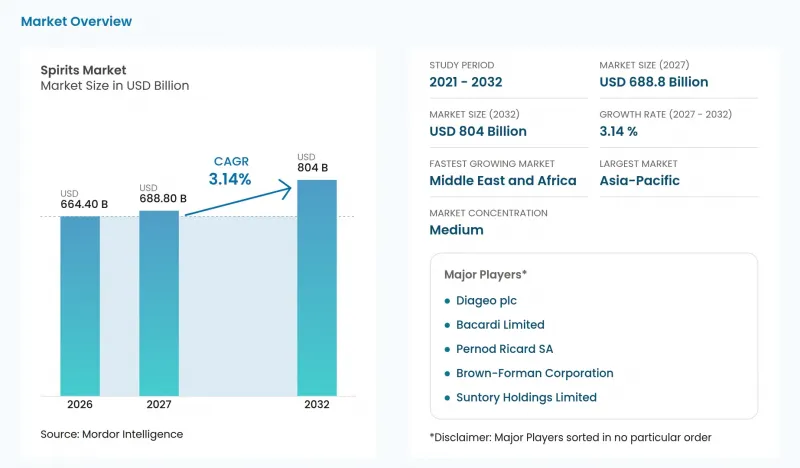
This report is segmented by Product Type (Whiskies, White Spirits, Other Spirit Types, Liqueur, Brandy and Cognac, Rum, and Tequila and Mezcal), End User (Men and Women), Distribution Channel (Off-Trade and On-Trade), and Geography (Asia-Pacific, North America, Europe, South America, and Middle East and Africa). The market forecasts are provided in terms of value (USD), based on availability.
Global Spirits Market Trends and Insights
Increasing consumer preference for craft and small-batch spirits
Direct access can support both existing craft-brand demand and discovery of other small producers. In August 2025, 84% of U.S. adults aged 21 or older who drank craft spirits at least monthly wanted the ability to legally buy their favorite craft spirits through direct-to-consumer channels. Among those regular craft drinkers, 77% said home shipping would make them more likely to try new craft spirit brands. The responses point to different commercial uses of shipping, connecting repeat drinkers to preferred labels while giving prospective buyers another route to unfamiliar brands. For a small producer, a legal channel serving both functions offers a broader growth proposition than availability for an existing following alone.
Expansion of the tourism and hospitality sector contributing to strong market growth
A larger visitor economy gives spirits suppliers more potential occasions to serve travelers through licensed hospitality venues. Global international visitor spending reached a record USD 2.02 trillion in 2025, up 3.2% from 2024, according to the World Travel & Tourism Council. IHG Hotels & Resorts also opened a record 443 hotels with 65,100 rooms globally in 2025. Visitor spending and additional accommodation capacity support different parts of the opportunity, combining a broader pool of travel expenditure with more potential hospitality locations. For spirits suppliers, the commercial benefit depends on converting those locations into licensed service relationships rather than assuming that tourism growth automatically becomes beverage sales. New venue access can therefore create a route to demand beyond competing for an existing bar's limited menu space.
Tight government controls and compliance requirements
The U.S. Alcohol and Tobacco Tax and Trade Bureau (TTB) makes label approval a pre-bottling requirement for covered spirits entering interstate commerce. The bottler obtains the approval even when another entity is contracted to produce the product. Spirits sold only within their bottling state may qualify for a certificate of exemption. TTB's 2025 Alcohol Facts labeling proposal also included a modeled mean cost of USD 1,636.52 per universal product code for coordinated changes to wine, distilled spirits and malt beverage labels. Multi-label suppliers therefore face cumulative compliance work before additional products can move into interstate commerce, alongside the potential expense of labeling changes TTB proposed in 2025.
Other drivers and restraints analyzed in the detailed report include:
- Rising demand for high-end and premium alcoholic beverages
- Greater product differentiation based on raw ingredients and alcohol strength
- Increasing health concerns related to heavy alcohol intake
For complete list of drivers and restraints, kindly check the Table Of Contents.
Segment Analysis
Whiskies accounted for a 22.91% share of the spirits market size in 2026. In 2025, Scotch whisky exports totaled the equivalent of 1.34 billion 70-centiliter bottles at 40% alcohol by volume across around 163 markets. India was the largest Scotch whisky export destination by volume, receiving 220 million 70-centiliter bottles in 2025, up 15% from 2024. The shipment base shows the international reach of Scotch whisky, one whisky category, while India's additional volume identifies a particular destination for incremental demand. Scotch exporters therefore choose between breadth across their export markets and deeper commitment to India, the largest destination by volume.
White spirits are forecast to be the fastest-growing segment, at a CAGR of 3.68% during 2027-2032. Global gin volumes reached approximately 109 million nine-liter cases in 2025, up 1%, compared with 2% growth in 2024. Within vodka, Diageo reported Ketel One net sales growth of 4.5% in fiscal 2026 and share gains in vodka and total spirits, while its total vodka net sales fell 1% and Smirnoff fell 5%. In FY2025-26, United Spirits reported 55.5% growth for white spirits within its India Prestige & Above segment and identified flavors as an emerging category growth driver. Flavor-led ranges can therefore address expanding demand in that Indian price tier, alongside gin volume growth and brand-level share opportunities in vodka.
Complete Report Scope:
- By Product Type
- Brandy and Cognac
- Liqueur
- Rum
- Tequila and Mezcal
- Whiskies
- White Spirits
- Other Spirit Types
- By End User
- Men
- Women
- By Distribution Channel
- On-Trade
- Off-Trade
- Specialty/Liquor Stores
- Other Off Trade Channels
- By Geography
- North America
- United States
- Canada
- Mexico
- Rest of North America
- Europe
- United Kingdom
- Germany
- France
- Italy
- Spain
- Netherlands
- Sweden
- Belgium
- Poland
- Rest of Europe
- Asia-Pacific
- China
- Japan
- India
- South Korea
- Australia
- Indonesia
- Thailand
- Singapore
- Rest of Asia-Pacific
- South America
- Brazil
- Argentina
- Chile
- Colombia
- Peru
- Rest of South America
- Middle East and Africa
- United Arab Emirates
- South Africa
- Saudi Arabia
- Nigeria
- Egypt
- Morocco
- Turkey
- Rest of Middle East and Africa
- North America
Geography Analysis
Asia-Pacific accounted for 45.77% of the spirits market size in 2026, making it the largest regional market. In May 2026, United Spirits Limited described India as the world's second-largest market for distilled spirits. The India-based producer's company-wide sales volume reached 65 million cases in FY2025-26, up 1.5% from the previous year. For entrants targeting India, the large demand pool comes with competition from a producer already serving buyers at substantial scale.
Middle East and Africa is forecast to be the fastest-growing regional market, at a CAGR of 4.65% during 2027-2032. Pernod Ricard reported triple-digit organic sales growth for Martell in South Africa in FY2026, measured at constant foreign exchange and group structure. Martell's global sales nevertheless fell sharply, while sales excluding China grew at a low-single-digit rate, driven by South Africa. Diageo also reported strong double-digit growth in South Africa in FY2026, driven by RTDs, particularly Smirnoff Ice, following innovation and a route-to-market transformation completed the previous year. Local distribution execution can therefore expand an existing portfolio's reach, while Martell's divergent results give cognac suppliers a reason to diversify their geographic exposure.
In North America, U.S. spirits exports fell 3.8% to USD 2.37 billion in 2025, while Dominican rum exports reached Spain and the United States that year. Ontario removed U.S. alcohol from liquor stores on March 4, 2025, responding to U.S. tariffs on Canadian goods, and on August 21, 2026 its liquor board had not restocked it, with Premier Doug Ford conditioning return on U.S. tariff removal. In Europe, more than 55% of EU spirits export value went outside the bloc in 2025, while Irish whiskey export value declined. South America's activity in 2025 included Brazil's 234.4 million liters of declared cachaca production and Paraguay's whiskey imports, mainly from the United Kingdom. For U.S. suppliers targeting Ontario liquor stores, tariff resolution and restocking are prerequisites to recovering that channel.
- Diageo plc
- Pernod Ricard SA
- Bacardi Limited
- Suntory Holdings Limited
- Brown-Forman Corporation
- Remy Cointreau S.A.
- LVMH Moet Hennessy Louis Vuitton SE
- Davide Campari-Milano N.V.
- Constellation Brands, Inc.
- William Grant & Sons Ltd
- The Edrington Group Limited
- Sazerac Company, Inc.
- Kweichow Moutai Co., Ltd.
- Wuliangye Yibin Co. Ltd.
- Becle, S.A.B. de C.V. (Jose Cuervo)
- Allied Blenders and Distillers Limited
- John Distilleries Pvt Ltd
- Heaven Hill Distilleries, Inc.
- Mast-Jagermeister SE
- Asahi Group Holdings, Ltd.
Additional Benefits:
- The market estimate (ME) sheet in Excel format
- 3 months of analyst support
TABLE OF CONTENTS
1 INTRODUCTION
- 1.1 Study Assumptions and Market Definition
- 1.2 Scope of the Study
2 RESEARCH METHODOLOGY
3 EXECUTIVE SUMMARY
4 MARKET LANDSCAPE
- 4.1 Market Overview
- 4.2 Market Drivers
- 4.2.1 Increasing consumer preference for craft and small-batch spirits
- 4.2.2 Expansion of the tourism and hospitality sector contributing to strong market growth
- 4.2.3 Rising demand for high-end and premium alcoholic beverages
- 4.2.4 Greater product differentiation based on raw ingredients and alcohol strength
- 4.2.5 Expanding cocktail culture acting as a major driver of market demand
- 4.2.6 Ongoing innovation in flavors and packaging enhancing market growth
- 4.3 Market Restraints
- 4.3.1 Tight government controls and compliance requirements
- 4.3.2 Increasing health concerns related to heavy alcohol intake
- 4.3.3 Growing consumer move toward low- and zero-alcohol options
- 4.3.4 Awareness and advocacy campaigns discouraging alcohol consumption and slowing market growth
- 4.4 Industry Value Chain Analysis
- 4.5 Regulatory Landscape
- 4.6 Technological Outlook
- 4.7 Porter's Five Forces Analysis
- 4.7.1 Threat of New Entrants
- 4.7.2 Bargaining Power of Suppliers
- 4.7.3 Bargaining Power of Buyers
- 4.7.4 Threat of Substitutes
- 4.7.5 Competitive Rivalry
- 4.8 Consumer Behaviour Analysis
5 MARKET SIZE AND GROWTH FORECASTS (VALUE)
- 5.1 By Product Type
- 5.1.1 Brandy and Cognac
- 5.1.2 Liqueur
- 5.1.3 Rum
- 5.1.4 Tequila and Mezcal
- 5.1.5 Whiskies
- 5.1.6 White Spirits
- 5.1.7 Other Spirit Types
- 5.2 By End User
- 5.2.1 Men
- 5.2.2 Women
- 5.3 By Distribution Channel
- 5.3.1 On-Trade
- 5.3.2 Off-Trade
- 5.3.2.1 Specialty/Liquor Stores
- 5.3.2.2 Other Off Trade Channels
- 5.4 By Geography
- 5.4.1 North America
- 5.4.1.1 United States
- 5.4.1.2 Canada
- 5.4.1.3 Mexico
- 5.4.1.4 Rest of North America
- 5.4.2 Europe
- 5.4.2.1 United Kingdom
- 5.4.2.2 Germany
- 5.4.2.3 France
- 5.4.2.4 Italy
- 5.4.2.5 Spain
- 5.4.2.6 Netherlands
- 5.4.2.7 Sweden
- 5.4.2.8 Belgium
- 5.4.2.9 Poland
- 5.4.2.10 Rest of Europe
- 5.4.3 Asia-Pacific
- 5.4.3.1 China
- 5.4.3.2 Japan
- 5.4.3.3 India
- 5.4.3.4 South Korea
- 5.4.3.5 Australia
- 5.4.3.6 Indonesia
- 5.4.3.7 Thailand
- 5.4.3.8 Singapore
- 5.4.3.9 Rest of Asia-Pacific
- 5.4.4 South America
- 5.4.4.1 Brazil
- 5.4.4.2 Argentina
- 5.4.4.3 Chile
- 5.4.4.4 Colombia
- 5.4.4.5 Peru
- 5.4.4.6 Rest of South America
- 5.4.5 Middle East and Africa
- 5.4.5.1 United Arab Emirates
- 5.4.5.2 South Africa
- 5.4.5.3 Saudi Arabia
- 5.4.5.4 Nigeria
- 5.4.5.5 Egypt
- 5.4.5.6 Morocco
- 5.4.5.7 Turkey
- 5.4.5.8 Rest of Middle East and Africa
- 5.4.1 North America
6 COMPETITIVE LANDSCAPE
- 6.1 Market Concentration
- 6.2 Strategic Moves
- 6.3 Market Share Analysis
- 6.4 Company Profiles (includes Global level Overview, Market level overview, Core Segments, Financials as available, Strategic Information, Market Rank/Share for key companies, Products and Services, and Recent Developments)
- 6.4.1 Diageo plc
- 6.4.2 Pernod Ricard SA
- 6.4.3 Bacardi Limited
- 6.4.4 Suntory Holdings Limited
- 6.4.5 Brown-Forman Corporation
- 6.4.6 Remy Cointreau S.A.
- 6.4.7 LVMH Moet Hennessy Louis Vuitton SE
- 6.4.8 Davide Campari-Milano N.V.
- 6.4.9 Constellation Brands, Inc.
- 6.4.10 William Grant & Sons Ltd
- 6.4.11 The Edrington Group Limited
- 6.4.12 Sazerac Company, Inc.
- 6.4.13 Kweichow Moutai Co., Ltd.
- 6.4.14 Wuliangye Yibin Co. Ltd.
- 6.4.15 Becle, S.A.B. de C.V. (Jose Cuervo)
- 6.4.16 Allied Blenders and Distillers Limited
- 6.4.17 John Distilleries Pvt Ltd
- 6.4.18 Heaven Hill Distilleries, Inc.
- 6.4.19 Mast-Jagermeister SE
- 6.4.20 Asahi Group Holdings, Ltd.
7 MARKET OPPORTUNITIES AND FUTURE OUTLOOK
- 7.1 White-Space and Unmet-Need Assessment

