PUBLISHER: Mordor Intelligence | PRODUCT CODE: 2187673

PUBLISHER: Mordor Intelligence | PRODUCT CODE: 2187673
Africa Electric Vehicle - Market Share Analysis, Industry Trends & Statistics, Growth Forecasts (2027 - 2032)
According to Mordor Intelligence, the Africa electric vehicle market size is expected to grow from USD 0.69 billion in 2026 to USD 1.06 billion in 2027 and is forecast to reach USD 9.22 billion by 2032 at 54.12% CAGR over 2027-2032.
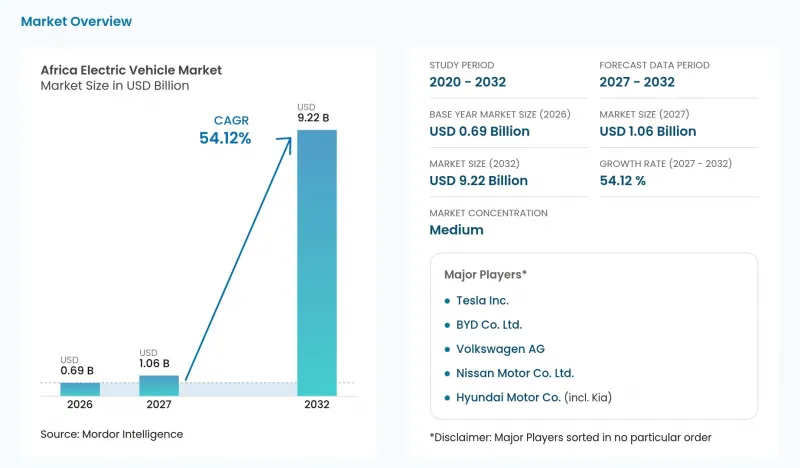
This report is segmented by Propulsion Type (Battery Electric Vehicles and more), Vehicle Type (Passenger Cars and more), Vehicle Drive Type (Front-Wheel Drive and more), Battery Chemistry (Nickel-Manganese-Cobalt and more), Charging Method (AC Slow and more), and Geography (Ghana and more). The market forecasts are provided in terms of value (USD), based on availability.
Africa Electric Vehicle Market Trends and Insights
Government Incentives and Zero-Duty Imports Surge EV Affordability.
In July 2024, the U.S. Department of Commerce described Ethiopia's exemptions from VAT, surtax and excise taxes on EV imports, with 5% customs duty applying to partially assembled vehicles. Removing these tax layers creates room for lower vehicle prices when importers pass the savings through. Rwanda's July 1, 2025 changes retained a 25% import-duty exemption for hybrids while introducing 18% VAT, 5% withholding tax and age-based excise duty. Those hybrid taxes were lower than those on fuel-powered vehicles, qualifying the tightening with a retained affordability advantage. Importers can direct that advantage toward eligible hybrid offers and age profiles whose final prices reach additional buyers.
Plummeting Battery-Pack Prices Unlock Mass-Market Models
Lower battery-pack prices give vehicle manufacturers more room to address entry costs without relying solely on consumer subsidies. The IEA reported an 8% decline in global average battery-pack prices per kWh in 2025 compared with 2024, covering electric-vehicle and stationary-storage applications across chemistries. For African vehicle suppliers, the commercial choice is how to allocate the component-cost reduction between lower transaction prices and a higher vehicle specification. Passing the saving into price widens the set of buyer budgets a model can reach, while spending it on specification mainly serves buyers who already qualify. A split between entry-price and better-equipped variants could let one component-cost improvement serve different customer budgets.
High Capex for Charging and Grid Upgrades
Charging investment can limit vehicle adoption even when the vehicle itself becomes more affordable, because operators must fund the supporting infrastructure. A 2026 Kenya charging-infrastructure study identified high upfront capital expenditure as a barrier for private charge-point operators. It also warned that unclear sharing of grid-upgrade costs between utilities and private developers could create bottlenecks that curb new stations. These are distinct financing problems, with the first affecting a site's investment case and the second leaving responsibility for enabling works unresolved. For fleet buyers dependent on those sites, unresolved grid-upgrade liability can add an infrastructure cost to vehicle acquisition or delay the start of paid service.
Other drivers and restraints analyzed in the detailed report include:
- Pan-African Mineral Value-Chain Push Fuels Local EV/Battery Investment
- Leap-Frogging To E-Motorcycles and Tuk-Tuks for Last-Mile Logistics
- Weak Grid Reliability and Low Electrification Outside Metros
For complete list of drivers and restraints, kindly check the Table Of Contents.
Segment Analysis
Battery electric vehicles (BEVs) accounted for a 78.74% share of the Africa electric vehicle market size in 2026. In South Africa, BEV sales, including heavy commercial vehicles, fell to 1,088 in 2025 from 1,257 in 2024. The South African setback shows why a leading regional position should be distinguished from annual unit-sales momentum in an individual country.
Fuel-cell electric vehicles (FCEVs) are the fastest-growing propulsion segment, with a forecast 56.62% CAGR over 2027-2032. For a prospective depot-based bus fleet in South Africa, growth would involve adding hydrogen-powered vehicles around a shared fueling location. A fueling arrangement able to serve multiple buses could accommodate subsequent vehicle orders without a separate fuel-supply arrangement for every buyer. This concentrated purchasing model offers a route from a small application base to repeat orders, provided hydrogen availability expands with fleet size.
Passenger cars represented a 60.76% Africa electric vehicle market share in 2026, making them the largest vehicle-type segment. South African buyers purchased 66 BYD Atto 3 electric vehicles from January through July 2026, according to naamsa data reported by Recharged. The model-level reading gives suppliers a concrete product and national customer group around which to assess a passenger-car offer. An entrant can sequence its range country by country, directing support toward models with demonstrated purchases before extending coverage to additional products.
Two- and three-wheelers are the fastest-growing vehicle-type segment, with a forecast 58.15% CAGR over 2027-2032. By September 2026, Spiro had deployed more than 28,000 electric motorcycles in Rwanda since starting operations there in April 2023. A cumulative deployed fleet creates a different commercial responsibility from the next batch of new vehicles, because existing motorcycles need support while additional deployments generate further vehicle transactions. After-sales capacity has to scale with the fleet already deployed, while new vehicle orders depend on additional operator deployments.
Complete Report Scope:
- By Propulsion Type
- Battery Electric Vehicles (BEV)
- Plug-in Hybrid Electric Vehicles (PHEV)
- Hybrid Electric Vehicles (HEV)
- Fuel-Cell Electric Vehicles (FCEV)
- By Vehicle Type
- Passenger Cars
- Commercial Vehicles
- Two- and Three-Wheelers
- Buses and Coaches
- By Vehicle Drive Type
- Front-Wheel Drive
- Rear-Wheel Drive
- All-Wheel Drive
- By Battery Chemistry
- Lithium-Iron-Phosphate (LFP)
- Nickel-Manganese-Cobalt (NMC)
- Sodium-ion
- Solid-State
- Other Emerging Chemistries (Li-S, Li-Air)
- By Charging Method
- AC Slow (Below 22 kW)
- DC Fast (Above 50 kW)
- By Geography
- South Africa
- Morocco
- Nigeria
- Egypt
- Ethiopia
- Ghana
- Kenya
- Rest of Africa
List of Companies Covered in this Report:
- Tesla Inc.
- BYD Co. Ltd.
- Nissan Motor Co. Ltd.
- Volkswagen AG
- Hyundai Motor Co. (incl. Kia)
- BMW AG
- Toyota Motor Corporation
- Mercedes-Benz Group AG
- Volvo Car AB
- Renault Group
- Rivian Automotive Inc.
- Ampersand Rwanda
- Roam (Kenya)
- Phoenix Mobility (Egypt)
- Kantanka Automobile (Ghana)
- Jet Motor Company (Nigeria)
- Oryx Motors (Morocco)
Additional Benefits:
- The market estimate (ME) sheet in Excel format
- 3 months of analyst support
TABLE OF CONTENTS
1 INTRODUCTION
- 1.1 Study Assumptions and Market Definition
- 1.2 Scope of the Study
2 RESEARCH METHODOLOGY
3 EXECUTIVE SUMMARY
4 MARKET LANDSCAPE
- 4.1 Market Overview
- 4.2 Market Drivers
- 4.2.1 Government Incentives and Zero-Duty Imports Surge EV Affordability.
- 4.2.2 Plummeting Battery-Pack Prices Unlock Mass-Market Models
- 4.2.3 Pan-African Mineral Value-Chain Push Fuels Local EV/Battery Investment
- 4.2.4 Leap-Frogging To E-Motorcycles and Tuk-Tuks for Last-Mile Logistics
- 4.2.5 Battery-Swap and Pay-Per-Use Models Mitigate Upfront-Cost Barrier
- 4.2.6 OEM Fin-Tech Micro-Leasing Widens Access for Informal-Sector Drivers
- 4.3 Market Restraints
- 4.3.1 High Capex for Charging and Grid Upgrades
- 4.3.2 Weak Grid Reliability and Low Electrification Outside Metros
- 4.3.3 Flood Of Cheap Used ICE Imports Undercuts New-EV Demand
- 4.3.4 Nascent Second-Hand EV Market Hurts Residual-Value Confidence
- 4.4 Industry Value Chain Analysis
- 4.5 Regulatory Landscape
- 4.6 Technological Outlook
- 4.7 Porter's Five Forces Analysis
- 4.7.1 Threat of New Entrants
- 4.7.2 Bargaining Power of Suppliers
- 4.7.3 Bargaining Power of Buyers
- 4.7.4 Threat of Substitutes
- 4.7.5 Competitive Rivalry
5 MARKET SIZE AND GROWTH FORECASTS (VALUE)
- 5.1 By Propulsion Type
- 5.1.1 Battery Electric Vehicles (BEV)
- 5.1.2 Plug-in Hybrid Electric Vehicles (PHEV)
- 5.1.3 Hybrid Electric Vehicles (HEV)
- 5.1.4 Fuel-Cell Electric Vehicles (FCEV)
- 5.2 By Vehicle Type
- 5.2.1 Passenger Cars
- 5.2.2 Commercial Vehicles
- 5.2.3 Two- and Three-Wheelers
- 5.2.4 Buses and Coaches
- 5.3 By Vehicle Drive Type
- 5.3.1 Front-Wheel Drive
- 5.3.2 Rear-Wheel Drive
- 5.3.3 All-Wheel Drive
- 5.4 By Battery Chemistry
- 5.4.1 Lithium-Iron-Phosphate (LFP)
- 5.4.2 Nickel-Manganese-Cobalt (NMC)
- 5.4.3 Sodium-ion
- 5.4.4 Solid-State
- 5.4.5 Other Emerging Chemistries (Li-S, Li-Air)
- 5.5 By Charging Method
- 5.5.1 AC Slow (Below 22 kW)
- 5.5.2 DC Fast (Above 50 kW)
- 5.6 By Geography
- 5.6.1 South Africa
- 5.6.2 Morocco
- 5.6.3 Nigeria
- 5.6.4 Egypt
- 5.6.5 Ethiopia
- 5.6.6 Ghana
- 5.6.7 Kenya
- 5.6.8 Rest of Africa
6 COMPETITIVE LANDSCAPE
- 6.1 Market Concentration
- 6.2 Strategic Moves
- 6.3 Market Share Analysis
- 6.4 Company Profiles (includes Global level Overview, Market level overview, Core Segments, Financials as available, Strategic Information, Market Rank/Share for key companies, Products and Services, and Recent Developments)
- 6.4.1 Tesla Inc.
- 6.4.2 BYD Co. Ltd.
- 6.4.3 Nissan Motor Co. Ltd.
- 6.4.4 Volkswagen AG
- 6.4.5 Hyundai Motor Co. (incl. Kia)
- 6.4.6 BMW AG
- 6.4.7 Toyota Motor Corporation
- 6.4.8 Mercedes-Benz Group AG
- 6.4.9 Volvo Car AB
- 6.4.10 Renault Group
- 6.4.11 Rivian Automotive Inc.
- 6.4.12 Ampersand Rwanda
- 6.4.13 Roam (Kenya)
- 6.4.14 Phoenix Mobility (Egypt)
- 6.4.15 Kantanka Automobile (Ghana)
- 6.4.16 Jet Motor Company (Nigeria)
- 6.4.17 Oryx Motors (Morocco)
7 MARKET OPPORTUNITIES AND FUTURE OUTLOOK
- 7.1 White-Space and Unmet-Need Assessment

