PUBLISHER: Mordor Intelligence | PRODUCT CODE: 2187704

PUBLISHER: Mordor Intelligence | PRODUCT CODE: 2187704
Electric Vehicles - Market Share Analysis, Industry Trends & Statistics, Growth Forecasts (2027 - 2032)
According to Mordor Intelligence, the electric vehicles market size is estimated at USD 0.77 trillion in 2026 and is projected to be USD 0.86 trillion in 2027, reaching USD 1.46 trillion by 2032, growing at a CAGR of 11.2% from 2027 to 2032.
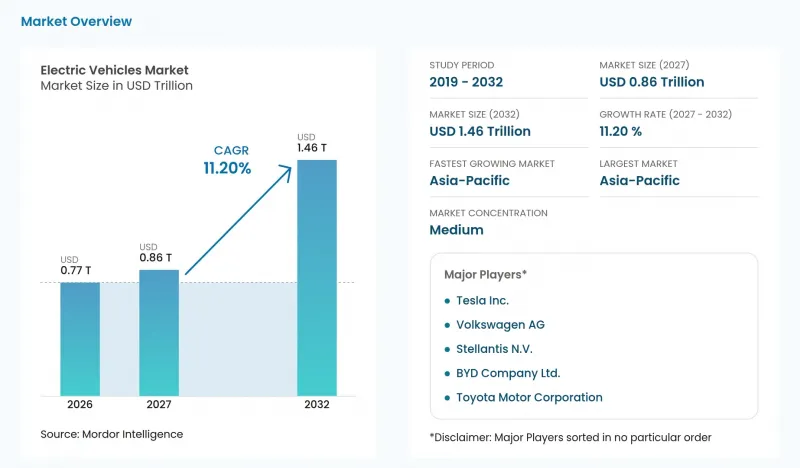
The market volume is estimated at 22.22 million units in 2026 and is projected to be 25 million units in 2027, reaching 45.05 million units by 2032, growing at a CAGR of 12.5% from 2027 to 2032. This report is Segmented by Powertrain (Battery Electric Vehicles and More), Vehicle Type (Passenger Car and More), Battery Chemistry (Lithium Nickel Manganese Cobalt Oxide and More), Motor Architecture (Permanent-Magnet Synchronous Motors and More), Range, Voltage, and Geography. The Market Forecasts are Provided in Terms of Value (USD) and Volume (units), Based On Availability.
Global Electric Vehicles Market Trends and Insights
Battery-Pack Cost Per kWh Keeps Falling
Lower pack prices give automakers room to improve vehicle affordability without requiring an equivalent reduction in other manufacturing costs. BloombergNEF's global average lithium-ion battery-pack price across multiple end uses fell 8% from 2024 to USD 108 per kWh in 2025. BEV packs averaged USD 99 per kWh in the 2025 survey, the lowest price within its transport segment. This was the second year BEV packs stayed below USD 100 per kWh. Manufacturers can use lower pack costs to fund cheaper vehicles or additional capacity, so model positioning determines whether buyers gain affordability or range in the electric vehicles market.
Ultra-Rapid (Above 350 kW) Charger Roll-Outs Along Freight Corridors
Electric-truck adoption depends on charging coverage that supports routes beyond an operator's own depot. In April 2026, the European Alternative Fuels Observatory (EAFO) recorded 373 operational heavy-duty charging locations, 2,405 recharging points and 1,225 stations across 21 European countries from data focused on sites meeting the 350 kW criterion. This operating infrastructure gives truck buyers a more concrete basis for considering public charging within their route plans. On June 8, 2026, ministers from 9 EU member states endorsed charging roadmaps for zero-emission trucks along the Scandinavian-Mediterranean and North Sea-Baltic TEN-T corridors. Corridor coordination can complement site deployment by directing attention to the connections between logistics destinations. Operating charging coverage can consequently define which freight operators are practical customers for a manufacturer's electric-truck offering in the electric vehicles industry.
Grid-Upgrade Bottlenecks at the Distribution Level
Distribution-level congestion can constrain vehicle adoption by postponing the charging access needed to support it. TNO's 2026 research reported a queue including public-charger connections in Laadwerk concession municipalities across North Holland, Utrecht and Flevoland. Amsterdam and the city of Utrecht organize their own concessions. Dutch priority rules applying from July 1, 2026, to new or upgraded connection requests in congested areas can place a hospital ahead of a charging-point applicant. Satellite chargers offer an alternative if new transport agreements cannot be arranged in time. Charging providers in congested areas therefore cannot schedule new public chargers independently of the network queue, so access to distribution capacity can constrain the charging provision needed for growth in the electric vehicles market.
Other drivers and restraints analyzed in the detailed report include:
- Tightening Fleet-Average Fuel-Consumption Standards in China and CO2 Standards in Europe
- Corporate-Fleet Decarbonization Procurement Mandates
- Critical-Minerals (Li, Ni) Supply-Chain Concentration Risk
For complete list of drivers and restraints, kindly check the Table Of Contents.
Segment Analysis
Battery electric vehicles (BEVs) accounted for a 73.2% share of the electric vehicles market size in 2026 and are the fastest-growing segment, with a forecast CAGR of 12.9% from 2027 to 2032. In Europe, BEVs' portion of electric-car sales rose from 55% in 2020 to nearly 70% in 2025. The IEA linked that shift to emissions standards favoring zero-emission vehicles. BEVs represented 80% of electric-car sales in emerging and developing economies outside China in 2025, compared with 65% in major markets. That breadth makes a BEV development program relevant to both mature and emerging car buyers.
In Southeast Asia, BEVs represented more than 90% of electric-car sales in 2025. That mix gives manufacturers expanding there a strongly battery-electric starting point for vehicle-program decisions in the electric vehicles market. Fuel cell electric vehicles have a distinct freight application in Hyundai Motor Company's March 19, 2026, announcement of an 8-truck XCIENT deployment for the Kahiros timber-logistics project in Uruguay. The announced fleet ties truck supply to the project's green-hydrogen infrastructure, creating an application-specific route for the supplier. Powertrain suppliers consequently face distinct commercial routes, from regional battery-electric car demand to the announced Uruguay deployment's combined truck and hydrogen-infrastructure requirements.
Passenger cars represented a 79.05% electric vehicles market share in 2026, making them the largest segment. The International Council on Clean Transportation (ICCT) reported over 20 million electric-vehicle sales globally in its 2025 light-duty coverage and said one in 4 cars sold worldwide was electric. China accounted for 71% of global EV production in that light-duty vehicle analysis. The combination of widespread adoption and concentrated manufacturing makes customer location and production location separate commercial decisions for a vehicle supplier. Passenger-car expansion can consequently reward manufacturers able to reach buyers across national markets.
Commercial vehicles are the fastest-growing segment, with a forecast CAGR of 12.5% from 2027 to 2032. Global electric medium- and heavy-freight trucks, including reclassified delivery vans weighing at least 3.5 metric tons, sold over 400,000 vehicles in 2025. That volume doubled from 2024 and represented 9% of truck sales worldwide. Electric light commercial vehicles, defined as weighing up to 3.5 metric tons, sold over 430,000 vehicles in 2025, up 45% year over year. The opportunity in the electric vehicles market therefore spans lighter delivery vehicles and heavier freight applications, which calls for separate commercial programs around each operating workload.
Complete Report Scope:
- By Powertrain
- Battery Electric Vehicles (BEVs)
- Plug-in Hybrid Electric Vehicles (PHEVs)
- Fuel Cell Electric Vehicles (FCEVs)
- By Vehicle Type
- Passenger Car
- Hatchback
- Sedan
- Sports Utility Vehicle/Crossover
- Multi-purpose Vehicle
- Commercial Vehicle
- Light Commercial Vehicle
- Medium and Heavy-duty Truck
- Bus
- Passenger Car
- By Battery Chemistry
- Lithium Iron Phosphate (LFP)
- Lithium Nickel Manganese Cobalt Oxide (NMC)
- Lithium Nickel Cobalt Aluminum Oxide (NCA)
- Others
- By Motor Architecture
- Permanent-Magnet Synchronous Motors (PMSM/IPM)
- Induction Motors (IM)
- Others (SRM, Axial Flux, etc.)
- By Range
- Short (0-200 km)
- Mid (200-400 km)
- Long (400-600 km)
- Ultra-Long (Above 600 km)
- By Voltage
- Low Voltage (Below 200 V)
- Mid Voltage (200-400 V)
- High Voltage (400-800 V)
- Ultra-High Voltage (Above 800 V)
- By Geography
- North America
- United States
- Canada
- Rest of North America
- South America
- Brazil
- Argentina
- Rest of South America
- Europe
- Germany
- United Kingdom
- France
- Italy
- Spain
- Rest of Europe
- Asia-Pacific
- China
- India
- Japan
- South Korea
- Rest of Asia-Pacific
- Middle-East and Africa
- United Arab Emirates
- Saudi Arabia
- South Africa
- Turkey
- Rest of Middle-East and Africa
- North America
Geography Analysis
Asia-Pacific accounted for a 53.24% share of the electric vehicles market size in 2026 and is the fastest-growing region, with a forecast CAGR of 13.4% from 2027 to 2032. Southeast Asian electric-car sales more than doubled in 2025 to nearly 20% of car sales. Viet Nam, Indonesia and Thailand led that expansion, giving the regional opportunity several distinct national demand centers. In the first quarter of 2026, electric-car sales in Asia-Pacific excluding China grew 80% year over year. In the ICCT's 2025 light-duty analysis, China accounted for approximately 62% of global EV sales and was the largest producer, anchoring regional demand and supply as growth outside China broadened the customer base.
Europe's electric-car sales increased more than 30% in 2025 to 4.2 million, or 28% of new-car sales, with 1 million additional sales versus 2024. That penetration gives manufacturers a substantial addressable car-buying population. In North America, the United States recorded electric cars at just under 10% of car sales in 2025, and a year-end sales decline coincided with the end of federal EV tax credits. The US pattern makes demand timing a separate commercial risk from annual adoption depth, complicating a manufacturer's allocation of vehicles across these 2 regions.
Country selection and powertrain selection create different entry decisions in South America and Middle-East and Africa, illustrated by Brazil, the United Arab Emirates and Morocco. Brazil registered 181,542 plug-in electric vehicles in 2025, comprising 101,364 plug-in hybrids and 80,178 battery-electric vehicles. Moroccan automaker Neo Motors began selling its first electric model in early 2026, adding a domestic supplier's offering in an African country. Middle Eastern electric-car sales reached around 75,000 in 2025, up more than 40% year over year, with the United Arab Emirates accounting for almost half. Brazil's mix makes powertrain breadth a concrete commercial consideration, while the UAE's almost-half share of Middle Eastern sales gives one national market a large weight in regional entry plans.
- BYD Company Ltd.
- Tesla Inc.
- SAIC Motor
- Volkswagen AG
- Hyundai Motor Company
- Nissan Motor Co. Ltd.
- Stellantis N.V.
- Mercedes-Benz Group AG (Mercedes-Benz)
- General Motors
- Ford Motor Company
- Toyota Motor Corporation
- BMW AG
- Honda Motor Co. Ltd.
- Volvo Car AB
- Rivian Automotive LLC
- Lucid Group Inc.
- NIO Inc.
- Tata Motors Passenger Vehicles Ltd.
Additional Benefits:
- The market estimate (ME) sheet in Excel format
- 3 months of analyst support
TABLE OF CONTENTS
1 INTRODUCTION
- 1.1 Study Assumptions and Market Definition
- 1.2 Scope of the Study
2 RESEARCH METHODOLOGY
3 EXECUTIVE SUMMARY
4 MARKET LANDSCAPE
- 4.1 Market Overview
- 4.2 Market Drivers
- 4.2.1 Battery-Pack Cost Per kWh Keeps Falling
- 4.2.2 Ultra-Rapid (Above 350 kW) Charger Roll-Outs Along Freight Corridors
- 4.2.3 Tightening Fleet-Average Fuel-Consumption Standards in China and CO2 Standards in Europe
- 4.2.4 Corporate-Fleet Decarbonization Procurement Mandates
- 4.2.5 Silicon-Anode Penetration Boosting Above 600 Km Segment
- 4.2.6 Secondary-Use Battery Value-Chain Lowering TCO
- 4.3 Market Restraints
- 4.3.1 Grid-Upgrade Bottlenecks at the Distribution Level
- 4.3.2 Critical-Minerals (Li, Ni) Supply-Chain Concentration Risk
- 4.3.3 Warranty-Period Residual-Value Uncertainty in Emerging Markets
- 4.3.4 Cyber-Security and OTA-Update Compliance Costs
- 4.4 Industry Value Chain Analysis
- 4.5 Regulatory Landscape
- 4.6 Technological Outlook
- 4.7 Porter's Five Forces Analysis
- 4.7.1 Threat of New Entrants
- 4.7.2 Bargaining Power of Suppliers
- 4.7.3 Bargaining Power of Buyers
- 4.7.4 Threat of Substitutes
- 4.7.5 Competitive Rivalry
- 4.8 Key Industry Trends
- 4.8.1 Urbanization, Population and Vehicle/Transit Demand
- 4.8.2 Car Ownership and Motorization Rate
- 4.8.3 EV Penetration in Car Market
- 4.8.4 Fuel vs Electricity Price Spread (Per km, ICE vs EV)
- 4.8.5 EV vs ICE Total Cost of Ownership (TCO) Gap
- 4.8.6 Financing and Ownership Models (Loans, Leasing, Subscription)
- 4.8.7 Battery Chemistry Mix and Pack Energy Density (LFP vs NMC etc.)
- 4.8.8 Home, Workplace and Public Charger Access / Density
- 4.8.9 Fast-Charging Network Coverage and Power Bands
- 4.8.10 Alternative Fuels Infrastructure (Hydrogen for FCEVs)
- 4.8.11 Subsidy and Consumer Incentive Value
- 4.8.12 OEM EV Line-up and Model Pipeline
- 4.8.13 Regulatory, Fiscal and Industrial Policy Framework
- 4.9 Key Strategic Questions for CEOs
5 MARKET SIZE AND GROWTH FORECASTS (VALUE AND VOLUME)
- 5.1 By Powertrain
- 5.1.1 Battery Electric Vehicles (BEVs)
- 5.1.2 Plug-in Hybrid Electric Vehicles (PHEVs)
- 5.1.3 Fuel Cell Electric Vehicles (FCEVs)
- 5.2 By Vehicle Type
- 5.2.1 Passenger Car
- 5.2.1.1 Hatchback
- 5.2.1.2 Sedan
- 5.2.1.3 Sports Utility Vehicle/Crossover
- 5.2.1.4 Multi-purpose Vehicle
- 5.2.2 Commercial Vehicle
- 5.2.2.1 Light Commercial Vehicle
- 5.2.2.2 Medium and Heavy-duty Truck
- 5.2.2.3 Bus
- 5.2.1 Passenger Car
- 5.3 By Battery Chemistry
- 5.3.1 Lithium Iron Phosphate (LFP)
- 5.3.2 Lithium Nickel Manganese Cobalt Oxide (NMC)
- 5.3.3 Lithium Nickel Cobalt Aluminum Oxide (NCA)
- 5.3.4 Others
- 5.4 By Motor Architecture
- 5.4.1 Permanent-Magnet Synchronous Motors (PMSM/IPM)
- 5.4.2 Induction Motors (IM)
- 5.4.3 Others (SRM, Axial Flux, etc.)
- 5.5 By Range
- 5.5.1 Short (0-200 km)
- 5.5.2 Mid (200-400 km)
- 5.5.3 Long (400-600 km)
- 5.5.4 Ultra-Long (Above 600 km)
- 5.6 By Voltage
- 5.6.1 Low Voltage (Below 200 V)
- 5.6.2 Mid Voltage (200-400 V)
- 5.6.3 High Voltage (400-800 V)
- 5.6.4 Ultra-High Voltage (Above 800 V)
- 5.7 By Geography
- 5.7.1 North America
- 5.7.1.1 United States
- 5.7.1.2 Canada
- 5.7.1.3 Rest of North America
- 5.7.2 South America
- 5.7.2.1 Brazil
- 5.7.2.2 Argentina
- 5.7.2.3 Rest of South America
- 5.7.3 Europe
- 5.7.3.1 Germany
- 5.7.3.2 United Kingdom
- 5.7.3.3 France
- 5.7.3.4 Italy
- 5.7.3.5 Spain
- 5.7.3.6 Rest of Europe
- 5.7.4 Asia-Pacific
- 5.7.4.1 China
- 5.7.4.2 India
- 5.7.4.3 Japan
- 5.7.4.4 South Korea
- 5.7.4.5 Rest of Asia-Pacific
- 5.7.5 Middle-East and Africa
- 5.7.5.1 United Arab Emirates
- 5.7.5.2 Saudi Arabia
- 5.7.5.3 South Africa
- 5.7.5.4 Turkey
- 5.7.5.5 Rest of Middle-East and Africa
- 5.7.1 North America
6 COMPETITIVE LANDSCAPE
- 6.1 Market Concentration
- 6.2 Strategic Moves
- 6.3 Market Share Analysis
- 6.4 Company Profiles (includes Global level Overview, Market level overview, Core Segments, Financials as available, Strategic Information, Market Rank/Share for key companies, Products and Services, and Recent Developments)
- 6.4.1 BYD Company Ltd.
- 6.4.2 Tesla Inc.
- 6.4.3 SAIC Motor
- 6.4.4 Volkswagen AG
- 6.4.5 Hyundai Motor Company
- 6.4.6 Nissan Motor Co. Ltd.
- 6.4.7 Stellantis N.V.
- 6.4.8 Mercedes-Benz Group AG (Mercedes-Benz)
- 6.4.9 General Motors
- 6.4.10 Ford Motor Company
- 6.4.11 Toyota Motor Corporation
- 6.4.12 BMW AG
- 6.4.13 Honda Motor Co. Ltd.
- 6.4.14 Volvo Car AB
- 6.4.15 Rivian Automotive LLC
- 6.4.16 Lucid Group Inc.
- 6.4.17 NIO Inc.
- 6.4.18 Tata Motors Passenger Vehicles Ltd.
7 MARKET OPPORTUNITIES AND FUTURE OUTLOOK
- 7.1 White-Space and Unmet-Need Assessment

