PUBLISHER: Mordor Intelligence | PRODUCT CODE: 2187676

PUBLISHER: Mordor Intelligence | PRODUCT CODE: 2187676
India Seed - Market Share Analysis, Industry Trends & Statistics, Growth Forecasts (2027 - 2032)
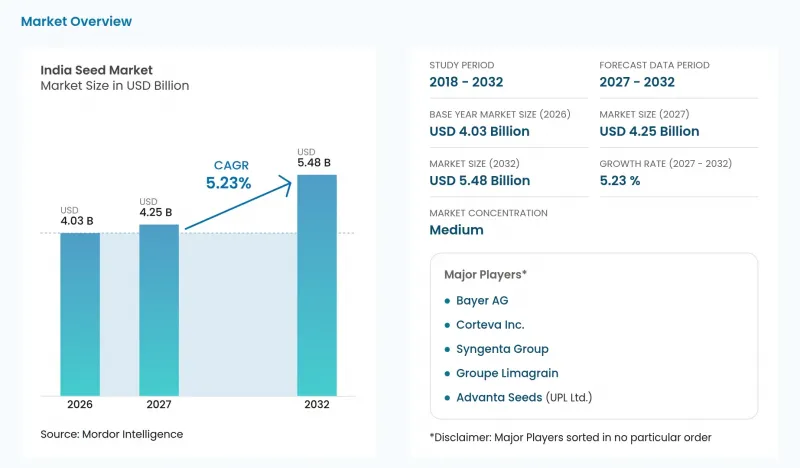
According to Mordor Intelligence, the India seed market size is expected to increase from USD 4.03 billion in 2026 to USD 4.25 billion in 2027 and reach USD 5.48 billion by 2032, growing at a CAGR of 5.23% over 2027-2032.
This report is segmented by Breeding Technology (Hybrids and Open Pollinated Varieties and Hybrid Derivatives), Cultivation Mechanism (Open Field and Protected Cultivation), and Crop Type (Row Crops, Vegetables, and Geography). The market forecasts are provided in terms of value (USD), based on availability.
India Seed Market Trends and Insights
Government cluster programs scaling certified seed demand
Government programs create an organized route for distributing improved seed to growers. The Mission for Aatmanirbharta in Pulses distributed 310,000 quintals of certified seeds in India during 2025-26. By August 2026, more than 600 government oilseed Value Chain Clusters were operating and providing free high-quality seed. Partners including farmer producer organizations and cooperatives managed those clusters. Together, these channels support seed use through both certified distribution and coordinated delivery, with different implications for suppliers than individual farmer purchases. The commercial opening is access to organized program requirements, where the ability to serve intermediary institutions matters alongside the seed's agronomic characteristics.
Shift to climate-resilient hybrids in cereals and pulses
Dryland cereal growers need hybrid development suited to the production conditions of low-rainfall zones. In January 2026, India notified the 3-way pearl millet hybrid RHB 273 for A1 dryland zones in parts of Rajasthan, Gujarat and Haryana. These zones receive less than 400 millimeters of annual rainfall. ICRISAT bred the hybrid with the Indian Council of Agricultural Research (ICAR) through the pearl millet research program's center at Rajasthan Agricultural Research Institute. This region-specific notification connects hybrid development to an identifiable cultivation environment, giving suppliers a more precise proposition than a broad yield claim. The notification fixes the hybrid's cultivation scope at specific dryland zones, narrower than the full area of the three states named.
Counterfeit seed trade and weak last-mile traceability
Seed-quality failures expose vegetable growers to losses beyond the price of the original planting material. In April 2026, preliminary findings in Dhar and Khargone, Madhya Pradesh, indicated that substandard bitter-gourd seeds and related saplings were sold as certified material, causing significant financial losses for farmers. The involvement of saplings matters because the quality problem can pass through a propagation stage before reaching the grower. Certification claims therefore cannot replace accountability for the material delivered through that chain. For growers buying seed in the affected districts, verifying a lot before purchase adds a transaction burden when certification claims alone cannot protect against crop losses.
Other drivers and restraints analyzed in the detailed report include:
- Expansion of protected cultivation boosting high-value vegetable seeds
- Digital crop-survey data unlocking hyper-local seed targeting
- Regulatory uncertainty around GM crop approvals
For complete list of drivers and restraints, kindly check the Table Of Contents.
Segment Analysis
Hybrids accounted for a 69.72% share of the India seed market size in 2026 and are the fastest-growing segment, with a forecast CAGR of 5.38% over 2027-2032. Kaveri Seed Company Ltd's India-focused standalone business reported an 18.37% increase in hybrid-rice revenue in FY2025-26. That result places an identifiable commercial crop business behind hybrid demand, connecting breeding technology with supplier earnings within an established product line.
Unauthorized trait use in cotton hybrids is a competitive limit on compliant seed suppliers. According to The Indian Express, the Federation of Seed Industry of India and National Seed Association of India commissioned a cotton field study. It estimated that hybrids containing unauthorized herbicide-tolerant or Bacillus thuringiensis genes covered 24% to 30% of India's cotton area in 2025-26. This points to a competitive constraint around the traits being offered, beyond the availability of hybrid breeding capacity. A breeder's growth proposition therefore needs to connect trait performance with an authorized route to sale, because adoption outside that route does not create the same opportunity for compliant suppliers.
Complete Report Scope:
- By Breeding Technology
- Hybrids
- Non-Transgenic Hybrids
- Transgenic Hybrids
- Insect Resistant Hybrids
- Open Pollinated Varieties and Hybrid Derivatives
- Hybrids
- By Cultivation Mechanism
- Open Field
- Protected Cultivation
- By Crop Type
- Row Crops
- Fiber Crops
- Cotton
- Other Fiber Crops
- Forage Crops
- Alfalfa
- Forage Corn
- Forage Sorghum
- Other Forage Crops
- Grains and Cereals
- Corn
- Rice
- Sorghum
- Wheat
- Other Grains and Cereals
- Oilseeds
- Canola, Rapeseed and Mustard
- Soybean
- Sunflower
- Other Oilseeds
- Pulses
- Fiber Crops
- Vegetables
- Brassicas
- Cabbage
- Cauliflower and Broccoli
- Other Brassicas
- Cucurbits
- Cucumber and Gherkin
- Pumpkin and Squash
- Other Cucurbits
- Roots and Bulbs
- Garlic
- Onion
- Potato
- Other Roots and Bulbs
- Solanaceae
- Chilli
- Eggplant
- Tomato
- Other Solanaceae
- Unclassified Vegetables
- Asparagus
- Lettuce
- Okra
- Peas
- Spinach
- Other Unclassified Vegetables
- Brassicas
- Geography
- Bihar
- Gujarat
- Haryana
- Karnataka
- Madhya Pradesh
- Maharashtra
- Rajasthan
- Telangana
- Uttar Pradesh
- West Bengal
- Other States
- Row Crops
List of Companies Covered in this Report:
- Syngenta Group
- Bayer AG
- Corteva Inc.
- Groupe Limagrain
- Nuziveedu Seeds Ltd
- East-West Seed Company
- BASF SE
- Namdhari Seeds Pvt Ltd
- Advanta Seeds (UPL Ltd.)
- Kaveri Seed Company Ltd
- VNR Seeds Pvt Ltd
- Rasi Seeds Pvt Ltd
- SeedWorks International Ltd
- Mahyco Pvt Ltd
- DCM Shriram Limited (Bioseed)
Additional Benefits:
- The market estimate (ME) sheet in Excel format
- 3 months of analyst support
TABLE OF CONTENTS
1 INTRODUCTION
- 1.1 Study Assumptions and Market Definition
- 1.2 Scope of the Study
2 RESEARCH METHODOLOGY
3 EXECUTIVE SUMMARY
4 MARKET LANDSCAPE
- 4.1 Market Overview
- 4.2 Market Drivers
- 4.2.1 Government cluster programs scaling certified seed demand
- 4.2.2 Shift to climate-resilient hybrids in cereals and pulses
- 4.2.3 Expansion of protected cultivation boosting high-value vegetable seeds
- 4.2.4 Digital crop-survey data unlocking hyper-local seed targeting
- 4.2.5 Export push for Indian vegetable and cotton seed
- 4.2.6 Venture capital inflows into seed-genomics start-ups
- 4.3 Market Restraints
- 4.3.1 Counterfeit seed trade and weak last-mile traceability
- 4.3.2 Regulatory uncertainty around GM crop approvals
- 4.3.3 Farm-saved seed dominance in rain-fed zones
- 4.3.4 Rising seed-treatment costs squeezing smallholders
- 4.4 Industry Value Chain Analysis
- 4.5 Regulatory Landscape
- 4.6 Technological Outlook
- 4.7 Porter's Five Forces Analysis
- 4.7.1 Threat of New Entrants
- 4.7.2 Bargaining Power of Suppliers
- 4.7.3 Bargaining Power of Buyers
- 4.7.4 Threat of Substitutes
- 4.7.5 Competitive Rivalry
- 4.8 EXECUTIVE SUMMARY AND KEY FINDINGS
- 4.9 REPORT OFFERS
- 4.10 Area Under Cultivation
- 4.10.1 Row Crops
- 4.10.2 Vegetables
- 4.11 Most Popular Traits
- 4.11.1 Cabbage and Onion
- 4.11.2 Rice and Corn
- 4.11.3 Tomato and Chilli
- 4.11.4 Wheat and Cotton
- 4.12 Breeding Techniques
- 4.12.1 Row Crops and Vegetables
- 4.13 KEY STRATEGIC QUESTIONS FOR SEED CEOS
5 MARKET SIZE AND GROWTH FORECASTS (VALUE)
- 5.1 By Breeding Technology
- 5.1.1 Hybrids
- 5.1.1.1 Non-Transgenic Hybrids
- 5.1.1.2 Transgenic Hybrids
- 5.1.1.2.1 Insect Resistant Hybrids
- 5.1.2 Open Pollinated Varieties and Hybrid Derivatives
- 5.1.1 Hybrids
- 5.2 By Cultivation Mechanism
- 5.2.1 Open Field
- 5.2.2 Protected Cultivation
- 5.3 By Crop Type
- 5.3.1 Row Crops
- 5.3.1.1 Fiber Crops
- 5.3.1.1.1 Cotton
- 5.3.1.1.2 Other Fiber Crops
- 5.3.1.2 Forage Crops
- 5.3.1.2.1 Alfalfa
- 5.3.1.2.2 Forage Corn
- 5.3.1.2.3 Forage Sorghum
- 5.3.1.2.4 Other Forage Crops
- 5.3.1.3 Grains and Cereals
- 5.3.1.3.1 Corn
- 5.3.1.3.2 Rice
- 5.3.1.3.3 Sorghum
- 5.3.1.3.4 Wheat
- 5.3.1.3.5 Other Grains and Cereals
- 5.3.1.4 Oilseeds
- 5.3.1.4.1 Canola, Rapeseed and Mustard
- 5.3.1.4.2 Soybean
- 5.3.1.4.3 Sunflower
- 5.3.1.4.4 Other Oilseeds
- 5.3.1.5 Pulses
- 5.3.1.1 Fiber Crops
- 5.3.2 Vegetables
- 5.3.2.1 Brassicas
- 5.3.2.1.1 Cabbage
- 5.3.2.1.2 Cauliflower and Broccoli
- 5.3.2.1.3 Other Brassicas
- 5.3.2.2 Cucurbits
- 5.3.2.2.1 Cucumber and Gherkin
- 5.3.2.2.2 Pumpkin and Squash
- 5.3.2.2.3 Other Cucurbits
- 5.3.2.3 Roots and Bulbs
- 5.3.2.3.1 Garlic
- 5.3.2.3.2 Onion
- 5.3.2.3.3 Potato
- 5.3.2.3.4 Other Roots and Bulbs
- 5.3.2.4 Solanaceae
- 5.3.2.4.1 Chilli
- 5.3.2.4.2 Eggplant
- 5.3.2.4.3 Tomato
- 5.3.2.4.4 Other Solanaceae
- 5.3.2.5 Unclassified Vegetables
- 5.3.2.5.1 Asparagus
- 5.3.2.5.2 Lettuce
- 5.3.2.5.3 Okra
- 5.3.2.5.4 Peas
- 5.3.2.5.5 Spinach
- 5.3.2.5.6 Other Unclassified Vegetables
- 5.3.2.1 Brassicas
- 5.3.3 Geography
- 5.3.3.1 Bihar
- 5.3.3.2 Gujarat
- 5.3.3.3 Haryana
- 5.3.3.4 Karnataka
- 5.3.3.5 Madhya Pradesh
- 5.3.3.6 Maharashtra
- 5.3.3.7 Rajasthan
- 5.3.3.8 Telangana
- 5.3.3.9 Uttar Pradesh
- 5.3.3.10 West Bengal
- 5.3.3.11 Other States
- 5.3.1 Row Crops
6 COMPETITIVE LANDSCAPE
- 6.1 Market Concentration
- 6.2 Strategic Moves
- 6.3 Market Share Analysis
- 6.4 Company Profiles (includes Global level Overview, Market level overview, Core Segments, Financials as available, Strategic Information, Market Rank/Share for key companies, Products and Services, and Recent Developments)
- 6.4.1 Syngenta Group
- 6.4.2 Bayer AG
- 6.4.3 Corteva Inc.
- 6.4.4 Groupe Limagrain
- 6.4.5 Nuziveedu Seeds Ltd
- 6.4.6 East-West Seed Company
- 6.4.7 BASF SE
- 6.4.8 Namdhari Seeds Pvt Ltd
- 6.4.9 Advanta Seeds (UPL Ltd.)
- 6.4.10 Kaveri Seed Company Ltd
- 6.4.11 VNR Seeds Pvt Ltd
- 6.4.12 Rasi Seeds Pvt Ltd
- 6.4.13 SeedWorks International Ltd
- 6.4.14 Mahyco Pvt Ltd
- 6.4.15 DCM Shriram Limited (Bioseed)
7 MARKET OPPORTUNITIES AND FUTURE OUTLOOK
- 7.1 White-Space and Unmet-Need Assessment

