PUBLISHER: Mordor Intelligence | PRODUCT CODE: 2187680

PUBLISHER: Mordor Intelligence | PRODUCT CODE: 2187680
Seed - Market Share Analysis, Industry Trends & Statistics, Growth Forecasts (2027 - 2032)
According to Mordor Intelligence, the seed market size was valued at USD 81.1 billion in 2026 and estimated to grow from USD 85.42 billion in 2027 to reach USD 109.4 billion by 2032, at a CAGR of 5.08% during the forecast period (2027-2032).
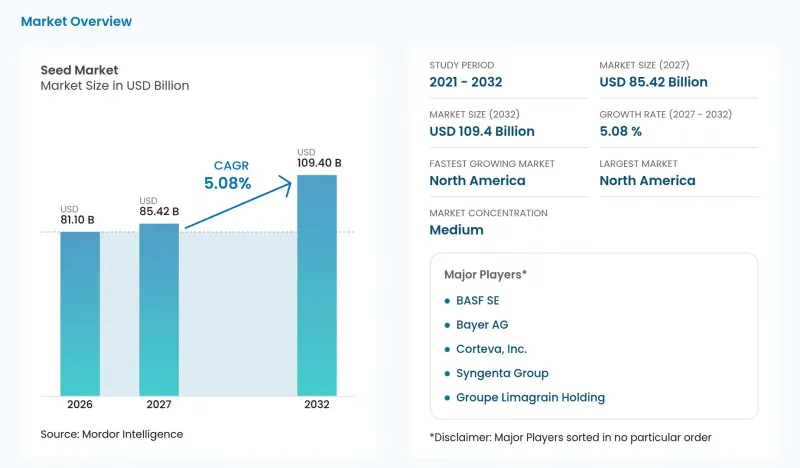
The seed market volume was valued at 43.88 million metric tons in 2026 and estimated to grow from 44.8 million metric tons in 2027 to reach 49.71 million metric tons by 2032, at a CAGR of 2.1% during the forecast period (2027-2032). This report is segmented by Breeding Technology (Hybrids and Open Pollinated Varieties & Hybrid Derivatives), Cultivation Mechanism (Open Field and Protected Cultivation), Crop Type (Row Crops and Vegetables), and Geography (North America, Asia-Pacific, Europe, South America, and Middle East and Africa). The market forecasts are provided in terms of value (USD) and volume (tonnes), based on availability.
Global Seed Market Trends and Insights
Increasing Adoption of Hybrid and GM Seed Varieties to Enhance Crop Yields
Farmers seeking higher yields need both effective varieties and enough seed to plant them. In March 2025, Bayer opened a maize seed facility in Kabwe, Zambia, for conventional hybrid seed. Bayer reported that the facility and related investments tripled its existing in-country capacity for high-quality maize seed production in 2025. Separately, USDA's Economic Research Service said genetically engineered crops had increased U.S. crop yields in many instances, establishing a qualified performance rationale for those varieties. Tripled maize-seed capacity in Zambia and documented U.S. yield gains from engineered crops together make improved seed easier to supply and easier to justify. Supply capacity therefore sets how many growers can act on that demand.
Technological Advancements in Seed Coating and Treatment Solutions
Seed-treatment advances can strengthen demand for purchased seed by protecting the crop during its vulnerable establishment stage. In 2025, the U.S. Environmental Protection Agency registered Syngenta's Victrato seed treatment for soybeans and cotton, targeting plant-parasitic nematodes and diseases with a single molecule. The agency also registered Syngenta's upgraded CruiserMaxx Vibrance Elite fungicide and insecticide seed-treatment premix for cereals. These approvals broaden the protection options that seed suppliers can pair with different crop portfolios. For growers, protecting establishment makes the seed decision partly a decision about managing early crop losses. Combining genetics and appropriate protection can give suppliers another way to justify the value of a purchased seed package.
Stringent Biosafety Regulations and Multi-Year Approval Timelines
A prolonged biosafety review can separate completed breeding work from permission to cultivate a seed variety commercially. By November 2025, Bangladesh's biosafety committees had reviewed the commercial-cultivation dossier for Golden Rice GR2E BRRI dhan 29 for more than 7 years without approval. The dossier had been submitted in November 2017 for commercial-cultivation, environmental-safety, and food-safety assessment. For a developer, this interval makes the approval pathway a separate commercial bottleneck after the technical work supporting submission. Regulated-seed suppliers face a timing exposure that multiplication capacity cannot resolve, because commercial cultivation depends on the authorization decision.
Other drivers and restraints analyzed in the detailed report include:
- Government Programs Boosting Certified Seed Replacement Rates
- Rising Demand for High-Value Crops Driven by Population and Diet Shifts
- Rising Seed Prices Limiting Access for Smallholder Farmers
For complete list of drivers and restraints, kindly check the Table Of Contents.
Segment Analysis
Hybrids accounted for a 72.77% share of the seed market size in 2026 and are the largest and fastest-growing segment, with a forecast CAGR of 5.25% during 2027-2032. Kaveri Seed Company Limited's hybrid-rice seed revenue in India increased 18.3% in FY2025-26. With hybrid-rice volumes up only 0.3%, almost all of the revenue gain reflected higher revenue per unit sold rather than added volume.
Export-market registration gives hybrid breeders a growth route that depends on regulatory access as well as agronomic performance. In FY2025-26, Kaveri Seed Company Limited described hybrid-rice registrations in the Philippines as a key growth driver. The company expected additional registrations to strengthen future export opportunities. For a rice-seed supplier, obtaining registration in a destination can extend the commercial reach of a defined hybrid portfolio. The opportunity therefore includes translating a variety into a saleable offer in each export jurisdiction, with further gains conditional on the additional registrations being obtained.
Complete Report Scope:
- By Breeding Technology
- Hybrids
- Non-Transgenic Hybrids
- Transgenic Hybrids
- Herbicide Tolerant Hybrids
- Insect Resistant Hybrids
- Other Traits
- Open Pollinated Varieties & Hybrid Derivatives
- Hybrids
- By Cultivation Mechanism
- Open Field
- Protected Cultivation
- By Crop Type
- Row Crops
- Fiber Crops
- Cotton
- Other Fiber Crops
- Forage Crops
- Alfalfa
- Forage Corn
- Forage Sorghum
- Other Forage Crops
- Grains & Cereals
- Corn
- Rice
- Sorghum
- Wheat
- Other Grains & Cereals
- Oilseeds
- Canola, Rapeseed & Mustard
- Soybean
- Sunflower
- Other Oilseeds
- Pulses
- Fiber Crops
- Vegetables
- Brassicas
- Cabbage
- Cauliflower & Broccoli
- Other Brassicas
- Cucurbits
- Cucumber & Gherkin
- Pumpkin & Squash
- Other Cucurbits
- Roots & Bulbs
- Garlic
- Onion
- Potato
- Other Roots & Bulbs
- Solanaceae
- Chilli
- Eggplant
- Tomato
- Other Solanaceae
- Unclassified Vegetables
- Asparagus
- Lettuce
- Carrot
- Okra
- Peas
- Spinach
- Other Unclassified Vegetables
- Brassicas
- Row Crops
- By Geography
- North America
- Canada
- Mexico
- United States
- Rest of North America
- Europe
- France
- Germany
- Italy
- Netherlands
- Poland
- Romania
- Russia
- Spain
- Turkey
- Ukraine
- United Kingdom
- Rest of Europe
- Asia-Pacific
- Australia
- Bangladesh
- China
- India
- Indonesia
- Japan
- Myanmar
- Pakistan
- Philippines
- Thailand
- Vietnam
- Rest of Asia-Pacific
- South America
- Argentina
- Brazil
- Rest of South America
- Middle East and Africa
- Iran
- Saudi Arabia
- Egypt
- Ethiopia
- Ghana
- Kenya
- Nigeria
- South Africa
- Tanzania
- Rest of Middle East and Africa
- North America
Geography Analysis
North America held a 35.18% seed market share in 2026 and is the largest and fastest-growing geography, with a forecast CAGR of 6.05% during 2027-2032. U.S. growers planted biotech varieties on 92% of corn acres in 2026, down from 2025. Herbicide-resistant varieties also covered 95% of U.S. soybean acreage in 2026, down from the previous year. By November 10, 2025, Vegetables by Bayer had commercialized 5 tomato varieties through De Ruiter in Canada and the United States, including 3 tomato-on-vine and 2 beef varieties resistant to Tomato Brown Rugose Fruit Virus. Their stated disease protection without compromised quality offers suppliers a route to differentiated vegetable seed sales alongside the established row-crop business, where wider biotech penetration has limited headroom.
Europe's production base includes 1,987,503 hectares approved for EU field-crop seed production in 2025, excluding vegetables. France led that area, with Spanish straw cereals and Danish forage grasses illustrating crop specializations that help suppliers match multiplication requirements to established capabilities. In Asia-Pacific, China's 2025/26 seed channels linked provincial or regional distributors with county wholesalers and local retailers, making agricultural-input shops farmers' main contact point. China's e-commerce and direct-to-farmer models were emerging alongside that network, so access to rural buyers involves both new routes and the local relationships supporting the dealer channel.
South America's multiplication capacity is illustrated by Brazil, where 3.6 million hectares across 18 states were registered as soybean seed-production fields in the 2024/25 season. That distributed footprint makes coordination across production locations a distinct commercial task for businesses serving soybean planting demand. In the Middle East and Africa, a 2026 Ghana study found that 51% of sampled vegetable farmers used agro-input dealers. Own-saved seed and local markets were also major sources, particularly in Ghana's Bono, Eastern, Northern, and Western regions. Brazil's registered multiplication network and Ghana's mixed sourcing channels call for different supplier capabilities, with production coordination shaping the former and access through local outlets shaping the latter.
- Bayer AG
- Corteva, Inc.
- Syngenta Group
- BASF SE
- Groupe Limagrain Holding
- KWS SAAT SE & Co. KGaA
- Sakata Seed Corporation
- Rijk Zwaan Zaadteelt en Zaadhandel B.V.
- Takii & Co., Ltd.
- Enza Zaden Beheer B.V.
- DLF Seeds A/S
- UPL Limited
- East-West Seed International B.V.
- Yuan Long Ping High-Tech Agriculture Co., Ltd.
- Bejo Zaden B.V.
Additional Benefits:
- The market estimate (ME) sheet in Excel format
- 3 months of analyst support
TABLE OF CONTENTS
1 INTRODUCTION
- 1.1 Study Assumptions and Market Definition
- 1.2 Scope of the Study
2 RESEARCH METHODOLOGY
3 EXECUTIVE SUMMARY
4 MARKET LANDSCAPE
- 4.1 Market Overview
- 4.2 Market Drivers
- 4.2.1 Increasing Adoption of Hybrid and GM Seed Varieties to Enhance Crop Yields
- 4.2.2 Technological Advancements in Seed Coating and Treatment Solutions
- 4.2.3 Government Programs Boosting Certified Seed Replacement Rates
- 4.2.4 Rising Demand for High-Value Crops Driven by Population and Diet Shifts
- 4.2.5 AI-Enabled Digital Phenotyping Shortening Breeding Cycles
- 4.2.6 Climate-Resilient Seed Traits Attracting Impact Capital
- 4.3 Market Restraints
- 4.3.1 Stringent Biosafety Regulations and Multi-Year Approval Timelines
- 4.3.2 Rising Seed Prices Limiting Access for Smallholder Farmers
- 4.3.3 Farmer-Led Seed-Saving Movements in Emerging Markets
- 4.3.4 Uncertain Clustered Regularly Interspaced Short Palindromic Repeats (CRISPR) Seed Policies in European Union and China
- 4.4 Industry Value Chain Analysis
- 4.5 Regulatory Landscape
- 4.6 Technological Outlook
- 4.7 Porter's Five Forces Analysis
- 4.7.1 Threat of New Entrants
- 4.7.2 Bargaining Power of Suppliers
- 4.7.3 Bargaining Power of Buyers
- 4.7.4 Threat of Substitutes
- 4.7.5 Competitive Rivalry
- 4.8 EXECUTIVE SUMMARY & KEY FINDINGS
- 4.9 REPORT OFFERS
- 4.10 Area Under Cultivation
- 4.10.1 Row Crops
- 4.10.2 Vegetables
- 4.11 Most Popular Traits
- 4.11.1 Alfalfa & Forage Corn
- 4.11.2 Cabbage, Pumpkin & Squash
- 4.11.3 Cotton, Canola, Rapeseed & Mustard
- 4.11.4 Rice & Corn
- 4.11.5 Soybean & Sunflower
- 4.11.6 Tomato & Cucumber
- 4.11.7 Wheat & Sorghum
- 4.12 Breeding Techniques
- 4.12.1 Row Crops & Vegetables
- 4.13 KEY STRATEGIC QUESTIONS FOR SEEDS CEOS
5 MARKET SIZE AND GROWTH FORECASTS (VALUE AND VOLUME)
- 5.1 By Breeding Technology
- 5.1.1 Hybrids
- 5.1.1.1 Non-Transgenic Hybrids
- 5.1.1.2 Transgenic Hybrids
- 5.1.1.2.1 Herbicide Tolerant Hybrids
- 5.1.1.2.2 Insect Resistant Hybrids
- 5.1.1.2.3 Other Traits
- 5.1.2 Open Pollinated Varieties & Hybrid Derivatives
- 5.1.1 Hybrids
- 5.2 By Cultivation Mechanism
- 5.2.1 Open Field
- 5.2.2 Protected Cultivation
- 5.3 By Crop Type
- 5.3.1 Row Crops
- 5.3.1.1 Fiber Crops
- 5.3.1.1.1 Cotton
- 5.3.1.1.2 Other Fiber Crops
- 5.3.1.2 Forage Crops
- 5.3.1.2.1 Alfalfa
- 5.3.1.2.2 Forage Corn
- 5.3.1.2.3 Forage Sorghum
- 5.3.1.2.4 Other Forage Crops
- 5.3.1.3 Grains & Cereals
- 5.3.1.3.1 Corn
- 5.3.1.3.2 Rice
- 5.3.1.3.3 Sorghum
- 5.3.1.3.4 Wheat
- 5.3.1.3.5 Other Grains & Cereals
- 5.3.1.4 Oilseeds
- 5.3.1.4.1 Canola, Rapeseed & Mustard
- 5.3.1.4.2 Soybean
- 5.3.1.4.3 Sunflower
- 5.3.1.4.4 Other Oilseeds
- 5.3.1.5 Pulses
- 5.3.1.1 Fiber Crops
- 5.3.2 Vegetables
- 5.3.2.1 Brassicas
- 5.3.2.1.1 Cabbage
- 5.3.2.1.2 Cauliflower & Broccoli
- 5.3.2.1.3 Other Brassicas
- 5.3.2.2 Cucurbits
- 5.3.2.2.1 Cucumber & Gherkin
- 5.3.2.2.2 Pumpkin & Squash
- 5.3.2.2.3 Other Cucurbits
- 5.3.2.3 Roots & Bulbs
- 5.3.2.3.1 Garlic
- 5.3.2.3.2 Onion
- 5.3.2.3.3 Potato
- 5.3.2.3.4 Other Roots & Bulbs
- 5.3.2.4 Solanaceae
- 5.3.2.4.1 Chilli
- 5.3.2.4.2 Eggplant
- 5.3.2.4.3 Tomato
- 5.3.2.4.4 Other Solanaceae
- 5.3.2.5 Unclassified Vegetables
- 5.3.2.5.1 Asparagus
- 5.3.2.5.2 Lettuce
- 5.3.2.5.3 Carrot
- 5.3.2.5.4 Okra
- 5.3.2.5.5 Peas
- 5.3.2.5.6 Spinach
- 5.3.2.5.7 Other Unclassified Vegetables
- 5.3.2.1 Brassicas
- 5.3.1 Row Crops
- 5.4 By Geography
- 5.4.1 North America
- 5.4.1.1 Canada
- 5.4.1.2 Mexico
- 5.4.1.3 United States
- 5.4.1.4 Rest of North America
- 5.4.2 Europe
- 5.4.2.1 France
- 5.4.2.2 Germany
- 5.4.2.3 Italy
- 5.4.2.4 Netherlands
- 5.4.2.5 Poland
- 5.4.2.6 Romania
- 5.4.2.7 Russia
- 5.4.2.8 Spain
- 5.4.2.9 Turkey
- 5.4.2.10 Ukraine
- 5.4.2.11 United Kingdom
- 5.4.2.12 Rest of Europe
- 5.4.3 Asia-Pacific
- 5.4.3.1 Australia
- 5.4.3.2 Bangladesh
- 5.4.3.3 China
- 5.4.3.4 India
- 5.4.3.5 Indonesia
- 5.4.3.6 Japan
- 5.4.3.7 Myanmar
- 5.4.3.8 Pakistan
- 5.4.3.9 Philippines
- 5.4.3.10 Thailand
- 5.4.3.11 Vietnam
- 5.4.3.12 Rest of Asia-Pacific
- 5.4.4 South America
- 5.4.4.1 Argentina
- 5.4.4.2 Brazil
- 5.4.4.3 Rest of South America
- 5.4.5 Middle East and Africa
- 5.4.5.1 Iran
- 5.4.5.2 Saudi Arabia
- 5.4.5.3 Egypt
- 5.4.5.4 Ethiopia
- 5.4.5.5 Ghana
- 5.4.5.6 Kenya
- 5.4.5.7 Nigeria
- 5.4.5.8 South Africa
- 5.4.5.9 Tanzania
- 5.4.5.10 Rest of Middle East and Africa
- 5.4.1 North America
6 COMPETITIVE LANDSCAPE
- 6.1 Market Concentration
- 6.2 Strategic Moves
- 6.3 Market Share Analysis
- 6.4 Company Profiles (includes Global level Overview, Market level overview, Core Segments, Financials as available, Strategic Information, Market Rank/Share for key companies, Products and Services, and Recent Developments)
- 6.4.1 Bayer AG
- 6.4.2 Corteva, Inc.
- 6.4.3 Syngenta Group
- 6.4.4 BASF SE
- 6.4.5 Groupe Limagrain Holding
- 6.4.6 KWS SAAT SE & Co. KGaA
- 6.4.7 Sakata Seed Corporation
- 6.4.8 Rijk Zwaan Zaadteelt en Zaadhandel B.V.
- 6.4.9 Takii & Co., Ltd.
- 6.4.10 Enza Zaden Beheer B.V.
- 6.4.11 DLF Seeds A/S
- 6.4.12 UPL Limited
- 6.4.13 East-West Seed International B.V.
- 6.4.14 Yuan Long Ping High-Tech Agriculture Co., Ltd.
- 6.4.15 Bejo Zaden B.V.
7 MARKET OPPORTUNITIES AND FUTURE OUTLOOK
- 7.1 White-Space and Unmet-Need Assessment

