PUBLISHER: Mordor Intelligence | PRODUCT CODE: 2187697

PUBLISHER: Mordor Intelligence | PRODUCT CODE: 2187697
India Passenger Car - Market Share Analysis, Industry Trends & Statistics, Growth Forecasts (2027 - 2032)
According to Mordor Intelligence, the India passenger car market size is expected to increase from USD 44.45 billion in 2026 to USD 47.79 billion in 2027 and reach USD 69.67 billion by 2032, growing at a CAGR of 7.83% over 2027-2032.
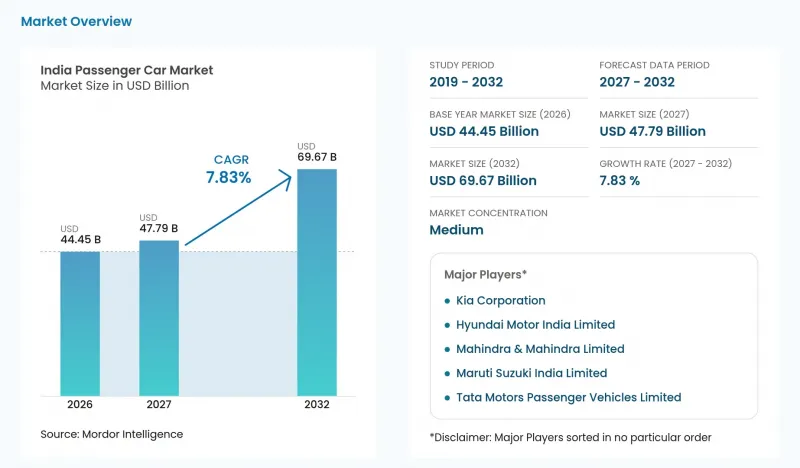
This report is segmented by Vehicle Configuration (Sports Utility Vehicle, Hatchback, and more), Propulsion Type (Internal Combustion Engine and Hybrid & Electric Vehicles), Transmission Type (Manual, Automatic, and more), Price Band (INR 5-10 lakh, INR 10-20 lakh, and more), and Ownership Model (Personal and Fleet). The market forecasts are provided in terms of value (USD), based on availability.
India Passenger Car Market Trends and Insights
Surging Compact-SUV Supply From Sub-4-Meter Length Bracket
India's compact-SUV sub-segment recorded 1.38 million wholesales in FY2025, up 10% year over year, with sub-4-meter models accounting for nearly half of SUV sales. The bracket gained further momentum as India's sub-4-meter SUV segment sold 116,552 units in July 2026, up 34.67% year over year from July 2025. New nameplates broadened the offer, with Skoda's Kylaq and Kia's Syros entering in early 2025 and selling 20,518 and 23,597 units, respectively, by May. For buyers in cities such as Delhi and Mumbai, more compact-SUV choices combine elevated seating with dimensions suited to dense streets and parking limits. That combination shifts showroom traffic toward small SUVs and gives dealers more price points to convert hatchback upgraders. Suppliers must support a wider model roster, so the commercial benefit depends on reliable availability across these new variants.
CNG Infrastructure Build-Out Reducing Running-Cost Parity Time
India had 9,158 CNG stations as of August 2026, extending the refueling network available to passenger-car buyers. Authorized city-gas entities also commissioned 1,206 new CNG stations across India in FY2024-25. The expanding network coincided with a CNG vehicle fleet increase from 5.86 million in March 2023 to 8.2 million in March 2025, with about 25% year-over-year growth in FY2024-25. For drivers in Delhi-NCR and Gujarat, denser coverage reduces the time and route deviation needed to refuel, improving the operating case for factory-fitted CNG cars. Lower access friction helps fleet operators and daily commuters compare fuel savings over a shorter ownership period. OEMs can therefore position CNG hatchbacks and compact sedans as practical cost-control choices, although station availability still shapes conversion outside established corridors.
Dealer Inventory Overhang Pressuring OEM Production
Passenger-vehicle dealer inventory reached 43 to 45 days in September 2026, more than twice FADA's 21-day benchmark. The imbalance was visible earlier, as H1 2025 wholesale dispatches rose 0.5% year over year while retail growth reached 2.5%, prompting OEMs to moderate factory output. High stock ties dealer cash in unsold cars and raises the risk that production plans misread local demand, especially for slower-moving trims. Honda Cars India said in July 2025 that it was aligning output with market demand by prioritizing retail deliveries over wholesale dispatches. That response can limit additional channel loading, but it does not clear vehicles already on dealer lots. Until inventory returns closer to the benchmark, OEMs face carrying-cost pressure and less flexibility to accelerate production for new launches.
Other drivers and restraints analyzed in the detailed report include:
- Digital-First Aspirational Younger Buyers
- E-Commerce-Fueled Urban Gig-Fleet Demand
- Intensifying Price War in Entry Hatchbacks Squeezing Margins
For complete list of drivers and restraints, kindly check the Table Of Contents.
Segment Analysis
Sports Utility Vehicle accounted for a 53.54% share of the India Passenger Car Market size in 2026 and is the fastest-growing segment at a 7.98% CAGR over 2027-2032. Hyundai Motor India's Creta sold 201,122 units in India in CY2025 and ranked as the country's best-selling SUV. Tata Motors Passenger Vehicles' Nexon sold 200,559 units and ranked second among SUVs in the same year. This scale gives SUV programs purchasing power, broad showroom visibility and room for connected or electrified variants. For families and urban professionals, higher seating converts into an everyday utility proposition.
Hatchback remains the practical entry format, and Maruti Suzuki's WagonR swivel-seat pilot shows how accessibility features can widen its use among senior citizens and persons with disabilities. Multi-Purpose Vehicle demand is supported by Toyota's more than 200,000 Innova HyCross sales by April 2026, reinforcing a comfort and reliability proposition. Sedan buyers retain a distinct value and first-time-buyer role, with Maruti Suzuki's Dzire selling more than 214,488 units in CY2025. These formats serve different space, access and driving needs, so SUV scale does not eliminate targeted opportunities elsewhere.
Internal Combustion Engine (ICE) represented an 83.33% India Passenger Car Market share in 2026. FADA's September 2026 retail mix still combined petrol or ethanol, diesel and CNG or LPG powertrains, showing a broad installed base for combustion vehicles. The CY2025 mix likewise retained a substantial ICE foundation across fuel types. That installed base supports service networks and supplier familiarity because repair networks and fuel retail are already organized around these powertrains. This continuity lowers switching risk for cost-conscious households and commercial operators.
Hybrid & Electric Vehicles are forecast to be the fastest-growing segment, with a 7.96% CAGR over 2027-2032. Toyota Kirloskar Motor reported cumulative sales of 300,000 hybrid vehicles in India by May 2026, indicating meaningful customer uptake of self-charging technology. Tata Motors reported 16,231 EV wholesales in Q1 FY2026, showing that new launches can sustain interest even when quarterly volume softened. The resulting mix favors staged electrification, with hybrids and EVs expanding alongside a still-dominant ICE service ecosystem. Suppliers that can serve both electrical and combustion architectures can smooth the transition for OEM programs.
Complete Report Scope:
- By Vehicle Configuration
- Hatchback
- Multi-Purpose Vehicle
- Sedan
- Sports Utility Vehicle
- By Propulsion Type
- Hybrid & Electric Vehicles
- Battery Electric
- Hybrid Electric
- Plug-in Hybrid Electric
- Fuel-cell Electric
- Internal Combustion Engine (ICE)
- CNG
- Diesel
- Gasoline
- LPG
- Hybrid & Electric Vehicles
- By Transmission Type
- Manual
- Automatic (Torque-Converter)
- Automated-Manual / iMT
- Dual-Clutch / CVT
- By Price Band
- Less than or equal to INR 5 lakh
- INR 5-10 lakh
- INR 10-20 lakh
- More than INR 20 lakh
- By Ownership Model
- Personal
- Fleet (Ride-hailing, Subscription, Leasing)
List of Companies Covered in this Report:
- Maruti Suzuki India Limited
- Hyundai Motor India Limited
- Tata Motors Passenger Vehicles Limited
- Mahindra & Mahindra Limited
- Kia Corporation
- Toyota Kirloskar Motor Pvt. Ltd.
- Honda Cars India Ltd.
- JSW MG Motor India Pvt. Ltd.
- Renault India Pvt. Ltd.
- Nissan Motor India Pvt. Ltd.
- Volkswagen AG
- BYD India Pvt. Ltd.
- Audi AG
- BMW India Pvt. Ltd.
Additional Benefits:
- The market estimate (ME) sheet in Excel format
- 3 months of analyst support
TABLE OF CONTENTS
1 INTRODUCTION
- 1.1 Study Assumptions and Market Definition
- 1.2 Scope of the Study
2 RESEARCH METHODOLOGY
3 EXECUTIVE SUMMARY
4 MARKET LANDSCAPE
- 4.1 Market Overview
- 4.2 Market Drivers
- 4.2.1 Surging Compact-SUV Supply From Sub-4-Meter Length Bracket
- 4.2.2 CNG Infrastructure Build-Out Reducing Running-Cost Parity Time
- 4.2.3 Digital-First Aspirational Younger Buyers
- 4.2.4 E-Commerce-Fueled Urban Gig-Fleet Demand
- 4.2.5 OEMs Leveraging India as Global Small-Car Export Hub
- 4.2.6 In-House Software-Defined-Vehicle Stacks Lowering Model-Cycle Time
- 4.3 Market Restraints
- 4.3.1 Dealer Inventory Overhang Pressuring OEM Production
- 4.3.2 Intensifying Price War in Entry Hatchbacks Squeezing Margins
- 4.3.3 Long-Tail Chip Shortages in Body-Control & ADAS ECUs
- 4.3.4 Patchy Fast-Charger Uptime Outside Tier-1 Cities
- 4.4 Industry Value Chain Analysis
- 4.5 Regulatory Landscape
- 4.6 Technological Outlook
- 4.7 Porter's Five Forces Analysis
- 4.7.1 Threat of New Entrants
- 4.7.2 Bargaining Power of Suppliers
- 4.7.3 Bargaining Power of Buyers
- 4.7.4 Threat of Substitutes
- 4.7.5 Competitive Rivalry
- 4.8 Key Industry Trend
- 4.8.1 Urbanization, Population & Vehicle/Transit Demand
- 4.8.2 Car Ownership & Motorization Rate
- 4.8.3 EV Penetration in Car Market
- 4.8.4 Fuel vs Electricity Price Spread (Per km, ICE vs EV)
- 4.8.5 EV vs ICE Total Cost of Ownership (TCO) Gap
- 4.8.6 Financing & Ownership Models (Loans, Leasing, Subscription)
- 4.8.7 Battery Chemistry Mix & Pack Energy Density (LFP vs NMC etc.)
- 4.8.8 Home, Workplace & Public Charger Access / Density
- 4.8.9 Fast-Charging Network Coverage & Power Bands
- 4.8.10 Alternative Fuels Infrastructure (Hydrogen for FCEVs)
- 4.8.11 Subsidy & Consumer Incentive Value (Purchase, Tax, Toll/Parking Benefits)
- 4.8.12 OEM EV Line-up & Model Pipeline
- 4.8.13 Value-Chain & Distribution-Channel Analysis
- 4.8.14 Regulatory, Fiscal & Industrial Policy Framework
- 4.9 Appendix
- 4.9.1 Global Overview
- 4.9.2 Porter's Five Forces Framework (Global)
- 4.9.3 Global Value-Chain Analysis
- 4.9.4 Market Dynamics (DROs)
- 4.9.5 Sources & References
- 4.9.6 List of Tables & Figures
- 4.9.7 Primary Insights
- 4.9.8 Data Pack
- 4.9.9 Glossary of Terms
- 4.10 Key Strategic Questions for CEOs
5 MARKET SIZE AND GROWTH FORECASTS (VALUE)
- 5.1 By Vehicle Configuration
- 5.1.1 Hatchback
- 5.1.2 Multi-Purpose Vehicle
- 5.1.3 Sedan
- 5.1.4 Sports Utility Vehicle
- 5.2 By Propulsion Type
- 5.2.1 Hybrid & Electric Vehicles
- 5.2.1.1 Battery Electric
- 5.2.1.2 Hybrid Electric
- 5.2.1.3 Plug-in Hybrid Electric
- 5.2.1.4 Fuel-cell Electric
- 5.2.2 Internal Combustion Engine (ICE)
- 5.2.2.1 CNG
- 5.2.2.2 Diesel
- 5.2.2.3 Gasoline
- 5.2.2.4 LPG
- 5.2.1 Hybrid & Electric Vehicles
- 5.3 By Transmission Type
- 5.3.1 Manual
- 5.3.2 Automatic (Torque-Converter)
- 5.3.3 Automated-Manual / iMT
- 5.3.4 Dual-Clutch / CVT
- 5.4 By Price Band
- 5.4.1 Less than or equal to INR 5 lakh
- 5.4.2 INR 5-10 lakh
- 5.4.3 INR 10-20 lakh
- 5.4.4 More than INR 20 lakh
- 5.5 By Ownership Model
- 5.5.1 Personal
- 5.5.2 Fleet (Ride-hailing, Subscription, Leasing)
6 COMPETITIVE LANDSCAPE
- 6.1 Market Concentration
- 6.2 Strategic Moves
- 6.3 Market Share Analysis
- 6.4 Company Profiles (includes Global level Overview, Market level overview, Core Segments, Financials as available, Strategic Information, Market Rank/Share for key companies, Products and Services, and Recent Developments)
- 6.4.1 Maruti Suzuki India Limited
- 6.4.2 Hyundai Motor India Limited
- 6.4.3 Tata Motors Passenger Vehicles Limited
- 6.4.4 Mahindra & Mahindra Limited
- 6.4.5 Kia Corporation
- 6.4.6 Toyota Kirloskar Motor Pvt. Ltd.
- 6.4.7 Honda Cars India Ltd.
- 6.4.8 JSW MG Motor India Pvt. Ltd.
- 6.4.9 Renault India Pvt. Ltd.
- 6.4.10 Nissan Motor India Pvt. Ltd.
- 6.4.11 Volkswagen AG
- 6.4.12 BYD India Pvt. Ltd.
- 6.4.13 Audi AG
- 6.4.14 BMW India Pvt. Ltd.
7 MARKET OPPORTUNITIES AND FUTURE OUTLOOK
- 7.1 White-Space and Unmet-Need Assessment

