PUBLISHER: Mordor Intelligence | PRODUCT CODE: 2187735

PUBLISHER: Mordor Intelligence | PRODUCT CODE: 2187735
Fidget Toys - Market Share Analysis, Industry Trends & Statistics, Growth Forecasts (2027 - 2032)
According to Mordor Intelligence, the fidget toys market size is expected to increase from USD 9.68 billion in 2026 to USD 10.41 billion in 2027 and reach USD 14.74 billion by 2032, growing at a CAGR of 7.21% over 2027-2032.
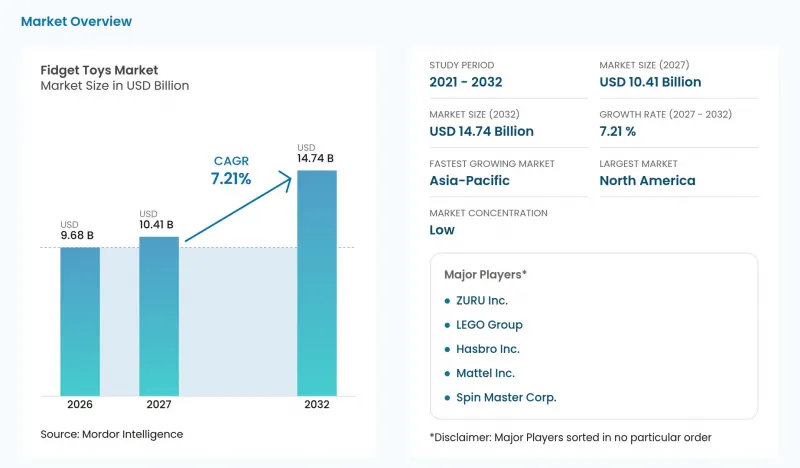
This report is segmented by Product Type (Fidget Spinners, Stress Balls, and more), Material (Plastic, Silicone, and more), Distribution Channels (Supermarkets/Hypermarkets, Online Retail Stores, and more), and Geography (North America, Asia-Pacific, and more). The market forecasts are provided in terms of value (USD), based on availability.
Global Fidget Toys Market Trends and Insights
Growing Awareness of Stress and Anxiety Management Products
Squishy toys such as NeeDoh appeal to buyers through stress relief and sensory benefits. U.S. sales of the broader squishy-toy category reached about USD 297 million through June 2026, quadrupling from the same period in 2025. That sensory proposition gives suppliers a use case beyond conventional play, broadening how they can explain the product to prospective retailers. Kids Village Asia, Schylling's sole NeeDoh distributor in Singapore, Malaysia, and Brunei, reported nearly 20-fold growth in retailer and trade inquiries in 2026 compared with the same period a year earlier. Converting the expanding trade interest into additional retail placements would extend NeeDoh's sensory proposition across the distributor's 3-country territory.
Increasing Adoption of Sensory Toys for ADHD and Autism Support
Institutional adoption creates a supply opportunity for sensory fidgets by placing them within student-support services. In 2025, Duke University's Perkins Library made 5 large and 5 small sensory kits containing fidgets available for student checkout. The kits included click fidget toys and were intended to support neurodiverse students. Students with a library card could check them out through the library. A kit combines sensory options within one service, so the fidget becomes part of an institutional assortment. The commercial opening is to supply the organization assembling those assortments, with fidgets serving a defined support function within the kit.
Availability of Counterfeit and Low-Quality Products
Counterfeit supply can interrupt the conversion of a sourced toy into a saleable retail product. In September 2026, the Office for Product Safety and Standards reported that an import of counterfeit Needoh Splash Ball sensory toys had been rejected at the UK border. Testing identified xylenes and styrene, while adequate assessment of the product's chemical hazards could not be verified. Counterfeit toys carrying the same product name create an authenticity problem for legitimate importers and retailers alongside the chemical-risk concern in this consignment. Supplier verification and safety documentation therefore become part of the economics of sourcing these tactile toys. Replacing rejected stock can delay availability and require another sourcing cycle before retail revenue becomes possible.
Other drivers and restraints analyzed in the detailed report include:
- Strong Influence of Social Media Trends and Viral Product Marketing
- Continuous Product Innovation in Designs, Materials, and Functions
- Short Product Life Cycles and Rapidly Changing Consumer Trends
For complete list of drivers and restraints, kindly check the Table Of Contents.
Segment Analysis
Fidget spinners accounted for a 39.68% share of the fidget toys market size in 2026. Anzmtosn sold luminous metal spinner balls with a mini flashlight on Amazon in the United States from November 2024 through August 2025 for about USD 17. In May 2026, the U.S. Consumer Product Safety Commission announced a recall of about 872 units because the supplied flashlight held button batteries that children could easily reach, violating the mandatory toy standard. Accessory batteries therefore fall inside the toy-safety review of a spinner sold with a light.
Stress balls are forecast to be the fastest-growing segment, at a CAGR of 8.85% over 2027-2032. Wellness and education buyers can select the squeeze-based format for tactile use alongside study, expanding its uses beyond novelty play. On February 24, 2025, Rockford Public Schools issued a purchase order for a 24-pack of mini slow-rising stress balls, with a line amount of USD 45.5. In September 2026, Duke University Libraries offered 5 large and 5 small sensory kits containing stress balls for 4-hour, in-library checkout, with instructors able to use small kits in library classes. Supplying multipacks and kit components gives stress-ball vendors a growth route through institutional orders and organized student-support services.
Complete Report Scope:
- By Product Type
- Fidget Spinners
- Stress Balls
- Infinity Cubes
- Pop-It Toys
- Others
- By Material
- Plastic
- Metal
- Silicone
- Wood
- Other Materials
- By Distribution Channels
- Supermarkets/Hypermarkets
- Convenience Stores
- Online Retail Stores
- Other Distribution Channels
- By Geography
- North America
- United States
- Canada
- Mexico
- Rest of North America
- Europe
- Germany
- United Kingdom
- France
- Italy
- Spain
- Netherlands
- Sweden
- Poland
- Belgium
- Rest of Europe
- Asia-Pacific
- China
- India
- Japan
- Australia
- South Korea
- Vietnam
- Indonesia
- Thailand
- Singapore
- Rest of Asia-Pacific
- South America
- Brazil
- Argentina
- Chile
- Peru
- Colombia
- Rest of South America
- Middle East and Africa
- United Arab Emirates
- Saudi Arabia
- South Africa
- Nigeria
- Egypt
- Morocco
- Turkey
- Rest of Middle East and Africa
- North America
Geography Analysis
North America was the largest geography and held a 41.12% fidget toys market share in 2026. In the broader U.S. squishy-toy category, dollar and unit sales both posted triple-digit growth through April 2026. In April 2026, Schylling president Paul Weingard reported dramatic NeeDoh sales growth across the United States and Canada. Growth in units as well as dollars gives suppliers a physical-volume opportunity, while the company example shows the same sensory line serving more than one national market. Because unit sales grew alongside dollar sales, suppliers in this category compete on shipment capacity as much as on brand appeal.
Asia-Pacific is forecast to be the fastest-growing geography, with a CAGR of 8.55% over 2027-2032. In May 2026, retailer Olivia & Grace Giftware in Perth, Western Australia, had more than 12,000 NeeDoh fidget toys on order, with shipments then scheduled for May through September 2026. An order covering several delivery months calls for a phased supply schedule rather than a single consignment. Comparable retailer accounts offer suppliers a route to repeated shipments within one selling season, provided they can meet the agreed delivery windows.
In Europe, the UK's 12+ toy segment grew 5% in the 12 months to June 2025 and accounted for 31% of total toy spending. In South America, Brazil's Inmetro added 2 MAJO TOYS PP plastic fidget models for ages 4 and older to Majo Comercio e Distribuicao Ltda.'s active registration in June 2026. In the Middle East and Africa, GCC rules covering Saudi Arabia, the United Arab Emirates, and Yemen require manufacturers to assess hazards and exposure before placing toys for children under 14 on the market. These examples call for different first steps, including positioning toward older UK toy buyers and preparing model registration in Brazil. In the covered Gulf markets and Yemen, the manufacturer's hazard and exposure assessment has to be completed before a toy for children under 14 reaches the market.
- LEGO Group
- Hasbro Inc.
- Mattel Inc.
- Spin Master Corp.
- ZURU Inc.
- Ravensburger AG
- Fat Brain Toys LLC
- Funskool Ltd.
- Schylling Inc.
- Goliath Games LLC
- ARK Therapeutic Services Inc.
- Bouncy Bands LLC
- Calm Strips LLC
- Spin-Balls, LLC (Fun In Motion Toys)
- Harkla
- Sensory Direct Limited
- Tangle Creations
- The Pencil Grip, Inc.
- Antsy Labs LLC
- MindWare
- Fidgetland
Additional Benefits:
- The market estimate (ME) sheet in Excel format
- 3 months of analyst support
TABLE OF CONTENTS
1 INTRODUCTION
- 1.1 Study Assumptions and Market Definition
- 1.2 Scope of the Study
2 RESEARCH METHODOLOGY
3 EXECUTIVE SUMMARY
4 MARKET LANDSCAPE
- 4.1 Market Overview
- 4.2 Market Drivers
- 4.2.1 Growing Awareness of Stress and Anxiety Management Products
- 4.2.2 Increasing Adoption of Sensory Toys for ADHD and Autism Support
- 4.2.3 Strong Influence of Social Media Trends and Viral Product Marketing
- 4.2.4 Continuous Product Innovation in Designs, Materials, and Functions
- 4.2.5 Growing Demand for Portable and On-the-Go Entertainment Products
- 4.2.6 Rising Consumer Interest in Screen-Free Recreational Activities
- 4.3 Market Restraints
- 4.3.1 Availability of Counterfeit and Low-Quality Products
- 4.3.2 Short Product Life Cycles and Rapidly Changing Consumer Trends
- 4.3.3 Regulatory Compliance Challenges for Children's Toy Safety Standards
- 4.3.4 Growing Competition from Digital Entertainment and Mobile Gaming
- 4.4 Industry Value Chain Analysis
- 4.5 Regulatory Landscape
- 4.6 Technological Outlook
- 4.7 Porter's Five Forces Analysis
- 4.7.1 Threat of New Entrants
- 4.7.2 Bargaining Power of Suppliers
- 4.7.3 Bargaining Power of Buyers
- 4.7.4 Threat of Substitutes
- 4.7.5 Competitive Rivalry
- 4.8 Consumer Behavior Analysis
5 MARKET SIZE AND GROWTH FORECASTS (VALUE)
- 5.1 By Product Type
- 5.1.1 Fidget Spinners
- 5.1.2 Stress Balls
- 5.1.3 Infinity Cubes
- 5.1.4 Pop-It Toys
- 5.1.5 Others
- 5.2 By Material
- 5.2.1 Plastic
- 5.2.2 Metal
- 5.2.3 Silicone
- 5.2.4 Wood
- 5.2.5 Other Materials
- 5.3 By Distribution Channels
- 5.3.1 Supermarkets/Hypermarkets
- 5.3.2 Convenience Stores
- 5.3.3 Online Retail Stores
- 5.3.4 Other Distribution Channels
- 5.4 By Geography
- 5.4.1 North America
- 5.4.1.1 United States
- 5.4.1.2 Canada
- 5.4.1.3 Mexico
- 5.4.1.4 Rest of North America
- 5.4.2 Europe
- 5.4.2.1 Germany
- 5.4.2.2 United Kingdom
- 5.4.2.3 France
- 5.4.2.4 Italy
- 5.4.2.5 Spain
- 5.4.2.6 Netherlands
- 5.4.2.7 Sweden
- 5.4.2.8 Poland
- 5.4.2.9 Belgium
- 5.4.2.10 Rest of Europe
- 5.4.3 Asia-Pacific
- 5.4.3.1 China
- 5.4.3.2 India
- 5.4.3.3 Japan
- 5.4.3.4 Australia
- 5.4.3.5 South Korea
- 5.4.3.6 Vietnam
- 5.4.3.7 Indonesia
- 5.4.3.8 Thailand
- 5.4.3.9 Singapore
- 5.4.3.10 Rest of Asia-Pacific
- 5.4.4 South America
- 5.4.4.1 Brazil
- 5.4.4.2 Argentina
- 5.4.4.3 Chile
- 5.4.4.4 Peru
- 5.4.4.5 Colombia
- 5.4.4.6 Rest of South America
- 5.4.5 Middle East and Africa
- 5.4.5.1 United Arab Emirates
- 5.4.5.2 Saudi Arabia
- 5.4.5.3 South Africa
- 5.4.5.4 Nigeria
- 5.4.5.5 Egypt
- 5.4.5.6 Morocco
- 5.4.5.7 Turkey
- 5.4.5.8 Rest of Middle East and Africa
- 5.4.1 North America
6 COMPETITIVE LANDSCAPE
- 6.1 Market Concentration
- 6.2 Strategic Moves
- 6.3 Market Share Analysis
- 6.4 Company Profiles (includes Global level Overview, Market level overview, Core Segments, Financials as available, Strategic Information, Market Rank/Share for key companies, Products and Services, and Recent Developments)
- 6.4.1 LEGO Group
- 6.4.2 Hasbro Inc.
- 6.4.3 Mattel Inc.
- 6.4.4 Spin Master Corp.
- 6.4.5 ZURU Inc.
- 6.4.6 Ravensburger AG
- 6.4.7 Fat Brain Toys LLC
- 6.4.8 Funskool Ltd.
- 6.4.9 Schylling Inc.
- 6.4.10 Goliath Games LLC
- 6.4.11 ARK Therapeutic Services Inc.
- 6.4.12 Bouncy Bands LLC
- 6.4.13 Calm Strips LLC
- 6.4.14 Spin-Balls, LLC (Fun In Motion Toys)
- 6.4.15 Harkla
- 6.4.16 Sensory Direct Limited
- 6.4.17 Tangle Creations
- 6.4.18 The Pencil Grip, Inc.
- 6.4.19 Antsy Labs LLC
- 6.4.20 MindWare
- 6.4.21 Fidgetland
7 MARKET OPPORTUNITIES AND FUTURE OUTLOOK
- 7.1 White-Space and Unmet-Need Assessment

