PUBLISHER: Mordor Intelligence | PRODUCT CODE: 2187754

PUBLISHER: Mordor Intelligence | PRODUCT CODE: 2187754
Anime - Market Share Analysis, Industry Trends & Statistics, Growth Forecasts (2027 - 2032)
According to Mordor Intelligence, the anime market size is expected to grow from USD 29.97 billion in 2026 to USD 33.15 billion in 2027 and is forecast to reach USD 54.22 billion by 2032 at 10.34% CAGR over 2027-2032.
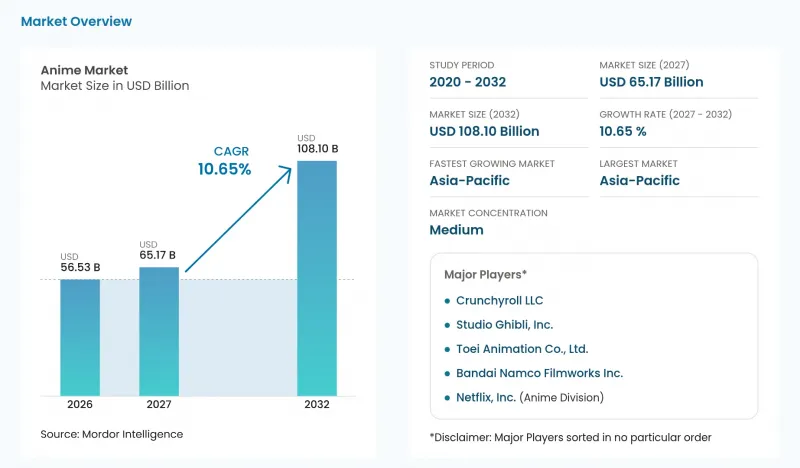
This report is segmented by Type (Merchandising, Internet Distribution, and more), Genre (Action and Adventure, Sci-Fi and Fantasy, and more), Target Demographic (Young Adults, Teens, and more), and Geography (Asia-Pacific, North America, and more). The market forecasts are provided in terms of value (USD), based on availability.
Global Anime Market Trends and Insights
Rising Popularity of Global Streaming Simulcasts
Simultaneous streaming gives international audiences access during a title's initial release, creating an opportunity to concentrate attention around licensed availability. Gachiakuta began simultaneous global streaming in July 2025 alongside nationwide TV broadcasting in Japan. Avex reported that the series ranked first on Crunchyroll. Across its wider anime programming, Netflix reported more than 1.5 billion views in 2025. When rights and availability align across intended territories at debut, synchronized promotion can direct release-time attention toward paid viewing.
Expansion of High-Value Collectible Merchandising Lines
Collectible merchandising can convert attachment to an anime character into demand for a physical product. In Dentsu's September 2025 survey of 400 U.S. self-identified collectors who had bought a collectible toy in the prior 3 years, 29% had purchased anime action figures. That participation gives licensors a defined collector audience for character-based figures. Bandai Spirits released the METAL BUILD ZETA GUNDAM transformable alloy model from Mobile Suit Zeta Gundam in Japan on April 26, 2025, at a tax-inclusive recommended retail price of JPY 44,000 (USD 305.3). The model illustrates how suppliers can develop another physical product format around an anime property, extending the merchandise offered to collectors. Licensing a character's design for figures lets a rights holder earn on the product separately from the animation's distribution.
Persistent Talent Shortages and Burnout
Limited animation staffing can restrict how readily Japanese producers convert additional commissions into deliverable series. In explaining the purpose of its FY2025 animation talent program, the Agency for Cultural Affairs said staffing shortages at Japanese animation production sites had become serious and that recruitment and workforce development were urgent. For commissioners, that constraint makes access to production labor a condition of expanding releases, even when audience demand supports additional titles. Allocating scarce workers to another project can leave less capacity for an existing production, exposing the release schedule to competing commitments. Trigger, WIT Studio, SILVER LINK., and Studio Colorido ran FY2025 training pilots for early-career or less experienced workers, but developing those workers takes time before commissioners can rely on additional delivery capacity.
Other drivers and restraints analyzed in the detailed report include:
- Cross-Media Franchise Strategies Boosting Lifetime IP Value
- Generative AI Targeting Faster Pre-Production Workflows
- Escalating Production Budgets Outpacing Revenue Growth
For complete list of drivers and restraints, kindly check the Table Of Contents.
Segment Analysis
Merchandising accounted for a 30.78% share of the anime market size in 2026. Bandai Namco Group companies recorded JPY 29.4 billion (USD 195 million) in Dragon Ball sales in Japan's Toys and Hobby Business for the year ended March 2026. The aggregate covered major group companies before elimination of inter-segment transactions. Product sellers tie revenue to the pull of individual licensed properties, so franchise selection sits alongside product development in their commercial decisions.
Internet distribution is forecast to be the fastest-growing segment, with an 11.9% CAGR over 2027-2032. In the first half of 2026, more than half of Netflix members globally had watched at least one anime title. Reaching that many existing members gives anime licensors a potential route to audiences already using a streaming service and can reduce reliance on attracting a separate audience for each release. For licensors, catalog relationships can extend commercial access beyond a single title if platforms broaden anime use across that established membership.
Complete Report Scope:
- By Type
- TV
- Movie
- Video
- Internet Distribution
- Merchandising
- Music
- Pachinko
- Live Entertainment
- By Genre
- Action and Adventure
- Sci-Fi and Fantasy
- Romance and Drama
- Sports
- Horror
- Slice of Life
- Others Genre
- By Target Demographic
- Young Adults (18-29)
- Teens (13-17)
- Kids (0-12)
- Seinen (Adult Males 20-40)
- Josei (Adult Females 20-40)
- By Geography
- North America
- United States
- Canada
- Mexico
- South America
- Brazil
- Argentina
- Rest of South America
- Europe
- Germany
- United Kingdom
- France
- Italy
- Spain
- Russia
- Rest of Europe
- Asia-Pacific
- Japan
- China
- South Korea
- India
- Australia and New Zealand
- Southeast Asia
- Rest of Asia-Pacific
- Middle East
- Saudi Arabia
- United Arab Emirates
- Turkey
- Rest of Middle East
- Africa
- South Africa
- Nigeria
- Egypt
- Rest of Africa
- North America
Geography Analysis
Asia-Pacific accounted for a 27.77% anime market share in 2026 and is forecast to be the fastest-growing region, with an 11.4% CAGR over 2027-2032. Dentsu's survey fielded February 19 to March 8, 2025, in China, Japan, Indonesia and Thailand found that 70% of respondents watched anime at least monthly. The sample included 700 respondents aged 18 or older per country, weighted by age, gender and region. At WAVES 2025 in Mumbai, Amazon MX Player announced its first anime category with Hindi-dubbed titles offered free to Indian audiences, as part of a slate scheduled for May 2025. For rights holders entering India, Hindi adaptation paired with free distribution can turn audience interest into licensed viewing without requiring an initial paid subscription.
In North America, Dentsu's October 2024-March 2025 survey found that 40% of U.S. anime viewers reported spending more than USD 200 on anime-related merchandise in the prior 12 months. For Europe, France provides another country example, with 27% of surveyed anime viewers above the same threshold on the same basis. These country-level patterns can support locally targeted licensing proposals that connect paid fan participation with the development of anime-related products. The 13 percentage point gap between the surveyed countries argues for country-specific merchandise terms rather than a uniform license scope.
South America's Brazil example provides a theatrical benchmark, with Demon Slayer: Infinity Castle recording 2.23 million admissions in 2025. In Africa, My Hero Academia season 8 streamed on Crunchyroll from October to December 2025. The Middle East has a frequent-viewing example in Saudi Arabia, where 31% of respondents in Dentsu's nationally representative 2025 survey of 1,400 consumers reported watching anime daily. These channels create different rights packages, with Brazil's example centered on a film and Africa's on a season. Daily viewing in Saudi Arabia favors long-running catalog access, making license duration a separate decision from the film and season formats evidenced elsewhere.
- Crunchyroll LLC
- Bandai Namco Filmworks Inc.
- Toei Animation Co., Ltd.
- Kyoto Animation Co., Ltd.
- Studio Ghibli, Inc.
- Production I.G., Inc.
- Pierrot Co., Ltd.
- Madhouse, Inc.
- P.A. Works, Inc.
- Bones Inc.
- MAPPA Co., Ltd.
- Ufotable Co., Ltd.
- WIT Studio Co., Ltd.
- Kadokawa Corporation
- VIZ Media LLC
- Sentai Holdings, LLC
- Good Smile Company, Inc.
- Netflix, Inc. (Anime Division)
- Amazon Content Services LLC (Anime)
- Bilibili Inc.
Additional Benefits:
- The market estimate (ME) sheet in Excel format
- 3 months of analyst support
TABLE OF CONTENTS
1 INTRODUCTION
- 1.1 Study Assumptions and Market Definition
- 1.2 Scope of the Study
2 RESEARCH METHODOLOGY
3 EXECUTIVE SUMMARY
4 MARKET LANDSCAPE
- 4.1 Market Overview
- 4.2 Market Drivers
- 4.2.1 Rising Popularity of Global Streaming Simulcasts
- 4.2.2 Expansion of High-Value Collectible Merchandising Lines
- 4.2.3 Cross-Media Franchise Strategies Boosting Lifetime IP Value
- 4.2.4 Generative AI Targeting Faster Pre-Production Workflows
- 4.2.5 Localization Investments Unlocking Non-Traditional Regions
- 4.2.6 Government Support for Cultural Export Programs
- 4.3 Market Restraints
- 4.3.1 Persistent Talent Shortages and Burnout
- 4.3.2 Escalating Production Budgets Outpacing Revenue Growth
- 4.3.3 Fragmented Intellectual Property Rights Across Markets
- 4.3.4 Piracy and Illicit Streaming Undermining Monetization
- 4.4 Industry Value Chain Analysis
- 4.5 Regulatory Landscape
- 4.6 Technological Outlook
- 4.7 Porter's Five Forces Analysis
- 4.7.1 Threat of New Entrants
- 4.7.2 Bargaining Power of Suppliers
- 4.7.3 Bargaining Power of Buyers
- 4.7.4 Threat of Substitutes
- 4.7.5 Competitive Rivalry
- 4.8 Impact of Macroeconomic Factors on the Market
- 4.9 Investment and Funding Analysis
5 MARKET SIZE AND GROWTH FORECASTS (VALUE)
- 5.1 By Type
- 5.1.1 TV
- 5.1.2 Movie
- 5.1.3 Video
- 5.1.4 Internet Distribution
- 5.1.5 Merchandising
- 5.1.6 Music
- 5.1.7 Pachinko
- 5.1.8 Live Entertainment
- 5.2 By Genre
- 5.2.1 Action and Adventure
- 5.2.2 Sci-Fi and Fantasy
- 5.2.3 Romance and Drama
- 5.2.4 Sports
- 5.2.5 Horror
- 5.2.6 Slice of Life
- 5.2.7 Others Genre
- 5.3 By Target Demographic
- 5.3.1 Young Adults (18-29)
- 5.3.2 Teens (13-17)
- 5.3.3 Kids (0-12)
- 5.3.4 Seinen (Adult Males 20-40)
- 5.3.5 Josei (Adult Females 20-40)
- 5.4 By Geography
- 5.4.1 North America
- 5.4.1.1 United States
- 5.4.1.2 Canada
- 5.4.1.3 Mexico
- 5.4.2 South America
- 5.4.2.1 Brazil
- 5.4.2.2 Argentina
- 5.4.2.3 Rest of South America
- 5.4.3 Europe
- 5.4.3.1 Germany
- 5.4.3.2 United Kingdom
- 5.4.3.3 France
- 5.4.3.4 Italy
- 5.4.3.5 Spain
- 5.4.3.6 Russia
- 5.4.3.7 Rest of Europe
- 5.4.4 Asia-Pacific
- 5.4.4.1 Japan
- 5.4.4.2 China
- 5.4.4.3 South Korea
- 5.4.4.4 India
- 5.4.4.5 Australia and New Zealand
- 5.4.4.6 Southeast Asia
- 5.4.4.7 Rest of Asia-Pacific
- 5.4.5 Middle East
- 5.4.5.1 Saudi Arabia
- 5.4.5.2 United Arab Emirates
- 5.4.5.3 Turkey
- 5.4.5.4 Rest of Middle East
- 5.4.6 Africa
- 5.4.6.1 South Africa
- 5.4.6.2 Nigeria
- 5.4.6.3 Egypt
- 5.4.6.4 Rest of Africa
- 5.4.1 North America
6 COMPETITIVE LANDSCAPE
- 6.1 Market Concentration
- 6.2 Strategic Moves
- 6.3 Market Share Analysis
- 6.4 Company Profiles (includes Global level Overview, Market level overview, Core Segments, Financials as available, Strategic Information, Market Rank/Share for key companies, Products and Services, and Recent Developments)
- 6.4.1 Crunchyroll LLC
- 6.4.2 Bandai Namco Filmworks Inc.
- 6.4.3 Toei Animation Co., Ltd.
- 6.4.4 Kyoto Animation Co., Ltd.
- 6.4.5 Studio Ghibli, Inc.
- 6.4.6 Production I.G., Inc.
- 6.4.7 Pierrot Co., Ltd.
- 6.4.8 Madhouse, Inc.
- 6.4.9 P.A. Works, Inc.
- 6.4.10 Bones Inc.
- 6.4.11 MAPPA Co., Ltd.
- 6.4.12 Ufotable Co., Ltd.
- 6.4.13 WIT Studio Co., Ltd.
- 6.4.14 Kadokawa Corporation
- 6.4.15 VIZ Media LLC
- 6.4.16 Sentai Holdings, LLC
- 6.4.17 Good Smile Company, Inc.
- 6.4.18 Netflix, Inc. (Anime Division)
- 6.4.19 Amazon Content Services LLC (Anime)
- 6.4.20 Bilibili Inc.
7 MARKET OPPORTUNITIES AND FUTURE OUTLOOK
- 7.1 White-Space and Unmet-Need Assessment

