PUBLISHER: Mordor Intelligence | PRODUCT CODE: 2187794

PUBLISHER: Mordor Intelligence | PRODUCT CODE: 2187794
Biotechnology - Market Share Analysis, Industry Trends & Statistics, Growth Forecasts (2027 - 2032)
According to Mordor Intelligence, the biotechnology market size is expected to grow from USD 2.42 trillion in 2026 to USD 2.73 trillion in 2027 and is forecast to reach USD 4.91 trillion by 2032 at 12.45% CAGR over 2027-2032.
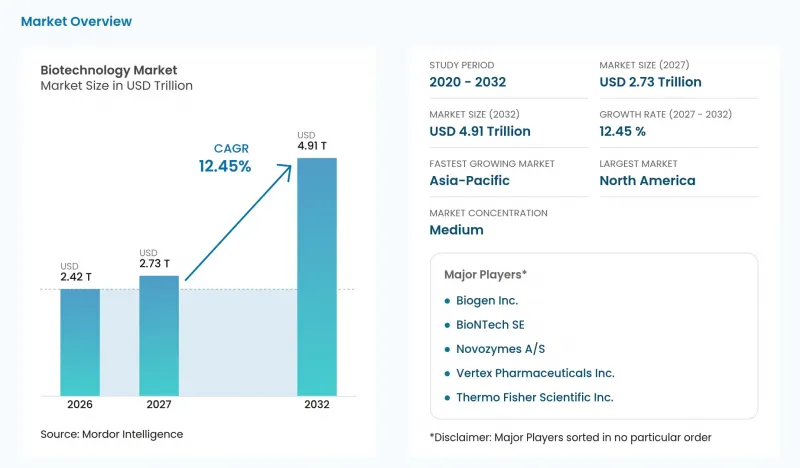
This report is segmented by Technology (Tissue Engineering & Regeneration and more), Application (Health & Red Biotechnology and more), End User (Biopharma & Biotechnology Companies and more), Product Type (Biopharmaceuticals and more), and Geography (North America and more). The market forecasts are provided in terms of value (USD), based on availability.
Global Biotechnology Market Trends and Insights
Accelerated demand for novel biologics and gene-based therapeutics
Demand for novel biologics can deepen as an approved therapy serves multiple defined treatment populations. Genmab reported USD 312 million in global EPKINLY/TEPKINLY net sales in the first half of 2026, up 48% from the first half of 2025. The bispecific antibody is co-developed and co-commercialized with AbbVie and is approved for multiple B-cell malignancies in the United States, Europe, and Japan. Genmab attributed the sales increase to growth across several treatment settings. For biotechnology suppliers, growth across these B-cell treatment settings can increase demand for manufacturing and development support around an already approved antibody.
Rapid cost decline in high-throughput sequencing
Lower sequencing consumables costs can make the breadth of a genomic study less expensive to expand. Illumina reported an approximate USD 200 whole-genome sequencing price in 2025, with a consumables-only list-price basis using a 25B flow cell and 100 Gb per genome. Its comparison placed earlier Solexa instrument sequencing at about USD 1 million per genome. Cheaper sequencing inputs can support larger study designs, and every added genome processed draws on the same reagents and flow cells. For sequencing suppliers, larger studies create a revenue opportunity only when recurring consumables volume more than offsets the lower price per genome.
Shortage of bioprocessing single-use-systems specialists
Specialist shortages can restrict how quickly biopharmaceutical manufacturers put single-use systems into reliable production. For these operators, replacing hardware does not by itself resolve the work of connecting a disposable assembly with the surrounding process. When integration expertise is scarce, a new production configuration can require more engineering time before it can be used consistently. That constraint can reduce the immediate commercial value of additional capacity, especially when manufacturing plans depend on transferring a process rapidly into production. Manufacturers can build integration expertise alongside equipment deployment, but this requires resources before extra production becomes available. The skilled work needed to make each installation usable can consequently delay capacity activation and the associated demand for production inputs.
Other drivers and restraints analyzed in the detailed report include:
- Government bio-economy stimulus and R&D tax credits
- M&A race for AI-driven drug-discovery platforms
- Regulatory lag on multi-omic companion diagnostics
For complete list of drivers and restraints, kindly check the Table Of Contents.
Segment Analysis
Tissue engineering and regeneration accounted for a 20.28% share of the biotechnology market size in 2026. Japan Tissue Engineering reported 111 orders for its autologous cultured cartilage product JACC in April-June 2026 and contracts with 143 facilities as of July 29, 2026. This Japanese example connects a regenerative product with a defined treatment network, making clinical reach part of its commercialization model. For producers, extending facility relationships can create a route to additional orders alongside the underlying tissue-manufacturing capability. The commercial opportunity therefore depends on connecting specialized production with the treatment locations through which patients can receive the product.
DNA sequencing is forecast to be the fastest-growing technology segment at a 21% CAGR over 2027-2032. Illumina reported USD 775 million in sequencing-consumables revenue in Q2 2026, up 5% year over year on a reported basis. High-throughput volume drove most of that growth, while NovaSeq X installed-base expansion supported consumables use. The company placed more than 95 NovaSeq X instruments that quarter and reported several multi-unit clinical-customer capacity orders, including for new trials. Clinical program expansion can therefore connect instrument demand with the ongoing sequencing work needed to execute research at the required throughput.
Health and red biotechnology represented a 48.21% biotechnology market share in 2026. The 2026 global cell and gene therapy pipeline included 383 active clinical trials, with Phase I and II studies representing 95% of that pipeline. Globally, 17 cell and gene therapy products received approval in the first half of 2026. Providers serving health applications can consequently address clinical-development work and the capabilities needed for commercial supply, with early-stage program support creating a service opportunity alongside manufacturing for approved cell and gene therapies.
The bioinformatics and omics segment is forecast to be the fastest-growing application segment at a 21.6% CAGR over 2027-2032. SOPHiA GENETICS had 542 core genomics customers as of June 30, 2026, compared with 490 a year earlier. A broader customer base can expand the organizational reach of genomic interpretation, creating opportunities around how biological information is used. Industrial processing has a different application focus, illustrated by GenScript Biotech Corporation subsidiary Bestzyme's enzyme development for biofuel, food and beverage, and animal feed uses. These applications favor distinct supplier capabilities, with genomics adoption centered on interpretation and industrial biotechnology addressing defined processing requirements.
Complete Report Scope:
- By Technology
- DNA Sequencing
- Nanobiotechnology
- Tissue Engineering & Regeneration
- PCR Technology
- Fermentation
- Chromatography
- Gene Amplification Technologies
- Synthetic Biology
- CRISPR & Gene-Editing Tools
- Biochips & Microarrays
- Others
- By Application
- Health & Red Biotechnology
- Biopharmaceuticals
- Diagnostics
- Gene Therapy
- Personalised Medicine
- Food & Agriculture (Green)
- Industrial Processing (White)
- Environmental & Natural Resources (Gray)
- Bioinformatics & Omics
- Others
- Health & Red Biotechnology
- By End User
- Biopharma & Biotechnology Companies
- CMOs & CROs
- Academic & Research Institutes
- Hospitals & Diagnostic Centers
- Agricultural Corporations
- Environmental Agencies & NGOs
- By Product Type
- Biopharmaceuticals
- Bioprocess Equipment & Consumables
- Reagents & Kits
- Bioservices
- Bioinformatics Platforms & Software
- Others
- By Geography
- North America
- United States
- Canada
- Mexico
- Europe
- Germany
- United Kingdom
- France
- Italy
- Spain
- Rest of Europe
- Asia-Pacific
- China
- Japan
- India
- Australia
- South Korea
- Rest of Asia-Pacific
- Middle East
- Israel
- Saudi Arabia
- United Arab Emirates
- Turkey
- Rest of Middle East
- Africa
- South Africa
- Egypt
- Nigeria
- Rest of Africa
- South America
- Brazil
- Argentina
- Rest of South America
- North America
Geography Analysis
North America held a 44.56% biotechnology market share in 2026. Amgen, a producer of therapeutics, reported USD 25.7 billion in U.S. product sales across its portfolio in 2025. In May 2026, Micron Biomedical opened a manufacturing facility spanning more than 26,000 square feet in Alpharetta, Georgia, for its dissolvable vaccine and therapeutic technology. The site opened with equipment for design and production at scale, positioning the company for pivotal clinical trials. Established medicine revenues and specialized infrastructure for clinical development create different supplier opportunities, linking the region's commercial base with the manufacturing work required to advance additional therapeutic technologies.
Asia-Pacific is forecast to be the fastest-growing region at a 16.4% CAGR over 2027-2032. Singapore's Economic Development Board attracted investments in the biomedical sciences sector in 2025 expected to create 1,775 jobs over the following 5 years. On February 1, 2026, India announced Biopharma SHAKTI to build a domestic production ecosystem for biologics and biosimilars and develop the country as a biopharmaceutical manufacturing hub. For bioprocessing suppliers, the growth opportunity lies in connecting production equipment with bioprocessing workforce and process development, helping investors turn capital commitments into usable manufacturing capabilities.
In Europe, the European Union received 7% of global health-biotechnology venture-capital investment from 2015 through June 2025. In the Middle East, Saudi Arabia's National Biotechnology Strategy, launched in 2024, prioritizes localizing vaccine manufacturing alongside biopharmaceutical manufacturing, genomics and gene therapy research, and agricultural biotechnology. In Africa, WHO Africa and the International Vaccine Institute signed an August 2025 agreement covering vaccine research, trials, regulatory capacity, technology transfer, local manufacturing, and workforce development. In South America, Argentina and Brazil expanded mRNA-platform production capacity through technology transfer and manufacturing partnerships during 2024-2025. The EU figure concerns access to venture capital, while Saudi priorities, the African agreement and capacity expansion in Argentina and Brazil point to opportunities for technology partners building local manufacturing capabilities.
- Amgen Inc.
- Biogen Inc.
- Gilead Sciences Inc.
- Illumina Inc.
- Thermo Fisher Scientific Inc.
- Regeneron Pharmaceuticals Inc.
- Moderna Inc.
- BioNTech SE
- Vertex Pharmaceuticals Inc.
- CSL Ltd.
- Lonza Group AG
- Novozymes A/S
- Catalent Inc.
- Charles River Laboratories International Inc.
- Genmab A/S
- CRISPR Therapeutics AG
- Editas Medicine Inc.
- Intellia Therapeutics Inc.
- Sangamo Therapeutics Inc.
- Alnylam Pharmaceuticals Inc.
- Sarepta Therapeutics Inc.
- Bluebird Bio Inc.
- Ginkgo Bioworks Holdings Inc.
- Zymergen Inc.
- Twist Bioscience Corp.
Additional Benefits:
- The market estimate (ME) sheet in Excel format
- 3 months of analyst support
TABLE OF CONTENTS
1 INTRODUCTION
- 1.1 Study Assumptions and Market Definition
- 1.2 Scope of the Study
2 RESEARCH METHODOLOGY
3 EXECUTIVE SUMMARY
4 MARKET LANDSCAPE
- 4.1 Market Overview
- 4.2 Market Drivers
- 4.2.1 Accelerated demand for novel biologics and gene-based therapeutics
- 4.2.2 Rapid cost decline in high-throughput sequencing
- 4.2.3 Government bio-economy stimulus and R&D tax credits
- 4.2.4 M&A race for AI-driven drug-discovery platforms
- 4.2.5 Emergence of cell-free biomanufacturing micro-plants
- 4.2.6 Synthetic biology-enabled carbon-negative materials
- 4.3 Market Restraints
- 4.3.1 Shortage of bioprocessing single-use-systems specialists
- 4.3.2 Regulatory lag on multi-omic companion diagnostics
- 4.3.3 Rising bio-geopolitical export controls on genetic data
- 4.3.4 Volatility in venture funding for platform-only start-ups
- 4.4 Industry Value Chain Analysis
- 4.5 Regulatory Landscape
- 4.6 Technological Outlook
- 4.7 Porter's Five Forces Analysis
- 4.7.1 Threat of New Entrants
- 4.7.2 Bargaining Power of Suppliers
- 4.7.3 Bargaining Power of Buyers
- 4.7.4 Threat of Substitutes
- 4.7.5 Competitive Rivalry
5 MARKET SIZE AND GROWTH FORECASTS (VALUE)
- 5.1 By Technology
- 5.1.1 DNA Sequencing
- 5.1.2 Nanobiotechnology
- 5.1.3 Tissue Engineering & Regeneration
- 5.1.4 PCR Technology
- 5.1.5 Fermentation
- 5.1.6 Chromatography
- 5.1.7 Gene Amplification Technologies
- 5.1.8 Synthetic Biology
- 5.1.9 CRISPR & Gene-Editing Tools
- 5.1.10 Biochips & Microarrays
- 5.1.11 Others
- 5.2 By Application
- 5.2.1 Health & Red Biotechnology
- 5.2.1.1 Biopharmaceuticals
- 5.2.1.2 Diagnostics
- 5.2.1.3 Gene Therapy
- 5.2.1.4 Personalised Medicine
- 5.2.2 Food & Agriculture (Green)
- 5.2.3 Industrial Processing (White)
- 5.2.4 Environmental & Natural Resources (Gray)
- 5.2.5 Bioinformatics & Omics
- 5.2.6 Others
- 5.2.1 Health & Red Biotechnology
- 5.3 By End User
- 5.3.1 Biopharma & Biotechnology Companies
- 5.3.2 CMOs & CROs
- 5.3.3 Academic & Research Institutes
- 5.3.4 Hospitals & Diagnostic Centers
- 5.3.5 Agricultural Corporations
- 5.3.6 Environmental Agencies & NGOs
- 5.4 By Product Type
- 5.4.1 Biopharmaceuticals
- 5.4.2 Bioprocess Equipment & Consumables
- 5.4.3 Reagents & Kits
- 5.4.4 Bioservices
- 5.4.5 Bioinformatics Platforms & Software
- 5.4.6 Others
- 5.5 By Geography
- 5.5.1 North America
- 5.5.1.1 United States
- 5.5.1.2 Canada
- 5.5.1.3 Mexico
- 5.5.2 Europe
- 5.5.2.1 Germany
- 5.5.2.2 United Kingdom
- 5.5.2.3 France
- 5.5.2.4 Italy
- 5.5.2.5 Spain
- 5.5.2.6 Rest of Europe
- 5.5.3 Asia-Pacific
- 5.5.3.1 China
- 5.5.3.2 Japan
- 5.5.3.3 India
- 5.5.3.4 Australia
- 5.5.3.5 South Korea
- 5.5.3.6 Rest of Asia-Pacific
- 5.5.4 Middle East
- 5.5.4.1 Israel
- 5.5.4.2 Saudi Arabia
- 5.5.4.3 United Arab Emirates
- 5.5.4.4 Turkey
- 5.5.4.5 Rest of Middle East
- 5.5.5 Africa
- 5.5.5.1 South Africa
- 5.5.5.2 Egypt
- 5.5.5.3 Nigeria
- 5.5.5.4 Rest of Africa
- 5.5.6 South America
- 5.5.6.1 Brazil
- 5.5.6.2 Argentina
- 5.5.6.3 Rest of South America
- 5.5.1 North America
6 COMPETITIVE LANDSCAPE
- 6.1 Market Concentration
- 6.2 Strategic Moves
- 6.3 Market Share Analysis
- 6.4 Company Profiles (includes Global level Overview, Market level overview, Core Segments, Financials as available, Strategic Information, Market Rank/Share for key companies, Products and Services, and Recent Developments)
- 6.4.1 Amgen Inc.
- 6.4.2 Biogen Inc.
- 6.4.3 Gilead Sciences Inc.
- 6.4.4 Illumina Inc.
- 6.4.5 Thermo Fisher Scientific Inc.
- 6.4.6 Regeneron Pharmaceuticals Inc.
- 6.4.7 Moderna Inc.
- 6.4.8 BioNTech SE
- 6.4.9 Vertex Pharmaceuticals Inc.
- 6.4.10 CSL Ltd.
- 6.4.11 Lonza Group AG
- 6.4.12 Novozymes A/S
- 6.4.13 Catalent Inc.
- 6.4.14 Charles River Laboratories International Inc.
- 6.4.15 Genmab A/S
- 6.4.16 CRISPR Therapeutics AG
- 6.4.17 Editas Medicine Inc.
- 6.4.18 Intellia Therapeutics Inc.
- 6.4.19 Sangamo Therapeutics Inc.
- 6.4.20 Alnylam Pharmaceuticals Inc.
- 6.4.21 Sarepta Therapeutics Inc.
- 6.4.22 Bluebird Bio Inc.
- 6.4.23 Ginkgo Bioworks Holdings Inc.
- 6.4.24 Zymergen Inc.
- 6.4.25 Twist Bioscience Corp.
7 MARKET OPPORTUNITIES AND FUTURE OUTLOOK
- 7.1 White-Space and Unmet-Need Assessment

