PUBLISHER: Mordor Intelligence | PRODUCT CODE: 2194775

PUBLISHER: Mordor Intelligence | PRODUCT CODE: 2194775
Detection Engineering Platform - Market Share Analysis, Industry Trends & Statistics, Growth Forecasts (2027 - 2032)
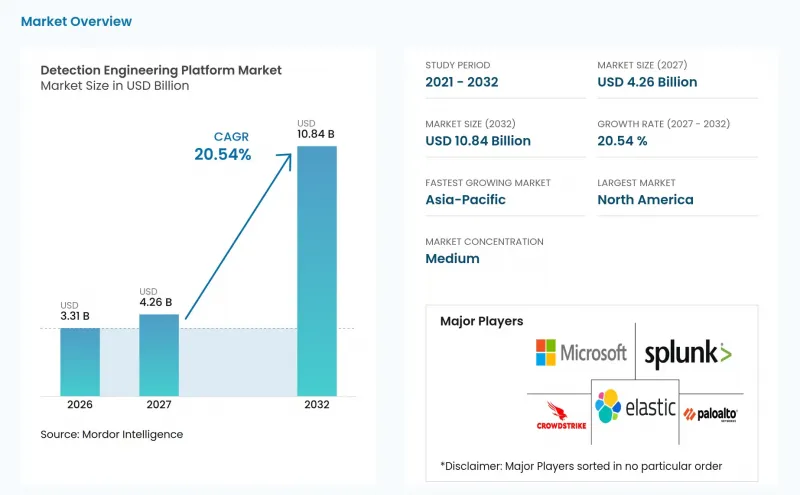
According to Mordor Intelligence, the detection engineering platform market size is projected to be USD 3.31 billion in 2026, USD 4.26 billion in 2027, and reach USD 10.84 billion by 2032, growing at a CAGR of 20.54% from 2027 to 2032.
Global Detection Engineering Platform Market Trends and Insights
Escalating Adversary Complexity and Multi-Stage Attack Paths
The detection engineering platform market is supported by attacks that move through several credential stores, cloud tenants, and SaaS environments. Threat actors can gain access through identity theft and then use familiar administrative tools, which makes a malware-only response inadequate. The SANS 2025 survey reported that living-off-the-land techniques appeared in 76% of nation-state attacks. Security teams, therefore, need to connect activity across identity, endpoint, network, and cloud records rather than assess each signal alone. Detection programs that cover identity pivots, lateral movement, and data staging provide a more complete view of these linked attack paths. This need supports continued investment in detection content that can be tested and maintained as attacker behavior changes.
Cloud, Identity, Endpoint, and SaaS Telemetry Expansion
Cloud-native workloads, SaaS applications, identity providers, and managed endpoints have expanded the volume of information that security teams must process. The 2026 SANS survey found that 43% of respondents saw cloud-native environments as their largest detection coverage gap. This gap reflects how quickly cloud activity has exceeded the coverage of existing rules and established data models in the detection engineering platform market. Organizations are responding by normalizing records before detection logic is applied in the SIEM. Microsoft expanded Sentinel UEBA in April 2026 to cover AWS, Google Cloud Platform, and Okta sources within a common behavioral analysis approach. The detection engineering platform market gains from architectures that treat data collection, normalization, and rule execution as connected parts of the detection process.
High Integration Complexity Across Heterogeneous Telemetry
The detection engineering platform market faces a practical constraint when data arrives through different connectors and incompatible schemas. Hybrid, multi-cloud, and on-premises estates require teams to normalize information before common detection logic can be used. This work absorbs resources that could otherwise be used to develop new coverage. CrowdStrike stated that Falcon Onum can process up to 5 times more events per second than legacy architectures and route detection-ready data across its platform and third-party destinations. Enterprises with large legacy SIEM investments can face lengthy migration programs. Data validation expectations under DORA and ISO/IEC 27001:2022 add urgency, because integration choices must also support reliable evidence.
Other drivers and restraints analyzed in the detailed report include:
- Detection-as-Code and CI/CD Adoption in Security Operations
- Regulatory Demand for Testable Detection Evidence
- Shortage of Detection Engineering and Threat-Hunting Talent
For complete list of drivers and restraints, kindly check the Table Of Contents.
Segment Analysis
Platforms accounted for 72.36% of the detection engineering platform market share in 2026. Enterprises use next-generation SIEM and XDR products for rule creation, alert review, and response coordination. These tools bring together threat intelligence, event storage, workflow controls, and content management. Vendor-specific query languages and rule governance can make platform changes difficult after programs are established. The Detection engineering platform market size for platforms reflects a preference for integrated operating environments rather than separate point tools.
Services are projected to expand at a 22.61% CAGR through 2032. Professional services support program design, data onboarding, rule testing, and operating-model change. Managed detection engineering services focus on creating, testing, and maintaining content rather than only incident response. This model helps organizations that lack internal detection specialists and need assurance of external coverage. The Detection engineering platform market creates room for providers that combine content work with repeatable governance and reporting.
Cloud-based deployment accounted for 64.89% share in 2026 and is projected to expand to a 24.72% CAGR through 2032. Elastic computing supports the ingestion and review of large volumes of telemetry data. Cloud environments can provide continuing updates to threat intelligence and analytical tools. The Detection engineering platform market size associated with cloud delivery is driven by the wider adoption of cloud-native security data lakes. Cloud deployment also makes centralized rule management more practical across distributed operations.
On-premises deployment remains relevant when data residency, internal control, or operational isolation is required. Hybrid environments combine local data handling with cloud-based analysis where policy permits. This combination provides a gradual path away from older SIEM estates. SOC Prime introduced DetectFlow Enterprise in March 2026 for cloud-connected and air-gapped architectures, with a stated mean time to detect of 0.005 to 0.01 seconds. The Detection engineering platform market must support different deployment choices rather than assume a complete public cloud transition.
Complete Report Scope:
- By Component
- Platforms
- Services
- Professional Services
- Managed Detection Engineering Services
- By Deployment Mode
- Cloud
- On-Premises
- Hybrid
- By Organization Size
- Large Enterprises
- Small and Medium-Sized Enterprises
- By Detection Content Type
- Signature and Indicator-Based Detections
- Behavioral and Anomaly-Based Detections
- Correlation and Multi-Event Detections
- Identity and Entity Behavior Detections
- Cloud and SaaS Detections
- Other Detection Content Types
- By End User
- Banking, Financial Services, and Insurance (BFSI)
- Government and Public Administration
- IT and Telecommunications
- Healthcare and Life Sciences
- Energy and Utilities
- Manufacturing and Industrial
- Other End Users
- By Geography
- North America
- United States
- Canada
- South America
- Brazil
- Mexico
- Rest of South America
- Europe
- United Kingdom
- Germany
- France
- Italy
- Rest of Europe
- Asia-Pacific
- China
- Japan
- India
- South Korea
- Rest of Asia-Pacific
- Middle East
- United Arab Emirates
- Saudi Arabia
- Rest of Middle East
- Africa
- South Africa
- Nigeria
- Rest of Africa
- North America
Geography Analysis
North America accounted for 41.64% of the Detection engineering platform market in 2026. The region has a large concentration of enterprise security programs and a dense vendor base. It also has active requirements for incident disclosure and cyber reporting. The SEC requires disclosure of a material cybersecurity incident within 4 business days after a company determines that the incident is material. CrowdStrike, Splunk, Palo Alto Networks, Rapid7, and SentinelOne invest in content libraries and platform automation.
Europe is the second-largest regional block in the Detection engineering platform market. DORA and NIS2 shape purchasing across the detection engineering platform market in financial services and critical infrastructure. The Commission's January 2026 proposal would simplify NIS2 compliance while extending the framework to 28,700 organizations, including 6,200 micro and small enterprises. France's ANSSI published its 2025 cyber threat panorama alongside the national cybersecurity strategy for 2026-2030, while Germany, the United Kingdom, and the Netherlands have a meaningful concentration of cybersecurity vendors.
Asia-Pacific is projected to expand at a 24.81% CAGR through 2032. China, India, Japan, and South Korea are advancing digital programs and cybersecurity frameworks. India's CERT-In directions require 180-day log retention and 6-hour reporting for specified incidents. These requirements raise expectations for data retention and timely detection in regulated environments. The Middle East and Africa remain earlier-stage regions, while the UAE and Saudi Arabia support investment through national cybersecurity programs and sovereign cloud development.
- Splunk Inc.
- Microsoft Corporation
- Palo Alto Networks, Inc.
- CrowdStrike Holdings, Inc.
- Elastic N.V.
- IBM Corporation
- Cisco Systems, Inc.
- SentinelOne, Inc.
- Securonix, Inc.
- Exabeam, Inc.
- Rapid7, Inc.
- Sumo Logic, Inc.
- Devo Technology, Inc.
- Google LLC
- Trellix
- Fortinet, Inc.
- AttackIQ, Inc.
- Cymulate Ltd.
- CardinalOps, Inc.
- Fig Security, Inc.
- Query.AI, Inc.
- SOC Prime, Inc.
Additional Benefits:
- The market estimate (ME) sheet in Excel format
- 3 months of analyst support
TABLE OF CONTENTS
1 INTRODUCTION
- 1.1 Study Assumptions and Market Definition
- 1.2 Scope of the Study
2 RESEARCH METHODOLOGY
3 EXECUTIVE SUMMARY
4 MARKET LANDSCAPE
- 4.1 Market Overview
- 4.2 Impact of Macroeconomic Factors on the Market
- 4.3 Market Drivers
- 4.3.1 Escalating Adversary Complexity and Multi-Stage Attack Paths
- 4.3.2 Cloud, Identity, Endpoint, and SaaS Telemetry Expansion
- 4.3.3 Detection-as-Code and CI/CD Adoption in Security Operations
- 4.3.4 Regulatory Demand for Testable Detection Evidence
- 4.3.5 AI-Assisted Rule Generation and Continuous Coverage Optimization
- 4.3.6 Data Drift and Schema Change Creating Demand for Self-Healing Detections
- 4.4 Market Restraints
- 4.4.1 High Integration Complexity Across Heterogeneous Telemetry
- 4.4.2 Shortage of Detection Engineering and Threat-Hunting Talent
- 4.4.3 Privacy, Data Sovereignty, and Employee-Monitoring Constraints
- 4.4.4 Incomplete, Low-Fidelity, or Unstable Telemetry from Legacy and Unsanctioned Environments
- 4.5 Industry Value Chain Analysis
- 4.6 Regulatory Landscape
- 4.7 Technological Outlook
- 4.8 Porter's Five Forces Analysis
- 4.8.1 Bargaining Power of Suppliers
- 4.8.2 Bargaining Power of Buyers
- 4.8.3 Threat of New Entrants
- 4.8.4 Threat of Substitutes
- 4.8.5 Competitive Rivalry
5 MARKET SIZE AND GROWTH FORECASTS (VALUE)
- 5.1 By Component
- 5.1.1 Platforms
- 5.1.2 Services
- 5.1.2.1 Professional Services
- 5.1.2.2 Managed Detection Engineering Services
- 5.2 By Deployment Mode
- 5.2.1 Cloud
- 5.2.2 On-Premises
- 5.2.3 Hybrid
- 5.3 By Organization Size
- 5.3.1 Large Enterprises
- 5.3.2 Small and Medium-Sized Enterprises
- 5.4 By Detection Content Type
- 5.4.1 Signature and Indicator-Based Detections
- 5.4.2 Behavioral and Anomaly-Based Detections
- 5.4.3 Correlation and Multi-Event Detections
- 5.4.4 Identity and Entity Behavior Detections
- 5.4.5 Cloud and SaaS Detections
- 5.4.6 Other Detection Content Types
- 5.5 By End User
- 5.5.1 Banking, Financial Services, and Insurance (BFSI)
- 5.5.2 Government and Public Administration
- 5.5.3 IT and Telecommunications
- 5.5.4 Healthcare and Life Sciences
- 5.5.5 Energy and Utilities
- 5.5.6 Manufacturing and Industrial
- 5.5.7 Other End Users
- 5.6 By Geography
- 5.6.1 North America
- 5.6.1.1 United States
- 5.6.1.2 Canada
- 5.6.2 South America
- 5.6.2.1 Brazil
- 5.6.2.2 Mexico
- 5.6.2.3 Rest of South America
- 5.6.3 Europe
- 5.6.3.1 United Kingdom
- 5.6.3.2 Germany
- 5.6.3.3 France
- 5.6.3.4 Italy
- 5.6.3.5 Rest of Europe
- 5.6.4 Asia-Pacific
- 5.6.4.1 China
- 5.6.4.2 Japan
- 5.6.4.3 India
- 5.6.4.4 South Korea
- 5.6.4.5 Rest of Asia-Pacific
- 5.6.5 Middle East
- 5.6.5.1 United Arab Emirates
- 5.6.5.2 Saudi Arabia
- 5.6.5.3 Rest of Middle East
- 5.6.6 Africa
- 5.6.6.1 South Africa
- 5.6.6.2 Nigeria
- 5.6.6.3 Rest of Africa
- 5.6.1 North America
6 COMPETITIVE LANDSCAPE
- 6.1 Market Concentration
- 6.2 Strategic Moves
- 6.3 Market Share Analysis
- 6.4 Company Profiles (includes Global Level Overview, Market Level Overview, Core Segments, Financials as available, Strategic Information, Market Rank/Share, Products and Services, Recent Developments)
- 6.4.1 Splunk Inc.
- 6.4.2 Microsoft Corporation
- 6.4.3 Palo Alto Networks, Inc.
- 6.4.4 CrowdStrike Holdings, Inc.
- 6.4.5 Elastic N.V.
- 6.4.6 IBM Corporation
- 6.4.7 Cisco Systems, Inc.
- 6.4.8 SentinelOne, Inc.
- 6.4.9 Securonix, Inc.
- 6.4.10 Exabeam, Inc.
- 6.4.11 Rapid7, Inc.
- 6.4.12 Sumo Logic, Inc.
- 6.4.13 Devo Technology, Inc.
- 6.4.14 Google LLC
- 6.4.15 Trellix
- 6.4.16 Fortinet, Inc.
- 6.4.17 AttackIQ, Inc.
- 6.4.18 Cymulate Ltd.
- 6.4.19 CardinalOps, Inc.
- 6.4.20 Fig Security, Inc.
- 6.4.21 Query.AI, Inc.
- 6.4.22 SOC Prime, Inc.
7 MARKET OPPORTUNITIES AND FUTURE OUTLOOK
- 7.1 White-Space and Unmet-Need Assessment

