PUBLISHER: Mordor Intelligence | PRODUCT CODE: 2194871

PUBLISHER: Mordor Intelligence | PRODUCT CODE: 2194871
Managed Email Security Services - Market Share Analysis, Industry Trends & Statistics, Growth Forecasts (2027 - 2032)
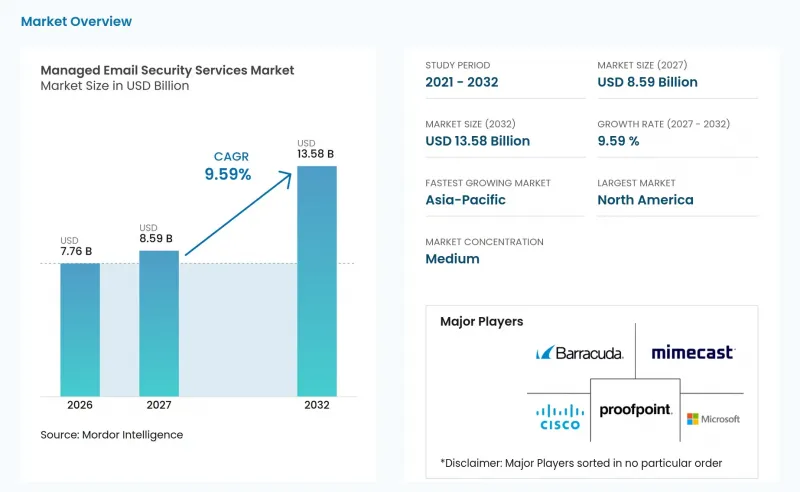
According to Mordor Intelligence, the managed email security services market size is USD 7.76 billion in 2026 and is forecast to reach USD 13.58 billion by 2032, growing at a CAGR of 9.59% from 2027 to 2032.
Global Managed Email Security Services Market Trends and Insights
Rising Phishing, Business Email Compromise, and Ransomware Incidents
Microsoft detected 7.6 billion email-based phishing threats during the second quarter of 2026, showing the scale of exposure that sustains demand in the managed email security services market. An automated BEC campaign reached more than 67,000 users across 42,000 organizations in under 3 hours on June 1, which reduced the time available for manual intervention. The FBI reported USD 3 billion in BEC losses during 2025 and recorded 3,611 ransomware complaints. The same FBI report identified 63 new ransomware variants, adding pressure on organizations to improve detection and response. These patterns favor managed operations that can investigate alerts continuously and coordinate containment when campaigns move quickly. The managed email security services market benefits from managed coverage, which can reduce the burden on internal teams during high-volume incidents.
Accelerating Cloud Email and Hybrid Work Adoption
Cloud productivity suites have made email security more dependent on direct integration with tenant environments. Microsoft reported that its protection removed 70.8% of malicious emails after delivery between November 2025 and January 2026, while integrated cloud email security partners contributed the remaining 29.2% of post-delivery removals. That gap supports services that connect to Microsoft 365 and Google Workspace via APIs and respond across tenants. Kaspersky recorded email-client threats on 2.76% of industrial control system computers in the fourth quarter of 2025. Hybrid work can also link routine business communications with industrial and operational environments. The managed email security services market, therefore, has opportunities for providers that apply consistent controls across email, collaboration, and distributed workforces.
High Total Cost of Ownership for Layered Email Security Stacks
Layered security stacks can increase total costs due to multiple licenses, overlapping tools, integration work, and operational oversight. TitanHQ found that organizations commonly use at least 2 email security solutions because native Microsoft 365 capabilities do not address every threat category. This can make the managed email security services market more attractive when providers consolidate gateway inspection, API-based detection, and remediation into a single service. Poorly configured systems can also create false positives that absorb analyst time. The cost issue is strongest for mid-market organizations with limited budgets and smaller security teams. Buyers may favor integrated platforms when the operational savings offset the cost of replacing separate point products.
Other drivers and restraints analyzed in the detailed report include:
- Increasing Email Authentication and Cybersecurity Compliance Requirements
- AI-Enabled Detection and Automated Incident Response Adoption
- Shortage of Email Security Operations and Threat-Hunting Skills
For complete list of drivers and restraints, kindly check the Table Of Contents.
Segment Analysis
Solutions accounted for 62.97% of managed email security services market revenue in 2026, supported by cloud-native detection engines, policy management consoles, and DMARC reporting platforms that buyers typically obtain through subscription arrangements. These platforms now extend beyond traditional secure email gateways, connecting directly to Microsoft 365 and Google Workspace via API-based, integrated cloud email security architectures. Direct integration avoids MX-record rerouting, which can delay detection and introduce an unnecessary point of failure in the path used for business communications. It also enables a provider to remove a malicious message after delivery across a tenant, which is harder to achieve with a conventional appliance-only approach. Solutions, therefore, remain the technical base for policy enforcement, threat detection, reporting, and the managed workflows that customers adopt around them.
Services are projected to expand at a CAGR of 10.86% through 2032, the fastest component rate, as organizations add managed detection and response and phishing simulation programs to their installed technology. These contracts provide ongoing monitoring and established response processes, rather than relying only on periodic software renewals and internal staff availability. Recurring service relationships can create stronger switching barriers because the provider develops knowledge of a customer's domains, users, mail flows, policies, and escalation requirements. Proofpoint completed its acquisition of Hornetsecurity in 2025 to extend its managed-service presence in the MSP and SMB channel. The managed email security services industry is therefore becoming more dependent on a combined product and operational service model.
Policy Enforcement and Optimization held 24.93% of service-type revenue in 2026 because multi-domain organizations need continuous management of DMARC, DKIM, and SPF settings across business units, partners, and external senders. Maintaining those controls requires ongoing configuration, testing, exception management, and evidence that mail is being authenticated in line with changing policy requirements. Financial institutions and organizations with complex supplier ecosystems often face the greatest burden, as they must maintain trusted mail flows while meeting internal and external compliance expectations. Managed providers can convert that work into a standing service that includes monitoring, configuration updates, documentation, and practical guidance for internal teams. The category can also open the way for broader managed protection because authentication reviews frequently reveal gaps in monitoring, incident response, and third-party sender control.
Security Awareness and Phishing Resilience is projected to expand at a CAGR of 10.63% through 2032, reflecting the continued importance of employee behavior in preventing account compromise and fraudulent payments. Barracuda found that phishing represented 48% of malicious email activity in its 2026 report. It also reported that 90% of high-volume phishing campaigns used phishing-as-a-service kits, making sophisticated methods available to a wider group of attackers. Managed programs can update training and simulations in response to current techniques, connect employee reports to security operations, and identify groups requiring additional support. The managed email security services market also includes monitoring, threat detection, authentication, encryption, data-loss prevention, archiving, and continuity services that providers increasingly package within coordinated agreements.
Complete Report Scope:
- By Component
- Solutions
- Services
- By Service Type
- Managed Monitoring and Reporting
- Policy Enforcement and Optimization
- Threat Detection and Incident Response
- Managed Authentication and Compliance
- Email Encryption and Data Loss Prevention
- Email Archiving and Continuity
- Security Awareness and Phishing Resilience
- By Deployment Mode
- Cloud-Based
- On-Premises
- Hybrid
- By Organization Size
- Small and Medium Enterprises
- Large Enterprises
- By End-User Industry
- Information Technology and Telecommunications
- BFSI
- Healthcare
- Retail and E-Commerce
- Manufacturing
- Government and Defense
- Education
- Energy and Utilities
- Other End-User Industries
- By Geography
- North America
- United States
- Canada
- Mexico
- South America
- Brazil
- Argentina
- Rest of South America
- Europe
- Germany
- United Kingdom
- France
- Italy
- Spain
- Russia
- Rest of Europe
- Asia-Pacific
- China
- India
- Japan
- South Korea
- Australia
- Rest of Asia-Pacific
- Middle East
- Saudi Arabia
- United Arab Emirates
- Turkey
- Rest of Middle East
- Africa
- South Africa
- Egypt
- Nigeria
- Rest of Africa
- North America
Geography Analysis
North America accounted for 38.74% of revenue in 2026, the largest share of the managed email security services market by geography. The region combines a large base of enterprise technology buyers with extensive security and procurement requirements. CISA Binding Operational Directive 25-01 strengthens secure cloud practices for federal civilian agencies, while a DFARS rule published in September 2025 advanced cybersecurity implementation requirements for covered defense contractors. These standards can influence suppliers and other organizations that support public-sector customers. Canada and Mexico also drive demand through enterprise modernization and security practices aligned with recognized frameworks.
Asia-Pacific is projected to expand at a CAGR of 10.23% through 2032. The managed email security services market is supported by expanding digital services, growing BFSI activity, and strengthening national security requirements. India's financial sector is a material opportunity because security controls, data localization, and incident reporting obligations require dependable operational processes. IRONSCALES expanded its presence in Asia-Pacific and Japan in 2025 and added data centers to support regional performance and data residency needs. The region's SME and MSP channels can favor providers that offer simple multi-tenant operations. China has distinct requirements for encryption and cross-border data handling, which can support localized service models.
Europe has substantial demand through Germany, the UK, and France, where privacy requirements sit alongside cyber protection obligations, and the CNIL issued a recommendation on email tracking pixels in May 2026. This environment can favor providers that offer clear retention controls and transparent handling of employee data. South America is led by Brazil and Argentina, where enterprise digitization is expanding the need for managed security. The Middle East, especially Saudi Arabia and the UAE, and Africa, led by South Africa and Egypt, are growing from a lower base as digital infrastructure investment and cybersecurity requirements advance.
- Proofpoint, Inc.
- Mimecast Limited
- Microsoft Corporation
- Cisco Systems, Inc.
- Barracuda Networks, Inc.
- Broadcom Inc.
- Google LLC
- Fortinet, Inc.
- Sophos Limited
- Trend Micro Incorporated
- Check Point Software Technologies Ltd.
- IRONSCALES, Inc.
- Abnormal Security Corporation
- Darktrace Holdings plc
- Fortra LLC
- Cofense Inc.
- OpenText Corporation
- Trustwave Holdings, Inc.
- Retarus GmbH
- Valimail, Inc.
- EasyDMARC Inc.
Additional Benefits:
- The market estimate (ME) sheet in Excel format
- 3 months of analyst support
TABLE OF CONTENTS
1 INTRODUCTION
- 1.1 Study Assumptions and Market Definition
- 1.2 Scope of the Study
2 RESEARCH METHODOLOGY
3 EXECUTIVE SUMMARY
4 MARKET LANDSCAPE
- 4.1 Market Overview
- 4.2 Impact of Macroeconomic Factors on the Market
- 4.3 Market Drivers
- 4.3.1 Rising Phishing, Business Email Compromise, and Ransomware Incidents
- 4.3.2 Accelerating Cloud Email and Hybrid Work Adoption
- 4.3.3 Increasing Email Authentication and Cybersecurity Compliance Requirements
- 4.3.4 AI-Enabled Detection and Automated Incident Response Adoption
- 4.3.5 Multi-Tenant AI Operations for Small and Medium-Sized Enterprises
- 4.3.6 Post-Delivery Visibility Gaps Across Email and Collaboration Platforms
- 4.4 Market Restraints
- 4.4.1 High Total Cost of Ownership for Layered Email Security Stacks
- 4.4.2 Shortage of Email Security Operations and Threat-Hunting Skills
- 4.4.3 API Throttling and Telemetry Access Constraints in Cloud Mail Platforms
- 4.4.4 Privacy and Employee-Trust Concerns From Behavioral Email Inspection
- 4.5 Industry Value Chain Analysis
- 4.6 Regulatory Landscape
- 4.7 Technological Outlook
- 4.8 Porter's Five Forces Analysis
- 4.8.1 Bargaining Power of Suppliers
- 4.8.2 Bargaining Power of Buyers
- 4.8.3 Threat of New Entrants
- 4.8.4 Threat of Substitutes
- 4.8.5 Competitive Rivalry
5 MARKET SIZE AND GROWTH FORECASTS (VALUE)
- 5.1 By Component
- 5.1.1 Solutions
- 5.1.2 Services
- 5.2 By Service Type
- 5.2.1 Managed Monitoring and Reporting
- 5.2.2 Policy Enforcement and Optimization
- 5.2.3 Threat Detection and Incident Response
- 5.2.4 Managed Authentication and Compliance
- 5.2.5 Email Encryption and Data Loss Prevention
- 5.2.6 Email Archiving and Continuity
- 5.2.7 Security Awareness and Phishing Resilience
- 5.3 By Deployment Mode
- 5.3.1 Cloud-Based
- 5.3.2 On-Premises
- 5.3.3 Hybrid
- 5.4 By Organization Size
- 5.4.1 Small and Medium Enterprises
- 5.4.2 Large Enterprises
- 5.5 By End-User Industry
- 5.5.1 Information Technology and Telecommunications
- 5.5.2 BFSI
- 5.5.3 Healthcare
- 5.5.4 Retail and E-Commerce
- 5.5.5 Manufacturing
- 5.5.6 Government and Defense
- 5.5.7 Education
- 5.5.8 Energy and Utilities
- 5.5.9 Other End-User Industries
- 5.6 By Geography
- 5.6.1 North America
- 5.6.1.1 United States
- 5.6.1.2 Canada
- 5.6.1.3 Mexico
- 5.6.2 South America
- 5.6.2.1 Brazil
- 5.6.2.2 Argentina
- 5.6.2.3 Rest of South America
- 5.6.3 Europe
- 5.6.3.1 Germany
- 5.6.3.2 United Kingdom
- 5.6.3.3 France
- 5.6.3.4 Italy
- 5.6.3.5 Spain
- 5.6.3.6 Russia
- 5.6.3.7 Rest of Europe
- 5.6.4 Asia-Pacific
- 5.6.4.1 China
- 5.6.4.2 India
- 5.6.4.3 Japan
- 5.6.4.4 South Korea
- 5.6.4.5 Australia
- 5.6.4.6 Rest of Asia-Pacific
- 5.6.5 Middle East
- 5.6.5.1 Saudi Arabia
- 5.6.5.2 United Arab Emirates
- 5.6.5.3 Turkey
- 5.6.5.4 Rest of Middle East
- 5.6.6 Africa
- 5.6.6.1 South Africa
- 5.6.6.2 Egypt
- 5.6.6.3 Nigeria
- 5.6.6.4 Rest of Africa
- 5.6.1 North America
6 COMPETITIVE LANDSCAPE
- 6.1 Market Concentration
- 6.2 Strategic Moves
- 6.3 Market Share Analysis
- 6.4 Company Profiles (includes Global Level Overview, Market Level Overview, Core Segments, Financials as available, Strategic Information, Market Rank/Share, Products and Services, Recent Developments)
- 6.4.1 Proofpoint, Inc.
- 6.4.2 Mimecast Limited
- 6.4.3 Microsoft Corporation
- 6.4.4 Cisco Systems, Inc.
- 6.4.5 Barracuda Networks, Inc.
- 6.4.6 Broadcom Inc.
- 6.4.7 Google LLC
- 6.4.8 Fortinet, Inc.
- 6.4.9 Sophos Limited
- 6.4.10 Trend Micro Incorporated
- 6.4.11 Check Point Software Technologies Ltd.
- 6.4.12 IRONSCALES, Inc.
- 6.4.13 Abnormal Security Corporation
- 6.4.14 Darktrace Holdings plc
- 6.4.15 Fortra LLC
- 6.4.16 Cofense Inc.
- 6.4.17 OpenText Corporation
- 6.4.18 Trustwave Holdings, Inc.
- 6.4.19 Retarus GmbH
- 6.4.20 Valimail, Inc.
- 6.4.21 EasyDMARC Inc.
7 MARKET OPPORTUNITIES AND FUTURE OUTLOOK
- 7.1 White-Space and Unmet-Need Assessment

