PUBLISHER: Mordor Intelligence | PRODUCT CODE: 2194788

PUBLISHER: Mordor Intelligence | PRODUCT CODE: 2194788
India Snacks - Market Share Analysis, Industry Trends & Statistics, Growth Forecasts (2027 - 2032)
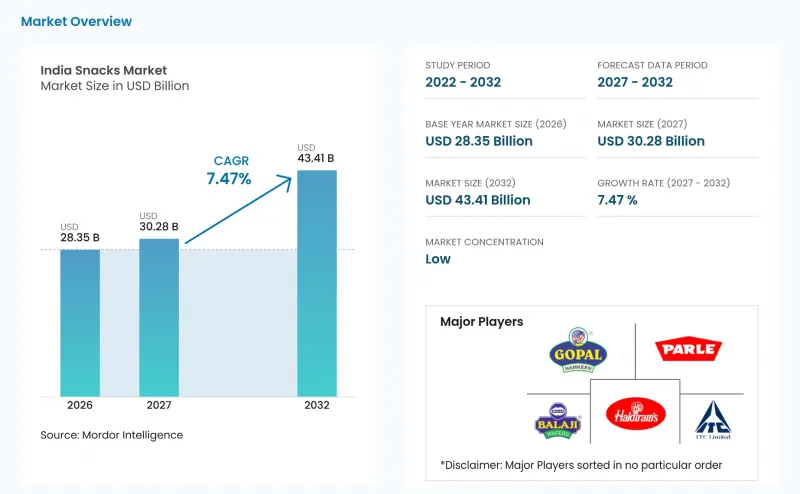
According to Mordor Intelligence, the India snacks market is projected to expand from USD 28.35 billion in 2026 and USD 30.28 billion in 2027 to USD 43.41 billion by 2032, registering a CAGR of 7.47% between 2027 and 2032.
India Snacks Market Trends and Insights
Changing Consumer Lifestyles and Demand for Convenient Foods
According to the United Nations' World Urbanization Prospects 2025, India's urban population reached 35.7% in 2025, creating more situations where packaged food serves as a practical meal supplement. Household structures, dual-income families, and longer travel times support routine purchases of portable snack products. The India snacks market benefits when consumers need accessible products during travel, work breaks, and short household shopping trips. Quick-commerce services make these purchases easier by placing familiar products within rapid delivery windows. This channel favors products with clear brand recognition, small packs, and regular repeat demand.
Growing Popularity of Traditional Indian Savory Snacks
Traditional savory snacks continue to anchor consumption because namkeen, bhujia, mathri, and related formats fit established eating habits. Their relevance extends beyond routine snacking because they are also used for hosting, gifting, and seasonal occasions. The India snacks market retains a broad base through products that can be sold in small, familiar, affordable packs. Premium regional versions can sit beside mass products without changing the underlying preference for local flavors. This allows manufacturers to offer both everyday products and higher-value assortments through overlapping retail channels.
Health Concerns Associated with Highly Processed Snacks
Health awareness may constrain demand for snacks containing high levels of sodium, fat, or highly processed ingredients. The proposed Indian Nutrition Rating system could also influence purchasing decisions if mandatory front-of-pack labeling requirements are finalized. The framework under consideration would assign products ratings ranging from 0.5 to 5 stars based on their nutritional composition. If implemented, manufacturers may need to reformulate products, modify packaging, and revise product claims to comply with the requirements. Such adjustments could pose greater challenges for smaller regional manufacturers with limited product-development capabilities. Consequently, the India snacks market must balance consumer preference for familiar fried snacks with evolving expectations around healthier food choices.
Other drivers and restraints analyzed in the detailed report include:
- Increasing Consumer Interest in Health-Oriented Snack Alternatives
- Expansion of Organized Retail and Modern Distribution Networks
- Fluctuating Edible Oil and Energy Costs
For complete list of drivers and restraints, kindly check the Table Of Contents.
Segment Analysis
Savory snacks accounted for 36.46% of the India snacks market share in 2026. Namkeen, chips, and bhujia benefit from broad availability across rural stores, urban outlets, and formal retail. Familiar flavors, small serving sizes, gifting traditions, and household sharing support regular demand across income groups. USD 0.01 to USD 0.11 price points remain important for immediate-consumption products. Strong local manufacturing and regional flavor adaptation protect the category's leading position.
Frozen snacks are forecast to grow at a 9.18% CAGR from 2027 to 2032. Wider cold-chain capacity and quick-commerce services support demand for ready-to-cook products. ITC invested USD 13.76 million for a 43.75% stake in Ample Foods, gaining access to the Prasuma and Meatigo brands. Extruded, confectionery, bakery, fruit, and meat snacks occupy distinct positions within the category. Companies can combine steady savory volume with faster-growing frozen products and smaller specialized formats.
Conventional ingredients held 67.52% of the India snacks market share in 2026. They support mainstream products that rely on large-scale manufacturing and accessible price points. Shoppers are paying closer attention to preservatives, palm oil, and synthetic additives. This creates an opportunity for clean-label ranges without displacing conventional formats. Ingredient choices affect product claims, packaging language, and consumer positioning.
Organic and clean-label ingredients are forecast to grow at a 9.27% CAGR from 2027 to 2032. Farmley reported that 55% of consumers seek preservative-free snacks and 52% prefer resealable, environmentally conscious packaging. E-commerce requirements make accurate product descriptions and physical-label alignment more important. Clear product distinctions can help companies serve both value-focused and health-focused buyers.
Complete Report Scope:
- Product Type
- Frozen Snacks
- Savory Snacks
- Extruded Snacks
- Fruit Snacks
- Confectionery Snacks
- Bakery Snacks
- Meat Snacks
- Other Type Snacks
- Ingredient Type
- Conventional
- Organic/Clean-Label
- Packaging Type
- Bags/Pouches
- Cans
- Jars and Tubs
- Others
- Distribution Channels
- Supermarkets/Hypermarkets
- Convenience Stores
- Online Retail Stores
- Other Distribution Channels
List of Companies Covered in this Report:
- Haldiram Snacks Food Pvt. Ltd.
- PepsiCo Inc.
- Balaji Wafers Private Limited
- ITC Limited
- Bikaji Foods International Limited
- Prataap Snacks Limited
- Gopal Snacks Limited
- DFM Foods Limited
- Bikanervala Foods Private Limited
- Parle Products Private Limited
- Sundrop Brands Limited
- MTR Foods Private Limited
- ADF Foods Limited
- Gopal Namkeens
- Laxmi Snacks Private Limited
- Garden Snacks
- Greendot Health Foods Pvt. Ltd. (Cornitos)
- Guiltfree Industries Ltd (Too Yumm)
- Farmley
- The Whole Truth Foods
- Makino
- Chheda Specialities Foods Pvt. Ltd.
Additional Benefits:
- The market estimate (ME) sheet in Excel format
- 3 months of analyst support
TABLE OF CONTENTS
1 INTRODUCTION
- 1.1 Study Assumptions and Market Definition
- 1.2 Scope of the Study
2 RESEARCH METHODOLOGY
3 EXECUTIVE SUMMARY
4 MARKET LANDSCAPE
- 4.1 Market Overview
- 4.2 Market Drivers
- 4.2.1 Changing consumer lifestyles and demand for convenient foods
- 4.2.2 Growing popularity of traditional Indian savory snacks
- 4.2.3 Product innovation across flavors, ingredients, and formats
- 4.2.4 Increasing consumer interest in health-oriented snack alternatives
- 4.2.5 Expansion of organized retail and modern distribution networks
- 4.2.6 Strong seasonal, festive, and gifting demand
- 4.3 Market Restraints
- 4.3.1 Health concerns associated with highly processed snacks
- 4.3.2 Competition from freshly prepared and homemade snacks
- 4.3.3 Fluctuating edible oil and energy costs
- 4.3.4 Price sensitivity and limited scope for premium pricing
- 4.4 Consumer Behavior Analysis
- 4.5 Regulatory Landscape
- 4.6 Technological Outlook
- 4.7 Porter's Five Forces Analysis
- 4.7.1 Bargaining Power of Suppliers
- 4.7.2 Bargaining Power of Buyers
- 4.7.3 Threat of New Entrants
- 4.7.4 Threat of Substitutes
- 4.7.5 Competitive Rivalry
5 MARKET SIZE AND GROWTH FORECASTS (VALUE)
- 5.1 Product Type
- 5.1.1 Frozen Snacks
- 5.1.2 Savory Snacks
- 5.1.3 Extruded Snacks
- 5.1.4 Fruit Snacks
- 5.1.5 Confectionery Snacks
- 5.1.6 Bakery Snacks
- 5.1.7 Meat Snacks
- 5.1.8 Other Type Snacks
- 5.2 Ingredient Type
- 5.2.1 Conventional
- 5.2.2 Organic/Clean-Label
- 5.3 Packaging Type
- 5.3.1 Bags/Pouches
- 5.3.2 Cans
- 5.3.3 Jars and Tubs
- 5.3.4 Others
- 5.4 Distribution Channels
- 5.4.1 Supermarkets/Hypermarkets
- 5.4.2 Convenience Stores
- 5.4.3 Online Retail Stores
- 5.4.4 Other Distribution Channels
6 COMPETITIVE LANDSCAPE
- 6.1 Market Concentration
- 6.2 Strategic Moves
- 6.3 Market Share Analysis
- 6.4 Company Profiles (Includes Global-level Overview, Market-level Overview, Core Segments, Financials, Strategic Info, Market Rank/Share, Products and Services, Recent Developments)
- 6.4.1 Haldiram Snacks Food Pvt. Ltd.
- 6.4.2 PepsiCo Inc.
- 6.4.3 Balaji Wafers Private Limited
- 6.4.4 ITC Limited
- 6.4.5 Bikaji Foods International Limited
- 6.4.6 Prataap Snacks Limited
- 6.4.7 Gopal Snacks Limited
- 6.4.8 DFM Foods Limited
- 6.4.9 Bikanervala Foods Private Limited
- 6.4.10 Parle Products Private Limited
- 6.4.11 Sundrop Brands Limited
- 6.4.12 MTR Foods Private Limited
- 6.4.13 ADF Foods Limited
- 6.4.14 Gopal Namkeens
- 6.4.15 Laxmi Snacks Private Limited
- 6.4.16 Garden Snacks
- 6.4.17 Greendot Health Foods Pvt. Ltd. (Cornitos)
- 6.4.18 Guiltfree Industries Ltd (Too Yumm)
- 6.4.19 Farmley
- 6.4.20 The Whole Truth Foods
- 6.4.21 Makino
- 6.4.22 Chheda Specialities Foods Pvt. Ltd.
7 MARKET OPPORTUNITIES AND FUTURE OUTLOOK

