PUBLISHER: Mordor Intelligence | PRODUCT CODE: 2194812

PUBLISHER: Mordor Intelligence | PRODUCT CODE: 2194812
North America Energy Retrofit Tools - Market Share Analysis, Industry Trends & Statistics, Growth Forecasts (2027 - 2032)
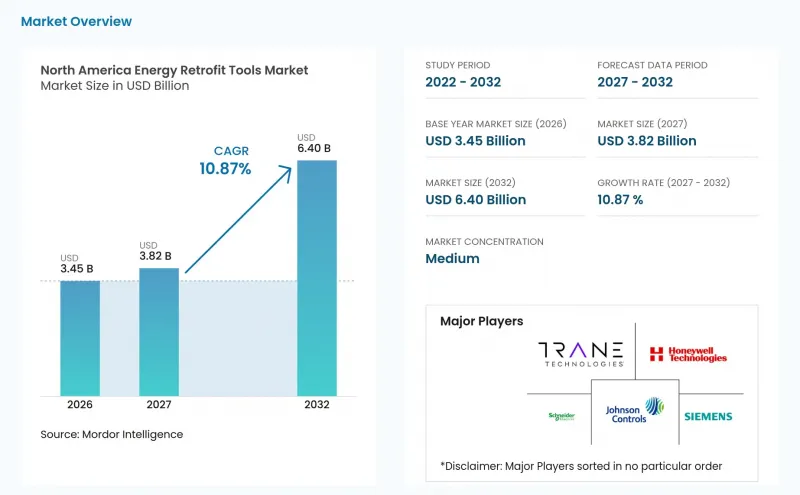
According to Mordor Intelligence, the North America energy retrofit tools market size is expected to grow from USD 3.45 billion in 2026 to USD 3.82 billion in 2027 and is forecast to reach USD 6.40 billion by 2032 at 10.87% CAGR over 2027-2032.
North America Energy Retrofit Tools Market Trends and Insights
Retrofit Incentives and Building Performance Standards
The North America energy retrofit tools market gains a clear demand signal when building rules require owners to establish an energy baseline and submit verified performance records. The U.S. Department of Energy states that Home Energy Rebates support home energy upgrades, and the associated program structure relies on documented assessments and modeled savings. The Building Performance Association notes that state rebate programs use qualified professionals and program requirements, which places assessment capability at the start of the customer journey. In Canada, the International Energy Agency reported Ontario's USD 7.6 billion, 12-year efficiency commitment and Hydro-Quebec's USD 7 billion, 10-year efficiency strategy. These programs make assessment, measurement, and reporting tools more relevant before equipment is selected. The North America energy retrofit tools market therefore benefits from recurring compliance tasks rather than only from one-time construction projects.
Aging Building Stock and HVAC Electrification
Aging heating and cooling equipment keeps the North America energy retrofit tools market tied to replacement cycles, but the work increasingly requires a detailed view of existing conditions. Legacy systems often lack complete sensor histories, so contractors need tools that can establish a credible pre-retrofit baseline from limited data. Trane Technologies completed its acquisition of BrainBox AI in January 2025, bringing autonomous HVAC controls and building analytics into its portfolio. The acquisition shows how equipment providers are seeking more control over diagnostics, operating data, and ongoing optimization. Refrigerant transitions and electrification also add commissioning work because replacement equipment must be sized, configured, and verified within an occupied building. The North America energy retrofit tools market can therefore serve both the planning stage and the post-installation validation stage of HVAC work.
High Upfront Capital Requirements and Long Payback Periods
High initial costs can delay comprehensive retrofits, especially for mid-sized owners without dedicated sustainability budgets. Performance contracts reduce this barrier, but they often require detailed audits, measurement plans, and savings documentation before financing is approved. Ameresco secured a USD 197 million Energy Savings Performance Contract with the U.S. Naval Research Laboratory in October 2025 for infrastructure modernization. Ameresco and CRC Innovations also announced a contract exceeding USD 200 million for capital improvements at 3 U.S. Army locations in February 2025. These examples show that financing structures can enable larger projects, although smaller owners may still struggle to fund the assessment and planning work required at the outset. Long payback periods can also discourage projects in locations with lower energy costs or uncertain ownership timelines.
Other drivers and restraints analyzed in the detailed report include:
- Rising Energy Costs and Corporate Decarbonization Commitments
- Artificial Intelligence and Predictive Building Analytics
- Shortage of Qualified Auditors, Integrators, and Commissioning Personnel
For complete list of drivers and restraints, kindly check the Table Of Contents.
Segment Analysis
Energy Audit and Assessment Tools held 24.6% of the 2026 market, reflecting the need to assess existing conditions before an owner selects a retrofit measure. This gives the North America energy retrofit tools market a dependable base in compliance-driven assessment work. Smart Building Analytics and Energy Management Platforms are forecast to grow at 14.4% CAGR through 2032, the fastest rate among tool types, because they continue to measure performance after an audit. Johnson Controls International plc launched Metasys 16.0 in June 2026 with integrated views of peak load, energy use, indoor air quality, and emissions. The company said ASHRAE Guideline 36 sequences in the system can produce up to 30% energy savings.
Building energy modeling software and HVAC diagnostic and commissioning tools remain important where owners need a calibrated plan before work begins. Envelope inspection tools help ensure that mechanical upgrades are not undermined by overlooked building-fabric issues, while renewable energy tools support projects combining solar, storage, and electric vehicle charging. Eaton's Brightlayer Energy illustrates the movement toward platforms that forecast energy use and monitor emissions from a common interface. Integrated platforms can absorb some standalone audit and measurement functions. The North America energy retrofit tools industry still needs specialized tools that provide reliable project-specific evidence alongside broader software platforms.
Complete Report Scope:
- By Tool Type
- Building Energy Modeling (BEM) Software
- Energy Audit and Assessment Tools
- HVAC Diagnostic and Commissioning Tools
- Building Envelope Inspection Tools
- Smart Building Analytics and Energy Management Platforms
- Renewable Energy Tools
- Other Tools
- By Application
- HVAC Retrofit
- Lighting Retrofit
- Building Envelope Retrofit
- Heating and Cooling Systems
- Water Heating and Service Hot Water
- Electrical Systems and Equipment
- Renewable Energy Integration
- Other Applications
- By Building Type
- Residential Buildings
- Commercial Buildings
- Industrial Buildings
- Institutional Buildings
- Other Building Types
- By Geography
- United States
- Canada
- Mexico
List of Companies Covered in this Report:
- Johnson Controls International plc
- Schneider Electric SE
- Siemens AG
- Honeywell International Inc.
- Ameresco, Inc.
- Trane Technologies plc
- Daikin Industries, Ltd.
- Carrier Global Corporation
- ABB Ltd.
- Eaton Corporation plc
- ENGIE SA
- AECOM
- Mitsubishi Electric Corporation
- Emerson Electric Co.
- Signify N.V.
- Danfoss A/S
- Veolia
- Kingspan Group plc
- ROCKWOOL A/S
- Orion Energy Systems, Inc.
Additional Benefits:
- The market estimate (ME) sheet in Excel format
- 3 months of analyst support
TABLE OF CONTENTS
1 INTRODUCTION
- 1.1 Study Assumptions and Market Definition
- 1.2 Scope of the Study
2 RESEARCH METHODOLOGY
3 EXECUTIVE SUMMARY
4 MARKET LANDSCAPE
- 4.1 Market Overview
- 4.2 Market Drivers
- 4.2.1 Retrofit Incentives and Building Performance Standards
- 4.2.2 Aging Building Stock and HVAC Electrification
- 4.2.3 Rising Energy Costs and Corporate Decarbonization Commitments
- 4.2.4 Artificial Intelligence and Predictive Building Analytics
- 4.2.5 Legacy-System Interoperability Enables Phased Retrofit Programs
- 4.2.6 Automated Rebate Qualification and Measurement Documentation
- 4.3 Market Restraints
- 4.3.1 High Upfront Capital Requirements and Long Payback Periods
- 4.3.2 Shortage of Qualified Auditors, Integrators, and Commissioning Personnel
- 4.3.3 Model-to-Measurement Liability and Savings-Guarantee Risk
- 4.3.4 Occupied-Building Disruption and Fragmented Data Governance
- 4.4 Supply-Chain Analysis
- 4.5 Porter's Five Forces Analysis
- 4.5.1 Bargaining Power of Suppliers
- 4.5.2 Bargaining Power of Buyers
- 4.5.3 Threat of New Entrants
- 4.5.4 Threat of Substitutes
- 4.5.5 Competitive Rivalry
- 4.6 Technology Outlook
- 4.7 Regulatory Landscape
- 4.8 Investment Analysis
5 MARKET SIZE AND GROWTH FORECASTS
- 5.1 By Tool Type
- 5.1.1 Building Energy Modeling (BEM) Software
- 5.1.2 Energy Audit and Assessment Tools
- 5.1.3 HVAC Diagnostic and Commissioning Tools
- 5.1.4 Building Envelope Inspection Tools
- 5.1.5 Smart Building Analytics and Energy Management Platforms
- 5.1.6 Renewable Energy Tools
- 5.1.7 Other Tools
- 5.2 By Application
- 5.2.1 HVAC Retrofit
- 5.2.2 Lighting Retrofit
- 5.2.3 Building Envelope Retrofit
- 5.2.4 Heating and Cooling Systems
- 5.2.5 Water Heating and Service Hot Water
- 5.2.6 Electrical Systems and Equipment
- 5.2.7 Renewable Energy Integration
- 5.2.8 Other Applications
- 5.3 By Building Type
- 5.3.1 Residential Buildings
- 5.3.2 Commercial Buildings
- 5.3.3 Industrial Buildings
- 5.3.4 Institutional Buildings
- 5.3.5 Other Building Types
- 5.4 By Geography
- 5.4.1 United States
- 5.4.2 Canada
- 5.4.3 Mexico
6 COMPETITIVE LANDSCAPE
- 6.1 Market Concentration
- 6.2 Strategic Moves
- 6.3 Market Share Analysis
- 6.4 Company Profiles (includes Global Level Overview, Market Level Overview, Core Segments, Financials as available, Strategic Information, Market Rank/Share, Products and Services, Recent Developments)
- 6.4.1 Johnson Controls International plc
- 6.4.2 Schneider Electric SE
- 6.4.3 Siemens AG
- 6.4.4 Honeywell International Inc.
- 6.4.5 Ameresco, Inc.
- 6.4.6 Trane Technologies plc
- 6.4.7 Daikin Industries, Ltd.
- 6.4.8 Carrier Global Corporation
- 6.4.9 ABB Ltd.
- 6.4.10 Eaton Corporation plc
- 6.4.11 ENGIE SA
- 6.4.12 AECOM
- 6.4.13 Mitsubishi Electric Corporation
- 6.4.14 Emerson Electric Co.
- 6.4.15 Signify N.V.
- 6.4.16 Danfoss A/S
- 6.4.17 Veolia
- 6.4.18 Kingspan Group plc
- 6.4.19 ROCKWOOL A/S
- 6.4.20 Orion Energy Systems, Inc.
7 MARKET OPPORTUNITIES AND FUTURE OUTLOOK
- 7.1 White-Space and Unmet-Need Assessment

