PUBLISHER: Mordor Intelligence | PRODUCT CODE: 2194845

PUBLISHER: Mordor Intelligence | PRODUCT CODE: 2194845
Managed DNS Traffic Management and Failover Services - Market Share Analysis, Industry Trends & Statistics, Growth Forecasts (2027 - 2032)
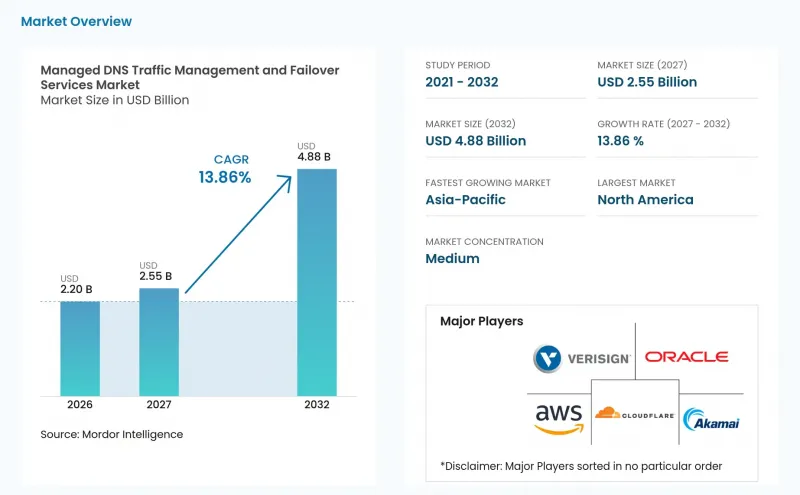
According to Mordor Intelligence, the managed DNS traffic management and failover services market size is projected to expand from USD 2.20 billion in 2026 and USD 2.55 billion in 2027 to USD 4.88 billion by 2032, registering a CAGR of 13.86% between 2027 and 2032.
Global Managed DNS Traffic Management and Failover Services Market Trends and Insights
Cloud-Native Application Proliferation
Cloud-native deployment is making DNS a service dependency inside production applications, not only a perimeter network function. The Cloud Native Computing Foundation reported that 98% of surveyed organizations use cloud-native techniques, with container use in production at 56% and Kubernetes use in 82% of containerized environments. CoreDNS was in production in 76% of those environments, which places DNS directly in the operating path of containerized workloads and supports service discovery, workload communication, and access to distributed application components. A routing error can affect the service path even when computing resources remain available. The managed DNS traffic management and failover services market benefits when enterprises need policy-based routing, cross-region failover, service-level commitments, and a common view of traffic rules beyond in-cluster DNS. The same shift increases the value of reporting and governance features for organizations that must document security controls for containerized software.
Rising DNS Query Volumes From IoT and Edge Computing
Internet of Things devices place a different load on the DNS infrastructure than conventional enterprise endpoints. Research presented through the ACM DNS workshop found that individual smart devices generate repeated DNS requests and that many devices show gaps in recommended DNS security practices. Some devices do not follow expected time-to-live behavior or retain fixed resolver settings, which can make standard enterprise DNS operating practices less effective for large fleets of connected equipment. Edge computing adds more locations where applications resolve names and leaves less time for a failed lookup to be corrected. The conditions favor anycast networks that can answer requests closer to the endpoint and support adaptive time-to-live settings with routing policies designed for different device classes. The managed DNS traffic management and failover services market gains relevance as connected equipment requires reliable name resolution outside centralized data centers, while providers can differentiate by identifying unusual device behavior before it results in service disruption.
Legacy On-Premises DNS Sunk Costs
Large enterprises can delay migration because they have already invested in BIND server clusters, proprietary DNS appliances, and on-premises DDI platforms. A transition also requires parallel operations, staff training, change management, testing, and a detailed map of existing zones, internal dependencies, access rights, and recovery procedures. Teams must decide which records can move first and which systems need to remain under local control. Internal depreciation schedules can extend migration decisions by 2-4 years in capital-intensive organizations, particularly in North America and Western Europe, where established enterprises often operate large installed bases. The managed DNS traffic management and failover services market faces a slower early adoption cycle among these buyers. Demand can shift toward the later years of the forecast period as assets are retired and providers support phased migration and hybrid operation.
Other drivers and restraints analyzed in the detailed report include:
- Expansion of Multi-CDN and Multi-Cloud Architectures
- Escalating DNS-Focused DDoS and Availability Threats
- IPv6, DNSSEC, and Hybrid DNS Operational Complexity
For complete list of drivers and restraints, kindly check the Table Of Contents.
Segment Analysis
DNS Traffic Management and Global Server Load Balancing held 32.67% of the managed DNS traffic management and failover services market share in 2026. The segment serves enterprises that need a single authoritative response to direct traffic among several active destinations. This requirement is common in multi-CDN and multi-cloud environments, where applications must distribute traffic according to geography, latency, capacity, or service health. Buyers pay for these capabilities because they link DNS operations directly to availability and performance outcomes. Managed Authoritative DNS, Managed Secondary DNS, and DNS Failover and Disaster Recovery remain important adjacent services. Failover is increasingly procured with traffic management because organizations need the same provider to detect health issues and change routing quickly.
Dynamic DNS and Specialized DNS Services is projected to expand at a 14.98% CAGR from 2027 to 2032. The service is relevant for edge deployments, connected devices, and workloads that create or move resources faster than static zone management can accommodate. The ACM research on Internet of Things DNS behavior supports the need for services that can handle recurring requests and device-specific DNS conditions. Providers are adapting dynamic DNS through time-to-live policies and routing rules that reflect device behavior. Within the managed DNS traffic management and failover services industry, dynamic DNS can increasingly be sold as part of a premium traffic management capability rather than as a separate basic function. That approach can raise service value without requiring a similar increase in the number of managed domains.
Cloud-based deployment accounted for 69.27% of the managed DNS traffic management and failover services market size in 2026. Distributed anycast infrastructure gives cloud services the geographic reach required for low-latency resolution and resilient traffic steering. Building a comparable on-premises footprint requires substantial investment in colocation, network capacity, operations staff, and security controls. Cloud delivery also aligns DNS management with application workloads that are already moving across cloud platforms. Cloud-based deployment is projected to expand at a 15.30% CAGR through 2032. API-first architectures support this movement because they allow DNS changes to be integrated into infrastructure-as-code workflows.
On-premises deployment remains relevant for defense contractors, central banks, and critical infrastructure operators that cannot route DNS requests through third-party systems. These organizations can have security, sovereignty, or regulatory requirements that limit the use of externally managed resolvers. Hybrid deployment offers a transitional path by extending cloud-based traffic management to on-premises authoritative DNS. Amazon Route 53 Global Resolver reached general availability in March 2026 with unified public and private DNS resolution and support for DNS-over-HTTPS and DNS-over-TLS. The product shows how large providers are combining public and private DNS functions within one operating model. This can reduce the operational case for maintaining separate on-premises DNS estates over time.
Complete Report Scope:
- By Service Type
- Managed Authoritative DNS
- Managed Secondary DNS
- DNS Traffic Management and Global Server Load Balancing
- DNS Failover and Disaster Recovery
- Dynamic DNS and Specialized DNS Services
- Other Service Types
- By Deployment Model
- Cloud-Based
- On-Premises
- Hybrid
- By Organization Size
- Large Enterprises
- Small and Medium-Sized Enterprises
- By Application
- Cloud and SaaS Applications
- E-Commerce and Digital Platforms
- Content Delivery Networks
- Enterprise Networks and Hybrid IT
- Mobile Applications
- Other Applications
- By End-User Industry
- IT and Telecommunications
- BFSI
- Retail and E-Commerce
- Media and Entertainment
- Healthcare and Life Sciences
- Government and Public Sector
- Other End-User Industries
- By Geography
- North America
- United States
- Canada
- Mexico
- South America
- Brazil
- Argentina
- Rest of South America
- Europe
- Germany
- United Kingdom
- France
- Italy
- Rest of Europe
- Asia-Pacific
- China
- Japan
- India
- South Korea
- Rest of Asia-Pacific
- Middle East
- United Arab Emirates
- Saudi Arabia
- Rest of Middle East
- Africa
- South Africa
- Nigeria
- Rest of Africa
- North America
Geography Analysis
North America held 38.91% of the managed DNS traffic management and failover services market share in 2026. The region benefits from high cloud provider density, mature enterprise technology spending, and public-sector demand for protective DNS. CISA's Protective DNS Resolver Service supported more than 104 federal civilian executive branch agencies and processed an average of 1.6 billion queries each day. This scale reinforces the importance of resilient, monitored DNS for government services. Amazon also made Route 53 public authoritative DNS generally available in AWS GovCloud regions during April 2025, giving government customers a DNSSEC-enabled public DNS service within that environment. AWS. South America has a smaller base, with Brazil and Argentina acting as key enterprise buyers. Infrastructure gaps and uneven regulatory conditions can limit the region's pace compared with more mature markets.
Europe is shaped by data residency expectations and security requirements for critical infrastructure. The United Kingdom's National Cyber Security Center entered a new Protective DNS delivery partnership with Cloudflare in 2024. The NCSC also published guidance on protective DNS for the private sector in August 2026. These measures support commercial interest in protective DNS capabilities that can meet public-sector and private-sector security needs. Germany, the United Kingdom, and France remain the largest European buyers. The Middle East is also adding demand through sovereign cloud and data center investment tied to Saudi Vision 2030 and the UAE Digital Economy Strategy.
Asia-Pacific is projected to expand at a 16.28% CAGR between 2027 and 2032. China requires authoritative DNS services that can support enterprise Internet of Things networks and digital payment platforms within sovereign boundaries. India's digital payments ecosystem and Digital India cloud mandates also support demand for managed DNS at scale. Japan and South Korea require low-latency resolution for advanced manufacturing digitization and edge AI deployments. The managed DNS traffic management and failover services market has a strong regional opportunity where government digital programs and private platforms both need reliable national and cross-border operations. Africa remains at an earlier stage, with South Africa and Nigeria forming initial demand centers. Data center investment can support wider adoption after 2028 as enterprise digital infrastructure becomes more established.
- Amazon Web Services, Inc.
- Cloudflare, Inc.
- Akamai Technologies, Inc.
- Microsoft Corporation
- Google LLC
- Oracle Corporation
- International Business Machines Corporation
- GoDaddy Inc.
- Verisign, Inc.
- Vercara, LLC
- Neustar Security Services, LLC
- Tiggee LLC
- Constellix LLC
- Infoblox Inc.
- DNSimple Corporation
- No-IP, Inc.
- CDNetworks Co., Ltd.
- EfficientIP SAS
- BlueCat Networks (USA) Inc.
- Alibaba Cloud Computing Ltd.
Additional Benefits:
- The market estimate (ME) sheet in Excel format
- 3 months of analyst support
TABLE OF CONTENTS
1 INTRODUCTION
- 1.1 Study Assumptions and Market Definition
- 1.2 Scope of the Study
2 RESEARCH METHODOLOGY
3 EXECUTIVE SUMMARY
4 MARKET LANDSCAPE
- 4.1 Market Overview
- 4.2 Market Drivers
- 4.2.1 Cloud-Native Application Proliferation
- 4.2.2 Rising DNS Query Volumes From IoT and Edge Computing
- 4.2.3 Expansion of Multi-CDN and Multi-Cloud Architectures
- 4.2.4 Escalating DNS-Focused DDoS and Availability Threats
- 4.2.5 Government Adoption of Protective DNS Programs
- 4.2.6 API-First DNS Automation and Infrastructure-as-Code Adoption
- 4.3 Market Restraints
- 4.3.1 Legacy On-Premises DNS Sunk Costs
- 4.3.2 IPv6, DNSSEC, and Hybrid DNS Operational Complexity
- 4.3.3 Price Commoditization of Basic Authoritative DNS
- 4.3.4 Third-Party Control-Plane Concentration and Sovereignty Conflicts
- 4.4 Industry Value Chain Analysis
- 4.5 Regulatory Landscape
- 4.6 Technological Outlook
- 4.7 Porter's Five Forces Analysis
- 4.7.1 Bargaining Power of Suppliers
- 4.7.2 Bargaining Power of Buyers
- 4.7.3 Threat of New Entrants
- 4.7.4 Threat of Substitutes
- 4.7.5 Competitive Rivalry
- 4.8 Impact of Macroeconomic Factors on the Market
5 MARKET SIZE AND GROWTH FORECASTS (VALUE)
- 5.1 By Service Type
- 5.1.1 Managed Authoritative DNS
- 5.1.2 Managed Secondary DNS
- 5.1.3 DNS Traffic Management and Global Server Load Balancing
- 5.1.4 DNS Failover and Disaster Recovery
- 5.1.5 Dynamic DNS and Specialized DNS Services
- 5.1.6 Other Service Types
- 5.2 By Deployment Model
- 5.2.1 Cloud-Based
- 5.2.2 On-Premises
- 5.2.3 Hybrid
- 5.3 By Organization Size
- 5.3.1 Large Enterprises
- 5.3.2 Small and Medium-Sized Enterprises
- 5.4 By Application
- 5.4.1 Cloud and SaaS Applications
- 5.4.2 E-Commerce and Digital Platforms
- 5.4.3 Content Delivery Networks
- 5.4.4 Enterprise Networks and Hybrid IT
- 5.4.5 Mobile Applications
- 5.4.6 Other Applications
- 5.5 By End-User Industry
- 5.5.1 IT and Telecommunications
- 5.5.2 BFSI
- 5.5.3 Retail and E-Commerce
- 5.5.4 Media and Entertainment
- 5.5.5 Healthcare and Life Sciences
- 5.5.6 Government and Public Sector
- 5.5.7 Other End-User Industries
- 5.6 By Geography
- 5.6.1 North America
- 5.6.1.1 United States
- 5.6.1.2 Canada
- 5.6.1.3 Mexico
- 5.6.2 South America
- 5.6.2.1 Brazil
- 5.6.2.2 Argentina
- 5.6.2.3 Rest of South America
- 5.6.3 Europe
- 5.6.3.1 Germany
- 5.6.3.2 United Kingdom
- 5.6.3.3 France
- 5.6.3.4 Italy
- 5.6.3.5 Rest of Europe
- 5.6.4 Asia-Pacific
- 5.6.4.1 China
- 5.6.4.2 Japan
- 5.6.4.3 India
- 5.6.4.4 South Korea
- 5.6.4.5 Rest of Asia-Pacific
- 5.6.5 Middle East
- 5.6.5.1 United Arab Emirates
- 5.6.5.2 Saudi Arabia
- 5.6.5.3 Rest of Middle East
- 5.6.6 Africa
- 5.6.6.1 South Africa
- 5.6.6.2 Nigeria
- 5.6.6.3 Rest of Africa
- 5.6.1 North America
6 COMPETITIVE LANDSCAPE
- 6.1 Market Concentration
- 6.2 Strategic Moves
- 6.3 Market Share Analysis
- 6.4 Company Profiles (includes Global Level Overview, Market Level Overview, Core Segments, Financials as available, Strategic Information, Market Rank/Share, Products and Services, Recent Developments)
- 6.4.1 Amazon Web Services, Inc.
- 6.4.2 Cloudflare, Inc.
- 6.4.3 Akamai Technologies, Inc.
- 6.4.4 Microsoft Corporation
- 6.4.5 Google LLC
- 6.4.6 Oracle Corporation
- 6.4.7 International Business Machines Corporation
- 6.4.8 GoDaddy Inc.
- 6.4.9 Verisign, Inc.
- 6.4.10 Vercara, LLC
- 6.4.11 Neustar Security Services, LLC
- 6.4.12 Tiggee LLC
- 6.4.13 Constellix LLC
- 6.4.14 Infoblox Inc.
- 6.4.15 DNSimple Corporation
- 6.4.16 No-IP, Inc.
- 6.4.17 CDNetworks Co., Ltd.
- 6.4.18 EfficientIP SAS
- 6.4.19 BlueCat Networks (USA) Inc.
- 6.4.20 Alibaba Cloud Computing Ltd.
7 MARKET OPPORTUNITIES AND FUTURE OUTLOOK
- 7.1 White-Space and Unmet-Need Assessment
- 7.2 Future Outlook, 2027-2032

