PUBLISHER: Mordor Intelligence | PRODUCT CODE: 2194867

PUBLISHER: Mordor Intelligence | PRODUCT CODE: 2194867
Managed Browser Security Services - Market Share Analysis, Industry Trends & Statistics, Growth Forecasts (2027 - 2032)
According to Mordor Intelligence, the managed browser security services market size is projected to expand from USD 1.86 billion in 2026 and USD 2.39 billion in 2027 to USD 5.58 billion by 2032, registering a CAGR of 18.48% between 2027 to 2032.
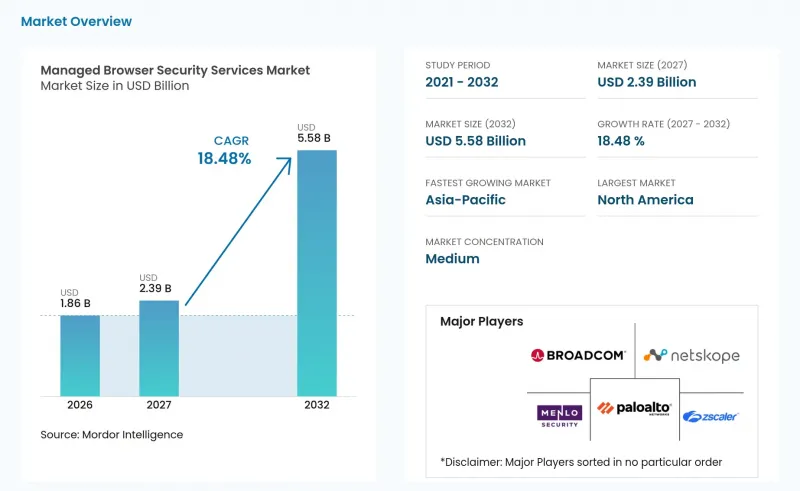
Global Managed Browser Security Services Market Trends and Insights
Escalating Browser-Borne Threats and Phishing-as-a-Service
The managed browser security services market is responding to phishing campaigns designed to avoid conventional detection methods. Menlo Security reported 115,842 evasive phishing campaigns in its first-quarter 2026 enterprise telemetry and found that 1 in 5 phishing links clicked by users went undetected by legacy URL filtering. Group-IB reported that Tycoon 2FA represented 44.5% of global credential-theft attacks in 2025 and 89% of the adversary-in-the-middle phishing-as-a-service category. Remote rendering and file disarm approaches can prevent untrusted web content from running on a user's device. This execution-level protection matters because session attacks may leave few file or process indicators for endpoint tools to inspect.
Permanent Hybrid Work and Unmanaged-Device Exposure
The managed browser security services market benefits from work models that extend access beyond corporate-managed endpoints. Session-layer controls can apply data-loss prevention and access policies without requiring the organization to own the device. This makes the model relevant for contractors, temporary staff, mergers, and bring-your-own-device use cases. The finding indicates that some Asia-Pacific demand is also linked to changes in access infrastructure, not only to higher threat exposure.
Application Compatibility and User Experience Friction
Application compatibility remains an immediate limit on broader deployment in the managed browser security services market. Remote rendering can add latency and may affect web applications that rely on WebSockets, WebRTC, or productivity extensions. Palo Alto Networks noted that extension-based controls cannot validate device posture and may inherit the operating system's trust from a compromised endpoint. These constraints make architecture selection important for organizations with complex workflows. Security teams must show that policy controls do not interfere with critical applications or create workarounds. Google's Manifest V3 changes also limit how browser extensions intercept traffic, which can reduce the scope of some extension-led controls.
Other drivers and restraints analyzed in the detailed report include:
- Zero Trust, NIS2, DORA, and Sector-Specific Compliance
- Browser Security Bundling Into SSE and SASE Platforms
- Data Residency and Cross-Border Processing Constraints
For complete list of drivers and restraints, kindly check the Table Of Contents.
Segment Analysis
Managed Remote Browser Isolation held 27.93% of the managed browser security services market share in 2026. Its position reflects a long record of deployment in regulated industries, where isolating untrusted content is considered a necessary control. In this model, web content runs in a remote container rather than on the endpoint. That separation reduces the risk that active code reaches a corporate device. Financial services and public-sector users can value the clear control boundary during audits. The service also supports access from devices that the organization does not directly manage.
Managed Enterprise Browser is projected to grow at a 19.11% CAGR through 2032. The category embeds controls into the browser runtime rather than placing them only around the browser. This design can apply policy to content, downloads, identity activity, and data movement during the session. Zscaler introduced Browser Detection and Response in October 2026, describing coverage for more than 90 client-side attack types across websites, files, extensions, identity, and clipboard activity. Managed Browser Security Extension and Managed Browser DLP and Data Protection services remain lighter options for organizations that do not require full isolation. Managed Browser Threat Detection and Response addresses activity that network controls may not identify once it occurs inside a browser session.
Remote Browser Isolation accounted for 32.22% of the managed browser security services market share in 2026. Its core advantage is that active web code does not run on the enterprise endpoint. This is useful in environments where device trust cannot be assumed. The architecture provides direct control for high-risk browsing, unknown sites, and unmanaged device access. Organizations can apply it broadly or reserve it for higher-risk destinations and users. Browser-native extension or agent models and hybrid designs support buyers who require a lower-overhead approach.
Dedicated Enterprise Browser is expected to grow at a 19.46% CAGR through 2032. The architecture shifts policy enforcement from an added layer to a control plane that is built into the browser experience. Hybrid browser security can isolate selected content while allowing trusted software-as-a-service traffic to continue through a standard workflow. This adoption indicates sustained interest in financial services with detailed browser controls. It also shows why providers are investing in reporting and controls that fit regulated access workflows.
Complete Report Scope:
- By Service Type
- Managed Remote Browser Isolation
- Managed Enterprise Browser
- Managed Browser Security Extension
- Managed Browser DLP and Data Protection
- Managed Browser Threat Detection and Response
- By Security Architecture
- Remote Browser Isolation
- Browser-Native Extension or Agent
- Dedicated Enterprise Browser
- Hybrid Browser Security
- By Deployment Mode
- Cloud-Based
- On-Premises
- Hybrid
- By Organization Size
- Small and Medium Enterprises
- Large Enterprises
- By End-User Industry
- Information Technology and Telecommunications
- BFSI
- Healthcare
- Retail and E-Commerce
- Manufacturing
- Government and Defense
- Education
- Energy and Utilities
- Other End-User Industries
- By Geography
- North America
- United States
- Canada
- Mexico
- South America
- Brazil
- Argentina
- Rest of South America
- Europe
- Germany
- United Kingdom
- France
- Italy
- Spain
- Russia
- Rest of Europe
- Asia-Pacific
- China
- India
- Japan
- South Korea
- Australia
- Rest of Asia-Pacific
- Middle East
- Saudi Arabia
- United Arab Emirates
- Turkey
- Rest of Middle East
- Africa
- South Africa
- Egypt
- Nigeria
- Rest of Africa
- North America
Geography Analysis
North America held 47.21% of the managed browser security services market share in 2026. The region benefits from the presence of SSE and enterprise browser providers and from early adoption among large enterprises. The US federal Zero Trust Architecture direction under Executive Order 14028 supports stronger access-control practices. SecurityWeek reported that US cybersecurity job postings declined 26.4% in the first 3 quarters of 2026 compared with the same period in 2025. This labor change can encourage buyers to use managed services for specialized capabilities. Canadian financial services and government users also support regional demand through privacy and security obligations.
Europe is the second-largest region in the managed browser security services market. NIS2 and DORA create structured requirements across Germany, the UK, France, and Italy. ENISA's 2025 technical guidance sets out cybersecurity risk management measures relevant to entities operating under NIS2. SANS reported in 2026 that 95% of surveyed organizations saw regulatory directives affecting hiring, up from 40% in 2025. The same report found that 27% had experienced breaches linked to workforce skills gaps. VirtualBrowser raised USD 6.5 million, in May 2026 to support research, development, and European expansion.
Asia-Pacific is projected to grow at a 19.37% CAGR through 2032. Cloud adoption, changing access infrastructure, and growing threat exposure support demand across China, India, South Korea, and Australia. Regional demand also benefits from enterprise digitalization efforts that increase browser use for core operations. It shows that demand can arise from changes to legacy access systems as well as from new security concerns. Cyber-insurance requirements may further encourage organizations to apply stronger controls over browser-based access.
- Zscaler, Inc.
- Palo Alto Networks, Inc.
- Netskope, Inc.
- Menlo Security, Inc.
- Broadcom Inc.
- Cloudflare, Inc.
- Forcepoint LLC
- iboss, Inc.
- Check Point Software Technologies Ltd.
- Proofpoint, Inc.
- Citrix Systems, Inc.
- Fortinet, Inc.
- Island Technology, Inc.
- Authentic8, Inc.
- Seraphic Security, Inc.
- Akamai Technologies, Inc.
- Google LLC
- Microsoft Corporation
- Kasm Technologies, Inc.
Additional Benefits:
- The market estimate (ME) sheet in Excel format
- 3 months of analyst support
TABLE OF CONTENTS
1 INTRODUCTION
- 1.1 Study Assumptions and Market Definition
- 1.2 Scope of the Study
2 RESEARCH METHODOLOGY
3 EXECUTIVE SUMMARY
4 MARKET LANDSCAPE
- 4.1 Market Overview
- 4.2 Impact of Macroeconomic Factors on the Market
- 4.3 Market Drivers
- 4.3.1 Escalating Browser-Borne Threats and Phishing-as-a-Service
- 4.3.2 Permanent Hybrid Work and Unmanaged-Device Exposure
- 4.3.3 Zero Trust, NIS2, DORA, and Sector-Specific Compliance
- 4.3.4 Browser Security Bundling Into SSE and SASE Platforms
- 4.3.5 Managed-Service Demand From Cybersecurity Talent Shortages
- 4.3.6 AI-Agent and GenAI Browser Governance Requirements
- 4.4 Market Restraints
- 4.4.1 Application Compatibility and User-Experience Friction
- 4.4.2 Data Residency and Cross-Border Processing Constraints
- 4.4.3 Budget Pressure and Unclear Standalone ROI
- 4.4.4 Browser Ecosystem Dependence and Platform Substitution
- 4.5 Industry Value Chain Analysis
- 4.6 Regulatory Landscape
- 4.7 Technological Outlook
- 4.8 Porter's Five Forces Analysis
- 4.8.1 Bargaining Power of Suppliers
- 4.8.2 Bargaining Power of Buyers
- 4.8.3 Threat of New Entrants
- 4.8.4 Threat of Substitutes
- 4.8.5 Competitive Rivalry
5 MARKET SIZE AND GROWTH FORECASTS (VALUE)
- 5.1 By Service Type
- 5.1.1 Managed Remote Browser Isolation
- 5.1.2 Managed Enterprise Browser
- 5.1.3 Managed Browser Security Extension
- 5.1.4 Managed Browser DLP and Data Protection
- 5.1.5 Managed Browser Threat Detection and Response
- 5.2 By Security Architecture
- 5.2.1 Remote Browser Isolation
- 5.2.2 Browser-Native Extension or Agent
- 5.2.3 Dedicated Enterprise Browser
- 5.2.4 Hybrid Browser Security
- 5.3 By Deployment Mode
- 5.3.1 Cloud-Based
- 5.3.2 On-Premises
- 5.3.3 Hybrid
- 5.4 By Organization Size
- 5.4.1 Small and Medium Enterprises
- 5.4.2 Large Enterprises
- 5.5 By End-User Industry
- 5.5.1 Information Technology and Telecommunications
- 5.5.2 BFSI
- 5.5.3 Healthcare
- 5.5.4 Retail and E-Commerce
- 5.5.5 Manufacturing
- 5.5.6 Government and Defense
- 5.5.7 Education
- 5.5.8 Energy and Utilities
- 5.5.9 Other End-User Industries
- 5.6 By Geography
- 5.6.1 North America
- 5.6.1.1 United States
- 5.6.1.2 Canada
- 5.6.1.3 Mexico
- 5.6.2 South America
- 5.6.2.1 Brazil
- 5.6.2.2 Argentina
- 5.6.2.3 Rest of South America
- 5.6.3 Europe
- 5.6.3.1 Germany
- 5.6.3.2 United Kingdom
- 5.6.3.3 France
- 5.6.3.4 Italy
- 5.6.3.5 Spain
- 5.6.3.6 Russia
- 5.6.3.7 Rest of Europe
- 5.6.4 Asia-Pacific
- 5.6.4.1 China
- 5.6.4.2 India
- 5.6.4.3 Japan
- 5.6.4.4 South Korea
- 5.6.4.5 Australia
- 5.6.4.6 Rest of Asia-Pacific
- 5.6.5 Middle East
- 5.6.5.1 Saudi Arabia
- 5.6.5.2 United Arab Emirates
- 5.6.5.3 Turkey
- 5.6.5.4 Rest of Middle East
- 5.6.6 Africa
- 5.6.6.1 South Africa
- 5.6.6.2 Egypt
- 5.6.6.3 Nigeria
- 5.6.6.4 Rest of Africa
- 5.6.1 North America
6 COMPETITIVE LANDSCAPE
- 6.1 Market Concentration
- 6.2 Strategic Moves
- 6.3 Market Share Analysis
- 6.4 Company Profiles (includes Global Level Overview, Market Level Overview, Core Segments, Financials as available, Strategic Information, Market Rank/Share, Products and Services, Recent Developments)
- 6.4.1 Zscaler, Inc.
- 6.4.2 Palo Alto Networks, Inc.
- 6.4.3 Netskope, Inc.
- 6.4.4 Menlo Security, Inc.
- 6.4.5 Broadcom Inc.
- 6.4.6 Cloudflare, Inc.
- 6.4.7 Forcepoint LLC
- 6.4.8 iboss, Inc.
- 6.4.9 Check Point Software Technologies Ltd.
- 6.4.10 Proofpoint, Inc.
- 6.4.11 Citrix Systems, Inc.
- 6.4.12 Fortinet, Inc.
- 6.4.13 Island Technology, Inc.
- 6.4.14 Authentic8, Inc.
- 6.4.15 Seraphic Security, Inc.
- 6.4.16 Akamai Technologies, Inc.
- 6.4.17 Google LLC
- 6.4.18 Microsoft Corporation
- 6.4.19 Kasm Technologies, Inc.
7 MARKET OPPORTUNITIES AND FUTURE OUTLOOK
- 7.1 White-Space and Unmet-Need Assessment

