PUBLISHER: Mordor Intelligence | PRODUCT CODE: 2194965

PUBLISHER: Mordor Intelligence | PRODUCT CODE: 2194965
Managed API Security Services - Market Share Analysis, Industry Trends & Statistics, Growth Forecasts (2027 - 2032)
According to Mordor Intelligence, the managed API security services market size is projected to expand from USD 2.18 billion in 2026 and USD 2.57 billion in 2027 to USD 5.43 billion by 2032, registering a CAGR of 16.14% between 2027 to 2032.
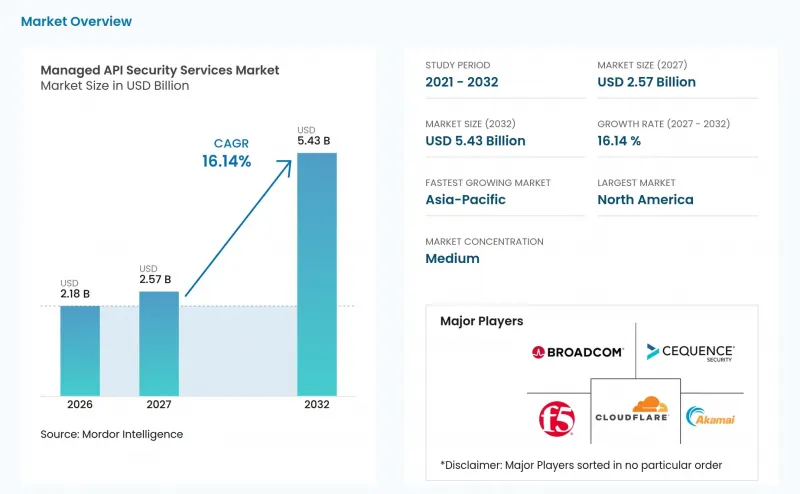
Global Managed API Security Services Market Trends and Insights
Rising API Exposure Across Cloud-Native and Microservices Architectures
Cloud-native adoption has changed how organizations must secure application traffic, because microservices exchange data through many distributed interfaces. Many security tools were designed for monolithic applications and have limited visibility into stateless interactions during runtime. Managed providers can maintain discovery tools, behavioral baselines, and threat intelligence across client environments. NIST's 2025 guidance sets out a risk-based approach for API protection before deployment and during runtime. Unregistered endpoints remain a material weakness, making continuous discovery a practical requirement for the managed API security services market.
Expansion of AI Agents and LLM-Based API Workloads
AI agents make repeated authenticated API calls that many conventional controls do not recognize as a distinct operational pattern. Palo Alto Networks stated that each AI model query or agentic workflow call creates API activity that needs appropriate visibility and governance. Wallarm recorded 439 AI-related CVEs in 2025, with 99% directly linked to APIs through flaws such as injection, misconfiguration, and memory corruption. A compromised agent can move through several services through prompt injection or tool misuse without exceeding volume-based detection thresholds. Salt Security introduced its Agentic Security Platform in March 2026 to provide discovery and governance across LLMs, MCP servers, and APIs. These requirements favor managed teams that can continuously baseline agent behavior and investigate deviations, thereby supporting the managed API security services market.
Data Sovereignty and Cross-Border Monitoring Constraints
Data sovereignty rules can limit centralized monitoring for organizations operating in several jurisdictions. China, India, Russia, and some Gulf states impose data localization requirements that can restrict transfers of API logs, behavioral telemetry, and threat intelligence. The GDPR also limits transfers of personal data to security operations centers in third countries. Managed providers may need local infrastructure or regional operating centers, which can reduce the visibility available to shared threat-correlation systems. Sovereign deployment options can address part of the issue, but they also increase operating costs and can slow expansion. This restraint shapes how the managed API security services market develops in regulated cross-border environments.
Other drivers and restraints analyzed in the detailed report include:
- Escalating Business-Logic Abuse and API Fraud
- Tightening Privacy, Financial-Services, and AI Regulations
- High Integration Complexity Across Legacy and Multi-Cloud Estates
For complete list of drivers and restraints, kindly check the Table Of Contents.
Segment Analysis
Managed Runtime API Protection held 28.43% of revenue in 2026. Enterprises use runtime protection to block anomalous API activity while applications are in production. Payment fraud, account takeover, and data scraping can directly affect revenue and customer trust. That exposure creates demand for operational coverage rather than periodic assessments alone. Akamai launched a managed API security service in June 2025 that combines real-time monitoring with expert response.
Managed API Threat Detection and Response is projected to grow at a 17.63% CAGR from 2027 to 2032. AI agents create authenticated, multistep interactions that often require human interpretation alongside automated detection. Managed discovery and inventory services for organizations that lack a complete view of their endpoints. Managed posture and compliance services support evidence collection and control monitoring. Testing and remediation services also support earlier validation in software development, keeping the managed API security services market aligned with shift-left security practices.
REST APIs accounted for 52.67% of the managed API security services market in 2026. They remain widely used across web services, mobile backends, and cloud microservices. Managed protection tools have broad operational maturity for these API patterns. Their installed base gives providers a large source of recurring monitoring and protection work. REST environments still require continuous discovery because endpoint inventories can change rapidly.
GraphQL APIs are projected to grow at a 17.34% CAGR from 2027 to 2032. Their flexible query model can create layered authorization issues and query-depth denial-of-service risks. Protection for SOAP and legacy APIs remains relevant for financial institutions with older core systems. gRPC and event-driven API protection also offer scope for the managed API security services market as performance-sensitive microservices programs expand.
Complete Report Scope:
- By Service Type
- Managed API Discovery and Inventory
- Managed API Posture and Compliance
- Managed Runtime API Protection
- Managed API Threat Detection and Response
- Managed API Security Testing and Remediation
- Managed API Security Advisory and Implementation
- By Architecture Type
- REST APIs
- GraphQL APIs
- SOAP and Legacy APIs
- gRPC and Event-Driven APIs
- Other Architecture Types
- By Deployment Model
- On-Premises
- Cloud-Based
- Hybrid
- By Organization Size
- Small and Medium Enterprises
- Large Enterprises
- By End-User Industry
- Information Technology and Telecommunications
- BFSI
- Healthcare
- Retail and E-Commerce
- Manufacturing
- Government and Defense
- Other End-User Industries
- By Geography
- North America
- United States
- Canada
- Mexico
- South America
- Brazil
- Argentina
- Rest of South America
- Europe
- Germany
- United Kingdom
- France
- Italy
- Spain
- Russia
- Rest of Europe
- Asia-Pacific
- China
- India
- Japan
- South Korea
- Australia
- Rest of Asia-Pacific
- Middle East
- Saudi Arabia
- United Arab Emirates
- Turkey
- Rest of Middle East
- Africa
- South Africa
- Egypt
- Nigeria
- Rest of Africa
- North America
Geography Analysis
North America held 41.87% of the managed API security services market share in 2026. The region combines regulated financial institutions, technology enterprises, and federal agencies that face overlapping security requirements. The U.S. Securities and Exchange Commission's cybersecurity disclosure rules require registrants to disclose material cybersecurity incidents within 4 business days after determining that an incident is material. This has increased board-level attention to continuous monitoring capabilities. Canada and Mexico add demand shaped by proximity to U.S. compliance standards and shared cloud infrastructure.
Europe is the second-largest region in the managed API security services market. Germany, the United Kingdom, and France lead spending because they have significant financial services activity and digital government programs. Buyers often prioritize auditability and documented operational control alongside detection outcomes. Spain, Italy, and Russia represent secondary growth opportunities in the source material. South America, led by Brazil and Argentina, is adding demand as digital banking and open finance programs increase API exposure.
Asia-Pacific is projected to expand at a 17.19% CAGR from 2027 to 2032. India's Account Aggregator framework, Australia's Consumer Data Right expansion, and the Monetary Authority of Singapore's Technology Risk Management guidelines are driving stronger API security requirements in digital financial systems. Cequence Security announced an NTT DOCOMO deployment in August 2026, showing that managed API security engagements are expanding in Japan. The Middle East and Africa offer longer-term opportunity as government digitization programs expand API use under national cybersecurity frameworks in the managed API security services market.
- Akamai Technologies, Inc.
- Broadcom Inc.
- Cequence Security, Inc.
- Cloudflare, Inc.
- F5, Inc.
- Fastly, Inc.
- Google LLC
- Imperva, Inc.
- Inspira Enterprise, Inc.
- International Business Machines Corporation
- Kong Inc.
- Microsoft Corporation
- Palo Alto Networks, Inc.
- Radware Ltd.
- Salt Security, Inc.
- Salesforce, Inc.
- Thales S.A.
Additional Benefits:
- The market estimate (ME) sheet in Excel format
- 3 months of analyst support
TABLE OF CONTENTS
1 INTRODUCTION
- 1.1 Study Assumptions and Market Definition
- 1.2 Scope of the Study
2 RESEARCH METHODOLOGY
3 EXECUTIVE SUMMARY
4 MARKET LANDSCAPE
- 4.1 Market Overview
- 4.2 Impact of Macroeconomic Factors on the Market
- 4.3 Market Drivers
- 4.3.1 Rising API Exposure Across Cloud-Native and Microservices Architectures
- 4.3.2 Expansion of AI Agents and LLM-Based API Workloads
- 4.3.3 Escalating Business-Logic Abuse and API Fraud
- 4.3.4 Tightening Privacy, Financial-Services, and AI Regulations
- 4.3.5 Shortage of Specialized API Security Talent
- 4.3.6 Demand for Continuous API Discovery and Runtime Monitoring
- 4.4 Market Restraints
- 4.4.1 Data Sovereignty and Cross-Border Monitoring Constraints
- 4.4.2 High Integration Complexity Across Legacy and Multi-Cloud Estates
- 4.4.3 False Positives That Can Disrupt Digital Transactions
- 4.4.4 Unclear Ownership Between Development, Security, and Operations Teams
- 4.5 Industry Value Chain Analysis
- 4.6 Regulatory Landscape
- 4.7 Technological Outlook
- 4.8 Porter's Five Forces Analysis
- 4.8.1 Bargaining Power of Suppliers
- 4.8.2 Bargaining Power of Buyers
- 4.8.3 Threat of New Entrants
- 4.8.4 Threat of Substitutes
- 4.8.5 Competitive Rivalry
5 MARKET SIZE AND GROWTH FORECASTS (VALUE)
- 5.1 By Service Type
- 5.1.1 Managed API Discovery and Inventory
- 5.1.2 Managed API Posture and Compliance
- 5.1.3 Managed Runtime API Protection
- 5.1.4 Managed API Threat Detection and Response
- 5.1.5 Managed API Security Testing and Remediation
- 5.1.6 Managed API Security Advisory and Implementation
- 5.2 By Architecture Type
- 5.2.1 REST APIs
- 5.2.2 GraphQL APIs
- 5.2.3 SOAP and Legacy APIs
- 5.2.4 gRPC and Event-Driven APIs
- 5.2.5 Other Architecture Types
- 5.3 By Deployment Model
- 5.3.1 On-Premises
- 5.3.2 Cloud-Based
- 5.3.3 Hybrid
- 5.4 By Organization Size
- 5.4.1 Small and Medium Enterprises
- 5.4.2 Large Enterprises
- 5.5 By End-User Industry
- 5.5.1 Information Technology and Telecommunications
- 5.5.2 BFSI
- 5.5.3 Healthcare
- 5.5.4 Retail and E-Commerce
- 5.5.5 Manufacturing
- 5.5.6 Government and Defense
- 5.5.7 Other End-User Industries
- 5.6 By Geography
- 5.6.1 North America
- 5.6.1.1 United States
- 5.6.1.2 Canada
- 5.6.1.3 Mexico
- 5.6.2 South America
- 5.6.2.1 Brazil
- 5.6.2.2 Argentina
- 5.6.2.3 Rest of South America
- 5.6.3 Europe
- 5.6.3.1 Germany
- 5.6.3.2 United Kingdom
- 5.6.3.3 France
- 5.6.3.4 Italy
- 5.6.3.5 Spain
- 5.6.3.6 Russia
- 5.6.3.7 Rest of Europe
- 5.6.4 Asia-Pacific
- 5.6.4.1 China
- 5.6.4.2 India
- 5.6.4.3 Japan
- 5.6.4.4 South Korea
- 5.6.4.5 Australia
- 5.6.4.6 Rest of Asia-Pacific
- 5.6.5 Middle East
- 5.6.5.1 Saudi Arabia
- 5.6.5.2 United Arab Emirates
- 5.6.5.3 Turkey
- 5.6.5.4 Rest of Middle East
- 5.6.6 Africa
- 5.6.6.1 South Africa
- 5.6.6.2 Egypt
- 5.6.6.3 Nigeria
- 5.6.6.4 Rest of Africa
- 5.6.1 North America
6 COMPETITIVE LANDSCAPE
- 6.1 Market Concentration
- 6.2 Strategic Moves
- 6.3 Market Share Analysis
- 6.4 Company Profiles (includes Global Level Overview, Market Level Overview, Core Segments, Financials as available, Strategic Information, Market Rank/Share, Products and Services, Recent Developments)
- 6.4.1 Akamai Technologies, Inc.
- 6.4.2 Broadcom Inc.
- 6.4.3 Cequence Security, Inc.
- 6.4.4 Cloudflare, Inc.
- 6.4.5 F5, Inc.
- 6.4.6 Fastly, Inc.
- 6.4.7 Google LLC
- 6.4.8 Imperva, Inc.
- 6.4.9 Inspira Enterprise, Inc.
- 6.4.10 International Business Machines Corporation
- 6.4.11 Kong Inc.
- 6.4.12 Microsoft Corporation
- 6.4.13 Palo Alto Networks, Inc.
- 6.4.14 Radware Ltd.
- 6.4.15 Salt Security, Inc.
- 6.4.16 Salesforce, Inc.
- 6.4.17 Thales S.A.
7 MARKET OPPORTUNITIES AND FUTURE OUTLOOK
- 7.1 White-Space and Unmet-Need Assessment

