PUBLISHER: Mordor Intelligence | PRODUCT CODE: 2195438

PUBLISHER: Mordor Intelligence | PRODUCT CODE: 2195438
Wedding Services - Market Share Analysis, Industry Trends & Statistics, Growth Forecasts (2027 - 2032)
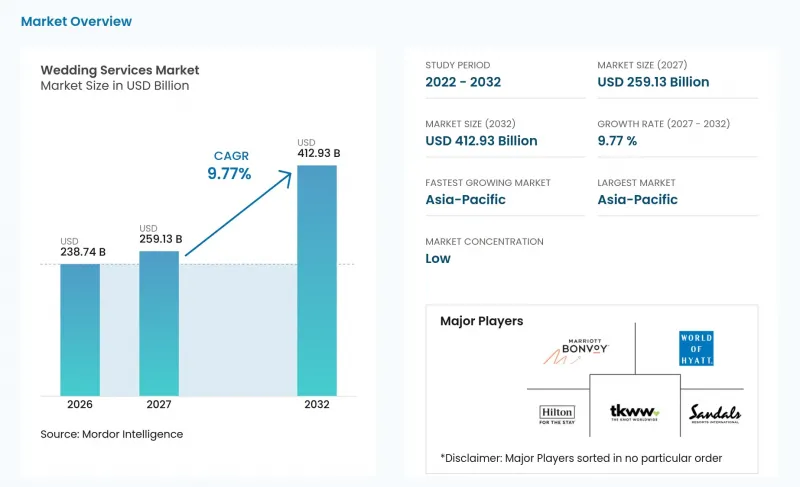
According to Mordor Intelligence, the global wedding services market size was valued at USD 238.74 billion in 2026 and is estimated to grow from USD 259.13 billion in 2027 to reach USD 412.93 billion by 2032, at a CAGR of 9.77% during the forecast period (2027-2032).
Global Wedding Services Market Trends and Insights
Rising Spending on Personalized and Premium Weddings
Personalization is increasing the number and value of services purchased for each celebration in the global wedding services market. In the United States, 77% of couples who adjusted their budgets due to economic pressures increased spending, while three in four considered their 2025 wedding financially worthwhile. Gen Z accounted for 41% of surveyed United States couples and drove demand for original vows, wedding content creators, and locally sourced products, increasing demand for planners, florists, caterers, and photographers. In India, destination wedding budgets averaged INR 58 lakh (USD 65,200) in 2025, and more than 60% of weddings with budgets above INR 1 crore (USD 112,400) took place away from home. This preference supported higher-value hotel packages and bundled vendor services, particularly in Rajasthan, Goa, and other established wedding destinations. Providers that coordinate individualized design choices rather than treating each service as a separate transaction play a broader role in the market.
Expansion of Destination and Multi-Day Weddings
Destination and multi-day wedding formats increase per-event spending on accommodation, food, decor, travel, and logistics. In India, destination weddings accounted for one in four events in 2025, with 89% held within the country. Rajasthan, Himachal Pradesh, and Goa benefit from this trend, as heritage venues and resorts can host multiple functions during a single stay. Italy hosted more than 15,000 weddings involving foreign couples in 2024, generating nearly EUR 1 billion (USD 1.18 billion) in revenue and demonstrating the revenue potential of international celebrations. These formats also require longer planning cycles to coordinate accommodations, transportation, guest schedules, and multiple ceremonies. The global wedding services market benefits from changing venue preferences and the expanded range of billable services associated with destination and multi-day weddings.
Declining Marriage Rates in Mature Markets
Lower marriage rates reduce the number of potential wedding events in mature economies. The European Union's crude marriage rate was 3.9 per 1,000 persons in 2024, compared with 8.0 per 1,000 persons in 1964. The rate declined across 15 European Union countries with available 2024 data. South Korea has also experienced a long-term decline in marriage rates, driven by changing economic conditions and shifts in the relative economic positions of men and women. These trends constrain volume growth for providers that rely on local ceremonies, particularly in Western Europe and East Asia. Higher spending per event can partially offset lower volumes but cannot overcome this demographic constraint.
Other drivers and restraints analyzed in the detailed report include:
- Adoption of Digital and AI-Assisted Wedding Planning
- Increasing Outsourcing of Vendor Coordination to Professionals
- Inflation in Venue, Food, Labor, and Floral Costs
For complete list of drivers and restraints, kindly check the Table Of Contents.
Segment Analysis
Catering Services accounted for 28.73% of the global wedding services market in 2026, making it the largest service category. Food and beverages remain central to the guest experience across wedding formats. In the United States, 85% of couples secured a caterer for their 2025 wedding. Caterers also benefit from multi-day celebrations. Multi-day weddings often require varied menus for different rituals and guest groups, supporting caterers and hotel kitchens. However, food, energy, labor, and imported ingredient costs affect menu design and margins.
Decoration and Floral Services segment is forecast to grow at a 10.73% CAGR through 2032. Social media and content creation drive demand for themed decor, tablescapes, floral installations, and photogenic settings. Photography and Videography Services also benefit from demand for video and short-form content alongside traditional photographs. In Japan, 71% of wedding photographers reported demand for video alongside photography in 2025. Wedding Planning Services benefit from coordination needs, especially for destination events. Transport and other services, including entertainment and stationery, benefit as multi-day formats add functions and guest travel.
Local weddings accounted for 75.93% of category revenue in 2026, as most ceremonies take place near the couple's home location. Guest convenience, family traditions, and lower travel requirements support this share. Local events also drive the adoption of digital booking tools, automated vendor searches, and standardized catering packages. They provide recurring demand across cities and towns, reducing providers' reliance on destination locations. Local weddings remain significant despite increased attention to destination formats. Providers with reliable local vendor networks can serve higher ceremony volumes and offer additional options when budgets permit.
Destination weddings are forecast to grow at a CAGR of 10.93% through 2032, outpacing the broader category. India's average destination wedding budget was INR 58 lakh (USD 65,200) in 2025, compared with an average wedding budget of INR 39.5 lakh (USD 44,400). Higher costs reflect accommodation, travel, multi-day catering, and guest programming. These weddings require stronger vendor coordination because families may organize events away from their home cities. Domestic destinations reduce cross-border travel barriers while allowing hotels and heritage properties to provide immersive event settings.
Complete Report Scope:
- By Service Type
- Catering Services
- Decoration and Floral Services
- Transport Services
- Photography and Videography Services
- Wedding Planning Services
- Other Services
- By Wedding Type
- Local Weddings
- Destination Weddings
- By Booking Mode
- Offline Booking
- Online Booking
- By Planning Model
- Full-Service Planning
- Partial Planning
- Day-of Coordination
- Others
- By Geography
- North America
- United States
- Canada
- Mexico
- South America
- Brazil
- Peru
- Chile
- Argentina
- Rest of South America
- Europe
- United Kingdom
- Germany
- France
- Spain
- Italy
- BENELUX (Belgium, Netherlands, and Luxembourg)
- NORDICS (Denmark, Finland, Iceland, Norway, and Sweden)
- Rest of Europe
- Asia-Pacific
- India
- China
- Japan
- Australia
- South Korea
- South East Asia (Singapore, Malaysia, Thailand, Indonesia, Vietnam, and Philippines)
- Rest of Asia-Pacific
- Middle East and Africa
- United Arab Emirates
- Saudi Arabia
- South Africa
- Nigeria
- Rest of Middle East and Africa
- North America
Geography Analysis
Asia-Pacific accounted for 33.92% of the global wedding services market in 2026 and is projected to grow at an 11.01% CAGR through 2032. High wedding volumes, rising spending, and greater use of professional services support growth. India's wedding economy reached INR 6.5 lakh crore (USD 73.0 billion) in 2025, while average spending increased 8% year over year. Jaipur recorded India's highest average destination wedding budget, at INR 73 lakh (USD 82,000). Hotel expansion in Rajasthan, including Hilton Jaipur Kukas, supports large events.
North America is the second-largest regional market, supported by United States spending and digital planning adoption. The United States recorded nearly 2 million weddings in 2025, with average spending of USD 34,000 per event. Venue costs averaged USD 12,200 in 2024. United States couples drive outbound destination demand, including for Italian venues, while Mexico and Canada support domestic and resort-based events. Europe combines high event spending with destination appeal, despite declining marriage volumes in several countries. Italy hosted over 15,000 foreign-couple weddings in 2024, generating nearly EUR 1 billion (USD 1.18 billion). Tuscany recorded over 3,380 events and EUR 215.2 million (USD 253.14 million) in turnover. South America and the Middle East and Africa are developing markets supported by destination locations and demand for professional coordination. The UAE and Saudi Arabia are expanding destination capabilities, while African cities support formal vendor networks.
- The Knot Worldwide
- Marriott International, Inc.
- Hilton Worldwide Holdings Inc.
- Hyatt Hotels Corporation
- Sandals Resorts International
- Four Seasons Hotels and Resorts
- The Indian Hotels Company Limited
- ITC Hotels Limited
- Weddingz.in
- WedMeGood
- Easy Weddings
- Bridebook
- Peerspace
- Tagvenue
- David Stark Design and Production
- Colin Cowie Lifestyle
- Fallon Carter Events
- David Tutera
- Mindy Weiss Party Consultants
- JZ Events
Additional Benefits:
- The market estimate (ME) sheet in Excel format
- 3 months of analyst support
TABLE OF CONTENTS
1 Introduction
- 1.1 Study Assumptions and Market Definition
- 1.2 Scope of the Study
2 Executive Summary
3 Market Landscape
- 3.1 Market Overview
- 3.2 Market Drivers
- 3.2.1 Rising Spending on Personalized and Premium Weddings
- 3.2.2 Expansion of Destination and Multi-Day Weddings
- 3.2.3 Adoption of Digital and AI-Assisted Wedding Planning
- 3.2.4 Increasing Outsourcing of Vendor Coordination to Professionals
- 3.2.5 Weddings Evolving into Multi-Event Travel Ecosystems
- 3.2.6 Virtual Venue Tours Enabling Cross-Border Booking
- 3.3 Market Restraints
- 3.3.1 Declining Marriage Rates in Mature Markets
- 3.3.2 Inflation in Venue, Food, Labor, and Floral Costs
- 3.3.3 Fragmented Vendor Cancellation and Quality Risk
- 3.3.4 Cross-Border Travel Disruption and Guest Affordability Pressure
- 3.4 Regulatory Landscape
- 3.5 Technological Outlook
- 3.6 Porter's Five Forces Analysis
- 3.6.1 Bargaining Power of Suppliers
- 3.6.2 Bargaining Power of Buyers
- 3.6.3 Threat of New Entrants
- 3.6.4 Threat of Substitutes
- 3.6.5 Competitive Rivalry
4 Service Provider Network & Expansion Intelligence
- 4.1 Existing Wedding Service Provider Network & Geographic Coverage
- 4.2 New Service Launches & Geographic Expansion
5 Wedding Service Market Performance Intelligence
- 5.1 Wedding Service Pricing & Package Analysis
- 5.2 Booking Conversion & Customer Acquisition Costs
6 Consumer Preferences & Spending Patterns
- 6.1 Wedding Service Preferences & Booking Behavior
- 6.2 Wedding Budgets, Service Expenditure & Premium-Service Adoption
7 Market Size & Growth Forecasts (USD, Value)
- 7.1 By Service Type
- 7.1.1 Catering Services
- 7.1.2 Decoration and Floral Services
- 7.1.3 Transport Services
- 7.1.4 Photography and Videography Services
- 7.1.5 Wedding Planning Services
- 7.1.6 Other Services
- 7.2 By Wedding Type
- 7.2.1 Local Weddings
- 7.2.2 Destination Weddings
- 7.3 By Booking Mode
- 7.3.1 Offline Booking
- 7.3.2 Online Booking
- 7.4 By Planning Model
- 7.4.1 Full-Service Planning
- 7.4.2 Partial Planning
- 7.4.3 Day-of Coordination
- 7.4.4 Others
- 7.5 By Geography
- 7.5.1 North America
- 7.5.1.1 United States
- 7.5.1.2 Canada
- 7.5.1.3 Mexico
- 7.5.2 South America
- 7.5.2.1 Brazil
- 7.5.2.2 Peru
- 7.5.2.3 Chile
- 7.5.2.4 Argentina
- 7.5.2.5 Rest of South America
- 7.5.3 Europe
- 7.5.3.1 United Kingdom
- 7.5.3.2 Germany
- 7.5.3.3 France
- 7.5.3.4 Spain
- 7.5.3.5 Italy
- 7.5.3.6 BENELUX (Belgium, Netherlands, and Luxembourg)
- 7.5.3.7 NORDICS (Denmark, Finland, Iceland, Norway, and Sweden)
- 7.5.3.8 Rest of Europe
- 7.5.4 Asia-Pacific
- 7.5.4.1 India
- 7.5.4.2 China
- 7.5.4.3 Japan
- 7.5.4.4 Australia
- 7.5.4.5 South Korea
- 7.5.4.6 South East Asia (Singapore, Malaysia, Thailand, Indonesia, Vietnam, and Philippines)
- 7.5.4.7 Rest of Asia-Pacific
- 7.5.5 Middle East and Africa
- 7.5.5.1 United Arab Emirates
- 7.5.5.2 Saudi Arabia
- 7.5.5.3 South Africa
- 7.5.5.4 Nigeria
- 7.5.5.5 Rest of Middle East and Africa
- 7.5.1 North America
8 North America Market Size & Growth Forecasts (USD, Value) 2022- 2032
- 8.1 By Service Type
- 8.2 By Wedding Type
- 8.3 By Booking Mode
- 8.4 By Planning Model
- 8.5 By Country
9 South America Market Size & Growth Forecasts (USD, Value) 2022- 2032
- 9.1 By Service Type
- 9.2 By Wedding Type
- 9.3 By Booking Mode
- 9.4 By Planning Model
- 9.5 By Country
10 Europe Market Size & Growth Forecasts (USD, Value) 2022- 2032
- 10.1 By Service Type
- 10.2 By Wedding Type
- 10.3 By Booking Mode
- 10.4 By Planning Model
- 10.5 By Country
11 Asia-Pacific Market Size & Growth Forecasts (USD, Value) 2022- 2032
- 11.1 By Service Type
- 11.2 By Wedding Type
- 11.3 By Booking Mode
- 11.4 By Planning Model
- 11.5 By Country
12 Middle East and Africa Market Size & Growth Forecasts (USD, Value) 2022- 2032
- 12.1 By Service Type
- 12.2 By Wedding Type
- 12.3 By Booking Mode
- 12.4 By Planning Model
- 12.5 By Country
13 Competitive Landscape
- 13.1 Market Concentration
- 13.2 Strategic Moves
- 13.3 Market Share Analysis
- 13.4 Company Profiles (includes Global Level Overview, Market Level Overview, Core Segments, Financials as available, Strategic Information, Market Rank/Share, Products and Services, and Recent Developments)
- 13.4.1 The Knot Worldwide
- 13.4.2 Marriott International, Inc.
- 13.4.3 Hilton Worldwide Holdings Inc.
- 13.4.4 Hyatt Hotels Corporation
- 13.4.5 Sandals Resorts International
- 13.4.6 Four Seasons Hotels and Resorts
- 13.4.7 The Indian Hotels Company Limited
- 13.4.8 ITC Hotels Limited
- 13.4.9 Weddingz.in
- 13.4.10 WedMeGood
- 13.4.11 Easy Weddings
- 13.4.12 Bridebook
- 13.4.13 Peerspace
- 13.4.14 Tagvenue
- 13.4.15 David Stark Design and Production
- 13.4.16 Colin Cowie Lifestyle
- 13.4.17 Fallon Carter Events
- 13.4.18 David Tutera
- 13.4.19 Mindy Weiss Party Consultants
- 13.4.20 JZ Events
14 Market Opportunities & Future Outlook
- 14.1 White-Space and Unmet-Need Assessment
- 14.2 Market Opportunities
- 14.2.1 Integrated Destination Wedding and Guest-Travel Platforms
- 14.2.2 AI-Enabled Sustainable Wedding Planning and Vendor Assurance
- 14.3 Future Outlook
15 Research Methodology

