PUBLISHER: Mordor Intelligence | PRODUCT CODE: 2196766

PUBLISHER: Mordor Intelligence | PRODUCT CODE: 2196766
Wedding Planner - Market Share Analysis, Industry Trends & Statistics, Growth Forecasts (2027 - 2032)
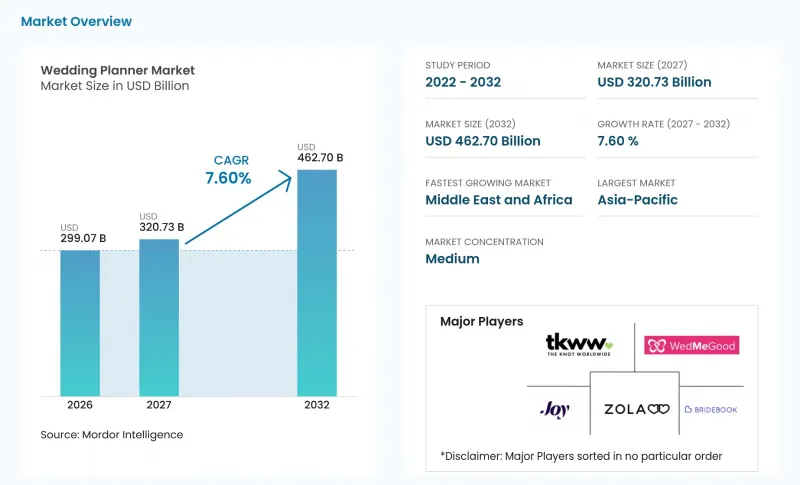
According to Mordor Intelligence, the global wedding planner market size was valued at USD 299.07 billion in 2026 and is estimated to grow from USD 320.73 billion in 2027 to reach USD 462.7 billion by 2032, at a CAGR of 7.60% during the forecast period (2027-2032).
Global Wedding Planner Market Trends and Insights
Demand for Personalized and Experience-Led Celebrations
The global wedding planner market benefits as couples increasingly prioritize personalized ceremonies. The Knot Worldwide reported that 61% of surveyed couples wrote their own vows in 2025. The study also found that 32% incorporated religious, ethnic, or cultural elements, while 28% selected eco-friendly options, increasing demand for specialized vendor networks. These preferences favor planners who understand family expectations, cultural requirements, and sustainable options. WedMeGood reported that destination weddings accounted for one in four Indian weddings in 2025-2026. Couples choosing destination weddings spent INR 58 lakh (USD 0.064 million), compared with INR 39.5 lakh (USD 0.044 million) for local celebrations. This difference reflects additional accommodation, transportation, venue, and guest-management requirements. The market benefits when providers organize personalized, multi-event wedding programs beyond decor or venue commissions.
Growth of Destination and Multi-Day Weddings
Destination and multi-day celebrations increase the operational decisions couples must manage, benefiting the global wedding planner market through greater vendor coordination and tighter scheduling. Italy hosted 15,100 foreign wedding ceremonies in 2024. The number rose to 16,700 in 2025, generating more than EUR 1.1 billion (USD 1.29 billion) in revenue and over 3 million overnight stays, linking planners to tourism demand. India provides a large domestic base, as celebrations often span multiple days. CAIT estimated that 460,000 weddings took place during the 45-day November-December 2025 season, generating INR 6.5 trillion (USD 72.34 billion) in spending. Destination couples spend more than local couples, increasing demand for logistics support. Multi-day weddings require planners to coordinate room blocks, arrivals, ceremony schedules, supplier briefings, and contingency arrangements.
Wedding Budget Inflation and Affordability Pressure
Affordability limits the number of couples that can use comprehensive professional wedding planning services. The Knot Worldwide reported that the average cost of a United States wedding was USD 34,000 in 2025. Per-guest spending reached USD 292, an increase of USD 8 from 2024. The study found that 85% of couples said economic conditions affected their planning decisions. Cost-sensitive couples may reduce the scope of planning services or manage some wedding elements independently. This pressure does not eliminate demand but affects the services couples consider. WeddingWire lists starting fees of USD 800 for day-of coordination and USD 3,000 for full-service planning. Modular offerings can improve access to professional support for couples unable to fund full-service planning. Planners can serve price-sensitive clients by separating essential coordination from optional design services while maintaining execution standards.
Other drivers and restraints analyzed in the detailed report include:
- Adoption of Digital Discovery and Booking Platforms
- Rising Need for Professional Execution Certainty
- Free Digital Tools and Social Content Commoditizing Basic Planning
For complete list of drivers and restraints, kindly check the Table Of Contents.
Segment Analysis
Full-service planning accounted for 55.70% of the global planning services share in 2026 and is projected to grow at an 8.30% CAGR through 2032. It includes vendor selection, budget support, scheduling, design coordination, guest logistics, and event-day management. In 2025, couples used an average of 13 vendors, and 71% of weddings lasted 2 to 3 days. These needs support demand for end-to-end planning. Partial planning allows couples to retain creative control while using planners for supplier management, running sheets, and selected logistics. In the United States, WeddingWire reports that these services start at USD 1,250. Day-of coordination, starting at USD 800, covers vendor arrivals, timing, guest flow, and issue resolution. Certifications may help clients assess provider training and roles, supporting clearer service tiers in the global wedding planner market.
Mid-range weddings accounted for 36.60% of the global wedding planner market in 2026, driven by couples seeking professional support within defined budgets. Planners use structured packages and supplier networks. Luxury weddings are projected to grow at an 8.10% CAGR through 2032, supported by destination formats, venues, and extensive guest services. Italy's foreign wedding budget averaged EUR 67,000 (USD 78,812.8) in 2025, driving demand for lodging, transport, hospitality, and multi-event coordination. The market has an affordability divide: United States weddings averaged USD 34,000 in 2025, while full-service planning starts at USD 3,000 and can exceed USD 12,000. Economy-tier customers favor digital tools and limited or event-day support, creating scope for modular services.
Complete Report Scope:
- By Planning Scope
- Full-Service Planning
- Partial Planning
- Day-Of Coordination
- By Budget Tier
- Economy
- Mid-Range
- Premium
- Luxury
- By Wedding Type
- Local Weddings
- Destination Weddings
- Micro-Weddings and Intimate Weddings
- Multi-Day and Wedding-Week Celebrations
- Cultural and Themed Weddings
- By Booking Channel
- Offline Booking
- Online Booking
- Hybrid Booking
- By Geography
- North America
- United States
- Canada
- Mexico
- South America
- Brazil
- Peru
- Chile
- Argentina
- Rest of South America
- Europe
- United Kingdom
- Germany
- France
- Spain
- Italy
- BENELUX (Belgium, Netherlands, and Luxembourg)
- NORDICS (Denmark, Finland, Iceland, Norway, and Sweden)
- Rest of Europe
- Asia-Pacific
- India
- China
- Japan
- Australia
- South Korea
- South East Asia (Singapore, Malaysia, Thailand, Indonesia, Vietnam, and Philippines)
- Rest of Asia-Pacific
- Middle East and Africa
- United Arab Emirates
- Saudi Arabia
- South Africa
- Nigeria
- Rest of Middle East and Africa
- North America
Geography Analysis
Asia-Pacific accounts for 44.60% of the global wedding planning services market in 2026. India is a major contributor: CAIT estimated 460,000 weddings during the 45-day peak season from November to December 2025, with spending of INR 6.5 trillion (USD 72.34 billion). The Middle East and Africa are projected to grow at a 10.70% CAGR through 2032. Dubai supports professionally managed weddings through international access, hotel infrastructure, and licensing for wedding-organizing activities. Heat also requires flexible venue planning, shifting events indoors or to cooler dates. ENIT reported 16,700 foreign weddings in Italy in 2025, generating over EUR 1.1 billion (USD 1.29 billion) in wedding-related revenue. The average foreign wedding budget was EUR 67,000 (USD 78,812.8). UNI 11954 and UNI 11955, effective October 2024, define Wedding Planner and Destination Wedding Planner profiles. North America supports digital tools and structured packages, although affordability limits full-service adoption.
- The Knot Worldwide
- Zola, Inc.
- Joy Life, Inc.
- WedMeGood (WMG Tech Private Limited)
- Bridebook Limited
- Easy Weddings Pty Ltd
- Zzeeh Weddings
- WATABE WEDDING CORPORATION
- Wedgewood Weddings
- DestinationWeddings.com
- Walters Wedding Estates
- Colin Cowie Lifestyle
- Mindy Weiss Party Consultants
- Rafanelli Events
- Marcy Blum Events
- Easton Events
- Michelle Rago Destinations
- BAQAA Glamour Weddings & Events
- Eventures Asia
- Tamarind Global Weddings
Additional Benefits:
- The market estimate (ME) sheet in Excel format
- 3 months of analyst support
TABLE OF CONTENTS
1 Introduction
- 1.1 Study Assumptions & Market Definition
- 1.2 Scope of the Study
2 Executive Summary
3 Market Landscape
- 3.1 Market Overview
- 3.2 Market Drivers
- 3.2.1 Demand for Personalized and Experience-Led Celebrations
- 3.2.2 Growth of Destination and Multi-Day Weddings
- 3.2.3 Adoption of Digital Discovery and Booking Platforms
- 3.2.4 Rising Need for Professional Execution Certainty
- 3.2.5 AI-Assisted Vendor Matching and Planning Productivity
- 3.2.6 Hospitality and Travel Partnerships Expanding Planner Wallet Share
- 3.3 Market Restraints
- 3.3.1 Wedding Budget Inflation and Affordability Pressure
- 3.3.2 Seasonal Demand Concentration and Weather Disruption
- 3.3.3 Free Digital Tools and Social Content Commoditizing Basic Planning
- 3.3.4 Cultural Localization and Cross-Border Compliance Complexity
- 3.4 Regulatory Landscape
- 3.5 Technological Outlook
- 3.6 Porter's Five Forces Analysis
- 3.6.1 Threat of New Entrants
- 3.6.2 Bargaining Power of Suppliers
- 3.6.3 Bargaining Power of Buyers
- 3.6.4 Threat of Substitutes
- 3.6.5 Rivalry Among Existing Competitors
4 Service Provider Network & Expansion Intelligence
- 4.1 Existing Wedding Planner Network & Service Availability
- 4.2 New Service Launches & Geographic Penetration
5 Service Market Performance Intelligence
- 5.1 Wedding Planning Service Pricing Analysis
- 5.2 Customer Acquisition Trends and Marketing Costs
6 Consumer Preferences & Spending Patterns
- 6.1 Consumer Preferences & Service Adoption
- 6.2 Consumer Spending Patterns
7 Market Size & Growth Forecasts (USD, Value)
- 7.1 By Planning Scope
- 7.1.1 Full-Service Planning
- 7.1.2 Partial Planning
- 7.1.3 Day-Of Coordination
- 7.2 By Budget Tier
- 7.2.1 Economy
- 7.2.2 Mid-Range
- 7.2.3 Premium
- 7.2.4 Luxury
- 7.3 By Wedding Type
- 7.3.1 Local Weddings
- 7.3.2 Destination Weddings
- 7.3.3 Micro-Weddings and Intimate Weddings
- 7.3.4 Multi-Day and Wedding-Week Celebrations
- 7.3.5 Cultural and Themed Weddings
- 7.4 By Booking Channel
- 7.4.1 Offline Booking
- 7.4.2 Online Booking
- 7.4.3 Hybrid Booking
- 7.5 By Geography
- 7.5.1 North America
- 7.5.1.1 United States
- 7.5.1.2 Canada
- 7.5.1.3 Mexico
- 7.5.2 South America
- 7.5.2.1 Brazil
- 7.5.2.2 Peru
- 7.5.2.3 Chile
- 7.5.2.4 Argentina
- 7.5.2.5 Rest of South America
- 7.5.3 Europe
- 7.5.3.1 United Kingdom
- 7.5.3.2 Germany
- 7.5.3.3 France
- 7.5.3.4 Spain
- 7.5.3.5 Italy
- 7.5.3.6 BENELUX (Belgium, Netherlands, and Luxembourg)
- 7.5.3.7 NORDICS (Denmark, Finland, Iceland, Norway, and Sweden)
- 7.5.3.8 Rest of Europe
- 7.5.4 Asia-Pacific
- 7.5.4.1 India
- 7.5.4.2 China
- 7.5.4.3 Japan
- 7.5.4.4 Australia
- 7.5.4.5 South Korea
- 7.5.4.6 South East Asia (Singapore, Malaysia, Thailand, Indonesia, Vietnam, and Philippines)
- 7.5.4.7 Rest of Asia-Pacific
- 7.5.5 Middle East and Africa
- 7.5.5.1 United Arab Emirates
- 7.5.5.2 Saudi Arabia
- 7.5.5.3 South Africa
- 7.5.5.4 Nigeria
- 7.5.5.5 Rest of Middle East and Africa
- 7.5.1 North America
8 North America Market Size & Growth Forecasts (USD, Value) 2022- 2032
- 8.1 By Planning Scope
- 8.2 By Budget Tier
- 8.3 By Wedding Type
- 8.4 By Booking Channel
- 8.5 By Country
9 South America Market Size & Growth Forecasts (USD, Value) 2022- 2032
- 9.1 By Planning Scope
- 9.2 By Budget Tier
- 9.3 By Wedding Type
- 9.4 By Booking Channel
- 9.5 By Country
10 Europe Market Size & Growth Forecasts (USD, Value) 2022- 2032
- 10.1 By Planning Scope
- 10.2 By Budget Tier
- 10.3 By Wedding Type
- 10.4 By Booking Channel
- 10.5 By Countries
11 Asia-Pacific Market Size & Growth Forecasts (USD, Value) 2022- 2032
- 11.1 By Planning Scope
- 11.2 By Budget Tier
- 11.3 By Wedding Type
- 11.4 By Booking Channel
- 11.5 By Country
12 Middle East and Africa Market Size & Growth Forecasts (USD, Value) 2022- 2032
- 12.1 By Planning Scope
- 12.2 By Budget Tier
- 12.3 By Wedding Type
- 12.4 By Booking Channel
- 12.5 By Country
13 Competitive Landscape
- 13.1 Market Concentration
- 13.2 Strategic Moves
- 13.3 Market Share Analysis
- 13.4 Company Profiles (includes Global Level Overview, Market Level Overview, Core Segments, Financials as available, Strategic Information, Market Rank/Share, Products and Services, and Recent Developments)
- 13.4.1 The Knot Worldwide
- 13.4.2 Zola, Inc.
- 13.4.3 Joy Life, Inc.
- 13.4.4 WedMeGood (WMG Tech Private Limited)
- 13.4.5 Bridebook Limited
- 13.4.6 Easy Weddings Pty Ltd
- 13.4.7 Zzeeh Weddings
- 13.4.8 WATABE WEDDING CORPORATION
- 13.4.9 Wedgewood Weddings
- 13.4.10 DestinationWeddings.com
- 13.4.11 Walters Wedding Estates
- 13.4.12 Colin Cowie Lifestyle
- 13.4.13 Mindy Weiss Party Consultants
- 13.4.14 Rafanelli Events
- 13.4.15 Marcy Blum Events
- 13.4.16 Easton Events
- 13.4.17 Michelle Rago Destinations
- 13.4.18 BAQAA Glamour Weddings & Events
- 13.4.19 Eventures Asia
- 13.4.20 Tamarind Global Weddings
14 Market Opportunities & Future Outlook
- 14.1 White-Space and Unmet-Need Assessment
- 14.2 Market Opportunities
- 14.2.1 Integrated Destination Wedding, Travel, and Guest Logistics Packages
- 14.2.2 AI-Assisted Planning With Verified Local Vendor and Cultural Intelligence
- 14.3 Future Outlook
15 Research Methodology

