PUBLISHER: Mordor Intelligence | PRODUCT CODE: 2195462

PUBLISHER: Mordor Intelligence | PRODUCT CODE: 2195462
Rotary Lobe Pump - Market Share Analysis, Industry Trends & Statistics, Growth Forecasts (2027 - 2032)
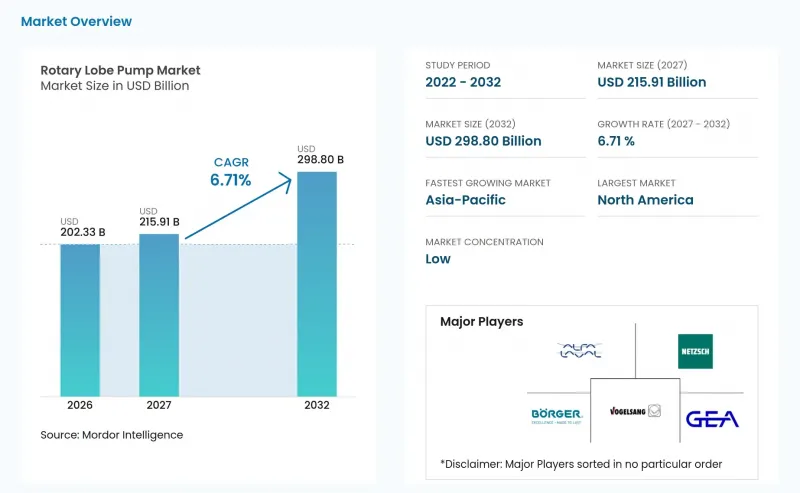
According to Mordor Intelligence, the rotary lobe pump market size is expected to increase from USD 202.33 billion in 2026 to USD 215.91 billion in 2027 and reach USD 298.80 billion by 2032, at a CAGR of 6.71% over 2027-2032.
Global Rotary Lobe Pump Market Trends and Insights
Hygienic Handling Demand in Food, Beverage, and Pharmaceutical Processing
Food and pharmaceutical producers are designing process lines around clean-in-place and steam-in-place requirements. This supports the global rotary lobe pump market because sanitary lobe pumps can be cleaned without disassembly and can be specified for validated hygienic processes. The 3-A Sanitary Standards Institute sets requirements for positive rotary pumps used in food and dairy processing, while EHEDG certification is relevant to hygienic food equipment selection in Europe. Biopharmaceutical users select tri-lobe and multi-lobe designs when lower pulsation can help protect shear-sensitive protein products during aseptic transfer. NETZSCH describes its TORNADO T.Sano pump as an all-metal, dead-space-free design with smooth contact surfaces intended to reduce product retention points in food applications. In personal care production, this flexibility is useful when operators transfer formulations with widely different viscosities, from lighter serums to thicker creams.
Wastewater and Sludge-Handling Infrastructure Investment
Wastewater investment supports the global rotary lobe pump market because treatment plants require reliable transfer of primary sludge, return activated sludge, thickened sludge, and digester feed. Rotary lobe designs are used where solids handling and maintenance access are important operational considerations for continuous treatment processes. The equipment can be selected when operators need to replace or service rotors without disconnecting the full pipe arrangement. This is particularly relevant where plant operators have limited in-house maintenance resources and need to minimize shutdown work. Borger positions its rotary lobe pumps for wastewater and sludge applications, including configurations for industrial process duties. A January 2026 Borger order for 22 BLUEline pumps for an Australian wastewater treatment plant illustrates the scale of municipal sludge-conveyance installations.
Stainless-Steel and Specialty-Alloy Cost Volatility
AISI 316L stainless steel is used for wetted parts in hygienic rotary lobe pumps, which leaves suppliers exposed to changes in nickel and alloy costs. This exposure is more pronounced for applications that require duplex or nickel-bearing materials. Higher material costs can affect quotation timing, component availability, and project budgets. The global rotary lobe pump market can therefore experience uneven order timing when customers defer purchases or specify lower-cost materials. The effect is especially relevant to municipal authorities and engineering contractors working under fixed project budgets. Suppliers with broad sourcing capability and pricing discipline may be better placed to manage this pressure.
Other drivers and restraints analyzed in the detailed report include:
- Industrial Demand for Viscous, Abrasive, and Solids-Laden Fluid Transfer
- Industrial Automation, IoT Monitoring, and Predictive Maintenance
- Higher Ownership Cost and Maintenance Complexity Versus Centrifugal Pumps
For complete list of drivers and restraints, kindly check the Table Of Contents.
Segment Analysis
Bi-wing lobe pumps held 37.6% of the global rotary lobe pump market in 2026. Their position reflects a balance of volumetric efficiency, cleanability, and resistance to rotor wear in food and dairy operations. Large bi-wing cavities can handle beverages, creams, and other products with different viscosities, which makes this design common in dairy, beverage, and cosmetics lines. Single-lobe pumps are forecast to grow at a 6.9% CAGR from 2027 to 2032 because their larger displacement per revolution suits biogas feed, thickened sludge, and slurry transfer. The global rotary lobe pump industry relies on these designs where throughput is more important than highly even flow.
Tri-lobe and multi-lobe pumps address applications where low pulsation and gentle handling carry greater weight. In biopharmaceutical transfer, these configurations can reduce pulsation and help preserve sensitive protein products. Alfa Laval states that its SX rotary lobe range offers 14 pump-head displacements, flows up to 115 m3/h, and pressures up to 15 bar. These pumps are also relevant to personal care formulations such as serums, emulsions, and active-ingredient suspensions, where manufacturers seek to limit excessive shear. The global rotary lobe pump market has room for several rotor designs because product properties and process requirements differ substantially.
Complete Report Scope:
- By Product Type
- Single-Lobe Pumps
- Bi-Wing Lobe Pumps
- Tri-Lobe Pumps
- Multi-Lobe Pumps
- By Flow Rate
- Up to 1,000 L/h
- 1,000-50,000 L/h
- 50,001-200,000 L/h
- 200,001-600,000 L/h
- Above 600,000 L/h
- By End User
- Food and Beverage
- Dairy
- Pharmaceutical and Biotechnology
- Water and Wastewater Treatment
- Chemical Processing
- Pulp and Paper
- Oil and Gas
- Biogas and Sludge Handling
- Personal Care and Cosmetics
- Other End Users
- By Geography
- North America
- United States
- Canada
- Mexico
- Europe
- Germany
- France
- Italy
- Spain
- United Kingdom
- Poland
- Russia
- Rest of Europe
- Asia-Pacific
- China
- India
- Japan
- South Korea
- Australia
- Indonesia
- Vietnam
- Thailand
- Rest of Asia-Pacific
- South America
- Brazil
- Argentina
- Chile
- Rest of South America
- Middle East and Africa
- Saudi Arabia
- United Arab Emirates
- Egypt
- South Africa
- Morocco
- Rest of Middle East and Africa
- North America
Geography Analysis
North America held 33.2% of the global rotary lobe pump market in 2026. The region has large food processing, pharmaceutical manufacturing, and municipal water systems in the United States and Canada. These industries create demand for hygienic and solids-handling equipment. U.S. food and dairy processing also relies on established sanitary pump requirements, while Mexico adds demand through dairy and beverage manufacturing.
Asia-Pacific is forecast to grow at a 7.3% CAGR from 2027 to 2032. China and India are important because water treatment and industrial capacity additions broaden the customer base for rotary lobe equipment. Southeast Asian pharmaceutical development, industrial wastewater compliance, and expanding food and dairy processing also support new installations. The global rotary lobe pump market can expand where suppliers combine suitable configurations with close service support. Local availability of trained technicians remains important when customers assess operating risk.
South America and the Middle East and Africa remain smaller regional markets with identifiable demand centers. Brazil supports food processing demand, while Argentina and Chile contribute chemical and mining-related applications. Saudi Arabia and the United Arab Emirates are developing water recycling and desalination pretreatment systems, and South Africa and Egypt provide industrial and municipal wastewater opportunities. The global rotary lobe pump market depends on after-sales coverage in these regions because skilled service capacity remains a central purchasing consideration.
- Alfa Laval AB
- Ampco Pumps Company
- Borger GmbH
- Fristam Pumpen GmbH
- GEA Group Aktiengesellschaft
- INOXPA Group
- IPEC Pump Systems, Inc.
- KSB SE and Co. KGaA
- LobePro, Inc.
- Megator Ltd.
- NETZSCH-Group
- ProMinent GmbH
- SPX FLOW, Inc.
- Tuthill Corporation
- Vanton Pump, Inc.
- Verder Group
- Vogelsang GmbH and Co. KG
- Wastecorp Pumps LLC
- Wilden Pump and Engineering LLC
- Wright Flow Technologies
Additional Benefits:
- The market estimate (ME) sheet in Excel format
- 3 months of analyst support
TABLE OF CONTENTS
1 INTRODUCTION
- 1.1 Study Assumptions and Market Definition
- 1.2 Scope of the Study
2 RESEARCH METHODOLOGY
3 EXECUTIVE SUMMARY
4 MARKET LANDSCAPE
- 4.1 Market Overview
- 4.2 Market Drivers
- 4.2.1 Hygienic Handling Demand in Food, Beverage, and Pharmaceutical Processing
- 4.2.2 Wastewater and Sludge-Handling Infrastructure Investment
- 4.2.3 Industrial Demand for Viscous, Abrasive, and Solids-Laden Fluid Transfer
- 4.2.4 Industrial Automation, IoT Monitoring, and Predictive Maintenance
- 4.2.5 Retrofit Demand for Reversible, Low-Shear Pumping in Constrained Plants
- 4.2.6 Modular Sealing and Wear-Part Designs Reducing Maintenance Downtime
- 4.3 Market Restraints
- 4.3.1 Stainless-Steel and Specialty-Alloy Cost Volatility
- 4.3.2 Higher Ownership Cost and Maintenance Complexity Versus Centrifugal Pumps
- 4.3.3 Seal Failure, Dry-Running, and Abrasive-Wear Exposure
- 4.3.4 Application-Specific Sizing and Skilled-Service Dependence
- 4.4 Supply-Chain Analysis
- 4.5 Porter's Five Forces Analysis
- 4.5.1 Bargaining Power of Suppliers
- 4.5.2 Bargaining Power of Buyers
- 4.5.3 Threat of New Entrants
- 4.5.4 Threat of Substitutes
- 4.5.5 Competitive Rivalry
- 4.6 Technology Outlook
- 4.7 Regulatory Landscape
- 4.8 Investment Analysis
5 MARKET SIZE AND GROWTH FORECASTS
- 5.1 By Product Type
- 5.1.1 Single-Lobe Pumps
- 5.1.2 Bi-Wing Lobe Pumps
- 5.1.3 Tri-Lobe Pumps
- 5.1.4 Multi-Lobe Pumps
- 5.2 By Flow Rate
- 5.2.1 Up to 1,000 L/h
- 5.2.2 1,000-50,000 L/h
- 5.2.3 50,001-200,000 L/h
- 5.2.4 200,001-600,000 L/h
- 5.2.5 Above 600,000 L/h
- 5.3 By End User
- 5.3.1 Food and Beverage
- 5.3.2 Dairy
- 5.3.3 Pharmaceutical and Biotechnology
- 5.3.4 Water and Wastewater Treatment
- 5.3.5 Chemical Processing
- 5.3.6 Pulp and Paper
- 5.3.7 Oil and Gas
- 5.3.8 Biogas and Sludge Handling
- 5.3.9 Personal Care and Cosmetics
- 5.3.10 Other End Users
- 5.4 By Geography
- 5.4.1 North America
- 5.4.1.1 United States
- 5.4.1.2 Canada
- 5.4.1.3 Mexico
- 5.4.2 Europe
- 5.4.2.1 Germany
- 5.4.2.2 France
- 5.4.2.3 Italy
- 5.4.2.4 Spain
- 5.4.2.5 United Kingdom
- 5.4.2.6 Poland
- 5.4.2.7 Russia
- 5.4.2.8 Rest of Europe
- 5.4.3 Asia-Pacific
- 5.4.3.1 China
- 5.4.3.2 India
- 5.4.3.3 Japan
- 5.4.3.4 South Korea
- 5.4.3.5 Australia
- 5.4.3.6 Indonesia
- 5.4.3.7 Vietnam
- 5.4.3.8 Thailand
- 5.4.3.9 Rest of Asia-Pacific
- 5.4.4 South America
- 5.4.4.1 Brazil
- 5.4.4.2 Argentina
- 5.4.4.3 Chile
- 5.4.4.4 Rest of South America
- 5.4.5 Middle East and Africa
- 5.4.5.1 Saudi Arabia
- 5.4.5.2 United Arab Emirates
- 5.4.5.3 Egypt
- 5.4.5.4 South Africa
- 5.4.5.5 Morocco
- 5.4.5.6 Rest of Middle East and Africa
- 5.4.1 North America
6 COMPETITIVE LANDSCAPE
- 6.1 Market Concentration
- 6.2 Strategic Moves
- 6.3 Market Share Analysis
- 6.4 Company Profiles (includes Global Level Overview, Market Level Overview, Core Segments, Financials as available, Strategic Information, Market Rank/Share, Products and Services, Recent Developments)
- 6.4.1 Alfa Laval AB
- 6.4.2 Ampco Pumps Company
- 6.4.3 Borger GmbH
- 6.4.4 Fristam Pumpen GmbH
- 6.4.5 GEA Group Aktiengesellschaft
- 6.4.6 INOXPA Group
- 6.4.7 IPEC Pump Systems, Inc.
- 6.4.8 KSB SE and Co. KGaA
- 6.4.9 LobePro, Inc.
- 6.4.10 Megator Ltd.
- 6.4.11 NETZSCH-Group
- 6.4.12 ProMinent GmbH
- 6.4.13 SPX FLOW, Inc.
- 6.4.14 Tuthill Corporation
- 6.4.15 Vanton Pump, Inc.
- 6.4.16 Verder Group
- 6.4.17 Vogelsang GmbH and Co. KG
- 6.4.18 Wastecorp Pumps LLC
- 6.4.19 Wilden Pump and Engineering LLC
- 6.4.20 Wright Flow Technologies
7 MARKET OPPORTUNITIES AND FUTURE OUTLOOK
- 7.1 White-Space and Unmet-Need Assessment

