PUBLISHER: Mordor Intelligence | PRODUCT CODE: 2195465

PUBLISHER: Mordor Intelligence | PRODUCT CODE: 2195465
Industrial Emission Control System - Market Share Analysis, Industry Trends & Statistics, Growth Forecasts (2027 - 2032)
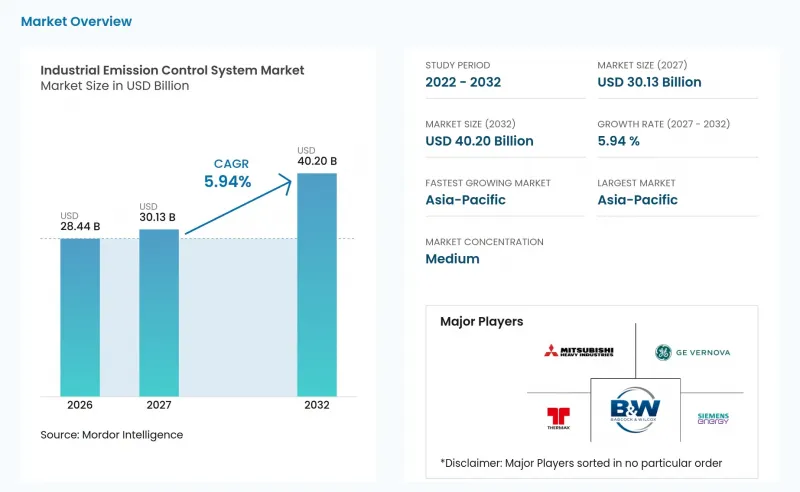
According to Mordor Intelligence, the industrial emission control system market size was valued at USD 28.44 billion in 2026 and is estimated to grow from USD 30.13 billion in 2027 to reach USD 40.20 billion by 2032, at a CAGR of 5.94% during the forecast period (2027-2032).
Global Industrial Emission Control System Market Trends and Insights
Stricter Multi-Sector Emission Caps
The global industrial emission control system market is gaining support as regulation extends beyond utilities into industries that historically faced less stringent permit conditions. The revised EU Industrial Emissions Directive entered into force in August 2024 and must be transposed by July 1, 2026. It extends best-available-technique permit obligations to metal ore mining and large battery manufacturing. The directive also requires penalties of at least 3% of annual turnover for serious violations. India's CAQM Statutory Direction No. 98 requires a particulate matter ceiling of 50 mg/Nm3 for 17 categories of highly polluting industries in Delhi-NCR from August 1, 2026. These overlapping requirements encourage cement and steel operators to procure coordinated controls for dust, sulfur oxides, and nitrogen oxides instead of treating each pollutant through separate projects.
Asia-Pacific Coal and Heavy-Industry Retrofit Cycle
The Asia-Pacific retrofit cycle remains a major source of demand for the global industrial emission control system market. China extended its ultra-low-emission program to cement and coke in 2024, bringing 2 high-emitting industries into a broader compliance cycle. In 2026, technical guides T/CAEPI 117-2026 for cement and T/CAEPI 119-2026 for coal-fired industrial boilers translated this policy direction into equipment guidance. China also issued JB/T 15533-2026 in April 2026 for flue gas desulfurization, denitrification, and dust removal equipment used in rolling mill heating furnaces, with implementation scheduled for November 2026. India's carbon credit trading framework covers 490 industrial plants across 8 sectors under greenhouse gas intensity rules notified in 2025 and January 2026. The need to demonstrate compliance is also increasing demand for digital monitoring alongside physical control systems.
High Installed-System CAPEX and O&M Burden
High capital requirements can delay projects in the global industrial emission control system market, especially when compliance deadlines move faster than plant financing decisions. Large flue gas desulfurization and SCR retrofits often require major shutdown planning, installation work, commissioning, and continuous emissions monitoring. Smaller industrial sites in developing economies may have limited access to long-term project financing or sustainability-linked credit. Operating costs also depend on inputs such as urea, ammonia, limestone, and catalyst materials. Changes in the cost or availability of these inputs make long-term maintenance pricing more difficult for both plant operators and suppliers. Long outage, installation, and certification cycles can further extend procurement decisions even when a plant has already identified a compliance need.
Other drivers and restraints analyzed in the detailed report include:
- Industrial Decarbonization and Carbon-Capture Pretreatment
- Data-Center-Led Gas-Turbine Capacity Additions
- Coal-Fleet Retirement in Mature Markets
For complete list of drivers and restraints, kindly check the Table Of Contents.
Segment Analysis
Flue gas desulfurization systems held 25.4% of the global industrial emission control system market share in 2026. Their role remains closely linked to sulfur dioxide compliance in coal-fired power generation and cement production across China, India, and Southeast Asia. Wet limestone scrubbing is increasingly supplied with mist elimination and wastewater recovery components, which broadens the scope of individual projects. Electrostatic precipitators and fabric filters remain core particulate matter controls. They also serve as important pretreatment stages before FGD and SCR equipment. Wet scrubbers continue to address acid gases and particulate matter in waste-to-energy and chemical applications.
Selective catalytic reduction has the highest forecast growth rate among the listed technologies at 6.5% CAGR through 2032. The global industrial emission control system market size for SCR is supported by the January 2026 US turbine standards and China's DL/T 3030-2026 guidance on SCR denitrification for flexible coal power operation. Thermal and catalytic oxidizers serve VOC-intensive automotive, pharmaceutical, and chemical operations. Durr CTS launched a fully electrified Oxi.X regenerative thermal oxidizer line in May 2026 for flows up to 120,000 Nm3/h. Cyclone separators continue to protect downstream high-efficiency equipment. Technology providers are increasingly positioned to offer complete systems for particulate matter, sulfur oxides, and nitrogen oxides within one contract.
Complete Report Scope:
- By Technology
- Electrostatic Precipitators (ESP)
- Fabric Filters / Baghouse Filters
- Flue Gas Desulfurization (FGD) Systems
- Wet Scrubbers
- Selective Catalytic Reduction (SCR)
- Thermal Oxidizers
- Catalytic Oxidizers
- Cyclone Separators
- Other Technologies
- By Pollutant Type
- Particulate Matter (PM)
- Nitrogen Oxides (NOx)
- Sulfur Oxides (SOx/SO2)
- Volatile Organic Compounds (VOCs)
- Carbon Monoxide (CO)
- Mercury and Heavy Metals
- Hazardous Air Pollutants (HAPs)
- Greenhouse Gases (GHGs)
- Other Pollutants
- By End-User Industry
- Power Generation
- Oil & Gas
- Chemical & Petrochemical
- Cement
- Iron & Steel
- Metals & Mining
- Pulp & Paper
- Pharmaceuticals
- Food & Beverage
- Automotive and Manufacturing
- Waste-to-Energy
- Other Industries
- By Geography
- North America
- United States
- Canada
- Mexico
- Europe
- Germany
- France
- Italy
- Spain
- United Kingdom
- Poland
- Russia
- Rest of Europe
- Asia-Pacific
- China
- India
- Japan
- South Korea
- Australia
- Indonesia
- Vietnam
- Thailand
- Rest of Asia-Pacific
- South America
- Brazil
- Argentina
- Chile
- Rest of South America
- Middle East and Africa
- Saudi Arabia
- United Arab Emirates
- Egypt
- South Africa
- Morocco
- Rest of Middle East and Africa
- North America
Geography Analysis
Asia-Pacific held 43.2% of the global industrial emission control system market share in 2026 and is forecast to grow at 7.2% CAGR through 2032. China's ultra-low-emission expansion in cement and coke is supported by the 2026 technical guides for cement enterprises and coal-fired industrial boilers. India's CAQM particulate matter requirement takes effect in Delhi-NCR in August 2026. India also has greenhouse gas intensity rules covering 490 plants across 8 sectors. Mitsubishi Heavy Industries' Himeji pilot and Kawasaki Heavy Industries' commercial-scale capture demonstration in Kobe show the role of carbon capture projects in Japan.
North America and Europe form another major demand area, although their drivers differ. In the United States, the global industrial emission control system market is supported by SCR requirements for large, high-utilization stationary turbines under the January 2026 EPA standards. This provides demand at large data center campuses and other regulated generation sites. Europe is shaped by the July 1, 2026 deadline for national transposition of the revised Industrial Emissions Directive. Germany has around 13,000 IED-regulated sites under its implementation process. The United Kingdom's industrial carbon capture support adds a second source of demand for upstream pretreatment equipment.
South America and the Middle East and Africa are earlier in their regulatory development. Brazil is the most active South American country in the supplied material, with rules affecting oil refining, cement, and industrial combustion. Chile is advancing sulfur dioxide controls, while macroeconomic conditions in Argentina can limit capital commitments. Saudi Arabia and the United Arab Emirates support demand through industrial diversification and supply-chain decarbonization requirements from European customers. South Africa has a sizeable potential retrofit base in its coal fleet, although utility financial conditions have delayed work. Egypt and Morocco are earlier-stage opportunities as industrial infrastructure expands. GE Vernova's April 2026 order to modernize plants in Egypt shows continued equipment activity in the region.
- AAF International
- ABB Ltd.
- ANDRITZ AG
- Anguil Environmental Systems, Inc.
- Babcock & Wilcox Enterprises, Inc.
- CECO Environmental Corp.
- Donaldson Company, Inc.
- Doosan Enerbility Co., Ltd.
- Ducon Technologies Inc.
- Durr AG
- Emerson Electric Co.
- FLSmidth & Co. A/S
- Fuel Tech, Inc.
- GE Vernova Inc.
- GEA Group AG
- Hamon & Cie (International) SA
- Honeywell International Inc.
- Horiba, Ltd.
- Johnson Matthey Plc
- Mitsubishi Heavy Industries, Ltd.
- Siemens Energy AG
- Thermax Limited
- Valmet Oyj
- Yokogawa Electric Corporation
Additional Benefits:
- The market estimate (ME) sheet in Excel format
- 3 months of analyst support
TABLE OF CONTENTS
1 INTRODUCTION
- 1.1 Study Assumptions and Market Definition
- 1.2 Scope of the Study
2 RESEARCH METHODOLOGY
3 EXECUTIVE SUMMARY
4 MARKET LANDSCAPE
- 4.1 Market Overview
- 4.2 Market Drivers
- 4.2.1 Stricter Multi-Sector Emission Caps
- 4.2.2 Asia-Pacific Coal and Heavy-Industry Retrofit Cycle
- 4.2.3 Industrial Decarbonization and Carbon-Capture Pretreatment
- 4.2.4 Data-Center-Led Gas-Turbine Capacity Additions
- 4.2.5 AI-Enabled Predictive Maintenance and Compliance Analytics
- 4.2.6 Net-Zero Industrial Clusters and Modular Abatement Packages
- 4.3 Market Restraints
- 4.3.1 High Installed-System CAPEX and O&M Burden
- 4.3.2 Coal-Fleet Retirement in Mature Markets
- 4.3.3 Long Outage-Installation and Certification Cycles
- 4.3.4 Reagent, Catalyst and Secondary-Waste Volatility
- 4.4 Supply-Chain Analysis
- 4.5 Porter's Five Forces Analysis
- 4.5.1 Bargaining Power of Suppliers
- 4.5.2 Bargaining Power of Buyers
- 4.5.3 Threat of New Entrants
- 4.5.4 Threat of Substitutes
- 4.5.5 Competitive Rivalry
- 4.6 Technology Outlook
- 4.7 Regulatory Landscape
- 4.8 Investment Analysis
5 MARKET SIZE AND GROWTH FORECASTS (VALUE)
- 5.1 By Technology
- 5.1.1 Electrostatic Precipitators (ESP)
- 5.1.2 Fabric Filters / Baghouse Filters
- 5.1.3 Flue Gas Desulfurization (FGD) Systems
- 5.1.4 Wet Scrubbers
- 5.1.5 Selective Catalytic Reduction (SCR)
- 5.1.6 Thermal Oxidizers
- 5.1.7 Catalytic Oxidizers
- 5.1.8 Cyclone Separators
- 5.1.9 Other Technologies
- 5.2 By Pollutant Type
- 5.2.1 Particulate Matter (PM)
- 5.2.2 Nitrogen Oxides (NOx)
- 5.2.3 Sulfur Oxides (SOx/SO2)
- 5.2.4 Volatile Organic Compounds (VOCs)
- 5.2.5 Carbon Monoxide (CO)
- 5.2.6 Mercury and Heavy Metals
- 5.2.7 Hazardous Air Pollutants (HAPs)
- 5.2.8 Greenhouse Gases (GHGs)
- 5.2.9 Other Pollutants
- 5.3 By End-User Industry
- 5.3.1 Power Generation
- 5.3.2 Oil & Gas
- 5.3.3 Chemical & Petrochemical
- 5.3.4 Cement
- 5.3.5 Iron & Steel
- 5.3.6 Metals & Mining
- 5.3.7 Pulp & Paper
- 5.3.8 Pharmaceuticals
- 5.3.9 Food & Beverage
- 5.3.10 Automotive and Manufacturing
- 5.3.11 Waste-to-Energy
- 5.3.12 Other Industries
- 5.4 By Geography
- 5.4.1 North America
- 5.4.1.1 United States
- 5.4.1.2 Canada
- 5.4.1.3 Mexico
- 5.4.2 Europe
- 5.4.2.1 Germany
- 5.4.2.2 France
- 5.4.2.3 Italy
- 5.4.2.4 Spain
- 5.4.2.5 United Kingdom
- 5.4.2.6 Poland
- 5.4.2.7 Russia
- 5.4.2.8 Rest of Europe
- 5.4.3 Asia-Pacific
- 5.4.3.1 China
- 5.4.3.2 India
- 5.4.3.3 Japan
- 5.4.3.4 South Korea
- 5.4.3.5 Australia
- 5.4.3.6 Indonesia
- 5.4.3.7 Vietnam
- 5.4.3.8 Thailand
- 5.4.3.9 Rest of Asia-Pacific
- 5.4.4 South America
- 5.4.4.1 Brazil
- 5.4.4.2 Argentina
- 5.4.4.3 Chile
- 5.4.4.4 Rest of South America
- 5.4.5 Middle East and Africa
- 5.4.5.1 Saudi Arabia
- 5.4.5.2 United Arab Emirates
- 5.4.5.3 Egypt
- 5.4.5.4 South Africa
- 5.4.5.5 Morocco
- 5.4.5.6 Rest of Middle East and Africa
- 5.4.1 North America
6 COMPETITIVE LANDSCAPE
- 6.1 Market Concentration
- 6.2 Strategic Moves
- 6.3 Market Share Analysis
- 6.4 Company Profiles (includes Global Level Overview, Market Level Overview, Core Segments, Financials as available, Strategic Information, Market Rank/Share, Products and Services, Recent Developments)
- 6.4.1 AAF International
- 6.4.2 ABB Ltd.
- 6.4.3 ANDRITZ AG
- 6.4.4 Anguil Environmental Systems, Inc.
- 6.4.5 Babcock & Wilcox Enterprises, Inc.
- 6.4.6 CECO Environmental Corp.
- 6.4.7 Donaldson Company, Inc.
- 6.4.8 Doosan Enerbility Co., Ltd.
- 6.4.9 Ducon Technologies Inc.
- 6.4.10 Durr AG
- 6.4.11 Emerson Electric Co.
- 6.4.12 FLSmidth & Co. A/S
- 6.4.13 Fuel Tech, Inc.
- 6.4.14 GE Vernova Inc.
- 6.4.15 GEA Group AG
- 6.4.16 Hamon & Cie (International) SA
- 6.4.17 Honeywell International Inc.
- 6.4.18 Horiba, Ltd.
- 6.4.19 Johnson Matthey Plc
- 6.4.20 Mitsubishi Heavy Industries, Ltd.
- 6.4.21 Siemens Energy AG
- 6.4.22 Thermax Limited
- 6.4.23 Valmet Oyj
- 6.4.24 Yokogawa Electric Corporation
7 MARKET OPPORTUNITIES AND FUTURE OUTLOOK
- 7.1 White-Space and Unmet-Need Assessment

