PUBLISHER: Mordor Intelligence | PRODUCT CODE: 2196503

PUBLISHER: Mordor Intelligence | PRODUCT CODE: 2196503
Warehouse Real Estate - Market Share Analysis, Industry Trends & Statistics, Growth Forecasts (2027 - 2032)
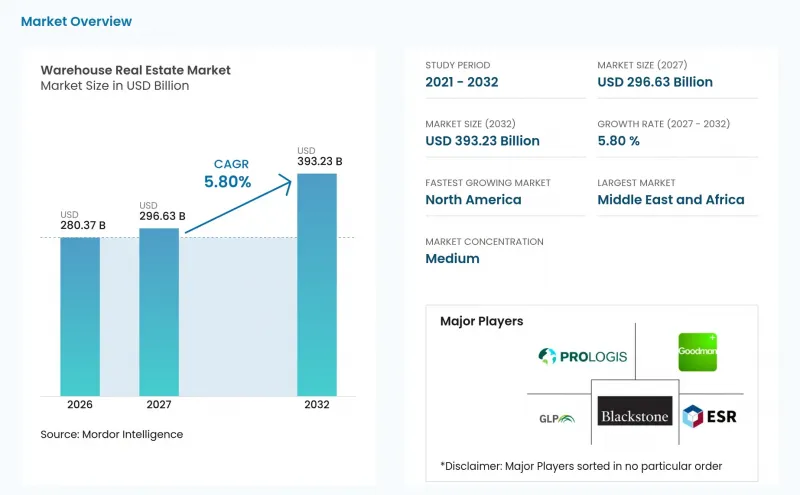
According to Mordor Intelligence, the warehouse real estate market size is projected to be USD 280.37 billion in 2026, USD 296.63 billion in 2027, and reach USD 393.23 billion by 2032, growing at a CAGR of 5.80% from 2027 to 2032.
Global Warehouse Real Estate Market Trends and Insights
E-Commerce, Omnichannel Retail, and Inventory Decentralization
E-commerce remains a major source of leasing demand in the Warehouse real estate market because delivery expectations require inventory to be held closer to consumers. Online sales penetration is expected to reach 19.7% in 2026, while e-commerce companies are projected to account for nearly 25% of global new leasing that year. Retailers have reduced occupied United States storefront space by 2.4% from the pre-pandemic period while expanding logistics footprints by 12%, which points to a lasting redistribution of space rather than a short-term response. Facilities close to population centers are becoming more important because they can reduce delivery time and support higher order frequency. JD.com's Joybuy marketplace launch in the United Kingdom, France, and Germany illustrates the push for next-day delivery capacity across European logistics corridors. The planned removal of the EUR 150 de minimis customs threshold in March 2028 is expected to encourage inventory positioning near Rotterdam, Antwerp-Bruges, and Hamburg before the rule takes effect.
Supply-Chain Regionalization, Nearshoring, and Reshoring
Supply-chain regionalization is broadening warehouse requirements beyond traditional import distribution. Manufacturers are building regional inventory buffers and creating logistics demand around semiconductor, electric vehicle, and clean-energy production sites, which brings suppliers, production sites, and warehouse space closer together. Manufacturing represented 20% of new industrial leasing in the United States Southeast and Central regions in 2026, compared with 13% before the pandemic. The Warehouse real estate market is benefiting from shorter supply routes and production shifts toward Mexico, where the Monterrey and Nuevo Leon corridor links industrial activity with United States demand. Advanced manufacturing requires storage, inbound parts handling, and outbound distribution near production facilities, so its effect reaches beyond the factory itself. Labor shortages in positions that cannot be automated may spread leasing absorption across several years rather than concentrate it in a single cycle. This makes demand more gradual but can also make it more durable across regional logistics markets.
Higher Interest Rates and Cost of Capital
Higher financing costs have reduced speculative development and reset property valuations in the Warehouse real estate market. Policy rates had fallen 175 basis points from their recent peak by 2026, while industrial capitalization rates remained above 2022 lows. United States construction starts in 2025 were 25% below the 2017 to 2019 average, and replacement-cost rents were 20% above Class A market rents. This gap discourages speculative construction in many locations because projected income may not justify higher financing and building costs. Higher debt service and tariffs on steel and aluminum can further increase the cost of delivering new Grade A facilities. The constraint is strongest outside supply-constrained gateway markets where rents do not fully support higher development costs.
Other drivers and restraints analyzed in the detailed report include:
- Tenant Flight to Quality and High-Specification Space
- Cold-Chain, Pharmaceutical, and Food Logistics Expansion
- Oversupply and Vacancy in Selected Secondary Markets
For complete list of drivers and restraints, kindly check the Table Of Contents.
Segment Analysis
Private warehouses held 44.00% of the warehouse real estate market share in 2026, reflecting the preference for dedicated facilities among retailers, manufacturers, and third-party logistics providers. These operators can configure proprietary automation and data systems when they control the full building. Dedicated space also helps tenants organize workflows around a single inventory model and service standard. Public warehouses remain useful for businesses entering new locations, handling seasonal volumes, or outsourcing noncore distribution. Shared facilities are particularly relevant in Asia-Pacific and the Middle East and Africa, where occupiers may expand gradually. This creates continued demand for both dedicated and multi-client formats.
The Others segment, which includes bonded warehouses, cross-docking terminals, and flex-industrial assets, is forecast to grow at a 6.80% CAGR through 2032. The planned European customs change supports interest in facilities that can process bulk inventory near Antwerp, Rotterdam, and Hamburg. Bonded storage can become more relevant as import flows are consolidated before they move to final markets. Cross-docking terminals also help retailers reduce handling time in regional distribution networks. Clarion Partners' North 15 Logistics Center in North Las Vegas combines a private facility with AutoStore robotics and reduced delivery windows from 5 to 7 days to 2 to 3 days. Such projects show why operators value specialized layouts when delivery speed is a competitive requirement.
General warehouses accounted for 68.00% of the warehouse real estate market size in 2026 because most retail, e-commerce, and manufacturing inventory does not need controlled temperatures. Ambient facilities provide the core storage capacity for consumer goods, industrial inputs, and standard distribution operations. Their broad customer base supports their large share of total warehouse demand. General warehouses also serve a wide mix of tenants in both mature and developing logistics locations. This breadth makes the segment less dependent on any one end-use sector. It remains the essential format for large regional distribution networks.
Refrigerated warehouses are forecast to grow at a 6.20% CAGR through 2032 as pharmaceutical, food, and specialty chemical supply chains require reliable temperature control. These facilities may handle products ranging from biologics requiring minus 70 degrees Celsius to controlled-ambient nutraceutical products. Insulated panels, redundant refrigeration equipment, and backup power create higher construction and operating requirements than standard warehouses. DHL's Florstadt project demonstrates the scale of investment entering pharmaceutical logistics. DP World announced a USD 53 million temperature-controlled hub beside its Antwerp Gateway terminal for pharmaceutical and perishable cargo. Good Distribution Practice and current Good Manufacturing Practice compliance make certified capacity harder to replace with conventional space.
Complete Report Scope:
- By Type
- Public
- Private
- Others
- By Temperature Control
- General Warehouse
- Refrigerated Warehouse
- By Grade
- Class A
- Class B
- Class C
- By Warehouse Size
- Small-Scale Warehouses (Under 50,000 sq ft)
- Medium-Scale Warehouses (50,000-250,000 sq ft)
- Large-Scale Warehouses (Above 250,000 sq ft)
- By Tenant Classification
- Manufacturing
- Retail and Consumer Goods
- Food and Beverage
- Pharmaceuticals and Healthcare
- Logistics
- Other End Users
- By Region
- North America
- United States
- Canada
- Mexico
- Europe
- Germany
- United Kingdom
- France
- Italy
- Spain
- Rest of Europe
- Asia-Pacific
- China
- India
- Japan
- South Korea
- Australia
- Rest of Asia-Pacific
- South America
- Brazil
- Argentina
- Chile
- Rest of South America
- Middle East & Africa
- United Arab Emirates
- Saudi Arabia
- South Africa
- Nigeria
- Rest of Middle East & Africa
- North America
Geography Analysis
North America held 46.00% of the warehouse real estate market share in 2026, supported by a mature real estate investment trust structure and deep institutional capital. U.S. warehouse utilization reached 84% to 85% through the third quarter of 2025, close to the 85.5% level associated with expansionary leasing. This supports demand in gateway areas such as the Inland Empire and Northern New Jersey. Canada faces pressure from cross-border trade exposure, while Mexico benefits from manufacturing-linked demand in the Monterrey and Nuevo Leon corridor. New state proposals to limit logistics development near residential areas may further reduce available land in constrained U.S. gateway locations.
Europe remains a large institutional logistics area, with investment activity supported by supply constraints in key markets. The warehouse real estate market has benefited from demand in London, the Randstad, Lyon, Germany, France, and Poland. Europe's vacancy was 6.1% in the second quarter of 2025, but well-located last-mile facilities continued to support rent growth. Asia-Pacific has a varied demand profile, with India's online retail rate of 9.4% in 2025 below South Korea's 27.7% and Taiwan's 30.00%. Tokyo's inner areas showed a stronger preference for well-located logistics facilities, while Brisbane faces tight industrial land availability.
The Middle East and Africa is forecast to grow at a 7.90% CAGR through 2032, the fastest regional rate in the warehouse real estate market. Saudi Arabia added more than 1.3 million sq m of warehouse space in the first half of 2025, but Riyadh occupancy reached 98%, showing the continuing shortage of high-quality stock. Blackstone and Lunate established the Gulf Logistics Infrastructure Development Enterprise platform, which targets USD 5 billion of Grade A logistics assets across the Gulf Cooperation Council. Brazil recorded 11.5% logistics rent growth in 2025 and 8.5% warehouse vacancy in the third quarter of 2025, while Mercado Libre continued to expand distribution capacity. South America offers targeted warehouse real estate market opportunities, although Argentina and Chile continue to face macroeconomic conditions that limit institutional activity. Sub-Saharan Africa is earlier in its institutional development, with Kenya approving its first dedicated industrial real estate investment trust in 2025.
- Prologis, Inc.
- Goodman Group
- GLP Pte. Ltd.
- Blackstone Real Estate
- ESR Group Limited
- SEGRO plc
- Mapletree Investments Pte Ltd
- Panattoni Development Company, Inc.
- CapitaLand Investment Limited
- Brookfield Properties
- Frasers Property Limited
- P3 Logistic Parks
- CBRE Group, Inc.
- Cushman & Wakefield plc
- Colliers International Group Inc.
- Hines
- Macquarie Group Limited
- AEW Capital Management, L.P.
- First Industrial Realty Trust, Inc.
- STAG Industrial, Inc.
- EastGroup Properties, Inc.
- Rexford Industrial Realty, Inc.
- Link Logistics Real Estate
- Americold Realty Trust, Inc.
Additional Benefits:
- The market estimate (ME) sheet in Excel format
- 3 months of analyst support
TABLE OF CONTENTS
1 INTRODUCTION
- 1.1 Study Assumptions and Market Definition
- 1.2 Scope of the Study
2 RESEARCH METHODOLOGY
3 EXECUTIVE SUMMARY
4 MARKET LANDSCAPE
- 4.1 Market Overview
- 4.2 Market Drivers
- 4.2.1 E-commerce, Omnichannel Retail and Inventory Decentralization
- 4.2.2 Supply-Chain Regionalization, Nearshoring and Reshoring
- 4.2.3 Tenant Flight to Quality and High-Specification Space
- 4.2.4 Cold-Chain, Pharmaceutical and Food Logistics Expansion
- 4.2.5 Urban Land Scarcity and Last-Mile Delivery Requirements
- 4.2.6 Data Center, Semiconductor and Advanced Manufacturing Supply Chains
- 4.3 Market Restraints
- 4.3.1 Higher Interest Rates and Cost of Capital
- 4.3.2 Oversupply and Vacancy in Selected Secondary Markets
- 4.3.3 Limited Land, Power and Transport Infrastructure
- 4.3.4 Planning, Zoning and Community Approval Delays
- 4.4 Value Chain Analysis
- 4.5 Regulatory Landscape
- 4.6 Technological Outlook
- 4.7 Industry Attractiveness - Porter's Five Forces Analysis
- 4.7.1 Bargaining Power of Suppliers
- 4.7.2 Bargaining Power of Buyers
- 4.7.3 Threat of New Entrants
- 4.7.4 Threat of Substitutes
- 4.7.5 Competitive Rivalry
5 WAREHOUSE REAL ESTATE MARKET, MARKET SIZE & GROWTH FORECASTS (VALUE IN USD)
- 5.1 By Type
- 5.1.1 Public
- 5.1.2 Private
- 5.1.3 Others
- 5.2 By Temperature Control
- 5.2.1 General Warehouse
- 5.2.2 Refrigerated Warehouse
- 5.3 By Grade
- 5.3.1 Class A
- 5.3.2 Class B
- 5.3.3 Class C
- 5.4 By Warehouse Size
- 5.4.1 Small-Scale Warehouses (Under 50,000 sq ft)
- 5.4.2 Medium-Scale Warehouses (50,000-250,000 sq ft)
- 5.4.3 Large-Scale Warehouses (Above 250,000 sq ft)
- 5.5 By Tenant Classification
- 5.5.1 Manufacturing
- 5.5.2 Retail and Consumer Goods
- 5.5.3 Food and Beverage
- 5.5.4 Pharmaceuticals and Healthcare
- 5.5.5 Logistics
- 5.5.6 Other End Users
- 5.6 By Region
- 5.6.1 North America
- 5.6.1.1 United States
- 5.6.1.2 Canada
- 5.6.1.3 Mexico
- 5.6.2 Europe
- 5.6.2.1 Germany
- 5.6.2.2 United Kingdom
- 5.6.2.3 France
- 5.6.2.4 Italy
- 5.6.2.5 Spain
- 5.6.2.6 Rest of Europe
- 5.6.3 Asia-Pacific
- 5.6.3.1 China
- 5.6.3.2 India
- 5.6.3.3 Japan
- 5.6.3.4 South Korea
- 5.6.3.5 Australia
- 5.6.3.6 Rest of Asia-Pacific
- 5.6.4 South America
- 5.6.4.1 Brazil
- 5.6.4.2 Argentina
- 5.6.4.3 Chile
- 5.6.4.4 Rest of South America
- 5.6.5 Middle East & Africa
- 5.6.5.1 United Arab Emirates
- 5.6.5.2 Saudi Arabia
- 5.6.5.3 South Africa
- 5.6.5.4 Nigeria
- 5.6.5.5 Rest of Middle East & Africa
- 5.6.1 North America
6 COMPETITIVE LANDSCAPE
- 6.1 Market Concentration
- 6.2 Strategic Moves
- 6.3 Market Share Analysis
- 6.4 Company Profiles (includes Global Level Overview, Market Level Overview, Core Segments, Financials as available, Strategic Information, Market Rank/Share, Products and Services, Recent Developments)
- 6.4.1 Prologis, Inc.
- 6.4.2 Goodman Group
- 6.4.3 GLP Pte. Ltd.
- 6.4.4 Blackstone Real Estate
- 6.4.5 ESR Group Limited
- 6.4.6 SEGRO plc
- 6.4.7 Mapletree Investments Pte Ltd
- 6.4.8 Panattoni Development Company, Inc.
- 6.4.9 CapitaLand Investment Limited
- 6.4.10 Brookfield Properties
- 6.4.11 Frasers Property Limited
- 6.4.12 P3 Logistic Parks
- 6.4.13 CBRE Group, Inc.
- 6.4.14 Cushman & Wakefield plc
- 6.4.15 Colliers International Group Inc.
- 6.4.16 Hines
- 6.4.17 Macquarie Group Limited
- 6.4.18 AEW Capital Management, L.P.
- 6.4.19 First Industrial Realty Trust, Inc.
- 6.4.20 STAG Industrial, Inc.
- 6.4.21 EastGroup Properties, Inc.
- 6.4.22 Rexford Industrial Realty, Inc.
- 6.4.23 Link Logistics Real Estate
- 6.4.24 Americold Realty Trust, Inc.
7 MARKET OPPORTUNITIES AND FUTURE OUTLOOK
- 7.1 White-Space and Unmet-Need Assessment

