PUBLISHER: Mordor Intelligence | PRODUCT CODE: 2187208

PUBLISHER: Mordor Intelligence | PRODUCT CODE: 2187208
Indonesia Real Estate - Market Share Analysis, Industry Trends & Statistics, Growth Forecasts (2027 - 2032)
According to Mordor Intelligence, the Indonesia real estate market size is expected to increase from USD 70.37 billion in 2026 to USD 74.53 billion in 2027 and reach USD 97.04 billion by 2032, growing at a CAGR of 5.42% over 2027-2032.
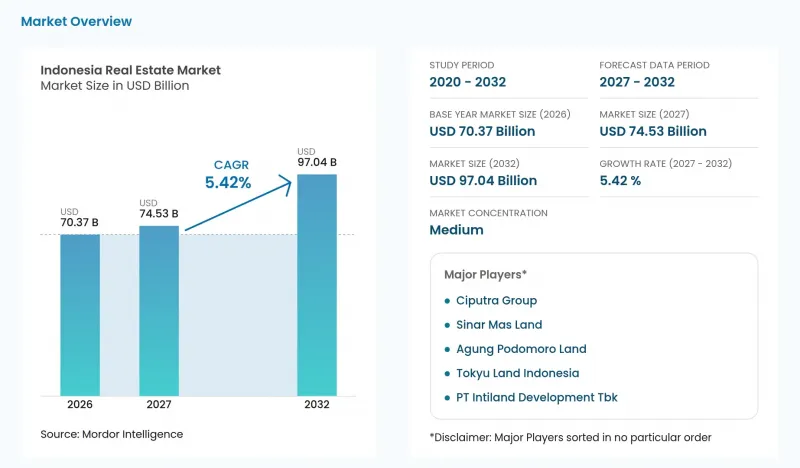
This report is segmented by Business Model (Sales and Rental), Property Type (Residential and Commercial), End-user (Individuals / Households, Corporates & SMEs, and Others), and Geography (DKI Jakarta, Rest of Indonesia, West Java, and East Java). The market forecasts are provided in terms of value (USD), based on availability.
Indonesia Real Estate Market Trends and Insights
Strong demographics, urbanization, and rising middle class boosting housing, retail, and services demand.
Subsidized housing finance through BP Tapera, the public housing savings agency, and the housing finance liquidity facility (FLPP) gives household need a route toward residential transactions with a landed-home emphasis. BP Tapera reported 177,161 subsidized FLPP mortgage disbursements for homes in Indonesia as of October 9, 2026. These home mortgage loans, known as KPR, covered 177,140 landed houses and 21 apartments. The World Bank's 2025 housing assessment also identified substantial need for new housing among Indonesian households. Against that need, the disbursement mix places landed homes at the center of this financing channel. Landed-home developers gain a demonstrated financed-buyer channel from this disbursement mix, without treating every household needing housing as a purchase-ready customer.
Infrastructure push and the new capital (IKN Nusantara) unlocking development corridors and mixed-use pipelines.
Supporting facilities in IKN Nusantara offer a route from new-capital development to a wider range of commercial property uses. In 2026, PT Panca Karya Sentosa, PT Maxi Nusantara Raya and PT Borneo Berkah Abadi signed development agreements for facilities in IKN. The agreements covered shopping centers, food areas and sports facilities in development areas 1A and 1C. The IKN Nusantara capital authority (Otorita IKN) reported 411,778 visitors during the 2026 Eid and Easter holiday periods of March 18 to 29 and April 3 to 5. Those visits provide a concrete customer occasion for prospective retail and food premises in the new capital. Holiday use of public spaces therefore gives the separate 1A and 1C facilities a potential audience, but does not establish their own trading demand.
Land/title complexity, zoning/permitting delays, and regional policy variability slowing execution.
Unsettled spatial plans can prevent housing developers from turning a proposed residential use into a deliverable property. On July 6, 2026, Hery Athmaja, chair of Real Estate Indonesia's Nusa Tenggara Barat chapter (REI NTB), said most local developers were postponing new housing projects. They were awaiting certainty on regional spatial plans and the conversion of paddy fields into residential land. Those reported decisions illustrate how the legal suitability of a site can constrain development before the question of buyer demand becomes decisive. For developers, committing construction resources before resolving the intended use can expose a project to an interruption that stronger sales interest cannot remove. The execution cost is uncertainty over when a marketable housing concept can become deliverable supply, even before construction performance is tested.
Other drivers and restraints analyzed in the detailed report include:
- "China+1" FDI and manufacturing growth driving industrial parks, warehousing, and worker housing.
- Tourism rebound and MICE activity supporting hotel, resort, and lifestyle mixed-use projects.
- High funding costs and construction inflation tightening feasibility for new starts.
For complete list of drivers and restraints, kindly check the Table Of Contents.
Segment Analysis
Sales accounted for a 71.95% share of the Indonesia real estate market size in 2026. Bank Indonesia's 18-city survey found that KPR mortgage financing accounted for 70.05% of consumer purchase schemes for primary-market residential properties in Q2 2026. For this largest segment, the financing concentration gives home sellers a substantial channel for converting purchase interest into completed transactions. A finished home that meets a buyer's requirements still needs a financing route before a mortgage-dependent purchase can close. Mortgage approval consequently becomes a transaction-completion dependency for sellers serving these primary-market residential buyers.
Rental is the fastest-growing segment, with a forecast CAGR of 6.45% over 2027-2032. Bank Indonesia's commercial-property rental-demand index grew 1.32% year over year in Q2 2026 after contracting 0.17% in Q1 2026. Hotel demand rose in most surveyed cities, while convention-hall demand increased in Jakarta. These distinct uses give rental operators a demand base that can respond to travel and organized gatherings, with the commercial opportunity tied to usable space and the ability to attract occupiers. Rental operators can earn income from completed hospitality and event properties by serving the recovering hotel and convention-hall demand.
Complete Report Scope:
- By Business Model
- Sales
- Rental
- By Property Type
- Residential
- Apartments & Condominiums
- Villas & Landed Houses
- Commercial
- Office
- Retail
- Logistics
- Others (industrial, hospitality, etc.)
- Residential
- By End-user
- Individuals / Households
- Corporates & SMEs
- Others
- By Geography
- DKI Jakarta
- West Java (Jawa Barat)
- East Java (Jawa Timur)
- Rest of Indonesia
List of Companies Covered in this Report:
- PT Intiland Development Tbk
- Tokyu Land Indonesia
- Agung Podomoro Land
- Ciputra Group
- Sinar Mas Land
- PP Properti
- Lippo Group
- Trans Property
- Agung Sedayu Group
- PT Pakuwon Jati Tbk
- Summarecon Agung
- LOGOS Property Indonesia
- ESR Indonesia
- DP World Indonesia
- PT Bumi Serpong Damai Tbk
- PT Alam Sutera Realty Tbk
- PT Modernland Realty Tbk
- PT Astra Land Indonesia
- PT Wika Realty
- Perum Perumnas
Additional Benefits:
- The market estimate (ME) sheet in Excel format
- 3 months of analyst support
TABLE OF CONTENTS
1 INTRODUCTION
- 1.1 Study Assumptions and Market Definition
- 1.2 Scope of the Study
2 RESEARCH METHODOLOGY
3 EXECUTIVE SUMMARY
4 MARKET LANDSCAPE
- 4.1 Market Overview
- 4.2 Market Drivers
- 4.2.1 Strong demographics, urbanization, and rising middle class boosting housing, retail, and services demand.
- 4.2.2 Infrastructure push and the new capital (IKN Nusantara) unlocking development corridors and mixed-use pipelines.
- 4.2.3 "China+1" FDI and manufacturing growth driving industrial parks, warehousing, and worker housing.
- 4.2.4 Tourism rebound and MICE activity supporting hotel, resort, and lifestyle mixed-use projects.
- 4.2.5 REITs/collective investment schemes and proptech adoption improving capital access and transparency.
- 4.3 Market Restraints
- 4.3.1 Land/title complexity, zoning/permitting delays, and regional policy variability slowing execution.
- 4.3.2 High funding costs and construction inflation tightening feasibility for new starts.
- 4.3.3 Segment-specific oversupply/uneven recovery (e.g., offices in Jakarta) weighing on rents and absorption.
- 4.4 Industry Value Chain Analysis
- 4.5 Regulatory Landscape
- 4.6 Technological Outlook
- 4.7 Porter's Five Forces Analysis
- 4.7.1 Threat of New Entrants
- 4.7.2 Bargaining Power of Suppliers
- 4.7.3 Bargaining Power of Buyers
- 4.7.4 Threat of Substitutes
- 4.7.5 Competitive Rivalry
5 MARKET SIZE AND GROWTH FORECASTS (VALUE)
- 5.1 By Business Model
- 5.1.1 Sales
- 5.1.2 Rental
- 5.2 By Property Type
- 5.2.1 Residential
- 5.2.1.1 Apartments & Condominiums
- 5.2.1.2 Villas & Landed Houses
- 5.2.2 Commercial
- 5.2.2.1 Office
- 5.2.2.2 Retail
- 5.2.2.3 Logistics
- 5.2.2.4 Others (industrial, hospitality, etc.)
- 5.2.1 Residential
- 5.3 By End-user
- 5.3.1 Individuals / Households
- 5.3.2 Corporates & SMEs
- 5.3.3 Others
- 5.4 By Geography
- 5.4.1 DKI Jakarta
- 5.4.2 West Java (Jawa Barat)
- 5.4.3 East Java (Jawa Timur)
- 5.4.4 Rest of Indonesia
6 COMPETITIVE LANDSCAPE
- 6.1 Market Concentration
- 6.2 Strategic Moves
- 6.3 Market Share Analysis
- 6.4 Company Profiles (includes Global level Overview, Market level overview, Core Segments, Financials as available, Strategic Information, Market Rank/Share for key companies, Products and Services, and Recent Developments)
- 6.4.1 PT Intiland Development Tbk
- 6.4.2 Tokyu Land Indonesia
- 6.4.3 Agung Podomoro Land
- 6.4.4 Ciputra Group
- 6.4.5 Sinar Mas Land
- 6.4.6 PP Properti
- 6.4.7 Lippo Group
- 6.4.8 Trans Property
- 6.4.9 Agung Sedayu Group
- 6.4.10 PT Pakuwon Jati Tbk
- 6.4.11 Summarecon Agung
- 6.4.12 LOGOS Property Indonesia
- 6.4.13 ESR Indonesia
- 6.4.14 DP World Indonesia
- 6.4.15 PT Bumi Serpong Damai Tbk
- 6.4.16 PT Alam Sutera Realty Tbk
- 6.4.17 PT Modernland Realty Tbk
- 6.4.18 PT Astra Land Indonesia
- 6.4.19 PT Wika Realty
- 6.4.20 Perum Perumnas
7 MARKET OPPORTUNITIES AND FUTURE OUTLOOK
- 7.1 White-Space and Unmet-Need Assessment

