PUBLISHER: Mordor Intelligence | PRODUCT CODE: 2196553

PUBLISHER: Mordor Intelligence | PRODUCT CODE: 2196553
Construction Technical Textile - Market Share Analysis, Industry Trends & Statistics, Growth Forecasts (2027 - 2032)
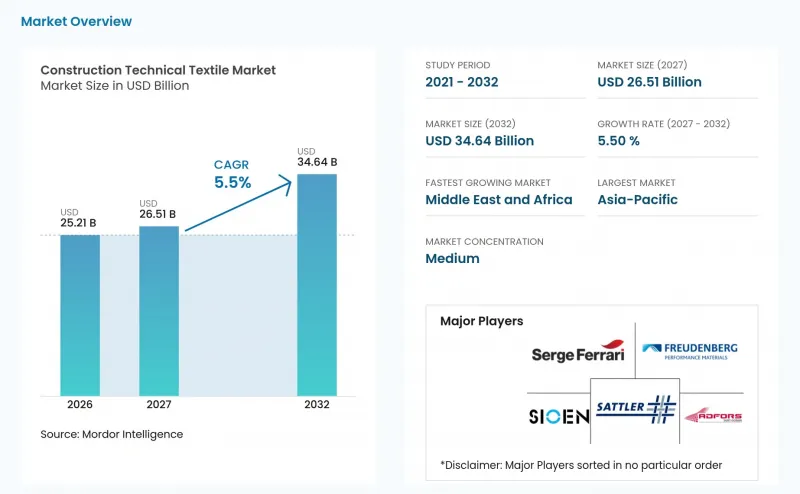
According to Mordor Intelligence, the construction technical textile market size is expected to grow from USD 25.21 billion in 2026 to USD 26.51 billion in 2027 and is forecast to reach USD 34.64 billion by 2032 at 5.5% CAGR over 2027-2032.
Global Construction Technical Textile Market Trends and Insights
Expansion of Commercial, Industrial, and Institutional Building Construction
Commercial, industrial, and institutional projects drive much of the demand for construction textiles because they require weather protection, acoustic control, insulation, and durable roofing systems. Data center projects are a key application because they use weatherization membranes, acoustic insulation, and raised-floor vapor barriers. These products help contractors manage moisture and installation schedules in technically demanding buildings. The construction technical textile market also benefits from industrial and logistics facilities, where large roof spans and durable barriers are important. Commercial buildings use roofing substrates, facade wraps, and reinforcement fabrics in new construction and renovation. This broad application base supports recurring demand across several building types rather than relying on a single project category.
Increasing Building Energy Efficiency and Thermal Insulation Requirements
Directive EU 2024/1275 entered into force in May 2024 and requires Member States to prepare national renovation plans and strengthen minimum energy performance standards for buildings. The directive focuses on insulation, windows, and air barriers, which makes building-envelope performance a central part of construction planning. Breathable membranes and fiber-based insulation facings can support these requirements by managing air and moisture within wall and roof assemblies. A 2024 study by Germany's Federal Institute for Research on Building, Urban Affairs and Spatial Development examined adaptive membrane facade modules and their potential to reduce embodied carbon and operational energy. The construction technical textile market therefore gains from regulations that turn building-envelope upgrades into planned compliance work. Demand can extend across insulation facings, roofing underlays, and facade wraps when building owners update existing assets.
Volatility in Polyester, Polypropylene, and Specialty Fiber Prices
Input-price movement complicates margin planning for producers of roofing textiles, geotextiles, and coated membranes. The British Plastics Federation reported changes in polypropylene pricing across North America, Europe, and Asia during 2025, reflecting differing regional supply and demand conditions. Lower commodity polypropylene prices can reduce input costs for high-volume converters, but they can also increase price competition in finished products. Specialty materials follow a different cost pattern because flame retardants and high-tenacity polyester are procured through more specialized supply chains. SergeFerrari cited pressure on strategic raw materials, including antimony, when discussing selective price increases in 2025. The construction technical textile market is more exposed when a producer has limited purchasing power or holds inventory bought at a higher cost.
Other drivers and restraints analyzed in the detailed report include:
- Growing Demand for Lightweight and High-Strength Construction Materials
- Rising Building Renovation and Facade Retrofitting Activities
- High Production and Installation Costs of Advanced Architectural Membranes
For complete list of drivers and restraints, kindly check the Table Of Contents.
Segment Analysis
Roofing and waterproofing textiles accounted for 27% of the Construction technical textile market size in 2026. Spunbonded polyester and glass-fiber substrates support moisture protection and bitumen reinforcement in residential and commercial roofing. Ahlstrom's FibRoc Plasterboard and FibRoc Ceiling platforms use wetlaid glass fiber and needlepunch nonwovens in fire-resistant garage shafts, elevator enclosures, and moisture-resistant wet-room linings. This extends textile use beyond exterior roofing components into interior building applications.
Architectural membranes and Tensile Fabrics are forecast to grow at a 7.2% CAGR through 2032. Airports, data-center roofs, sports facilities, and public-realm structures benefit from large spans and lower structural weight. Facade and Building Envelope Textiles also gain from renovation programs that use breathable housewraps and weather-resistive barriers. Protektor identifies fiber reinforcement mesh as a component used in modern external thermal insulation composite systems, supporting recurring demand in facade work. The varied applications of roofing, reinforcement, insulation, shading, and site-protection products reduce reliance on a single category within the construction technical textile market.
Complete Report Scope:
- By Product Type
- Architectural Membranes and Tensile Fabrics (PVC-Coated Membranes, PTFE-Coated Fiberglass Membranes, etc.)
- Roofing and Waterproofing Textiles
- Facade and Building Envelope Textiles (Wraps & weather-Resistive Barriers, Facade Membrane Fabrics, etc.)
- Construction Reinforcement Textiles (Fiberglass Plaster, Reinforcement Fabric & Meshes, Scrims, etc.)
- Insulation and Acoustic Textiles
- Architectural Shading and Canopy Textiles
- Construction Site Protection Textiles (Debris Nets, Dust and Containment Fabrics, etc.)
- Other Construction Technical Textiles
- By Material Type
- Polyester (PET)
- Polypropylene (PP)
- Polyethylene (PE)
- Glass Fiber
- Acrylic and Polyamide Fibers
- Carbon, Aramid, and Other High-Performance Fibers
- Natural and Regenerated Fibers
- Other Specialty Materials
- By Construction Project Type
- Residential Construction
- Commercial Construction
- Industrial and Logistics Construction
- Institutional and Other Building Construction
- By Geography
- North America
- United States
- Canada
- Mexico
- Europe
- Germany
- United Kingdom
- France
- Italy
- Spain
- Netherlands
- Rest of Europe
- Asia-Pacific
- China
- Japan
- India
- South Korea
- Taiwan
- Australia
- Indonesia
- Vietnam
- Rest of Asia-Pacific
- Middle East and Africa
- Saudi Arabia
- United Arab Emirates
- Turkey
- South Africa
- Rest of Middle East and Africa
- South America
- Brazil
- Argentina
- Chile
- Rest of South and Central America
- North America
Geography Analysis
Asia-Pacific accounted for 42.5% of the construction technical textile market size in 2026. China's manufacturing base, India's construction activity, and urban development in Southeast Asia support the region's leading position. India's construction sector grew 9% in 2025, according to Freudenberg Group's annual report. India's National Technical Textiles Mission had an approved outlay of INR 1,480 crore (USD 164.7 million) through 2025-26 and had approved 168 research projects. It also issued 68 Quality Control Orders, including 20 related to geotechnical textiles.
The regional supply base also serves nearby export markets. South Korea, Taiwan, Japan, Vietnam, and Indonesia each have different demand patterns. Higher-technology fiberglass reinforcement is relevant in South Korea and Taiwan, while roofing underlays and site-protection nets are more prominent in parts of Vietnam and Indonesia. This range of demand profiles supports the volume position of the construction technical textile market.
Europe and North America are established regions where regulation and product specifications shape demand. EU Directive 2024/1275 supports building-envelope improvements and can raise demand for insulation facings, roofing underlays, and textile facade systems. Middle East and Africa is forecast to grow at a 6.5% CAGR through 2032, supported by demand for membranes, shading systems, and high-performance facade textiles in large regional projects. South America remains smaller and more project-led, with activity in commercial construction, infrastructure, geosynthetics, and site-protection uses.
- Serge Ferrari Group
- Sioen Industries NV
- Freudenberg Performance Materials (including MehlerHeytex)
- Saint-Gobain ADFORS
- SATTLER PRO-TEX GmbH
- Seaman Corporation
- Herculite Products Inc.
- Hiraoka & Co., Ltd.
- DuPont de Nemours, Inc.
- Ahlstrom Oyj
- Fibertex Nonwovens A/S
- CHOMARAT
- Owens Corning
- Sika AG
- RENOLIT SE
- Glen Raven, Inc.
- Phifer Incorporated
- TENAX
- Shreeram Nets
- Taiyo Kogyo Corporation
Additional Benefits:
- The market estimate (ME) sheet in Excel format
- 3 months of analyst support
TABLE OF CONTENTS
1 Introduction
- 1.1 Study Assumptions and Market Definition
- 1.2 Scope of the Study
2 Research Methodology
3 Executive Summary
4 Market Landscape
- 4.1 Market Overview
- 4.2 Value Chain and Supply Chain Analysis
- 4.2.1 Raw Material and Specialty Fiber Suppliers
- 4.2.2 Technical Yarn, Glass Fiber, and Reinforcement Production
- 4.2.3 Woven, Knitted, and Nonwoven Construction Textile Manufacturing
- 4.2.4 Fabric Conversion and Construction Product Integration
- 4.2.5 Distribution through Building Material Suppliers and Specialist Contractors
- 4.3 Market Drivers
- 4.3.1 Expansion of Commercial, Industrial, and Institutional Building Construction
- 4.3.2 Increasing Building Energy Efficiency and Thermal Insulation Requirements
- 4.3.3 Growing Demand for Lightweight and High-Strength Construction Materials
- 4.3.4 Rising Building Renovation and Facade Retrofitting Activities
- 4.3.5 Increasing Adoption of Architectural Membranes and Tensile Fabric Structures
- 4.3.6 Stricter Building Fire Safety and Construction Material Performance Requirements
- 4.4 Market Restraints
- 4.4.1 Volatility in Polyester, Polypropylene, and Specialty Fiber Prices
- 4.4.2 High Production and Installation Costs of Advanced Architectural Membranes
- 4.4.3 Stringent Product Certification and Building Code Compliance Requirements
- 4.4.4 Durability, UV Degradation, and Weathering Concerns
- 4.5 Key Market Trends
- 4.5.1 Increasing Adoption of PTFE-Coated Fiberglass and PVC-Coated Polyester Architectural Membranes
- 4.5.2 Growing Use of Textile-Reinforced Concrete and Non-Metallic Reinforcement Meshes
- 4.5.3 Development of Fire-Resistant and Low-Emission Building Envelope Textiles
- 4.5.4 Increasing Integration of Technical Textiles in Prefabricated and Modular Buildings
- 4.5.5 Rising Adoption of Breathable Roofing and Facade Membranes
- 4.5.6 Growing Demand for Recyclable and Lower-Carbon Construction Textiles
- 4.5.7 Development of Advanced Solar Shading and Acoustic Textile Systems
- 4.6 Regulatory and Standards Landscape
- 4.6.1 European Construction Products Regulation (EU) 2024/3110
- 4.6.2 European Energy Performance of Buildings Directive (EU) 2024/1275
- 4.6.3 EN 13501-1 Reaction-to-Fire Classification for Construction Products
- 4.6.4 EN 15619 Performance Requirements for Coated Fabrics in Temporary Structures
- 4.6.5 EN 13859 Roofing and Wall Underlay Standards
- 4.6.6 EN 13956 Requirements for Plastic and Rubber Roofing Waterproofing Sheets
- 4.6.7 ASTM E2556 Water-Resistive Barrier Material Specifications
- 4.6.8 Textile Reinforcement and Composite Concrete Material Testing Requirements
- 4.6.9 Environmental Product Declarations and Construction Material Sustainability Certification
- 4.7 Technological Outlook
- 4.7.1 Woven, Knitted, and Nonwoven Construction Textile Technologies
- 4.7.2 Coated Architectural Membrane Manufacturing Technologies
- 4.7.3 PTFE-Coated Fiberglass and PVC-Coated Polyester Membranes
- 4.7.4 Fiberglass Mesh and Carbon Fiber Textile Reinforcement Technologies
- 4.7.5 Advanced Breathable and Moisture-Control Building Membranes
- 4.7.6 Fire-Resistant, UV-Stabilized, and High-Durability Textile Finishing
- 4.7.7 Textile-Based Thermal and Acoustic Insulation Technologies
- 4.8 Construction Textile Performance and Material Selection Analysis
- 4.8.1 Tensile Strength, Tear Resistance, and Dimensional Stability
- 4.8.2 Fire Resistance and Smoke Performance
- 4.8.3 Water Resistance, Breathability, and Moisture Management
- 4.9 Sustainability and Environmental Impact Assessment
- 4.9.1 Life-Cycle Environmental Impact of Construction Textile Materials
- 4.9.2 Contribution to Lightweight Construction and Material Efficiency
- 4.9.3 Recycled-Content and Bio-Based Textile Alternatives
- 4.9.4 End-of-Life Recycling and Disposal of Coated Construction Fabrics
- 4.9.5 Role of Construction Textiles in Building Decarbonization
5 Market Size and Growth Forecasts
- 5.1 By Product Type
- 5.1.1 Architectural Membranes and Tensile Fabrics (PVC-Coated Membranes, PTFE-Coated Fiberglass Membranes, etc.)
- 5.1.2 Roofing and Waterproofing Textiles
- 5.1.3 Facade and Building Envelope Textiles (Wraps & weather-Resistive Barriers, Facade Membrane Fabrics, etc.)
- 5.1.4 Construction Reinforcement Textiles (Fiberglass Plaster, Reinforcement Fabric & Meshes, Scrims, etc.)
- 5.1.5 Insulation and Acoustic Textiles
- 5.1.6 Architectural Shading and Canopy Textiles
- 5.1.7 Construction Site Protection Textiles (Debris Nets, Dust and Containment Fabrics, etc.)
- 5.1.8 Other Construction Technical Textiles
- 5.2 By Material Type
- 5.2.1 Polyester (PET)
- 5.2.2 Polypropylene (PP)
- 5.2.3 Polyethylene (PE)
- 5.2.4 Glass Fiber
- 5.2.5 Acrylic and Polyamide Fibers
- 5.2.6 Carbon, Aramid, and Other High-Performance Fibers
- 5.2.7 Natural and Regenerated Fibers
- 5.2.8 Other Specialty Materials
- 5.3 By Construction Project Type
- 5.3.1 Residential Construction
- 5.3.2 Commercial Construction
- 5.3.3 Industrial and Logistics Construction
- 5.3.4 Institutional and Other Building Construction
- 5.4 By Geography
- 5.4.1 North America
- 5.4.1.1 United States
- 5.4.1.2 Canada
- 5.4.1.3 Mexico
- 5.4.2 Europe
- 5.4.2.1 Germany
- 5.4.2.2 United Kingdom
- 5.4.2.3 France
- 5.4.2.4 Italy
- 5.4.2.5 Spain
- 5.4.2.6 Netherlands
- 5.4.2.7 Rest of Europe
- 5.4.3 Asia-Pacific
- 5.4.3.1 China
- 5.4.3.2 Japan
- 5.4.3.3 India
- 5.4.3.4 South Korea
- 5.4.3.5 Taiwan
- 5.4.3.6 Australia
- 5.4.3.7 Indonesia
- 5.4.3.8 Vietnam
- 5.4.3.9 Rest of Asia-Pacific
- 5.4.4 Middle East and Africa
- 5.4.4.1 Saudi Arabia
- 5.4.4.2 United Arab Emirates
- 5.4.4.3 Turkey
- 5.4.4.4 South Africa
- 5.4.4.5 Rest of Middle East and Africa
- 5.4.5 South America
- 5.4.5.1 Brazil
- 5.4.5.2 Argentina
- 5.4.5.3 Chile
- 5.4.5.4 Rest of South and Central America
- 5.4.1 North America
6 Competitive Landscape
- 6.1 Market Concentration
- 6.2 Market Share Analysis
- 6.3 Strategic Developments (Mergers/ Acquisitions, New Product Developments, Strategic Partnerships and Distribution Agreements)
- 6.4 Competitive Positioning on Application Coverage & Sustainability Positioning
- 6.5 Company Profiles (Includes Global Level Overview, Market Level Overview, Core Segments, Financials as available, Strategic Information, Products and Services, Recent Developments)
- 6.5.1 Serge Ferrari Group
- 6.5.2 Sioen Industries NV
- 6.5.3 Freudenberg Performance Materials (including MehlerHeytex)
- 6.5.4 Saint-Gobain ADFORS
- 6.5.5 SATTLER PRO-TEX GmbH
- 6.5.6 Seaman Corporation
- 6.5.7 Herculite Products Inc.
- 6.5.8 Hiraoka & Co., Ltd.
- 6.5.9 DuPont de Nemours, Inc.
- 6.5.10 Ahlstrom Oyj
- 6.5.11 Fibertex Nonwovens A/S
- 6.5.12 CHOMARAT
- 6.5.13 Owens Corning
- 6.5.14 Sika AG
- 6.5.15 RENOLIT SE
- 6.5.16 Glen Raven, Inc.
- 6.5.17 Phifer Incorporated
- 6.5.18 TENAX
- 6.5.19 Shreeram Nets
- 6.5.20 Taiyo Kogyo Corporation
7 Market Opportunities and Future Outlook
- 7.1 White-Space and Unmet-Need Assessment
- 7.1.1 Affordable High-Performance Building Reinforcement Textiles
- 7.1.2 Fire-Resistant Architectural Membranes for Commercial Buildings
- 7.1.3 Advanced Facade Textiles for Energy-Efficient Retrofitting
- 7.1.4 Lightweight Textile Reinforcement for Modular Construction
- 7.1.5 Recyclable and Lower-Carbon Construction Textile Materials
- 7.2 Future Outlook
- 7.2.1 Advanced Acoustic Textiles for Commercial Interiors
- 7.2.2 Increasing Integration of Technical Textiles in Green Buildings
- 7.2.3 Evolution of Advanced Architectural and Tensile Membrane Systems
- 7.2.4 Growing Commercialization of Textile-Reinforced Concrete
- 7.2.5 Transition Toward Circular and Sustainable Construction Textiles

